

He shouldn’t have to upset you to find out whether you love him.
When he tells you he ignored you to see whether you would keep calling, the conversation changes. You thought something was wrong. He was waiting to see what you would do.
Now he’s talking about whether you tried hard enough, got jealous enough, or gave him the reaction he wanted.
But what about the situation he created to get that reaction?
Mind games in relationships can include setting someone up to respond to something they don’t know has been arranged. A loyalty test takes that response and treats it as an answer about love, faithfulness, or commitment.
You may end up defending your reaction before you’ve even had room to consider how you feel about being tested.
That part belongs in the conversation too. You aren’t just a result he gets to interpret. You’re the woman who had to live through the situation he made.
Start with what you know about the setup
There’s a difference between knowing he arranged something and worrying that he might have.
Maybe he tells you afterward, “I wanted to see if you’d chase me.” Maybe he acknowledges asking somebody to contact you so he could judge your response.
Those admissions give you something specific to discuss. What did he arrange? What did he keep from you? What does he say your reaction was supposed to prove?
You don’t need to turn that into a story about his entire personality to address what he did.
But if all you know is that he was quiet, needed time alone, or mentioned somebody else, you don’t yet know there was a test.
People can be distracted, unsure what to say, or genuinely need space. Something hurting or confusing you doesn’t establish that it was staged.
Where it feels safe, you can ask about what happened. Be clear about the difference between his explanation, what you observed, and what you suspect.
Playing mind games is a description people use for manipulative interactions, not a diagnosis you can establish from a delayed reply.
And you don’t need to catch him running a test before you can discuss treatment that hurts. If he repeatedly disappears without addressing an agreement, you can discuss that conduct without proving a secret plan behind it.
You didn’t agree that chasing him was how your love would be measured
Here’s a short example of an acknowledged test.
He says he deliberately stopped responding because he wanted to know whether you’d keep trying. You contacted him, became worried, and eventually stopped calling.
Now he says stopping showed him you didn’t care enough.
But you didn’t know you were being asked to demonstrate anything. You were responding to a person who wasn’t answering you.
Maybe you thought he wanted space. Maybe you were getting on with something you needed to do. Maybe you felt hurt and didn’t want to keep calling somebody who wouldn’t respond.
He can’t treat his private rule as an agreement you knowingly broke.
If what he wanted was affection, contact, or time together, that was something he could have asked about directly. You would have had a chance to understand the request and give an honest answer.
Sis, you shouldn’t have to guess which difficult moment is secretly asking you to prove you love that man.
You can care about his need for connection while questioning why he chose to hide the request inside something upsetting.
And if there was a real agreement about contact, discuss that agreement. A genuine missed commitment deserves its own answer. It doesn’t make a separate hidden test fair.
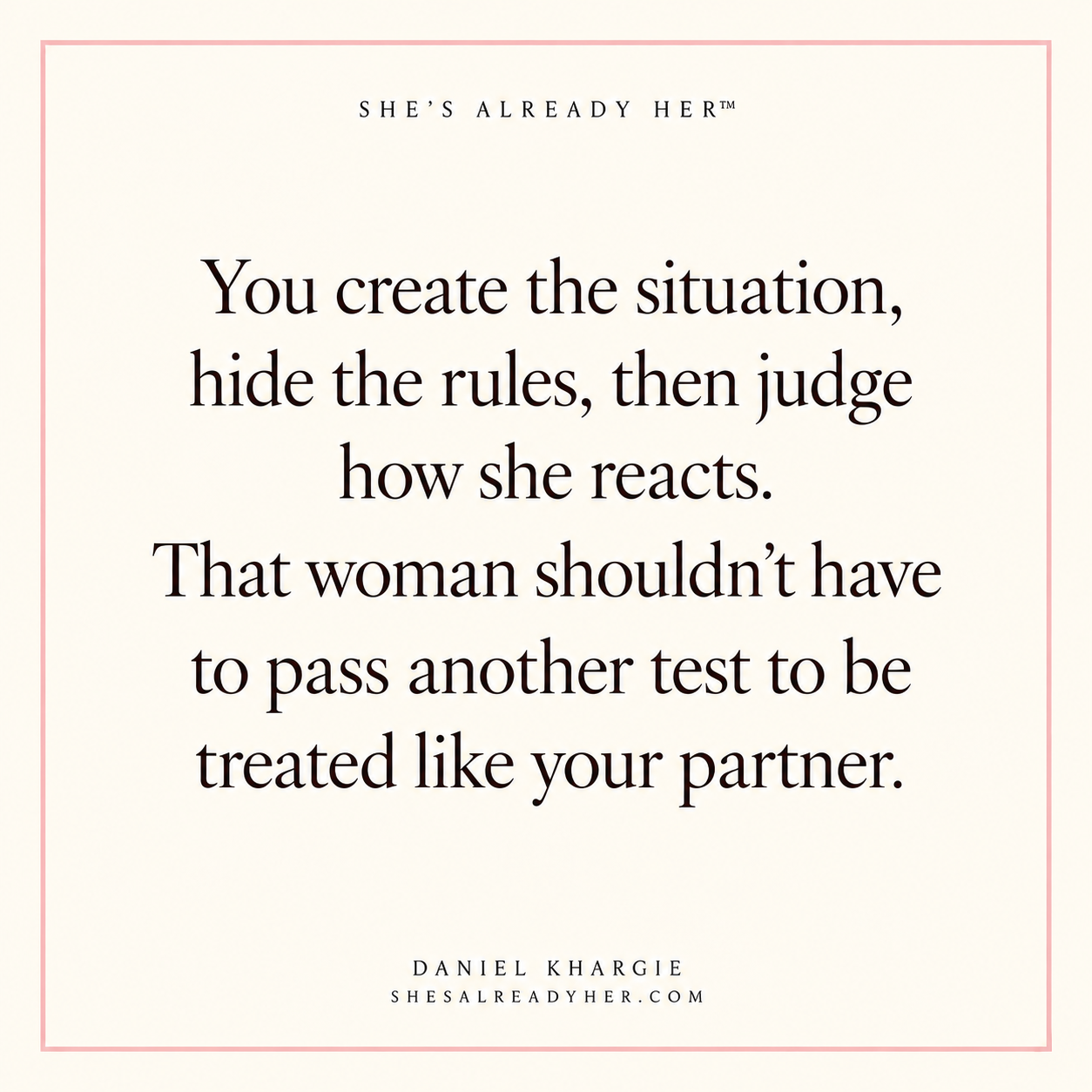
Read this quote as text
You create the situation, hide the rules, then judge how she reacts. That woman shouldn’t have to pass another test to be treated like your partner.
One reaction can’t answer for your whole character
He may sound very certain about what the result means.
“You didn’t get jealous, so you don’t love me.”
Or, “You got upset, so now I know you’re insecure.”
Neither conclusion follows just because he wanted a particular reaction. Getting jealous isn’t a requirement for loving somebody. Not getting jealous doesn’t tell him everything about how you feel.
A response to an arranged situation still needs context. What did you understand was happening? What were you actually asked? What did you do, and what is he adding to it?
If somebody contacted you, for example, the fact that you answered doesn’t by itself say what kind of conversation you had or whether you broke an agreement.
At the same time, being set up doesn’t erase something harmful you actually chose to do. If you crossed an agreement, you can own that conduct. You can also address his decision to create a deceptive situation. Both actions can receive an honest discussion.
You don’t need to accept his whole verdict to acknowledge one part that is true.
Likewise, passing his test doesn’t settle every question about the relationship. It tells you how you responded in that situation. It doesn’t promise what either person will do forever, or make the deception disappear.
If the issue is ongoing accusations of infidelity, read about repeatedly having to defend your faithfulness.
How you feel about being tested matters too
He may want the conversation to stay on whether you passed.
You may still be trying to understand which parts of what happened were real.
Did he actually want time apart, or was he waiting for pursuit? Was that conversation genuine, or had somebody been asked to create it? What were you making decisions about without knowing what he already knew?
Those are understandable questions after you learn something was arranged. You don’t have to spend the whole discussion accepting his evaluation of you while your experience goes unmentioned.
You can say, where safe, “I thought you weren’t answering because you didn’t want to talk. Hearing that you did it to judge my response changes how I feel about what happened.”
He can hear that without being required to agree with every interpretation you have. He can explain what he did and acknowledge what you were left to understand.
But if his only answer is that a loyal woman wouldn’t object to being tested, notice that. Your objection has become another test he gets to grade.
Refusing an evaluation doesn’t, by itself, prove that you’re hiding a betrayal. Being willing to talk honestly about your conduct is different from agreeing to any method he chooses to judge it.
You’re allowed to consider what his method has done to your confidence in him too.
Honesty gives both people something they can actually answer
Honesty in a relationship includes what a person wants from an interaction.
“I miss you, and I’d like more time together” tells you something you can discuss.
Deliberately making you think he’s losing interest, then judging how hard you work to get him back, gives you a different situation to respond to.
You can’t answer a request he hasn’t actually made. You can only respond to what you’re being shown.
If you’re thinking about how to build trust in a relationship, look at whether concerns can be brought into the open. What agreement matters? What happened? What does each person need to acknowledge or do differently?
Those questions allow both of you to participate. An undisclosed test gives one person information and rules the other person doesn’t have.
A difficult conversation may still end in disagreement. He may want something you aren’t willing to offer. You may need something he cannot honestly promise.
That can be painful without meaning the conversation failed. At least you have something real to consider, rather than trying to earn an outcome through a performance you didn’t know was expected.
If his worry keeps becoming a conclusion about you before he hears your answer, this article focuses on fear being treated as fact.

Read this quote as text
You pull away to see if she’ll chase, then call her distant when she doesn’t. Look at the confusion you create while asking her to prove her love.
You don’t need to outplay him to choose what you’ll participate in
Finding out you were tested can make you want to show him how it feels.
But another setup won’t give either of you the honest conversation that was missing. You don’t have to provoke jealousy, pretend to leave, or arrange a test of your own to make your concern legitimate.
You can decide what you’re willing to take part in without trying to produce a particular reaction from him.
Where it feels safe, that might sound like, “I’ll talk about a concern you have. I’m not agreeing to situations you create to see whether I react the way you want.”
That states your position. It cannot guarantee he will respect it or stop.
Think about what the choice means in your actual circumstances. You may want private support before you respond. You may need time to consider what you now know. You don’t have to decide the whole relationship in the same conversation where he tells you it was a test.
If there are threats, monitoring, or fear about refusing, don’t treat a firmer sentence as protection. Seek private support that fits what you’re living with.
His decision to create another test remains his decision. You aren’t causing it by failing to find the perfect way to object.
Look for a change in how he brings concerns to you
He may say he understands why the test hurt. You can consider that answer without having to restore all your confidence immediately.
What happens the next time he feels unsure?
Does he tell you what’s worrying him? Can he ask for connection without first creating distance? Can he discuss an actual agreement instead of quietly inventing a new standard for you to meet?
Those are differences you can notice. You don’t need to create a difficult situation yourself to find out whether he’s changed.
And you don’t need to know his whole history to know how you feel about another setup. If he shares that he was hurt before, you can care about that without treating your participation in tests as something you owe for it.
You can offer an honest answer. You can keep commitments you freely make. You can acknowledge your mistakes.
You still get to ask whether this relationship gives you room to be a person, rather than someone waiting to learn how her last reaction was scored.
Your love should have room to be lived. It shouldn’t keep being turned into another situation you were never told you had to pass.

Read this quote as text
You call it a loyalty test. She’s the one left wondering which moments were real and which ones you arranged just to see what she’d do.
Frequently asked questions
What are mind games when he creates a situation to test my reaction?
The phrase commonly describes manipulative interactions in which someone obscures what they want or creates confusion to influence another person. It isn’t a clinical diagnosis. An acknowledged setup used to judge your love is one situation you can examine. A quiet mood, delayed response, or upsetting conversation alone doesn’t prove deliberate staging. Stay clear about what you know and what remains uncertain.
Why do people play mind games, and can I know why he tests me?
Reasons can differ. Someone may want reassurance, a sense of control, or a reaction they associate with being loved. That doesn’t establish his particular reason, personal history, or diagnosis. You can consider what he actually says and does without inventing an explanation. Understanding a possible reason doesn’t make you responsible for accepting repeated tests or teaching him how to stop.
Loyalty vs trust: does passing a test prove I can be trusted?
Loyalty involves how you act and the commitments you keep; trust involves the confidence someone places in you. A response to one arranged situation doesn’t establish your whole character or guarantee future conduct. Refusing the test alone doesn’t prove betrayal either. Discuss actual actions and agreements. Any genuine breach and the decision to create a deceptive test can both require an answer.
How to build trust in a relationship without testing each other?
Bring concerns into an honest conversation, make expectations clear, and consider how both people behave over time. A person can ask a fair question without manufacturing an event or demanding certainty about everything. If an actual agreement was broken, discuss that specifically. Neither passing a test nor finding better wording can replace both people’s participation in honest treatment.
Boundaries vs control: is declining a loyalty test controlling?
Declining a test is a choice about your own participation. Trying to dictate his every action or test him in return is different. You can state what you’re willing to discuss and consider your options without forcing his agreement. For the broader question of choosing a limit you can follow through on, read about setting boundaries. If refusing could bring danger, seek private support before confronting him.