
Sis, I need to talk to you about what happens when you express your feelings to him.
You tell him something hurt you. You explain why something he said or did affected you. You share your emotional response to a situation.
You’re being vulnerable. You’re communicating. You’re sharing your inner experience.
And instead of listening, instead of trying to understand, instead of showing empathy, he shuts you down with three words:
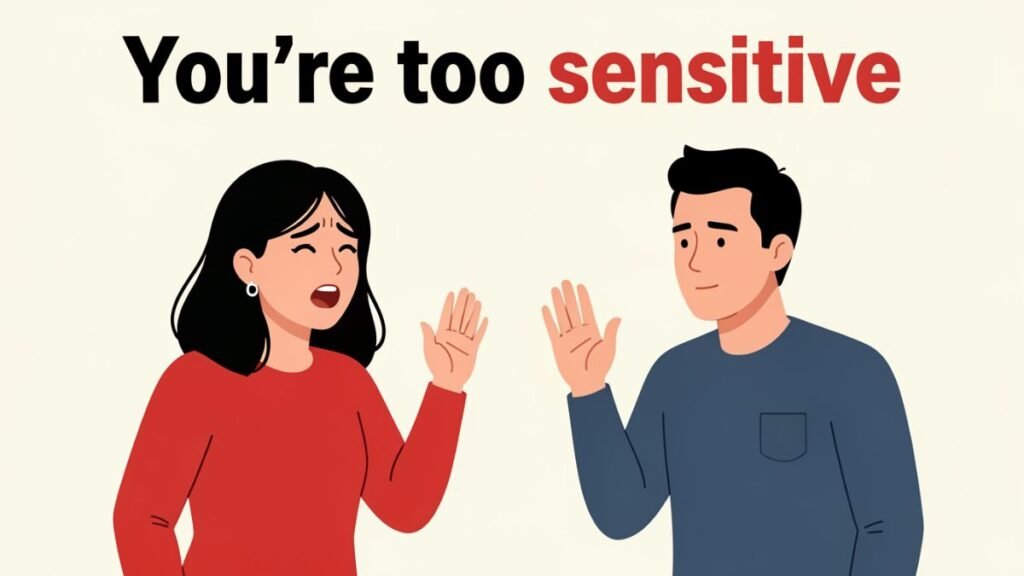
“You’re too sensitive.”
Your feelings are too big. Your reaction is too much. Your emotions are excessive. The problem isn’t what happened—the problem is how you’re responding to it.
He makes your sensitivity the issue instead of addressing what actually hurt you.
I see how this makes you doubt yourself. You start wondering: “Am I too sensitive? Am I overreacting? Should I just not feel so much?”
You start policing your own emotions. Suppressing your feelings. Trying to be less sensitive so he won’t dismiss you.
And I see you wondering: “Am I really too sensitive? Why does he make me feel bad for having feelings? Should I just toughen up?”
No, sis. You’re not too sensitive. What he’s doing is emotional invalidation—and it’s a form of abuse.
Let me explain what’s really happening and why you need to trust your feelings.
What’s Really Happening: The “Too Sensitive” Weapon
As a man who understands healthy emotional communication, let me be clear: “You’re too sensitive” is not feedback. It’s dismissal.
A healthy partner hears “That hurt me” and responds: “I’m sorry. Help me understand why so I don’t do it again.”
Your boyfriend hears “That hurt me” and responds: “You’re too sensitive. That shouldn’t hurt you.”
He’s not addressing what hurt you. He’s attacking your emotional response to being hurt.
Here’s what’s really going on:
He’s Avoiding Accountability
Think about what happens if he acknowledges your feelings as valid:
If he says: “I understand why that hurt you. I’m sorry.”
Then he has to:
- Take responsibility for his behavior
- Acknowledge he caused you pain
- Feel uncomfortable (guilt, shame)
- Change his behavior
- Make amends
That requires effort and accountability.
If he says: “You’re too sensitive.”
Then:
- The problem is YOUR sensitivity, not his behavior
- He doesn’t have to change
- He doesn’t have to apologize
- He doesn’t have to feel bad
- You’re the one who needs to change
“Too sensitive” shifts responsibility from him to you. It’s easier than being accountable.
He Can’t Handle Your Emotions
Some men are emotionally immature and can’t handle other people’s feelings:
Your emotions make him uncomfortable:
- He doesn’t know how to respond
- He feels pressured to “fix” it
- He feels blamed or criticized
- He can’t sit with discomfort
Instead of learning to handle emotions like an adult, he dismisses yours:
“You’re too sensitive” = “Your feelings make me uncomfortable, so I’m going to make them your problem instead of learning to deal with them.”
He’s prioritizing his comfort over your emotional needs.
He’s Gaslighting You
Gaslighting: Making you doubt your own perceptions and feelings.
The “too sensitive” gaslighting pattern:
- Something happens that hurts you
- You express that hurt
- He tells you you’re too sensitive
- You question whether your hurt is legitimate
- You start doubting your emotional responses
- Eventually, you distrust your own feelings
The goal is to make you doubt your emotional reality so you stop expressing feelings he doesn’t want to deal with.
This is psychological manipulation.
He Learned That Emotions Are Weakness
Think about where he might have learned this:
Maybe:
- His family didn’t talk about feelings
- Emotions were dismissed or punished in his household
- He was told “boys don’t cry” or that emotions are weakness
- Sensitivity was mocked or seen as feminine and therefore bad
He internalized that feelings are problems to be suppressed, not experiences to be honored.
So when you express feelings, he sees weakness or overreaction instead of healthy emotional communication.
He’s projecting his own emotional suppression onto you.
He Wants You to Stop Bringing Things Up
Here’s the strategic function of “too sensitive”:
If every time you express hurt, you’re told you’re too sensitive:
- You’ll start suppressing your feelings
- You’ll stop bringing up issues
- You’ll question whether your hurt is valid
- Eventually, you’ll stop communicating your needs
The goal is to silence you by making you doubt whether your feelings deserve airtime.
If you believe you’re too sensitive, you’ll stop “bothering” him with your emotions. Problem solved—for him.
He’s Projecting His Emotional Unavailability Onto You
Projection: Attributing your own issues to someone else.
The reality: He’s emotionally unavailable and can’t meet your emotional needs.
His projection: “You’re too needy/sensitive/emotional. The problem is your excessive needs, not my inability to meet normal emotional needs.”
By calling you too sensitive, he doesn’t have to acknowledge his emotional limitations. He makes your normal needs seem abnormal instead.
You’re Actually Responding Appropriately
Here’s what “too sensitive” often really means: “You’re responding appropriately to my inappropriate behavior, and I don’t like it.”
Examples:
- He does something disrespectful → You’re hurt → “You’re too sensitive”
- He breaks a promise → You’re disappointed → “You’re too sensitive”
- He says something mean → You’re sad → “You’re too sensitive”
Your sensitivity isn’t the problem. His behavior is the problem, and your feelings are an appropriate response to problematic behavior.
He calls you too sensitive because he doesn’t want to acknowledge his behavior is the issue.
Why This Pattern Is Destroying You
You’re losing trust in your own feelings. When your emotions are constantly invalidated, you stop knowing if what you feel is real or legitimate.
You’re suppressing yourself. You learn to hide or minimize your feelings to avoid being called too sensitive. The real you disappears.
You can’t communicate your needs. If expressing hurt leads to being dismissed, you stop expressing it. Your needs go unmet because you’ve learned not to voice them.
You’re isolated in your pain. You can’t share your hurt with the person who’s supposed to care most. You suffer alone because he won’t listen.
You become numb. To avoid being “too sensitive,” you shut down emotionally. You become less feeling, less alive, less you.
You accept mistreatment. If your hurt is “too sensitive,” you’ll tolerate behavior you shouldn’t tolerate because you’ve been taught your reaction to it is the problem.
Your mental health suffers. Suppressing emotions and doubting your feelings leads to anxiety, depression, and emotional dysregulation.
What You Need to Do
Step 1: Trust Your Feelings
Your feelings are valid. They’re not too much. They’re not excessive. They’re not wrong.
You feel what you feel. And those feelings deserve to be heard and respected.
Stop doubting yourself when he calls you too sensitive.
Step 2: Reframe “Too Sensitive”
When he says “You’re too sensitive,” hear what he’s really saying:
“I don’t want to be accountable for hurting you.”
“Your feelings are inconvenient to me.”
“I want you to suppress yourself so I don’t have to change.”
He’s not giving you helpful feedback. He’s dismissing you.
Step 3: Call It Out
When he calls you too sensitive:
“You’re dismissing my feelings instead of listening to them. Calling me ‘too sensitive’ doesn’t address what I’m trying to communicate. My feelings are valid whether you think I should have them or not.”
Name the dismissal.
Step 4: Redirect to the Actual Issue
Don’t let him make this about your sensitivity:
Him: “You’re too sensitive.”
You: “My sensitivity isn’t the issue. The issue is [what hurt you]. Can we discuss that?”
Refuse to defend your right to have feelings. Redirect to the actual problem.
Step 5: Set a Boundary
“I will not accept being called ‘too sensitive’ when I express my feelings. That’s dismissive and disrespectful. If you can’t listen to my emotions without dismissing them, we can’t have healthy communication.”
Then enforce it. If he continues dismissing you, end the conversation.
Step 6: Stop Suppressing Your Feelings
Don’t change yourself to avoid being called too sensitive.
Keep expressing your feelings. Keep being emotional. Keep being sensitive.
Sensitivity is not a flaw. It’s a feature of being emotionally attuned.
Step 7: Evaluate If He Can Change
Ask yourself:
- Have you addressed this clearly?
- Does he acknowledge dismissing your feelings is a problem?
- Is he willing to work on it?
- Has anything actually improved?
If you’ve addressed it and nothing changes, he’s not capable of emotional validation.
Step 8: Leave If Necessary
If he consistently invalidates your feelings, calls you too sensitive, and refuses to listen to your emotions—you cannot have a healthy relationship with him.
Emotional validation is a basic relationship requirement. Without it, the relationship is fundamentally broken.
What You Need to Understand
Sensitivity Is Not a Flaw
Being sensitive means:
- You’re emotionally attuned
- You notice subtleties in relationships
- You feel deeply
- You’re empathetic
These are strengths, not weaknesses.
The problem isn’t that you’re too sensitive. The problem is he’s not sensitive enough.
Your Feelings Don’t Need His Approval
You don’t need him to agree that your feelings are valid for them to BE valid.
You feel what you feel. His dismissal doesn’t change that reality.
This Is About Control
Calling you “too sensitive” is a control tactic:
- It silences you
- It makes you question yourself
- It shifts blame to you
- It allows him to avoid accountability
It’s about controlling you through emotional invalidation.
Healthy Partners Validate Emotions
In healthy relationships:
- Partners validate feelings even when they don’t fully understand them
- “Too sensitive” isn’t in the vocabulary
- Emotions are respected, not dismissed
- Both people feel safe expressing feelings
If you’re being called too sensitive, you’re not in a healthy relationship.
What You Deserve
You deserve a partner who listens to your feelings without dismissing them.
Someone who says “I hear you” instead of “You’re too sensitive.”
Someone who validates your emotions even when they don’t fully understand them.
Someone who makes you feel safe to be vulnerable, not punished for it.
That person exists. But it’s not him.
The Bottom Line
Sis, he accuses you of being too sensitive instead of listening because:
- He’s avoiding accountability for hurting you
- He can’t handle your emotions
- He’s gaslighting you
- He wants to silence your emotional communication
- He’s projecting his emotional unavailability onto you
You’re not too sensitive. He’s emotionally dismissive.
Trust your feelings. Call out the dismissal. Demand validation.
And if he can’t respect your emotions, leave.
Choose yourself, sis. Your feelings are valid. You’re allowed to be sensitive.
FAQ
Q: What if I really am more sensitive than most people?
Even if you are, that doesn’t make your feelings invalid. Highly sensitive people have valid emotions that deserve respect. The right partner honors your sensitivity, not dismisses it.
Q: How do I know if I’m actually overreacting vs. being dismissed?
Ask trusted friends or a therapist. If he’s the ONLY one calling you too sensitive, you’re being dismissed. If everyone says your reaction seems disproportionate, examine that honestly.
Q: What if he says other women aren’t as sensitive?
That’s manipulation. Other women’s emotional responses are irrelevant to yours. Your feelings are valid regardless of how other people feel.
Q: Should I try to be less sensitive?
Only for YOURSELF, never to accommodate someone’s dismissal. If you want to work on emotional regulation for your own wellbeing, great. But don’t suppress yourself to avoid being called too sensitive.
Q: Can someone who dismisses feelings learn to validate them?
Only if they genuinely want to change and do significant work (usually therapy). Most don’t because dismissing is easier and they see nothing wrong with it.



One Comment