
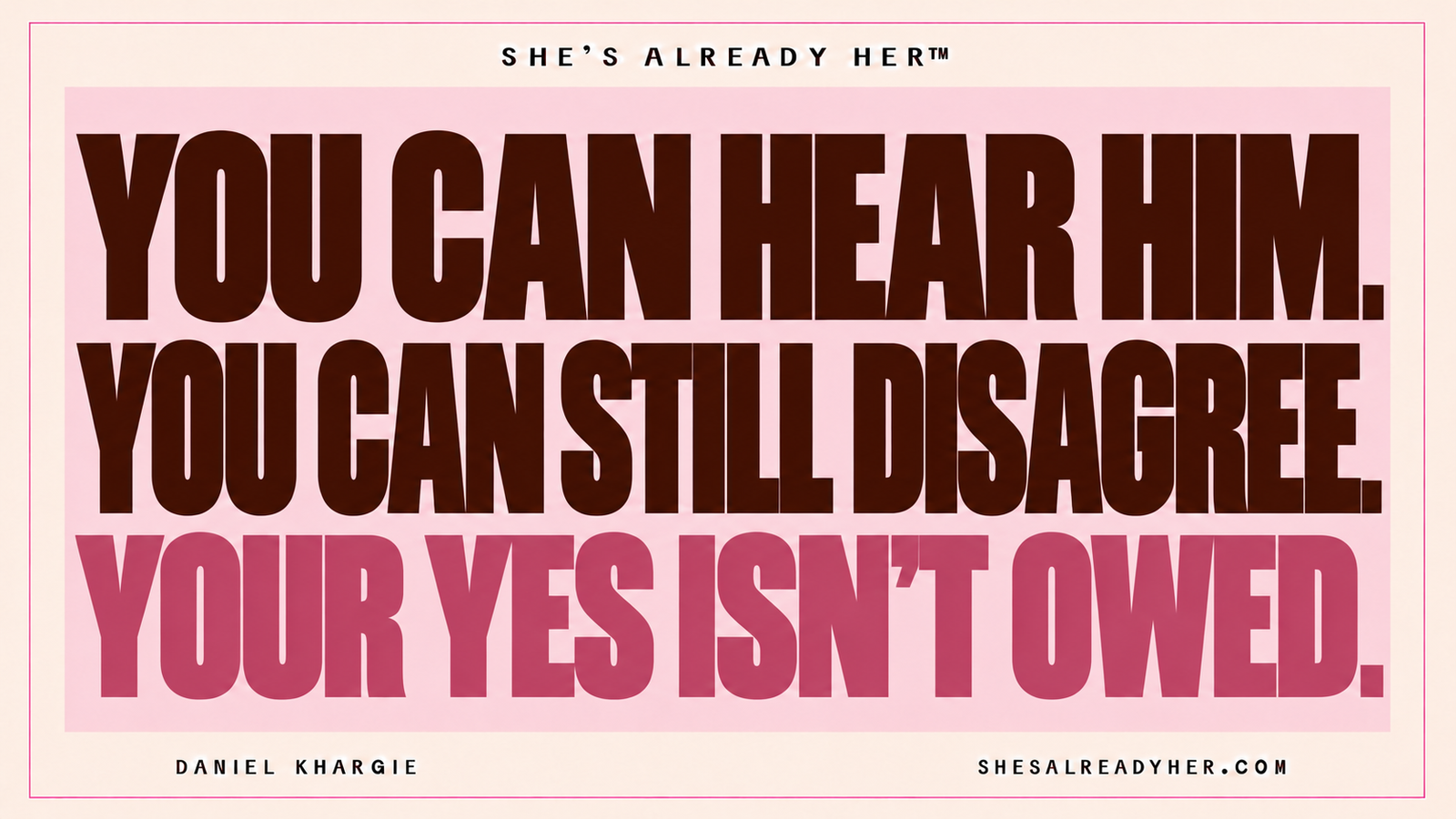
You don’t have to tell that man he’s right just because you’re tired of hearing him argue. You can understand everything he’s saying and still have a different answer. And you can agree to disagree without taking back what you actually think just to get through the rest of your night.
I want you to think about the last time you finally said, “Okay, you’re right.” Did you mean it? Did something he said change your mind? Or were you looking at the time, thinking about everything you still had to do, and realizing he wasn’t going to let this go until you gave him that answer?
Because there’s a difference. You might have ended the argument, but now you’re sitting there bothered because you had to say something you didn’t believe just to be done talking. Then the next time you disagree, you already know what you’re in for.
You start making little decisions before the conversation even happens. Don’t bring that up. Let that one go. Just say okay. And after a while, you’re hardly sharing an opinion unless you’re pretty sure he’ll agree with it.
I’m not telling you to turn every difference into a fight. I’m telling you that getting along with a man shouldn’t require you to keep pretending you think exactly like him. Let’s talk about when you can leave a disagreement alone, what still needs an answer, and how to stop saying yes when you mean something else.
You can agree to disagree and still mean what you said
When you agree to disagree, you’re saying, “I heard you. You heard me. We still don’t see it the same way.” You’re letting that difference exist without spending the next hour trying to get the same answer out of each other.
That’s it. You haven’t admitted you were wrong. He hasn’t agreed you were right. You’ve both had a chance to speak, and you’re choosing to stop going back over an opinion neither of you has changed.
If you’ve wondered, “What does agree to disagree mean if I still think he’s wrong?” you don’t have to stop thinking that. You can understand where he’s coming from and still think his take makes no sense. He may feel the same about yours.
Take something simple, like a movie. You thought the ending was terrible. He thought it was the best part. You’ve both explained why. Now he’s explaining it again, like you couldn’t possibly have understood the ending if you still didn’t like it.
You understood it. You didn’t like it. Those two things can happen at the same time.
You can leave that conversation with different opinions. You don’t need to come up with a better defense of your taste, and he doesn’t need to keep discussing yours until you share his. Agreeing to disagree gives both of you room to keep your own answer.
But you both need to have been heard. It doesn’t work if either person says “let’s drop it” before the other has had a reasonable chance to explain. And it doesn’t work if he says you can disagree, then spends the rest of the evening trying to talk you out of it.

Read this quote as text
You say you want her honest opinion, but keep arguing until she agrees with yours. That woman shouldn’t have to surrender her answer to end a conversation.
Understanding him doesn’t mean you have to agree with him
Sometimes a man keeps telling you that you don’t understand him when you understand him just fine. What he hasn’t accepted is that understanding his reason didn’t change your mind.
You know what he means. You could explain his whole point back to him. You just don’t see it that way. So when he starts the explanation over, you’re wondering what else he expects you to say.
You can tell him, “I understand what you’re saying. I don’t agree with it.” You don’t have to keep adding to that sentence because he doesn’t like where it ends.
To listen to understand means you make an honest effort to hear somebody. It doesn’t mean you owe them agreement afterward. And you owe him that same room. If he’s heard you fairly, he doesn’t have to share every opinion you have either.
That’s part of respectful communication. You can ask questions. You can point out something the other person missed. You can even change your mind. But there has to be room for the answer to stay different after you’ve done all that.
Now look at what happens when yours does. Can you both move on? Or does he keep asking the same thing, getting more irritated, and acting like you’re being difficult because you haven’t given him the answer he wants?
You don’t have to figure out everything going on in his head before you can address what’s happening in front of you. You can say, “I’ve heard your point. I’ve explained mine. I don’t want to keep repeating this until one of us gives in.”
And listen, if new information shows that you missed something, give it a fair look. You can stand by your answer and still be willing to change it. Read about making room for your side when he insists he is always right. Here, we’re talking about what happens when you’ve heard each other and still disagree.
Before you drop it, be clear about what’s still unfinished
There are things you can leave different. There are also things you still have to work out. You don’t want “agree to disagree” to become the reason a real problem never gets an answer.
If you’re arguing about a fact you can check, check it. For example, if you disagree about what time an event starts, look at the event listing. You don’t have to keep arguing from memory when the answer is right there. Treating each other with respect doesn’t require you to pretend two different start times are both correct.
But let’s say he wants visitors over this weekend and you don’t want to host. That involves your time and your home. You can understand why he wants company and still need an actual agreement about whether anybody is coming over.
He can’t settle that by saying, “Well, we disagree,” and inviting them anyway. You having a different preference doesn’t make your part in the decision disappear.
This is where figuring out how to compromise in a relationship means getting practical. Could you choose another day? Meet somewhere else? Have a shorter visit you both willingly agree to? You might never share his excitement about hosting, but you can still decide what works for both of you.
And if the conversation is about something he did that hurt you, stay clear on what you’re asking him to do. For example, maybe he shared something private and thought it was funny. You didn’t. You don’t need to convince him the story wasn’t funny before asking him to stop sharing your private information.
You can say, “We clearly don’t agree about the joke. I’m asking whether you’ll keep that information private from now on.” That question still needs an answer.
When he makes a plan that affects you before you’ve agreed to it, read about decisions made before you have agreed. You don’t have to keep defending why you want a say in something that involves you.
Stop saying you agree when what you mean is you’re done talking
You know how sometimes “fine” comes out of your mouth when nothing feels fine? You’re tired, you want the conversation to end, and you don’t have another explanation left in you.
I understand why you do that. You’re trying to get through the night. You don’t need somebody blaming you for the way you’ve managed an exhausting conversation. But where you can, start saying what you actually mean instead of giving an agreement you don’t feel.
For an opinion you’ve both had a chance to explain, that might be: “I haven’t changed my mind. I don’t think we have anything new to add, and I’m done discussing this tonight.”
You don’t need to follow that with five more reasons. You already gave your reasons. If he repeats the same question, you can repeat your answer without starting the whole explanation over.
If there’s a decision still to make, say that too: “I’m taking a break from this conversation. We still need to decide about the weekend before either of us makes plans.” You’re allowed to stop talking for a while without pretending the decision has been made.
When something he did hurt you, keep the request where you need it: “You don’t have to agree that you would’ve been hurt. I’m asking you not to do it to me again.”
Use your own words. You don’t need to sound like you memorized a speech. These are examples to help you stay with what you mean when the conversation keeps pulling you somewhere else.
If you’re wondering how to have difficult conversations without spending the whole night trying to convince him, start by knowing what you need an answer to. Are you sharing an opinion? Making a plan? Asking him to stop doing something? When you know that, it’s easier to notice when you’re being drawn into another debate that won’t answer your question.
And no, saying it perfectly won’t make him respond the way you want. You can be clear. You can listen. You can be fair. You still can’t do his part of the conversation for him.
Read this quote as text
You don’t have to share her opinion to respect her. But if the conversation only ends when she agrees, where was the room for her answer?
Pay attention to what happens when you don’t give in
Mutual respect in a relationship has to leave room for the answer he didn’t want. It’s easy to ask what you think when he expects you to agree with him. What happens when you don’t tells you more about how that conversation works between you.
If you’re asking, “What is mutual respect supposed to look like when we disagree?” you should be able to hold your opinion without being mocked, worn down, or treated like you’ve done something wrong just by having it.
That doesn’t mean he has to be happy about every difference. You might both be disappointed. You might need some time. There’s room for that without making somebody pay for the disagreement until they take it back.
Ask yourself whether the same freedom exists for you both. Does he get to say, “That’s just how I see it,” while you have to keep defending how you see it? Can he end a discussion about his preference, but your preference stays up for debate until it changes?
If you’ve started agreeing before you’ve even said what you think, take a minute with that. What are you expecting to happen if you answer honestly? Is it one uncomfortable conversation you’re remembering, or something you keep dealing with?
You don’t have to decide the whole relationship from one disagreement. Look at what keeps happening. When you explain that you feel pressured to agree, does he make room for a different answer over time? Or do you end up having to defend why you felt pressured in the first place?
You’re allowed to want honest conversations with the man you’re with. You shouldn’t have to hide every difference just to make being around each other easier.
You can stop arguing and still take the difference seriously
I also want to be clear about this: leaving a disagreement alone doesn’t mean you have to live with every difference forever.
Some differences are easy enough to live with. You like different movies. You enjoy different music. You don’t need to keep convincing each other to have the same taste.
Other differences affect the life you’re trying to build. If you want children and he doesn’t, for example, you can hear each other clearly and still want different futures. Ending the argument doesn’t make that decision go away.
You don’t have to keep trying to prove he’s wrong to ask yourself whether the relationship can give you what you want. You can accept that his answer is honest and still be honest about what it means for you.
And when the issue is repeated hurt, don’t let “we see it differently” close every conversation about what he’s doing. You can disagree about how something came across and still talk about what needs to change. Read about having your hurt acknowledged when he sees things differently.
If saying what you think brings threats, intimidation, or attempts to keep you from leaving, you don’t need to stay there working on a better sentence. Put your immediate safety first and reach for support you can use safely.
For an ordinary difference of opinion, though, let yourself leave the conversation without handing him an agreement you don’t mean. You heard him. You gave him a fair chance to hear you. You can still see it differently.
You don’t need to win every argument. And you don’t need to keep losing your own answer just so he’ll finally let one end.

Read this quote as text
You can see things differently and still answer for how you treated her. Agreeing to disagree doesn’t erase the hurt you keep refusing to address.
Questions you may still have
What does agree to disagree mean in a relationship?
It means you’ve both had a fair chance to speak, and you still see something differently. You’re choosing to leave that opinion there without pretending either person changed their mind. Just be clear about what’s unfinished. A shared decision or something that hurt you may still need an answer.
What is healthy conflict when you still don’t agree?
You can disagree and still hear each other, ask questions, and treat each other with respect. You don’t have to give in just to make the pressure stop. If something practical needs deciding, work on that decision instead of trying to make the other person have the same opinion first.
How do you compromise in a relationship if your opinions stay different?
Look for a plan you can both willingly agree to. You don’t have to start wanting the exact same thing. You might choose another day or another arrangement that works for both of you. But be honest if it doesn’t work for you. Saying yes because you’re worn out hasn’t made it a shared choice.
What is mutual respect when your partner disagrees with you?
It means your answer can stay different without you being mocked or pressured to change it. Give him that same room when he’s heard you fairly. You can both hold your own opinions and still be responsible for how you behave, what you’ve promised, and decisions that affect each other.
How can you have difficult conversations without being pressured to agree?
Say what you’ve understood, where you still differ, and what you need an answer to. You can stop debating an opinion or take a break if the conversation isn’t helping. If a decision remains, be clear about coming back to it. Your words can make your point clearer, but his response is still his responsibility.