

He does not get to make how he treated you disappear because he never raised his voice.
You can hear every word he says and still feel like there is no room for your answer. You can leave the conversation upset while he keeps pointing out how quietly he spoke. And now you are defending your reaction instead of talking about what actually happened.
That is the part I want you to look at. What did he say? What did he ask you to give up? What happened when you disagreed?
Covert emotional abuse describes harmful behavior that can be less obvious, including pressure, threats, or put-downs that happen without shouting. A quiet voice does not make those actions acceptable. At the same time, feeling uneasy does not automatically tell you why you feel that way or prove that he is abusive. You deserve help making sense of both the feeling and the conduct.
You do not have to wait for a louder incident before talking to somebody. If you are in immediate danger, contact emergency services when safe to do so.
“I never yelled at you” does not answer what he did
You are talking about the demand. He is talking about his delivery. Those are two different things.
If he told you that you could not go somewhere unless he approved, speaking softly does not answer why he thinks your choices belong to him. If he threatened to expose something private unless you agreed, there does not need to be shouting for that threat to matter.
You are allowed to return to the actual concern in your own thinking, even if you never have another conversation with him about it. You do not need his agreement before you can say that something hurt you or frightened you.
And I know how easy it is to start leaving things out when you explain it. You say you had a disagreement. You say he was upset. You mention that he never yelled, almost like you owe him that defense before you can describe the rest.
Include the rest. If he kept pressing after you answered, say that. If he attached a threat to your decision, say that. You do not have to make it sound worse, and you do not have to soften it until nobody can understand why you were upset.
Covert manipulation can be difficult to sort through when pressure is presented as concern or a reasonable request. Look at whether there is room for your answer, whether the issue can actually be discussed, and whether threats or humiliation are being used to get agreement. His tone is only one part of that conversation.
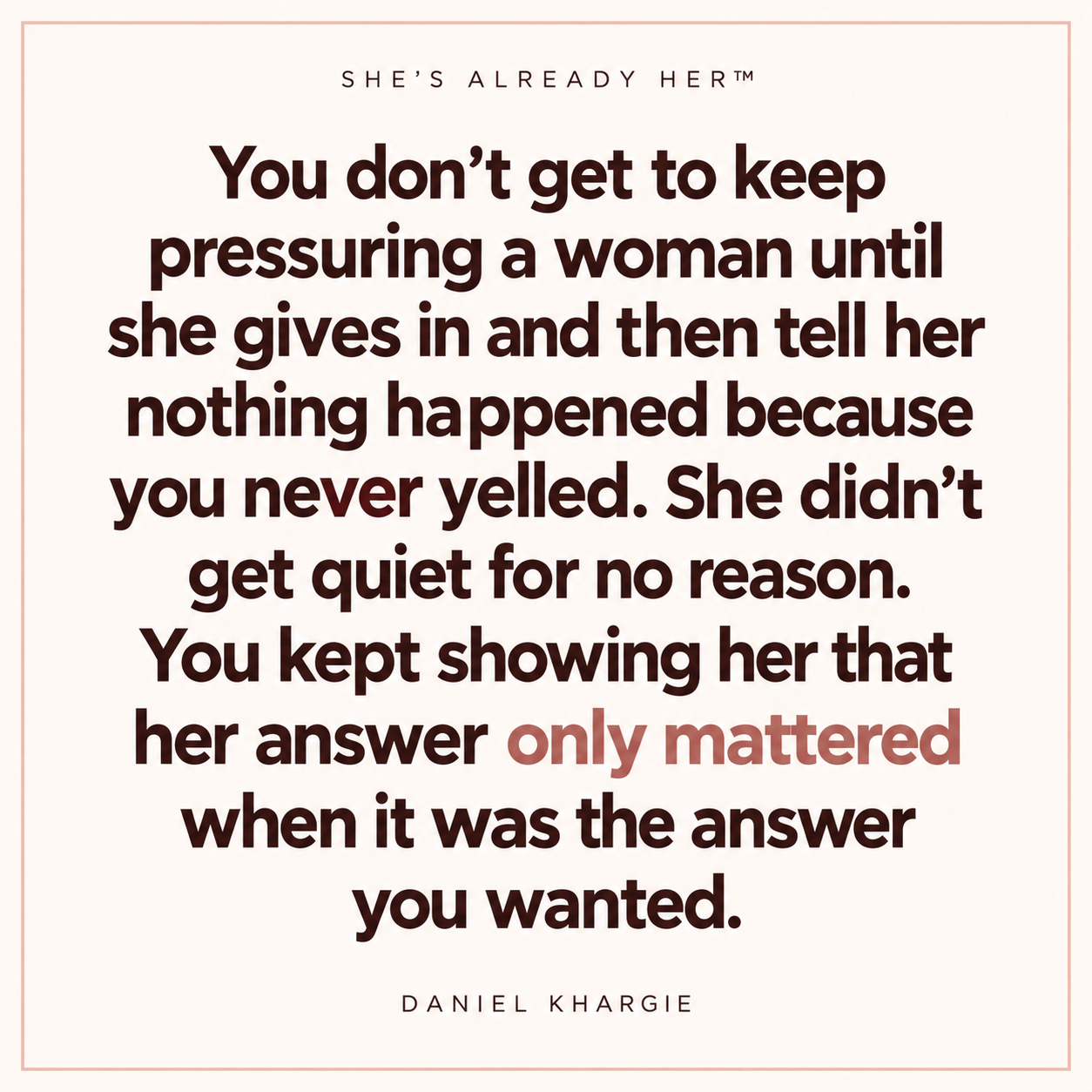
Read this quote as text
You don’t get to keep pressuring a woman until she gives in and then tell her nothing happened because you never yelled. She didn’t get quiet for no reason. You kept showing her that her answer only mattered when it was the answer you wanted.
Quiet is not the problem. Look at what comes with it.
Your man is allowed to have a quiet evening. He is allowed to be disappointed. He can need time to think, feel tired, or want space without that automatically meaning he is trying to control you.
You do not need to study every look on his face to find an answer. One short reply does not tell you everything happening in his head. An unanswered message does not, by itself, tell you why he has not replied.
What matters is what you can actually describe. There is a difference between noticing that he seems irritated and hearing him say he will punish you for a choice. You can take either concern into a conversation with someone you trust without pretending they establish the same thing.
The word “covert” in covert abuse does not mean that every quiet moment hides a secret plan. It means harmful conduct can be less easy to recognize. The label still needs more than his personality, his volume, or a feeling you cannot yet explain.
You also do not have to collect months of mistreatment before a concern deserves attention. A single threat is enough to ask for help understanding what happened. Looking at context should help you see more clearly; it should not become another reason you have to keep accepting something that scares you.
He can be upset and still be responsible for his words
The National Domestic Violence Hotline describes emotional abuse as including threats, humiliation, monitoring, and other nonphysical controlling behavior. Those actions do not become acceptable because he delivers them in an ordinary voice.
You can understand that he is hurt without agreeing to everything he wants. You can care about his disappointment without accepting that disappointing him gives him permission to threaten you.
Emotional blackmail can involve using fear, guilt, or a threatened consequence to pressure you into doing what he wants. The concern is the pressure attached to your choice. A genuine disagreement about responsibilities still needs discussion; it does not give either partner ownership of the other person’s answer.
You do not have to decide whether every word was planned. You can start with what he said, what happened afterward, and how it affected your choices. That is something concrete to discuss with support, without trying to read his mind.
Needing a break is different from making you give in
Taking time away from a difficult conversation can be reasonable. Neither of you has to keep talking when you cannot manage a useful discussion. You both still need room to say when you can return to a concern.
A condition that he will not speak to you until you withdraw your answer is different. Now ordinary contact has been tied to your giving in. You are not being asked only for time. You are being asked to surrender the point before he will speak again.
If that is what he has actually said, you do not have to explain it away as him being a quiet man. His words gave you information. If he has not explained why he withdrew, you do not have to invent certainty either.
Look at whether concerns get addressed later or keep disappearing when contact stops. Look at whether you both have room to pause. Look at any conditions he has stated. Those details can help someone understand what you are dealing with.
This is not an instruction to keep messaging him, demand an answer, or test what happens when you refuse to give in. If you fear his response, talk privately with someone who can help you consider your circumstances. You do not owe a dangerous conversation to an article.

Read this quote as text
You can’t refuse to speak to a woman until she apologizes for saying no and then act like she’s scared of nothing. Look at what you keep making her do just to have a conversation. Her hesitation didn’t come from nowhere. You made honesty feel like something she’d pay for.
You can ask for support before you have the perfect explanation
You might be asking yourself why you tense up around him. You might feel relieved when a conversation ends and then feel guilty for being relieved. That deserves attention. You do not have to talk yourself out of the feeling because you cannot explain every part of it yet.
You also do not have to make the feeling prove more than it can. Being anxious does not let an article determine his intentions or assess your danger. You can explore your reactions with a qualified professional and still take anything harmful he is doing now seriously.
Start with what you know. How you feel. What he has said. What he has done. What you are unsure about. A trusted person or an advocate can hear that without requiring a finished verdict from you first.
You do not need to confront him to earn that conversation. You do not need to announce that you are looking for support. And you do not need written records to deserve to be heard. If notes or messages could put you at risk, do not create them just because you think you need evidence for someone else.
If threats, monitoring, or retaliation are part of the concern, read the article about private support when his behavior makes you afraid. If you think your device is monitored, seek support from a safer device when possible. Private browsing alone does not guarantee privacy.
You can ask for help while you are still in the relationship and still unsure about your next step. You do not have to leave first. You do not have to buy a guide first. You do not have to get him to agree with your description first.
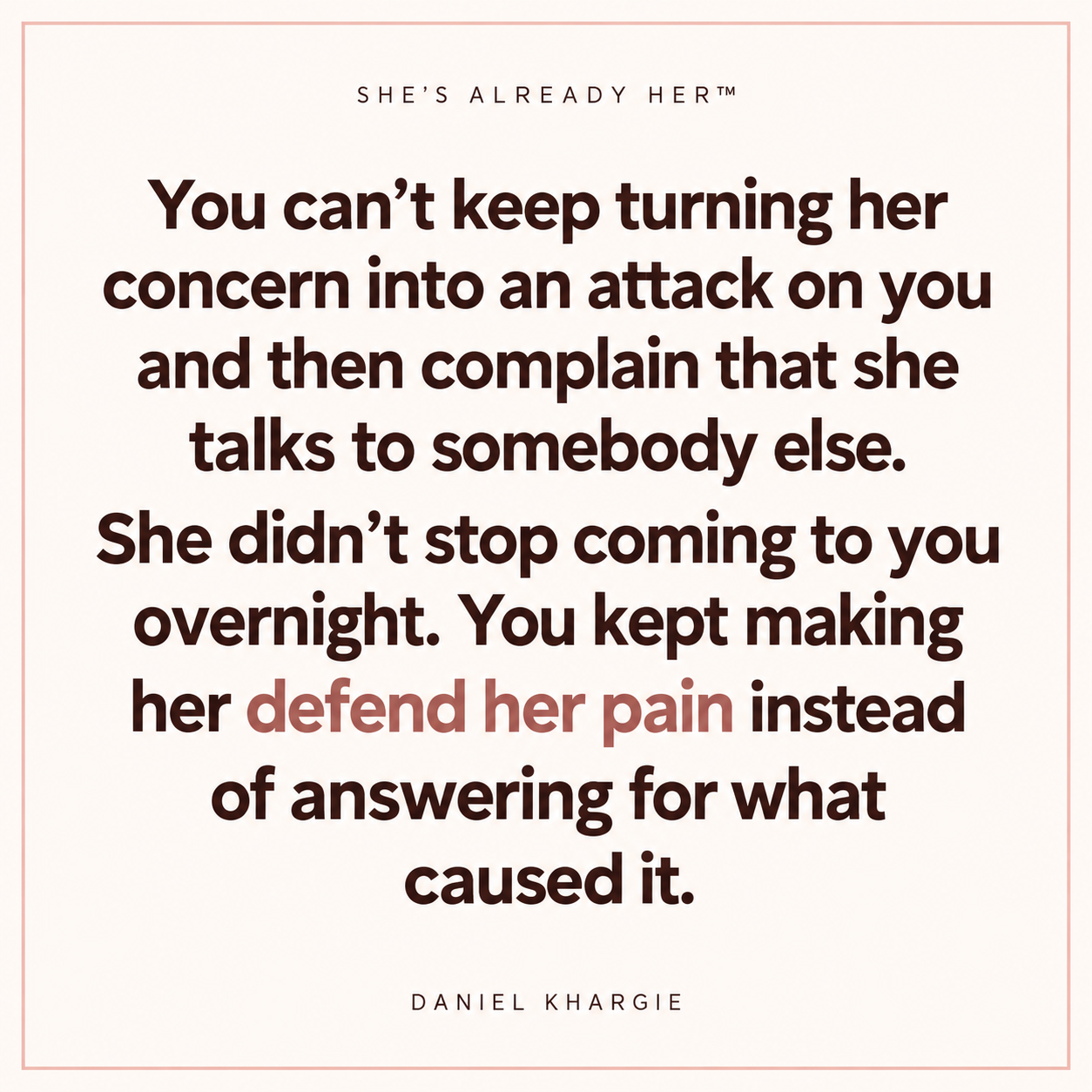
Read this quote as text
You can’t keep turning her concern into an attack on you and then complain that she talks to somebody else. She didn’t stop coming to you overnight. You kept making her defend her pain instead of answering for what caused it.
His volume does not get the last word on your experience
You can own something you said badly without letting that erase what he did. You can acknowledge a real disagreement without pretending every response to it was reasonable. Both things can be considered honestly.
For a wider look at recurring harmful conduct, read the article on recognizing emotional abuse. This conversation is about the excuse that nothing serious happened because nothing got loud. A quiet delivery does not settle that question.
And if you are asking what respectful treatment would make sharing with him feel possible again, Article 17 looks at your privacy, your pace, and your choice about opening up. You do not have to rush into closeness to prove you are being fair.
You deserve to have the actual concern heard. Not reduced to whether he shouted. Not dismissed because somebody else’s relationship looks worse. Not postponed until you can say everything perfectly.
He can speak quietly and still be responsible for every threat, demand, and put-down. You do not need the room to get louder before you take yourself seriously.
Questions about harm that happens without yelling
What is covert abuse when a partner never raises his voice?
It is a way of describing abuse that is less obvious or harder to recognize, including controlling or demeaning conduct that may happen quietly. It is not a diagnosis you can make from his tone alone. Look at his words and actions, and ask for help understanding anything that concerns you. You do not need shouting before a threat matters.
What are covert abuse examples that do not involve yelling?
Examples can include quietly threatening to reveal private information unless you comply, repeatedly putting you down in ways he dismisses as harmless, or using stated conditions to pressure you out of a choice. These describe conduct to take seriously, not a checklist that can assess your relationship or risk. Being quiet, tired, or disappointed alone is not enough to establish abuse.
Is silent treatment abuse, or can he simply need a break?
He can need a break. Silence alone does not establish abuse or tell you his intention. Withholding contact as punishment or making it conditional on your giving in raises a different concern from taking time and returning to the issue. Consider what he actually says, whether concerns ever get addressed, and any wider pressure involved. You do not need to test his response to seek support.
What is emotional blackmail when he says he is only asking?
It can involve fear, guilt, or threatened consequences used to push you into agreement. Calling something a request does not settle whether you have room to decline. Look at the condition or threat attached to your answer. A partner can express a need or discuss a real responsibility without making you responsible for preventing his retaliation.
Is guilt tripping emotional abuse if he does it without shouting?
Guilt used repeatedly to control your choices can be part of emotional abuse; a disappointed response by itself does not establish that. Look at what he asks you to accept, what happens when you disagree, and whether threats or punishment are involved. His volume does not answer those questions. You can talk with an advocate while you are unsure and without deciding first whether to stay or leave.