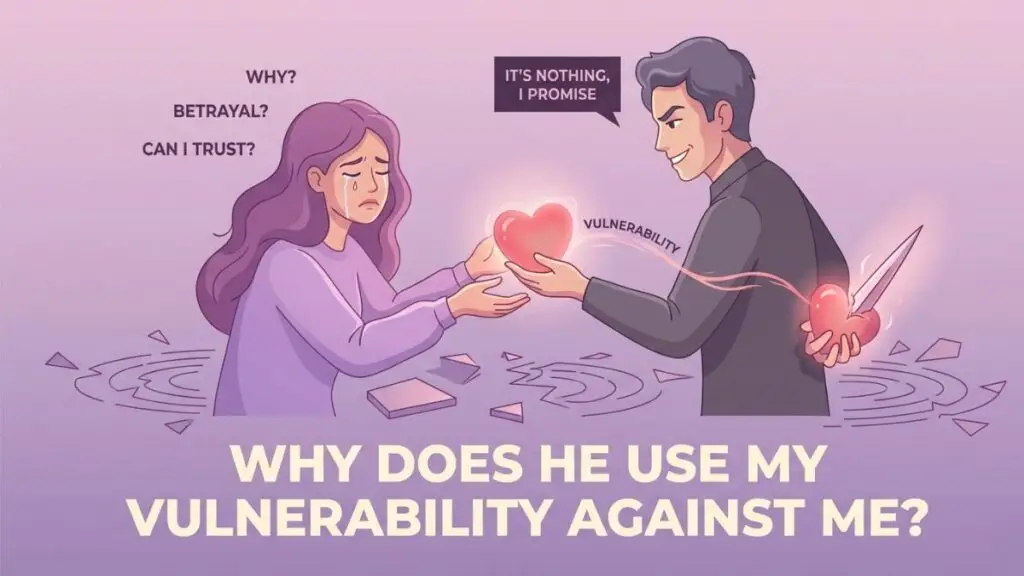
Sis, let me name the betrayal that cuts deepest.
You opened up to him. Not casually. Deeply. You shared something you don’t share with everyone — a fear, an insecurity, a wound from your past, a secret you carry, a piece of yourself you keep protected because you know how easily it can be used to hurt you.
And you gave it to him. Because you trusted him. Because he asked. Because he said “you can tell me anything.” Because he held your hand and looked at you like your vulnerability was safe with him. Because you believed that the man who said he loved you would treat your most tender parts with care.
And then he weaponized them.
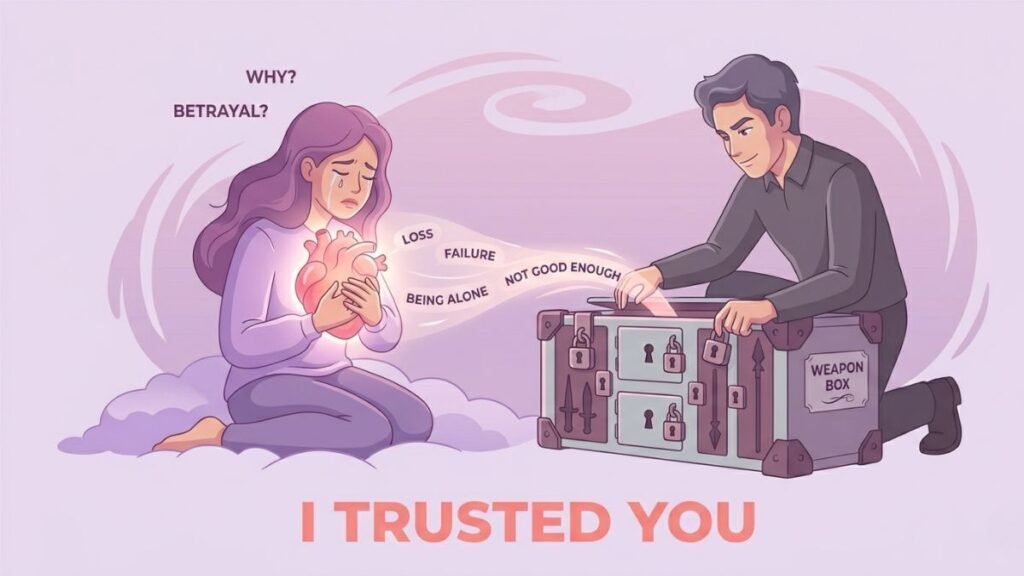
Not immediately. Not that same night. Later. During an argument. During a moment when he needed ammunition and reached for the thing that would hurt most. The thing you told him in confidence. The fear you whispered in the dark. The wound you let him see because you thought seeing it would make him gentle with it.
He wasn’t gentle. He was strategic. He filed what you shared. Stored it. And deployed it at the exact moment it would do maximum damage — when you were already vulnerable, already hurting, already in the middle of a disagreement where the power needed to shift in his direction.
That’s emotional manipulation at its most intimate. And it doesn’t just hurt. It rewires everything. Your relationship with vulnerability. Your capacity for trust. Your willingness to ever let anyone that close again. Because the person who was supposed to be safest took the most private thing you own and turned it into a blade.
What Weaponized Vulnerability Looks Like
It doesn’t always look like a dramatic attack. Sometimes it’s subtle — a reference so brief you almost miss the cruelty underneath it. But the impact is the same regardless of volume.
He references your insecurities during arguments. You told him you struggle with feeling unlovable. Now during a fight, he says something like “maybe that’s why no one sticks around” or “I can see why you’d feel that way.” He didn’t say it randomly. He aimed it at the exact wound you showed him. The wound he promised to help heal. Emotional manipulation through weaponized vulnerability is cruelty with a GPS — it always finds the softest spot because you drew him the map.
He throws your past in your face. You shared something about your childhood. A painful experience. A trauma you survived. And now, during a disagreement, it resurfaces — not as compassion, but as ammunition. “Maybe if your childhood wasn’t so messed up, you wouldn’t react like this.” “That’s your trauma talking, not reality.” He’s not referencing your past because it’s relevant to the conversation. He’s referencing it because it’s the most effective way to destabilize you in the moment.
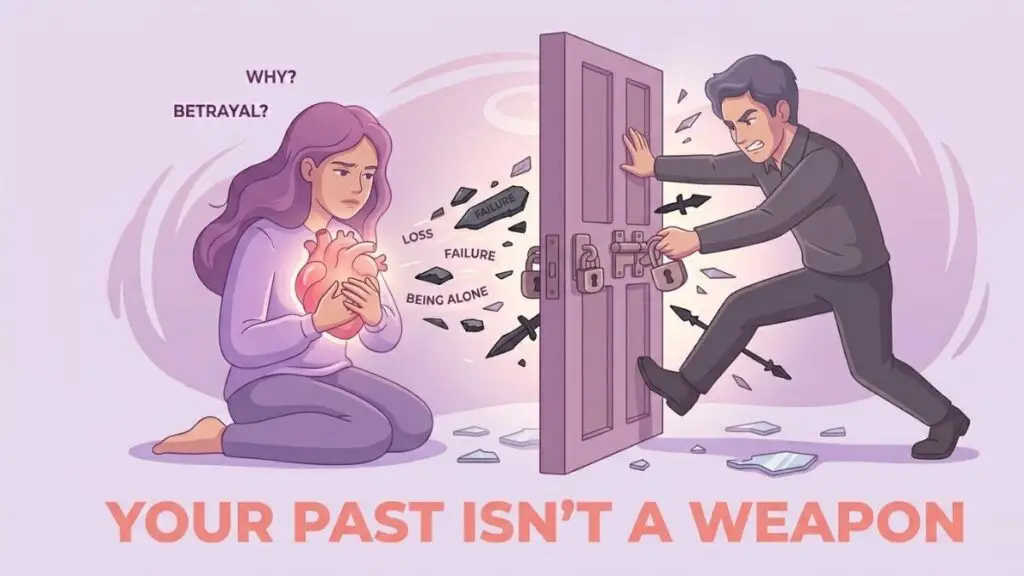
He uses your confessions to undermine your credibility. You told him about a mistake you made. A moment you’re not proud of. Something you trusted him with because you thought honesty would deepen the relationship. Now he brings it up whenever he needs to discredit you. “Well, you’re not exactly in a position to judge, given what you told me about…” Your confession, given in trust, becomes the evidence he uses to disqualify your voice whenever it threatens his position.
He hints at your secrets in front of others. Not overtly. Not revealing the full story. Just a subtle reference — a look, a comment, a joke that only you understand the weight of — that lets you know he’s holding your vulnerability like a card he could play at any moment. The hint is the threat. It says “I have this. And I could use it. So be careful.” Emotional manipulation doesn’t always require the weapon to be fired. Sometimes just knowing it exists is enough to control you.
Why He Uses Your Vulnerability Against You
Your vulnerability gave him access to your most effective pressure points. When you opened up, you did something brave. You showed him where you’re most tender. Where you carry the most pain. Where the smallest touch can cause the biggest reaction. And he catalogued it. Not as a man who wanted to protect those places. As a man who wanted to know where to aim when he needed leverage. Emotional manipulation at this level requires intelligence — the intelligence to remember what you shared, recognize its value as a weapon, and deploy it at the moment it will do the most damage. He’s not impulsive when he uses your vulnerability against you. He’s precise.
Power matters more to him than your trust. In the moment he uses your vulnerability as a weapon, he’s making a choice. He’s choosing power over trust. Impact over intimacy. Winning the argument over preserving the safety you offered him. That choice tells you everything about his value system. Your trust — the thing that made the vulnerability possible in the first place — is less important to him than the tactical advantage your openness provides. Emotional manipulation that weaponizes vulnerability isn’t a mistake. It’s a priority statement. And the priority is always him.
He doesn’t experience intimacy the way you do. When you share something vulnerable, you’re seeking connection. Closeness. The kind of intimacy that comes from being fully known by another person. But when he receives your vulnerability, he doesn’t experience connection. He experiences information. Data about you that gets stored in his system the way any useful information gets stored — for potential future use. He’s not connecting with your pain. He’s cataloguing it. Emotional manipulation of this kind reveals a fundamental difference in how the two of you experience intimacy. For you, vulnerability deepens love. For him, vulnerability provides leverage. Those are opposite orientations. And you can’t build genuine intimacy with someone who treats your openness as raw material for future attacks.
He was taught that vulnerability is weakness to exploit, not strength to honor. If he grew up in an environment where vulnerability was punished — where showing weakness meant getting hurt, where emotional openness was used against people rather than received with care — he internalized that model. Vulnerability equals target. Openness equals ammunition. Trust equals something to exploit. He’s not just being cruel to you. He’s running a program that says “when someone shows you where they’re soft, that’s where you strike when you need to.” Emotional manipulation through weaponized vulnerability is often a learned behavior — inherited from environments where tenderness was dangerous and exploitation was survival.
Using your vulnerability wins arguments he can’t win on merit. When the disagreement isn’t going his way — when your point is valid, your evidence is strong, and his position is indefensible — he needs a way to shift the balance. And nothing shifts the balance faster than deploying something that hits you at your core. Your insecurity. Your trauma. Your deepest fear. It’s a nuclear option that ends the argument not through resolution but through devastation. You can’t argue effectively when you’re reeling from a blow to your most vulnerable place. Emotional manipulation through vulnerability exploitation isn’t about the disagreement. It’s about power. When he can’t win the argument, he destroys the opponent. And the weapon he uses is the one you handed him yourself.
He sees your trust as naivety rather than gift. When you opened up to him, you were offering something precious — the parts of yourself you protect most carefully. You were trusting him with the real you. But he didn’t receive it as a gift. He received it as opportunity. In his framework, a woman who shares her vulnerabilities isn’t brave. She’s foolish. She’s handing over the tools of her own destruction. And he’s not going to refuse the tools just because she offered them lovingly. This perspective — that trust is exploitable rather than sacred — is one of the clearest indicators of emotional manipulation as a core character pattern rather than an occasional lapse.
Your vulnerability gives him leverage he can’t generate any other way. There are things about you that nobody else knows. Wounds that nobody else can see. Fears that nobody else can access. You gave him exclusive access to those things. And that exclusivity gives him a unique form of leverage — the ability to hurt you in ways nobody else can, in places nobody else can reach, with information nobody else has. Emotional manipulation through vulnerability weaponization is intimate abuse — it can only happen inside a relationship where someone was trusted enough to receive the information that’s now being used as a weapon.
What His Weaponization of Your Vulnerability Is Doing to You
You’ve stopped opening up. Completely. The woman who once shared freely — who trusted the process of vulnerability, who believed that being known was a path to being loved — has built her own walls. Not because she’s avoidant by nature. Because she learned, through direct experience, that openness gets punished. The parts of yourself you used to share? They’re locked away now. Behind doors that may not open for anyone again. That’s not self-protection. That’s scar tissue from emotional manipulation so severe that your nervous system has reclassified vulnerability as danger.
You carry your pain alone. Not because you prefer solitude. Because the one person you trusted with your pain used it against you. And if he — the person who was supposed to be safest — did that, why would anyone else be different? The isolation you feel isn’t a choice. It’s a logical conclusion drawn from devastating evidence. If trust leads to weaponization, the safest option is to trust no one.
You feel betrayed in a way that’s hard to articulate. Because this isn’t normal betrayal. This isn’t a lie or a broken promise — although those may also be present. This is a betrayal of the most sacred exchange humans can offer each other — the exchange of vulnerability for care. You offered tenderness. He returned violence. You offered your most private self. He turned it into his most effective weapon. That specific betrayal — the corruption of intimacy itself — creates a wound that affects not just this relationship but your capacity for all future relationships.
You’ve started editing your past around new people. You don’t share your full story anymore. Not because you’re private by nature. Because you’ve learned that full stories give people ammunition. You’ve started presenting a curated version of yourself — selective, protected, incomplete — because the complete version was used against you by the person who promised to hold it with care.
You flinch during vulnerability. Literally. When someone invites you to share something personal — when a friend says “you can tell me anything” or a therapist asks about a painful memory — your body tenses. Not because you don’t want to share. Because your body remembers what happened the last time those words preceded vulnerability. Emotional manipulation that weaponizes openness doesn’t just damage your mind. It rewires your body’s relationship with trust.
What You Need to Do
Recognize that his weaponization is abuse. Not a bad moment. Not a heated argument where words got away from him. Deliberately using someone’s vulnerability against them is emotional abuse. It’s calculated. It requires him to remember what you shared, identify its tactical value, and deploy it for maximum impact. That’s not losing control. That’s exercising it. Name it for what it is — not to label him, but to anchor yourself in the reality of what you’re dealing with.
Stop sharing vulnerable information with him. This isn’t about playing games or withholding to punish him. It’s about protecting yourself from someone who’s proven he can’t be trusted with your tenderness. You wouldn’t hand a weapon to someone who’s already shot you. Stop giving emotional ammunition to a man who’s shown you exactly what he does with it.
Name the betrayal directly. “I shared something with you in trust and you used it against me during an argument. That’s not something a person who loves me would do. And it’s changed what I’m willing to share with you going forward.” Say it once. Clearly. Without emotion that he can dismiss as overreaction. Let the gravity of the statement speak for itself.
Rebuild trust in vulnerability — outside this relationship. Your capacity for openness has been damaged but it’s not destroyed. Start small. With a therapist who honors what you share. With a friend who’s earned your trust over time. Let yourself experience what vulnerability is supposed to feel like — received with care, held with tenderness, never weaponized. Those experiences will slowly rewire what his emotional manipulation corrupted.
Understand that his use of your vulnerability is about him, not about you. You didn’t share too much. You didn’t trust too freely. You didn’t make a mistake by being open with someone you loved. You did exactly what healthy intimacy requires — and he corrupted it. The flaw is in his character, not in your willingness to be known. Don’t let his manipulation teach you that openness is dangerous. It’s not. He is.
Evaluate whether this relationship can hold real intimacy. Genuine intimacy requires safety. Safety requires trust. Trust requires knowing that what you share will be protected, not deployed. If he’s weaponized your vulnerability, the trust is broken. And without trust, intimacy is impossible — no matter how much love exists alongside the damage. Can you be in a relationship where you can never fully open up? Where everything you share might be used against you? Where the deepest parts of you are treated as tactical resources? Answer honestly.
What You Need to Understand
Emotional manipulation that weaponizes vulnerability is one of the most intimate forms of abuse. It can only happen inside a relationship where someone was trusted enough to receive the information now being used as a weapon. The abuse is possible precisely because love was present. And that makes the betrayal uniquely devastating — because the trust that enabled it was real even though the safety it assumed was not.
A man who uses your vulnerability against you doesn’t love the real you. He loves the access the real you provides. He loves knowing where you’re soft because softness is where his words land hardest. He loves having information no one else has because that information gives him power no one else holds. That’s not love. That’s emotional manipulation operating inside love’s clothing.
The right man treats your vulnerability like the sacred thing it is. He holds what you share with reverence. He protects your secrets like they’re his own. He would rather lose an argument than win it by deploying something you told him in confidence. That’s the standard. And anything less than that standard — anything that uses your openness as a weapon — is a violation of the most fundamental contract that intimacy creates.
What You Deserve
You deserve a man who treats your vulnerability as sacred. Who hears your fears and holds them gently. Who knows your wounds and approaches them with care rather than targeting them with precision.
You deserve to share your full self with someone and know — in your bones, without question — that what you’ve shared will never be used against you. That your openness will be met with protection, not exploitation. That your trust will be honored, not leveraged.
You deserve to be fully known and fully safe at the same time, sis. Those two things are supposed to coexist. And a man who makes them contradictory has revealed everything about how he defines love — and it looks nothing like what you deserve.
The Bottom Line
He uses your vulnerability against you because emotional manipulation through weaponized openness gives him power no other tactic can match, because your trust provided access to pressure points he can’t reach any other way, because winning matters more to him than your safety, and because he sees vulnerability as exploitable rather than sacred.
Stop sharing with someone who uses what you give as ammunition. Stop trusting a man who’s proven that your openness is his opportunity. Stop carrying the shame of being betrayed by someone you loved — the shame belongs to him, not you.
Your vulnerability wasn’t the mistake, sis. Giving it to someone who didn’t deserve it was. And recognizing that difference is where your healing begins.
FAQ
Q: What if he says he didn’t mean to use my vulnerability against me?
Intent doesn’t erase impact. Even if the words “slipped out” in the heat of an argument, they slipped out because he stored them as ammunition. A man who accidentally fires a weapon he deliberately loaded is still responsible for the wound. And “I didn’t mean to” doesn’t heal the damage of hearing your deepest fear thrown back at you.
Q: How do I trust anyone again after this?
Slowly. With people who earn it through consistent behavior over time. Not through grand gestures or promises but through small, repeated demonstrations that what you share is treated with care. A therapist can help you rebuild the trust infrastructure his manipulation damaged. It takes time. But the capacity for trust isn’t destroyed. It’s just wounded. And wounds heal.
Q: Is using vulnerability as a weapon always intentional?
In the strictest sense, deploying specific information at a specific moment for specific impact requires intention — even if that intention operates below conscious awareness. The precision of the attack — knowing exactly what to say to cause maximum damage — reveals a level of calculation that transcends accidental. Emotional manipulation this specific is never truly random.
Q: What if he apologizes afterward?
Watch whether the apology is followed by the behavior stopping permanently. An apology after weaponizing your vulnerability means nothing if the same weapon gets deployed in the next argument. A genuine apology would include understanding why it’s devastating, commitment to never doing it again, and recognition that trust has been fundamentally damaged. If the apology lacks those components, it’s damage control, not remorse.
Q: Should I tell him about the impact of what he did?
You can — once. “Using what I shared in confidence as a weapon during arguments has damaged my ability to trust you. I need you to understand the severity of that.” But manage your expectations. A man capable of weaponizing your vulnerability may not be capable of understanding — or caring about — the impact. Tell him for your own clarity. Not for his transformation.