
Sis, let me describe the rollercoaster you ride every day that nobody else can see.
Someone says something nice about you. “You look great today.” “That was really impressive.” “I love the way you handled that.” And your mood the entire internal weather system that determines how you experience the next few hours shifts upward. Dramatically. Immediately. The compliment doesn’t just feel pleasant. It feels like rescue. Like someone threw you a rope you didn’t realize you were dangling without. The day was gray and now it’s bright. The self-doubt that was running quietly in the background just went silent. The woman who felt uncertain about herself five seconds ago now feels real. Visible. Confirmed.
Then the compliment fades. Not because it was retracted. Because compliments, in your system, don’t have staying power. They arrive with impact and dissolve with speed like sugar that hits the bloodstream fast and crashes just as quickly. The mood that rose on the compliment’s delivery falls back to its pre-compliment baseline within hours. Sometimes within minutes. And the baseline is always the same uncertain. Unconfirmed. Waiting for the next piece of external input that will temporarily make you feel like you exist at the level you need to exist at.
And it’s not just compliments that move you. It’s their absence. A day without positive feedback doesn’t just feel neutral. It feels like evidence. Evidence that you’re not impressive enough to warrant comment. That whatever you offered today wasn’t notable enough to produce the response your system depends on. That the silence where the compliment should have been is actually a verdict delivered through omission rather than through words.
Validation seeking behavior at this level isn’t about enjoying praise. Everyone enjoys praise. This is about needing praise the way a lamp needs electricity not as a nice feature, but as the power source without which the entire system goes dark.
What Compliment-Dependent Mood Looks Like
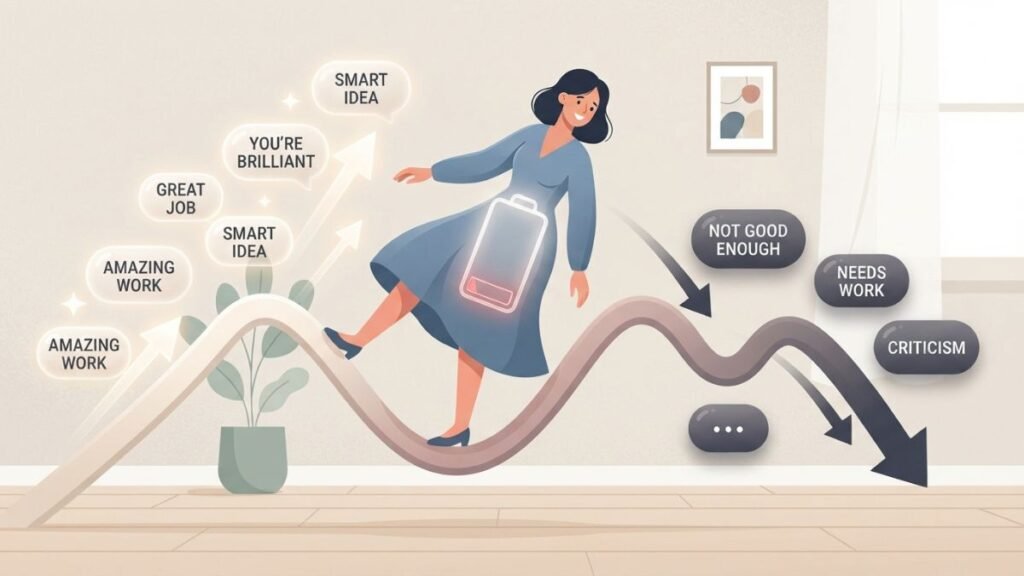
It doesn’t look like vanity. It looks like a woman whose confidence has no internal generator rising and falling entirely on the current supplied by other people’s words.
Your mood tracks external input like a stock price tracks the market. Positive comment mood rises. Negative comment mood crashes. No comment mood drifts downward toward the default, which is always some version of “not enough.” The tracking is real-time, automatic, and operates with a sensitivity that registers not just what people say but what people don’t say. Validation seeking behavior has converted your emotional state from something internally regulated to something externally determined. You’re not managing your mood. The room is managing it. And the room doesn’t know it’s been given that job.
You replay compliments to extend their effect. The words were said hours ago. You’re still running them through your mind not savoring them, but metabolizing them. Extracting whatever self-worth fuel they carry and burning it as slowly as possible before the supply runs out. The replay isn’t enjoyment. It’s the equivalent of rationing stretching a limited resource because you know the next delivery isn’t guaranteed. Validation seeking behavior doesn’t just receive compliments. It processes them with the desperation of a system that knows the internal supply is empty and the external supply is unreliable.
You fish for compliments without realizing you’re fishing. “I look terrible today.” “That presentation was probably awful.” “I’m not sure anyone even noticed.” The statements aren’t genuine assessments. They’re invitations — carefully constructed openings for someone to deliver the compliment your system needs but your pride won’t let you ask for directly. The fishing is unconscious, driven by the same mechanism that produces all validation seeking behavior — the need for external input delivered through indirect channels because the direct request feels too vulnerable.
Criticism devastates you disproportionately. If a compliment raises you up, criticism drops you through the floor. Not because the criticism is severe it might be mild, constructive, even delivered with care. But the impact is seismic because a system that runs on external validation processes every criticism as a withdrawal from an already-depleted account. The account has no buffer. No reserves. No internal balance that would absorb the criticism without collapsing the mood. Validation seeking behavior makes criticism feel existential not because you’re dramatic, but because the system has no shock absorbers. Every impact hits the self-concept directly.
Why Compliments Affect Your Mood So Much
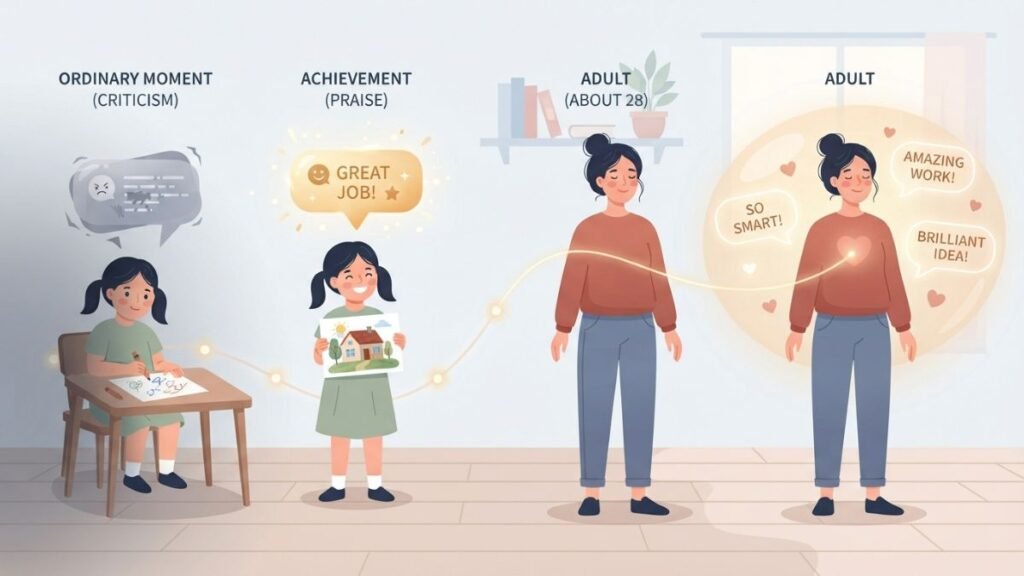
Your self-worth system runs on external fuel because internal fuel was never generated. The internal system — the one that produces self-worth independently, that generates the baseline hum of “I’m okay” without requiring anyone else’s input — was supposed to be built during childhood. Through the specific, repeated, consistent process of receiving positive regard from caregivers and gradually internalizing it until the regard became self-generated. The external input was supposed to become internal structure. And it didn’t. Not because you failed to internalize. Because the input itself was inconsistent, conditional, or absent — which meant the internalization process never completed. Validation seeking behavior is the adult version of a developmental process that stalled. The seeking is the system still reaching outward for the input it was supposed to convert to internal structure decades ago. The reaching isn’t a choice. It’s an incomplete developmental sequence still running.
Compliments fill a void that criticism created early. Before the first compliment ever moved you this intensely, something else happened — something that created the void the compliment is filling. A parent whose feedback was predominantly critical. A household where what you did wrong was noticed and what you did right was invisible. An environment where the positive input that should have been building your self-worth was replaced by the negative input that was dismantling it. Validation seeking behavior at the compliment-dependent level is a response to early criticism that hollowed out the container. The compliment doesn’t just add to something that’s already there. It fills something that was emptied before you had any say in the matter. And filling empty containers requires more volume than topping off full ones — which is why the compliments need to keep coming and why one is never enough.
Your nervous system uses external validation as a safety signal. At the neurological level, your system doesn’t just enjoy compliments. It needs them — the way it needs any safety signal. The compliment says “you’re seen. You’re valued. You’re safe in this environment.” And the nervous system — calibrated since childhood to treat external approval as evidence of safety — relaxes when the signal arrives. The mood elevation you experience after a compliment isn’t just emotional. It’s physiological — a nervous system settling because the safety signal it was scanning for has been received. Validation seeking behavior at the nervous system level is a safety-seeking behavior. The compliment isn’t a luxury. It’s the “all clear” signal your body has been waiting for since the last one expired.
You were praised conditionally — which made praise feel like earned relief rather than natural warmth. If praise in your childhood was conditional — delivered for performance, withheld during normalcy, allocated based on achievement rather than existence — then praise never became associated with warmth. It became associated with relief. The relief of having performed well enough to earn the conditional input. Validation seeking behavior that runs on compliment dependency often traces back to this specific conditioning — where praise wasn’t the natural expression of a caregiver’s love for a child. It was the payment for a performance the child delivered. And the payment, once internalized as the model, converts every compliment in adulthood into the same thing — not warmth received, but relief earned. Which is why the compliment elevates the mood so dramatically. And why its absence produces anxiety rather than neutrality.
The compliment gives you temporary access to a self-worth you can’t generate independently. Here’s what the compliment actually does — functionally, at the level of your internal system. It provides a brief, externally generated experience of self-worth that your system can’t produce on its own. The mood elevation isn’t about the words themselves. It’s about the experience they temporarily create — the experience of feeling worthy, of feeling valuable, of feeling like you matter. An experience your internal system can’t sustain without external input. Validation seeking behavior is the pursuit of that experience — the chasing of a feeling that should be internally available but isn’t. The compliment provides the feeling. The internal absence ensures it doesn’t last. And the gap between the temporary provision and the permanent absence is where the dependency lives.
You’ve built no internal response to the question “am I okay?” When the question surfaces — “am I okay? am I enough? am I doing well?” — where does your system look for the answer? If the answer always comes from outside — from the compliment, from the approval, from someone else’s assessment — then the system has no internal respondent. The question gets asked and the internal silence is deafening. So the system looks outward. And finds the compliment. And the compliment answers the question — briefly, temporarily, with a conviction that dissolves the moment the external voice goes quiet and the internal silence returns. Validation seeking behavior is the system repeatedly asking a question it can’t answer internally and seeking the answer from whoever happens to be nearby. Not because the question is unanswerable. Because the internal respondent was never developed.
Your identity is assembled from other people’s assessments rather than your own. Who are you? In a healthy system, the answer comes from self-knowledge — accumulated through self-reflection, through honest self-assessment, through the internal process of understanding your own values, qualities, and worth. In your system, the answer comes from external input. You’re who they say you are. You’re worth what they reflect. You’re as beautiful, as competent, as lovable as the last compliment suggested — and as insufficient as the last silence implied. Validation seeking behavior has outsourced your identity to a market of external assessors. And a market-based identity fluctuates the way markets do — rising and falling on daily input rather than holding steady on internal fundamentals.
What Compliment-Dependent Mood Is Doing to You
You can’t sustain a positive self-image for more than a few hours. The compliment lifts you. The hours pass. The lift fades. The baseline returns. And the baseline is always the same — slightly below okay, slightly uncertain, slightly in need of the next external input to restore the temporary elevation the last one provided. Validation seeking behavior has made your self-image a day-trading operation — where the value changes constantly based on the latest input and the long-term trend is always uncertain.
You’re performing constantly to produce the compliments your system needs. The effort you invest in appearance, in work, in relational dynamics isn’t driven by self-expression. It’s driven by the need to generate the external response your internal system depends on. The outfit is chosen for the compliment it might produce. The work is delivered for the praise it might elicit. The relational behavior is calibrated for the approval it might earn. The performance is exhausting — because it’s a full-time job whose compensation is compliments and whose termination condition is their absence.
Your emotional stability depends on the most unstable variable available — other people’s words. You can’t control what people say. You can’t control when they say it. You can’t control whether the person whose compliment would steady you today happens to notice the thing your system needs noticed. Your emotional stability is at the mercy of variables you have zero influence over — which means your stability isn’t stable at all. It’s a series of micro-stabilizations that occur when external input arrives and micro-destabilizations that occur when it doesn’t. Validation seeking behavior has placed your emotional wellbeing on a foundation you can’t control. And uncontrollable foundations are, by definition, unstable.
You’ve stopped trusting your own assessment of anything. Your assessment of your appearance requires external confirmation. Your assessment of your work requires external evaluation. Your assessment of your worth requires external certification. The internal assessor — the one whose opinion should carry the most weight in your own self-evaluation — has been demoted to such an insignificant position that its voice is barely audible underneath the noise of the external assessments your system is perpetually seeking. Validation seeking behavior doesn’t just create external dependency. It actively undermines internal authority. Every compliment sought and received is a moment where the internal assessor’s opinion was bypassed in favor of the external one. And bypassed authorities lose credibility. Which makes the external dependency deepen. Which makes the internal authority weaken. The cycle is self-reinforcing.
You miss the genuine connection that exists underneath the validation exchange. People are complimenting you. And instead of receiving the compliment as a moment of connection — as a person seeing something beautiful about you and choosing to express it — you’re processing it as fuel. Metabolizing it. Extracting the worth and discarding the rest. The person behind the compliment becomes invisible — because their role in your system isn’t “person connecting with me.” It’s “delivery system for the validation I require.” Validation seeking behavior converts human connection into a transactional exchange — where the value of the interaction is measured by the validation it produces rather than the intimacy it creates.
What You Need to Do
Start generating one self-assessment per day that requires no external input. Not an affirmation you don’t believe. An evidence-based assessment. “I handled that situation well today. I know this because I was present, I observed the outcome, and my own evaluation is sufficient.” The assessment will feel incomplete without external confirmation. Let it feel incomplete. The incompleteness is the internal assessor operating without its usual backup. And operating without backup — however uncomfortable — is how the internal assessor builds the credibility your system has been denying it.
Sit with a compliment-free day without treating it as evidence. A day without compliments isn’t a day without worth. It’s a day without external input. The two are different. Start catching the interpretation that converts the absence of compliments into evidence of insufficiency: “Nobody said anything nice today — but that doesn’t mean there’s nothing nice to say. It means nobody said it out loud.” The reframe doesn’t produce the same mood elevation a compliment would. It produces something better — the capacity to maintain a stable mood without the compliment. And stable without the compliment is the goal. Not elevated. Stable.
Notice the fishing and replace it with direct self-validation. When the impulse to fish arrives — “I look terrible today” — catch it. Name it: “That’s the fishing. I’m looking for a compliment because my system needs external input right now.” Then provide the input internally: “I look fine. I know this because I looked in the mirror and assessed myself with my own eyes.” The internal provision won’t satisfy the way the external compliment would. It’s not supposed to. It’s supposed to build the internal muscle. And the muscle gets stronger through use, not through replacement of the exercise with external delivery.
Delay the mood response to compliments by thirty seconds. When a compliment arrives — before the mood elevates, before the relief washes through, before the system locks onto the external input as today’s fuel supply — pause. Thirty seconds. And during the pause, ask: “Was I okay before this compliment arrived? Was my mood genuinely bad — or was it neutral and the compliment is creating an artificial elevation that will crash when the compliment fades?” The pause creates awareness. And awareness of the elevation pattern is the first step toward moderating it. Validation seeking behavior runs on the automatic loop of input → elevation → crash → seeking. The pause interrupts the automaticity. And interrupted automaticity is automaticity losing its grip.
Build a self-worth file that doesn’t depend on daily input. Document what you know about yourself — your qualities, your achievements, your specific way of showing up in the world — and keep it somewhere accessible. Not as a one-time exercise. As an ongoing project. Add to it weekly. Read it when the system is seeking. Let the file serve as the internal source that the system has been sourcing externally. Validation seeking behavior weakens when the internal source gets populated enough that the external source becomes supplemental rather than primary.
Track your mood alongside the external input and look for the pattern. For one week, note every compliment you receive and rate your mood before and after. Note every compliment-free period and rate your mood during. The data will reveal the correlation your system has been operating on — and seeing the correlation clearly, in your own data, is more powerful than being told it exists. The pattern becomes undeniable. And undeniable patterns are patterns you can choose to restructure rather than patterns you unconsciously repeat.
Get professional support. Validation seeking behavior that controls your mood, that traces back to conditional praise in childhood, that has organized your life around producing external input rather than generating internal worth — requires therapeutic intervention. A therapist can help you trace the dependency to its developmental source, build the internal self-worth structure that was never completed, develop self-validation practices that replace the external dependency, and restructure your relationship with compliments from survival fuel to enrichment supplement.
What You Need to Understand
Compliments should feel good. That’s normal. What’s not normal — what indicates a structural deficit rather than a healthy preference — is when compliments determine your mood rather than enhance it. When the absence of compliments produces anxiety rather than neutrality. When your entire emotional state is a function of the most recent external input rather than a stable baseline your internal system maintains independently.
Validation seeking behavior at the mood-control level isn’t about enjoying praise. It’s about depending on it — the way a building depends on its foundation. Remove the foundation and the building collapses. Remove the compliments and the mood collapses. The parallel is exact. And the solution is the same in both cases — build a foundation that doesn’t require external support to hold the structure up.
You can build that foundation. The internal self-worth system that should have been constructed during childhood can be built in adulthood — through therapy, through self-validation practice, through the accumulated evidence of your own assessment being trustworthy enough to maintain your mood without external reinforcement. The building takes time. It takes professional support. It takes the willingness to experience compliment-free periods without the mood collapse the system currently produces. But the building is possible. And the result — a mood that holds steady regardless of the daily input — is worth every uncomfortable moment the construction requires.
What You Deserve
You deserve to feel good about yourself without someone else saying it first. To wake up and feel okay — not because someone told you you’re beautiful, but because your internal system carries that information independently of anyone else’s delivery.
You deserve a mood that’s yours. Not the room’s. Not the compliment’s. Not the algorithmically determined product of whatever external input happened to arrive today. Yours. Generated internally. Maintained independently. Available regardless of whether anyone in your vicinity has anything nice to say.
You deserve to receive a compliment and feel warmth rather than relief. To hear “you look great” and think “I know” rather than “thank God someone noticed.” To have the compliment add to something that’s already present rather than filling something that’s perpetually absent.
You deserve stability, sis. The emotional kind. The kind that doesn’t rise and fall on someone else’s words. The kind that holds — through compliment-rich days and compliment-free ones alike — because the holding comes from inside rather than from whatever the room decides to deliver.
The compliments will still feel good. They should. But they’ll feel good the way dessert feels good — a delightful addition to a meal that was already sufficient. Not the meal itself. Not the thing you starve without. Not the difference between okay and not-okay.
Just the cherry on top of a self-worth that was already complete.
The Bottom Line
Compliments affect your mood so dramatically because your self-worth system runs on external fuel that was never converted to internal structure, because the void the compliments fill was created by early criticism that hollowed out the container, because your nervous system uses external validation as a safety signal, because praise in your childhood was conditional and therefore associated with earned relief rather than natural warmth, and because your system has no internal respondent for the question “am I okay.”
Validation seeking behavior at the mood-control level isn’t a preference for praise. It’s a dependency on it. And dependencies — however long-standing, however deeply conditioned — can be restructured. Not through willpower. Through building. Building the internal source. Building the self-assessment authority. Building the container that finally has a bottom — so the compliments that arrive don’t pass through but accumulate. And the accumulated worth produces something no single compliment ever could.
Stability. The kind that lasts. The kind that doesn’t expire between deliveries. The kind that lets you hear a compliment and smile rather than sigh with relief.
That stability is buildable, sis. And the woman who builds it discovers something the validation seeking has been hiding from her for years.
She was always worth the compliment. She just couldn’t hold it long enough to believe it.
Now she can.
FAQ
Q: Is it wrong to enjoy compliments?
Not at all. Enjoying compliments is healthy and human. The issue isn’t enjoyment — it’s dependency. Enjoyment says “that felt nice.” Dependency says “I needed that to feel okay.” The distinction is whether the compliment adds to existing stability or creates it from scratch. If your mood is fine without the compliment and better with it — that’s enjoyment. If your mood requires the compliment to reach baseline — that’s dependency.
Q: Why do compliments from certain people affect me more than others?
Because the affect is calibrated to the perceived authority of the source. Compliments from people whose approval mirrors the original source — the parent, the caregiver, the first person whose validation your system coded as essential — produce the strongest mood response. The hierarchy isn’t about the current relationship. It’s about the historical echo the current person activates.
Q: Can I stop needing compliments to feel good?
You can significantly reduce the need — through building internal self-worth, through developing self-validation practices, and through therapeutic work that addresses the developmental deficit that created the dependency. The need won’t disappear entirely because humans are social beings who naturally respond to positive social input. But the need can shift from survival-level to enrichment-level. And that shift changes everything.
Q: What if I know I’m fishing for compliments but can’t stop?
The awareness is the first step. Catch the fishing in real time. Name it: “I’m fishing.” Then try the internal provision: “What would I need to hear right now — and can I say it to myself?” The fishing weakens when the internal source starts providing what the fishing was designed to extract. Not immediately. Gradually. And gradually is the pace of genuine change.
Q: Why does criticism hit so much harder than compliments help?
Because your system has no shock absorbers. A healthy self-worth system absorbs criticism through an internal buffer — “that feedback was about my work, not about my being.” Your system — lacking the internal buffer — receives criticism as a direct hit to the self-concept. Every criticism subtracts from an account that’s already depleted. And subtracting from a depleted account produces a more dramatic impact than adding to a full one. Building the internal buffer — the self-worth structure that absorbs criticism without it reaching the identity level — is the intervention that makes criticism survivable rather than devastating.