
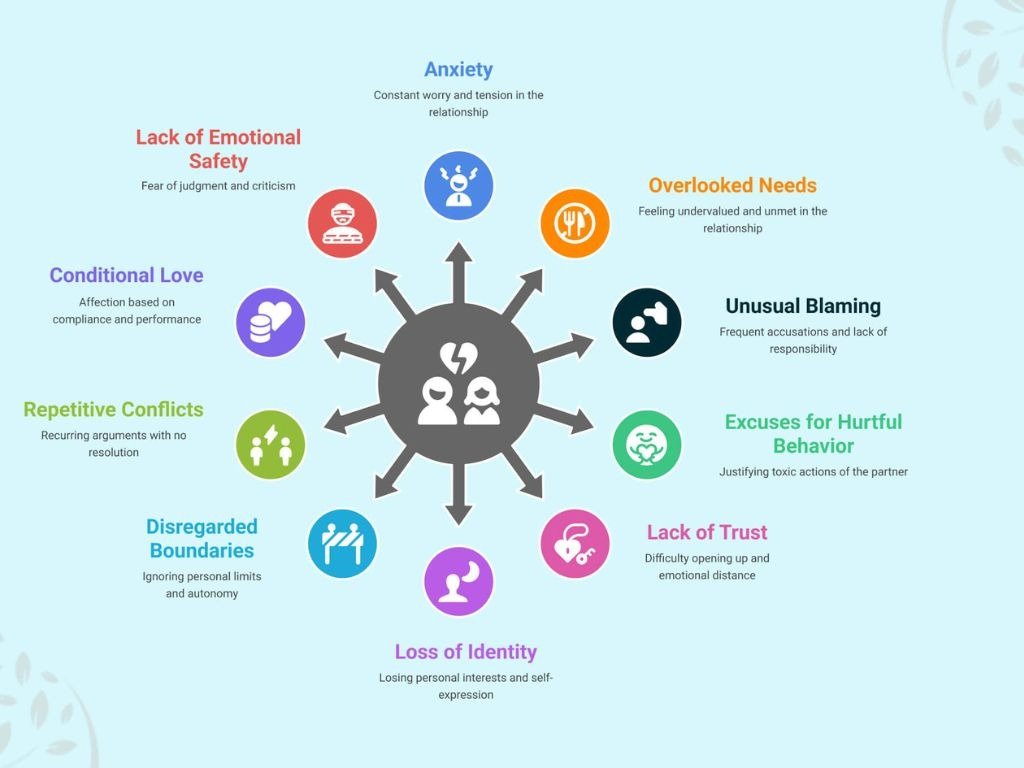
Not all toxic relationships start with cruelty.
Some begin with charm, attention, and intensity that feel like connection.
But over time, something shifts.
You start feeling confused, drained, and emotionally smaller—while the other person remains untouched by accountability. This is often where narcissistic behavior quietly takes control.
Understanding this pattern isn’t about labeling people.
It’s about recognizing dynamics that harm your emotional well-being.
What Is Narcissistic Behavior in Relationships?
Narcissistic behavior is not simply confidence or self-focus.
It’s a pattern of emotional dominance where one person’s needs, image, and control matter more than mutual respect.
In relationships, this behavior often includes:
- Lack of genuine empathy
- A need to feel superior or admired
- Difficulty taking responsibility
- Subtle or overt emotional manipulation
The relationship becomes centered around them—their emotions, their needs, their version of reality.
Common Narcissistic Patterns in Toxic Relationships
1. Idealization, Then Devaluation
At first, you may feel deeply seen:
- intense attention
- fast emotional bonding
- constant validation
Then slowly, that admiration turns into criticism, distance, or emotional withdrawal—often without explanation.
This cycle keeps you chasing the version of them you first met.
2. Gaslighting and Reality Distortion
You may start questioning your own memory or feelings:
- “You’re overreacting.”
- “That never happened.”
- “You’re too sensitive.”
Over time, you stop trusting yourself and rely on their version of truth instead.
3. Conditional Love
Affection becomes a reward.
Care is given when you comply and removed when you assert yourself.
This teaches you that love must be earned through silence, tolerance, or self-sacrifice.
4. Lack of Accountability
When problems arise, responsibility is often redirected:
- Blame is shifted
- mistakes are minimized
- Apologies feel empty or defensive
Instead of resolution, you’re left carrying emotional weight alone.
5. Control Through Emotional Uncertainty
Hot-and-cold behavior keeps you off balance:
- closeness followed by distance
- affection followed by withdrawal
This unpredictability creates emotional dependence, not connection.
Why Narcissistic Relationships Are Hard to Leave
People often ask, “Why didn’t I leave sooner?”
But narcissistic dynamics don’t trap you through weakness—they trap you through psychological conditioning.
You may stay because:
- You keep hoping things will return to how they started
- You doubt your own perceptions
- You feel responsible for fixing the relationship
- You confuse endurance with loyalty
This isn’t failure.
It’s a survival response to emotional instability.
The Emotional Impact of Narcissistic Behavior
Over time, you may notice:
- chronic self-doubt
- emotional exhaustion
- anxiety around communication
- shrinking self-esteem
- fear of setting boundaries
The relationship teaches you to abandon yourself to maintain peace.
That is not love.
Healing Begins With Awareness
Recognizing narcissistic patterns is not about blame.
It’s about clarity.
Healing starts when you:
- Trust your emotional experience
- Stop minimizing your discomfort
- understand that love does not require self-betrayal
You don’t need to prove your pain to justify leaving a dynamic that harms you.
Healthy Relationships Feel Different
In emotionally healthy relationships:
- accountability exists
- boundaries are respected
- Disagreements don’t erase safety
- Love is consistent, not conditional
You don’t have to disappear to be accepted.
Final Thoughts
Narcissistic behavior in relationships can be subtle, confusing, and deeply destabilizing.
But understanding these patterns gives you back something powerful: choice.
You are not too sensitive.
You are not asking for too much.
And you are not broken for wanting respect.
Choosing yourself is not selfish.
It’s the beginning of emotional safety.



One Comment