
Sis, let me describe the race you’ve been running that nobody else seems to be in.
You’re competing. Not in the way athletes compete with a clear finish line, a fair field, and a trophy at the end. You’re competing for something that shouldn’t require competition at all. Love. Attention. Priority. The basic experience of being chosen by the people you’ve chosen — without having to outperform, outgive, and outshine every other option in their orbit just to maintain your position.
You compete with his ex. With his friends. With his phone. With his hobbies. With his job. With every person and every thing that occupies space in his life — because your space never feels guaranteed. It feels earned. Maintained through effort. Preserved through performance. Subject to revocation the moment your output drops below whatever invisible standard keeps you in the running.
And the exhaustion of that competition is something nobody talks about. Because from the outside, it just looks like a woman who tries hard in relationships. Who gives a lot. Who goes above and beyond. But from the inside, the trying isn’t generosity. It’s desperation. The giving isn’t love. It’s strategy. The going above and beyond isn’t devotion. It’s survival — the constant output of a woman who believes that the moment she stops competing is the moment she gets replaced.
That’s self worth issues at their most hidden. Not the obvious kind that announces itself through visible insecurity. The kind that hides behind effort so impressive it looks like strength — when underneath, it’s a woman running as fast as she can because she believes that standing still means losing everything.
What Competing for Love Looks Like
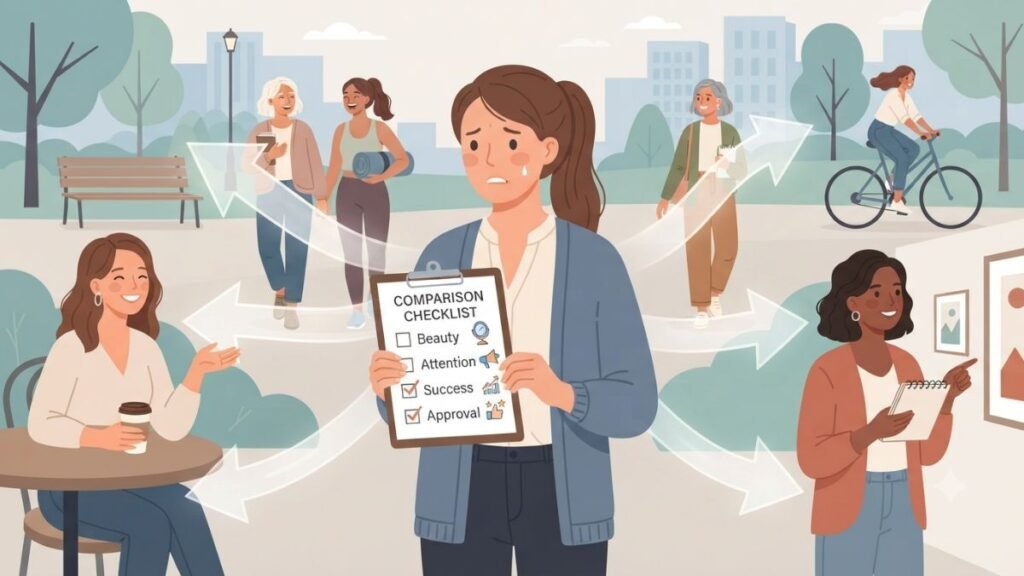
It doesn’t look like desperation from the outside. It looks like dedication. Like a woman who really cares. Like a partner who’s all in. But underneath the dedication is something much more painful.
You monitor your competition constantly. Not consciously — automatically. Every woman in his life gets evaluated. Every interaction he has gets assessed for threat level. Every person who receives his attention triggers a recalculation of your position. Self worth issues that manifest as competition create a permanent surveillance system — one that scans the environment for anyone who might be offering what you’re offering, but better. The scanning is exhausting. And it never produces peace — because there’s always someone to compare yourself to. Always another competitor. Always another reason to believe your position isn’t secure.
You over-invest to stay ahead. More effort. More presence. More giving. More of everything — not because the relationship naturally inspires that level of investment, but because you believe that anything less than maximum output opens the door for someone else to surpass you. Self worth issues turn love into a performance race where the prize is simply being kept. Not celebrated. Not chosen with enthusiasm. Kept. And the keeping requires a pace you can’t sustain — but you sustain it anyway, because the alternative is unthinkable.
You interpret his attention to others as your demotion. He talks to a female coworker. He laughs at another woman’s joke. He spends time on something that isn’t you. And instead of registering these as normal, healthy aspects of a full life, your system registers them as competitive threats. Moments where his attention flowed elsewhere — which means moments where your position weakened. Self worth issues that produce competitive love don’t allow for a partner to have a full life. Because every piece of his life that doesn’t include you feels like a piece where you’re being outperformed.
You change yourself to stay competitive. You adjust your appearance. Your interests. Your personality. Your opinions. Not because you want to grow — because you want to stay relevant. To remain the option he’d choose if he were choosing right now. Self worth issues that drive competitive love produce a woman who’s constantly updating herself — not for her own fulfillment, but for someone else’s continued selection. The updates aren’t growth. They’re renovations designed to prevent the building from being condemned.
Why You Feel Like You Have to Compete for Love
Love in your experience has always involved a ranking. Before you ever entered a romantic relationship, you learned that love had a hierarchy. A parent who favored a sibling — not always overtly, but consistently enough that you registered your position. A family dynamic where someone else got more attention, more affection, more of the thing you needed but received less of. Self worth issues that produce competitive love almost always trace back to a childhood where love wasn’t distributed equally. Where the question “am I the favorite?” was answered — through behavior if not through words — with “no.” And the answer didn’t just hurt in the moment. It installed a framework. One where love is scarce, recipients are ranked, and your position is never guaranteed unless you’re actively fighting to maintain it.
A relationship confirmed that love is something you win rather than receive. The childhood ranking created the template. Then a partner confirmed it. A man whose attention you had to earn through constant effort. Whose affection fluctuated based on your performance. Whose loyalty seemed contingent on your ability to remain the most impressive option in his field. Self worth issues deepened by romantic confirmation are the most entrenched — because now the evidence spans two contexts. Childhood and adulthood. Family and partnership. Both confirming the same devastating thesis — love is a competition, and you’d better keep running because the moment you stop, someone else takes your place.
You’ve tied your worth to your ability to be chosen over other options. Your value, in your internal framework, isn’t intrinsic. It’s competitive. You don’t feel worthy because of who you are. You feel worthy — briefly, temporarily — when you’re chosen over someone else. When his attention lands on you instead of her. When you win the comparison your wound is always running. But competitive worth has no resting state. Because the next comparison is always coming. The next woman is always appearing. The next opportunity for your position to be threatened is always approaching. Self worth issues that are tied to competitive selection produce a woman who can never feel secure — because security would require winning permanently, and permanently isn’t available in a competitive framework.
You’ve been valued for what you offer rather than who you are. If your experience of being valued has been transactional — appreciated for your body, your support, your emotional labor, your ability to make someone’s life easier — then of course love feels competitive. Because offerings can be outbid. Another woman can offer a more attractive body. Another partner can offer more convenience. Another person can provide the same functions you provide — maybe better. Self worth issues rooted in transactional love make competition feel inevitable because the love was always conditional on delivery. And delivery-based love is, by definition, subject to competitive replacement. The competition isn’t irrational. It’s the logical consequence of being loved for function rather than essence.
You believe you’re starting from a deficit. In the competition your wound has constructed, you don’t begin at the starting line. You begin behind it. Every other woman starts with an advantage — more beauty, more confidence, more ease, more of whatever quality you’ve decided you lack. Self worth issues that position you as starting from a deficit make the competition feel unwinnable before it begins. You’re not just competing. You’re competing while believing you’re already losing. And the energy required to overcome a perceived deficit that doesn’t actually exist is enormous — because you’re fighting not just for position but against the belief that your natural position is at the bottom.
Nobody ever told you that love isn’t a limited resource. In your framework, love is scarce. There’s a finite amount. And if someone else gets more, you get less. If his attention goes to her, it’s taken from you. If he invests in something else, that investment is subtracted from your account. Self worth issues that operate on a scarcity model make competition feel necessary — because in a scarce environment, every resource someone else receives is a resource you lose. But love isn’t scarce. It’s not a pie where someone else’s slice reduces yours. A man who loves you fully doesn’t love you less because he also has friends, colleagues, and a life beyond you. The scarcity model was installed by an environment where love actually was scarce — a childhood where there wasn’t enough to go around. But the scarcity was about the source’s limitation. Not about love’s nature.
Competing gives you a sense of control that trusting doesn’t. When you’re competing — monitoring, performing, adjusting, staying ahead — you feel like you’re doing something. Like you have agency. Like the outcome depends on your effort. Trusting, by contrast, requires surrender. Requires believing that your position is secure without constant maintenance. Requires sitting with the uncertainty that exists in every relationship and choosing faith over surveillance. Self worth issues make trust feel negligent — like resting while the house burns. Competing feels proactive. Responsible. Like the vigilance that’s keeping you from losing what you have. The competition isn’t really about winning. It’s about the illusion of control in a space where your wound tells you that losing control means losing love.
What Competing for Love Is Doing to You
You can never rest inside a relationship. Rest requires security. Security requires believing your position is stable without active maintenance. And your system doesn’t believe that — can’t believe it — because self worth issues have convinced you that positions are only maintained through effort. So you’re always on. Always performing. Always monitoring. Always one step ahead of the competitor who might not even exist. The exhaustion isn’t from the relationship itself. It’s from the race you’re running inside it — a race with no finish line, no trophy, and no moment where you can stop running and just be loved.
You’ve lost yourself inside the competition. Who are you when you’re not competing? What do you want when you’re not performing? What do you look like when you’re not adjusting yourself to maintain someone’s interest? The answers might be hard to find — because the competition has been consuming so much of your identity that the woman underneath it has become unfamiliar. Self worth issues that drive competitive love don’t just exhaust you. They erase you. The version of yourself that exists when you’re competing isn’t the real you. She’s the competitor. And the competitor has been so dominant for so long that the woman behind her might need to be reintroduced.
You attract partners who enjoy the competition you provide. A man who benefits from a woman who’s constantly performing to keep him has no incentive to end the competition. Your effort. Your monitoring. Your constant pursuit of his continued selection. All of it serves him. He gets maximum investment from a woman who believes she has to outperform the field just to stay in the game. Self worth issues that produce competitive love create a specific kind of partner dynamic — one where his comfort increases in direct proportion to your exhaustion. Because your exhaustion is the product of effort directed entirely at him.
You can’t enjoy the love you have because you’re too busy defending it. When something good is happening — a beautiful evening, a moment of genuine connection, a season of stability — you can’t sink into it. Because somewhere in the back of your mind, the competition is still running. The surveillance hasn’t paused. The monitoring hasn’t stopped. Self worth issues turn every good moment into a moment that needs protecting rather than enjoying. You hold love the way you’d hold something fragile while running — gripping tight, terrified of impact, unable to appreciate what’s in your hands because you’re too focused on not dropping it.
Your self-worth has become entirely dependent on winning. Good days are days you feel like you’re ahead — more attractive than the women around you, more invested than his alternatives, more indispensable than his other options. Bad days are days the comparison swings the other way — days where someone else seems more appealing, where his attention drifts, where the gap between your effort and his response widens. Your worth has been outsourced to a competition that produces temporary winners and permanent anxiety. And the anxiety has become your baseline.
What You Need to Do
Recognize that competing for love is the wound operating, not love requiring it. Love — healthy, real, secure love — doesn’t involve competition. It involves choice. A choice that’s made once and sustained through consistency rather than performance. If you’re competing, the wound is active. Not the relationship’s demands. Start separating the wound’s voice from the relationship’s reality. “Am I competing because I need to — or because my self worth issues are telling me I have to?”
Stop monitoring other women as threats. The next time the comparison activates — she’s prettier, she’s more interesting, she’s more his type — catch the reflex. Name it: “That’s the wound running a competition that doesn’t exist in the actual relationship.” The women around you aren’t competing for your position. Your wound is placing them in a race they didn’t enter. Redirect the energy you spend monitoring competitors toward investing in your own sense of worth — which is the only thing that actually determines your security.
Stop performing to justify your position. Let yourself exist in the relationship without maximum effort. Without the extra. Without the performance that’s been keeping you in a race that should never have started. See what happens when you’re just yourself — unperformed, unoptimized, simply present. Self worth issues predict that love without performance leads to abandonment. Test the prediction. Let the performance drop and observe. If the love survives your stillness, the competition was never real. If it doesn’t, the love was never about you — it was about what you provided. And that information, however painful, is what sets you free.
Start building worth that isn’t competitive. Your value isn’t measured against other women. It isn’t determined by whether you’d win a comparison. It exists independently of every other person on the planet. Start connecting with that independent value. What do you love about yourself that has nothing to do with being better than someone else? What do you know about your own heart that no comparison can touch? What is true about your worth that remains true even on days when someone else seems more impressive? Self worth issues dissolve when worth stops being comparative and starts being intrinsic.
Ask yourself who installed the competition. Whose voice is running the race? A parent who ranked the children? A partner who made you feel replaceable? A culture that pits women against each other for male attention? Identify the installer. Recognize that the competition they created served their needs — not yours. And decide whether you want to keep running a race that was designed by someone who benefited from your exhaustion.
Get professional support. Self worth issues that produce competitive love — where the competition predates your current relationship, spans your entire relational history, and operates at a level that prevents rest — require therapeutic intervention. A therapist can help you trace the competition to its origin, dismantle the comparative framework your worth has been operating inside, and build a self-concept where your value is inherent rather than earned through outperformance.
What You Need to Understand
Self worth issues that make love feel like a competition are running a framework that was installed before you could evaluate it. The competition isn’t real. It was constructed — by a childhood where love was ranked, by relationships where your position felt conditional, by a culture that profits from women who believe they have to outperform each other to deserve love. The race you’re running doesn’t have a finish line because it was designed to keep you running indefinitely. And the exhaustion is the point — because an exhausted woman is a woman too depleted to question whether the race should exist at all.
You were never supposed to compete for love. Love isn’t a prize awarded to the most impressive contestant. It’s a choice made by someone who sees your specific, irreplaceable value and responds with commitment that doesn’t require your constant performance to sustain. The right love doesn’t ask you to run. It asks you to rest. Not because you’ve proven yourself. Because your existence — your specific, unreplicable existence — is the only qualification real love has ever required.
The right man doesn’t make you feel like you’re in a competition. He makes you feel like the competition is over. Like the choosing happened and the choosing was you. Like his attention flows toward you not because you’ve outperformed the alternatives but because you’re the one he wants — and wanting you isn’t something anyone else can compete for because it’s not a position he’s offering to the highest bidder. It’s a position he filled with you and closed the application.
What You Deserve
You deserve love that doesn’t require a competitor to make you feel valuable. That doesn’t fluctuate based on who else is in the room. That doesn’t ask you to prove your worth through performance, comparison, or the constant maintenance of a position that should never have been conditional.
You deserve to stop running. To stand still inside your own relationship and feel safe. To exist without performing. To be loved without competing. To know — without monitoring, without surveillance, without the exhausting vigilance your wound demands — that your position is secure because the man who chose you chose you. Period.
You deserve to be enough, sis. Not enough compared to her. Not enough because of what you do. Not enough only when you’re outperforming the field. Enough. Inherently. Permanently. Without a single competitor in sight.
The Bottom Line
You feel like you have to compete for love because self worth issues installed a competitive framework in your childhood, because relationships confirmed that love is earned through outperformance, because your value has been tied to selection rather than existence, because no one taught you that love isn’t a scarce resource distributed to the most deserving contestant, and because competing gives you the illusion of control that trusting would require you to surrender.
Stop competing. Stop comparing. Stop running a race that was designed by people who benefited from your exhaustion. Stop measuring your worth against other women whose existence has nothing to do with your value.
The race was never real, sis. The competition was never the requirement for love. It was the wound’s replacement for something you never received — the unconditional assurance that your position was never at risk because you were never interchangeable.
You’re not interchangeable. You never were. And the man who makes you feel like you’re in a competition for his love isn’t offering love. He’s offering a contest. And you deserve a man who ended the contest the moment he found you.
FAQ
Q: How do I stop seeing other women as competition?
Start by recognizing the reflex as the wound’s programming, not an accurate threat assessment. When the comparison fires, interrupt it: “She’s not my competition. My worth isn’t determined by how I measure against her.” Then redirect — what do I know about my own value that exists independently of any comparison? The interruption weakens the reflex over time. A therapist can also help dismantle the comparative framework at a deeper level.
Q: What if he actually does compare me to other women?
A man who compares you to other women isn’t revealing your inadequacy. He’s revealing his character. Comparison from a partner is manipulation — designed to activate the exact competitive behavior your self worth issues already produce. A man worth loving doesn’t compare. He appreciates. If he’s comparing, the problem is his behavior, not your position.
Q: Can competitive love ever become secure love?
Yes when the competitive framework gets dismantled. Through therapy. Through choosing partners whose consistent behavior eliminates the need for competition. Through the daily practice of separating your worth from your ranking. The transformation isn’t from competitive love to secure love within the same framework. It’s from a competitive framework to an intrinsic one. Different operating system entirely.
Q: What if I’ve been competing so long I don’t know how to just be in a relationship?
That’s a common and valid experience. Years of competing can make rest feel dangerous and stillness feel negligent. Start small. One evening where you don’t perform. One conversation where you don’t monitor. One moment where you let yourself exist without strategic intent. The discomfort will be real. But the discomfort is the old framework encountering the new one. Let them meet. The new one will win — if you let it practice enough.
Q: What if I’m afraid that stopping the competition means losing him?
If he stays when you stop competing, the competition was never necessary. If he leaves when you stop performing, the relationship only survived your exhaustion. Either outcome is information you need. One proves the love was real. The other proves it wasn’t. And both answers — however painful — are better than running a race that never ends inside a relationship that only values your output.