
You shouldn’t have to keep disappointing yourself so your man never has to be disappointed.
You know what you want to say. You’ve already thought about it. But before the answer comes out, you start thinking about how he’ll take it. Now you’re changing your words, offering something else, trying to make sure he won’t be upset with you.
And by the time you finish explaining, you’ve agreed to something you didn’t want. Again.
If you’re trying to work out how to stop people pleasing, start right there. Your answer keeps changing before your needs have even had a chance to count. You’ve put so much thought into making this easier for him. When does making it harder for yourself become a reason to stop?
Being easy to love shouldn’t mean never having a need
He’s happy with the answer. You’re the one left trying to make it work. And because you said yes, what it cost you can go completely unnoticed.
You can be understanding without agreeing to everything. You can care about him without pretending you’re fine with something you’re not fine with. The problem isn’t that you want to be good to your man. It’s that being good to him keeps getting treated like a reason to ignore yourself.
People pleasing in relationships can leave you saying what will get the easiest reaction instead of what you actually mean. Then the relationship looks easier from his side while you keep dealing with the discomfort. You deserve to have an answer he takes seriously, even when it isn’t the one he wanted.
Read this quote as text
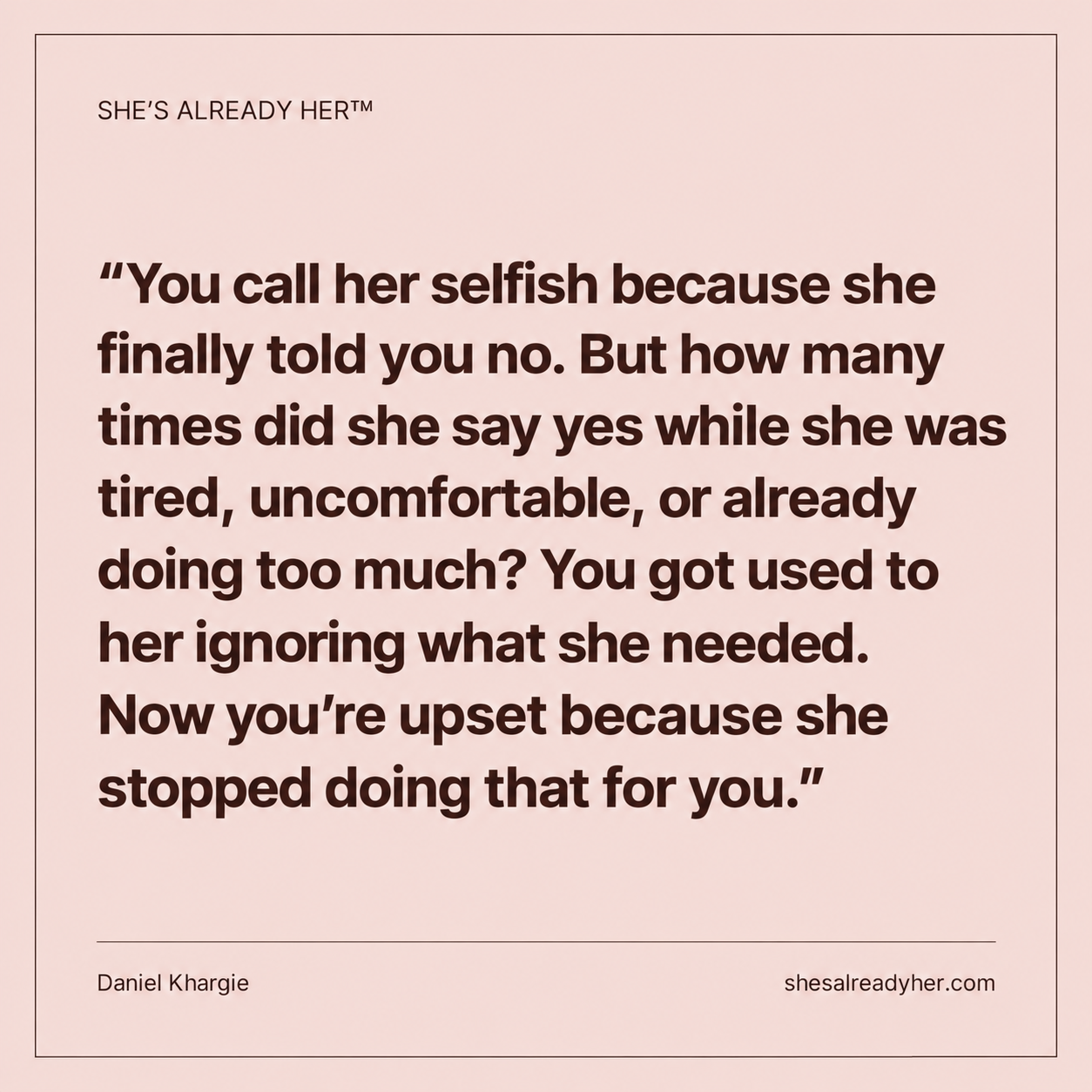
You call her selfish because she finally told you no. But how many times did she say yes while she was tired, uncomfortable, or already doing too much? You got used to her ignoring what she needed. Now you’re upset because she stopped doing that for you.
Look at when your answer changes
You might call it a fear of disappointing others. But with him, look at how often you end up disappointing yourself so you don’t have to deal with his reaction.
What did you want to say before you started thinking about how to keep him happy? That’s the answer I want you to pay attention to. Not because you can never reconsider. Because you keep skipping over it like it doesn’t deserve a place in the decision.
Ask yourself what changed. Did you learn something that genuinely changed your mind? Or did you start worrying that he’d call you selfish, become distant, or keep bringing it up until you gave in?
You don’t need to blame yourself for finding that difficult. If he keeps making an honest answer exhausting, that matters too. You working on your answer doesn’t make his response your responsibility.
You’re allowed to think before agreeing
You don’t have to answer immediately just because he asked immediately. Give yourself a chance to consider what you actually want.
‘I need to think about that before I agree.’
That can be the whole sentence. You don’t need a long explanation for needing a little time. If something needs an answer by a certain time, be clear about when you can respond, then follow through.
Use the pause to check your own answer. Do you want to do this? Can you manage it? Are you agreeing because you want to, or because you’re already trying to prevent him from being unhappy?
And if you already know you don’t want to agree, you don’t need to pretend you’re considering it. The pause is there to make room for you, not to put off an answer you’re allowed to give.
Stop apologizing before you’ve even said what you need
Listen to how much you talk against yourself before making a request. You explain why he’s busy. You explain why your need might not be important. You make the request smaller, then offer to handle it anyway.
Your need hasn’t even had room in the conversation yet.
Try saying the actual thing. ‘That doesn’t work for me.’ ‘I want something different.’ ‘I can’t agree to that.’ Use words you’d actually say. You don’t need to sound like someone else to be clear.
You can explain a decision without apologizing for having a preference. And you don’t have to offer another favor just to make your answer easier for him to accept. Otherwise, you can finish the conversation still agreeing to more than you wanted.
His disappointment doesn’t have to change your answer
Saying no can feel uncomfortable even when you mean it. That doesn’t automatically mean you’ve done something wrong.
Before you take it back, look at the actual decision. Did you overlook a responsibility? Is there something practical you need to address? You can deal with that. But if the only thing that changed is that he doesn’t like the answer, you’re allowed to keep it.
You can say, ‘I understand you wanted a different answer. I’m still not agreeing to that.’ You don’t have to keep adding reasons until you find one he can’t argue with.
And if you feel the urge to send another apology afterward, pause before sending it. Are you correcting something you did wrong, or trying to make the discomfort disappear by offering your answer back? You don’t have to feel completely confident before you let your own decision stand.

Read this quote as text
You say she’s making everything difficult now. She used to keep quiet, change her answer, and apologize just to keep you happy. You weren’t getting along better. She was taking on the discomfort you didn’t want to deal with.
Start with one answer you can safely keep
You don’t need to change every habit at once. Notice one kind of decision where you regularly agree before considering yourself. Start practicing an honest answer there, when it’s safe to do so.
Keep it clear enough that you know what you agreed to. If you can help with one part, don’t say yes to all of it and hope he notices you’re struggling. If you can’t do it, don’t promise it just to get through the conversation.
If the harder part is what to do when a limit keeps being ignored, there’s more on setting boundaries after being hurt. Here, start with giving yourself a real say before the agreement is made.
If you’re afraid he may threaten you, hurt you, or punish you for refusing, get private support before trying a firmer confrontation. You don’t need to put yourself at risk to prove you can keep a no.
Compromise needs your actual opinion in it
You’re allowed to agree to something because it matters to him. The question is whether you felt free to give a different answer.
Could you say what you wanted without being made to regret bringing it up? Did your needs make it into the discussion? Or did you decide it was easier to go along with him before he’d even heard your preference?
If you aren’t comfortable with the agreement, don’t keep calling it fine just because the conversation ended. You can say, ‘I answered too quickly. I need to talk about what I actually agreed to.’ Address anything that now needs rearranging without promising to ignore yourself next time.
You don’t have to get your first choice every time. But your first choice deserves to be heard. Agreeing because you had a real say feels different from agreeing because you didn’t feel able to have one.
You don’t have to earn care by being endlessly available
If being needed has become the way you feel valued, an honest no can bring up more than guilt. You might wonder whether he’ll still want you when you aren’t making everything easy for him.
That’s a painful thing to be carrying. You shouldn’t have to keep proving your value by never needing anything back. You’re in the relationship too. Your preferences aren’t an inconvenience you have to apologize for.
If this keeps turning into you carrying more of the relationship, read about overgiving and what keeps getting left on you. And if you keep feeling you have to prove why he should care, look at feeling like you have to earn love.
You can be generous because you want to be. You don’t owe him unlimited agreement as proof that you’re worth loving.

Read this quote as text
You want her to be the understanding woman she used to be. She understood you so much she kept talking herself out of what she needed. She didn’t stop caring about you. She stopped agreeing that caring about you meant never considering herself.
Pay attention to what he does with your honest answer
You can work on being clearer. He still has to decide how he treats you when you are.
Does he make room for what you said? Can you disagree without spending the rest of the conversation defending whether you care about him? Or does he keep pushing until your answer becomes the one he wanted?
You don’t need to find the perfect wording before you’re allowed to notice that pattern. If he only calls you understanding when you agree, look at what he’s asking that word to mean.
You’ve already spent plenty of time considering him. Before the next automatic yes, let yourself finish the thought about what you need. You can care about his disappointment without making yourself responsible for removing it.
He doesn’t get to call it a good relationship just because you stopped telling him what it was costing you.
Questions you may still be asking
What is a people pleaser?
A people pleaser repeatedly prioritizes approval or avoiding disappointment over expressing an honest preference or need. In a relationship, this can mean agreeing when you want to refuse, saying you’re fine when you aren’t, or changing an answer solely to prevent an unhappy reaction. Being considerate doesn’t automatically make you a people pleaser. The important question is whether your care for him still leaves room for a genuine choice.
What are the signs of people pleasing?
Signs of people pleasing can include agreeing before checking what you want, repeatedly apologizing for ordinary needs, hiding disagreement, and feeling responsible for making a partner happy with every answer. Look at the repeated pattern rather than labeling yourself from one compromise. His pressure, insults, or refusal to accept an answer also deserve attention; they aren’t problems you can solve just by choosing better words.
What causes people pleasing?
There isn’t one explanation that fits every woman. To understand what causes people pleasing in your situation, look at what you expect will happen if you answer honestly. Are you seeking approval, trying to avoid disappointment, or responding to the way your partner treats disagreement? You don’t need to assume a diagnosis or a particular childhood history. Understanding your own habit doesn’t excuse pressure or disrespect from him.
Is being a people pleaser bad?
If you’re asking ‘Is being a people pleaser bad?’, separate being caring from feeling unable to say no. Kindness you freely choose can be part of a good relationship. Repeatedly ignoring your needs because you fear his reaction deserves attention. Recognizing the habit isn’t a reason to shame yourself or take responsibility for his behavior. The aim is to give your needs a real place in your decisions.
How to stop apologizing so much?
Start by distinguishing a real apology from an apology for having a need. If you hurt someone or mishandled a commitment, acknowledge that and address what needs repairing. If you simply expressed a preference or declined something you couldn’t manage, try giving the answer without adding an apology automatically. If your partner pressures you to apologize whenever you disagree, consider that pattern too. Reducing unnecessary apologies doesn’t mean refusing accountability.