
Sis, let me ask you something and I need you to sit with the answer before you move past it.
Have you ever been loved without performing for it?
Not loved because you were useful. Not loved because you were easy. Not loved because you showed up perfectly, asked for nothing, caused no inconvenience, and made yourself so small that loving you required zero effort from the other person. Loved. Period. Without conditions attached. Without a checklist you had to complete before the love felt safe enough to trust.
If you’re struggling to find that experience — if every version of love you’ve ever known came with terms and conditions printed in ink you couldn’t read until after you’d already signed — that’s not because you’re unlovable. It’s because somewhere along the way, you learned that love has a price tag. And you’ve been paying it ever since. With your silence. With your smallness. With the parts of yourself you edit out before presenting the “acceptable” version to whoever you’re hoping will choose you this time.
Feeling not good enough doesn’t start in relationships. It starts long before that — in the moments where love first taught you that it had requirements. That being yourself wasn’t sufficient. That something about you, as you naturally exist, needed adjustment before you qualified for the thing every human being deserves without adjustment.
And now you carry that lesson into everything. Every relationship. Every friendship. Every room you walk into. The quiet, constant calculation running in the background of your life: am I enough for this? Do I qualify? What do I need to change, hide, or perform to keep this love from being revoked?
That’s not insecurity, sis. That’s a wound. And the wound didn’t come from nowhere.
What Conditional Love Actually Feels Like
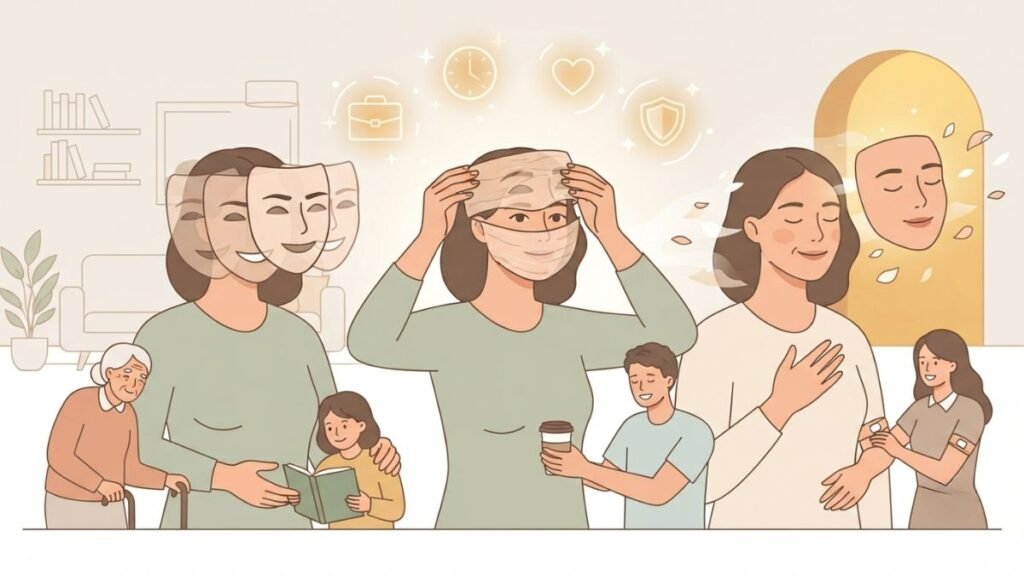
It doesn’t always feel like obvious rejection. Sometimes it feels like love — the kind that’s warm enough to seem real but never quite stable enough to rest inside.
You feel loved when you’re performing but invisible when you’re not. When you’re cooking, cleaning, managing, supporting, solving, soothing — the love flows. When you stop doing and just exist — sitting, resting, needing — the love dims. Not dramatically. Just enough for your body to register the difference. The message lands below language: you’re loved for what you do, not who you are. Feeling not good enough often starts here — in the gap between being valued for function and being valued for presence.
You monitor yourself constantly for signs that you’re “too much.” Too emotional. Too needy. Too opinionated. Too present. You’ve developed an internal surveillance system that scans your own behavior for anything that might exceed the invisible threshold someone set for what’s acceptable. And the monitoring is exhausting — not because you’re naturally high-maintenance, but because you’ve been taught that the unmonitored version of you is the one that gets love withdrawn.
You apologize for existing at full volume. You preface your needs with “sorry.” You soften your opinions before delivering them. You shrink your emotional expression to fit inside the space someone else decided you should occupy. Not because you chose smallness. Because love, in your experience, has always required it.
You feel safest when you’re useful and most anxious when you’re not. The equation is simple and devastating — your worth equals your utility. When you’re helping, you matter. When you’re not, the ground feels less stable. Feeling not good enough ties your value directly to your output — and a woman who only feels secure when she’s producing has never been shown that her presence alone is enough.
Why Love Feels Conditional for You
Your earliest experience of love came with strings attached. This is where the wound started. Not in your last relationship. Not in the dating world. In the first place love existed — your childhood. If a parent’s affection was tied to performance — good grades, good behavior, being quiet, being helpful, being the version of a child that made their life easier — you absorbed a foundational lesson before you had the cognitive capacity to question it. Love is earned. Love is conditional. Love is the thing you receive when you meet the standard and lose when you fall short. Feeling not good enough as an adult is almost always rooted in a childhood where “enough” was defined by someone else and moved every time you got close.
You’ve been in relationships that confirmed the lesson. A parent taught you love has conditions. Then a partner confirmed it. He loved you when you were agreeable and withdrew when you weren’t. He was warm when you performed and cold when you needed. He reinforced the exact framework your childhood installed — that love is something you earn through compliance, not something you receive through existence. Every conditional relationship you’ve experienced wasn’t random. You were drawn to dynamics that felt familiar — not because they were healthy, but because they matched the template you were given. Feeling not good enough in relationships isn’t something you chose. It’s something that was confirmed so many times your brain stopped questioning whether it was true.
You’ve internalized other people’s limitations as your inadequacy. When someone couldn’t love you fully — a parent who was emotionally absent, a partner who was avoidant, a friend who was conditional — you didn’t conclude that they were limited. You concluded that you were lacking. Their inability to show up became your failure to deserve showing up. Their emotional deficit became your unworthiness of emotional investment. Feeling not good enough is often the internalization of someone else’s incapacity. You absorbed their limitation as your identity. And now you walk through the world believing something about yourself that was never about you — it was always about them.
You’ve been measuring yourself against a standard nobody can meet. The “good enough” you’re chasing doesn’t exist as a fixed destination. It moves. Every time you get close — every time you think “maybe this time I’m enough” — the bar shifts. More achievement. More beauty. More compliance. More perfection. The standard is designed to be unreachable — not because you set it that way, but because the environments that installed it needed you perpetually striving. A daughter who’s always trying to be enough is a daughter who never stops performing. A partner who’s always chasing “good enough” is a partner who never stops giving. Feeling not good enough is profitable for the people around you — because a woman who believes she’s insufficient works harder than a woman who knows she’s already whole.
You’ve confused love’s inconsistency with your unworthiness. When love showed up and then disappeared — when a parent was warm one day and absent the next, when a partner was loving one week and cold the following — you didn’t blame the inconsistency. You blamed yourself. “If I were better, the love would stay.” “If I were enough, it wouldn’t fluctuate.” The inconsistency felt like a verdict on your value rather than a reflection of the other person’s instability. Feeling not good enough is often the conclusion a heart draws when it tries to make sense of unpredictable love. The logic goes: if the love doesn’t stay, I must not deserve it staying. But the love’s instability was never about your worth. It was about their capacity.
You’ve been performing for so long you’ve lost access to who you actually are. Underneath the performance — the people-pleasing, the self-editing, the constant adjustment — is a woman you might not fully recognize anymore. The one who existed before the conditions were set. Before she learned what was acceptable and what wasn’t. Before she started measuring every thought, feeling, and behavior against someone else’s standard. Feeling not good enough has buried her — not because she disappeared, but because the performance required to earn love left no room for the woman who deserved it without performing.
You don’t have a reference point for unconditional love. How do you recognize something you’ve never experienced? If every version of love you’ve known came with terms — spoken or unspoken — you have no baseline for what love without terms feels like. So when unconditional love is offered — by a friend, a partner, even by yourself — it feels wrong. Suspicious. Too easy. You don’t trust it because it doesn’t match your template. Feeling not good enough isn’t just about believing you’re insufficient. It’s about lacking the emotional reference point that would show you what sufficiency actually receives.
What Conditional Love Has Done to You
You’ve become a world-class performer in your own life. You perform ease when you’re struggling. You perform strength when you’re breaking. You perform contentment when you’re starving. The performance is so polished that nobody around you knows how exhausted the woman behind it actually is. Because the performance has always worked — it earned you the love you needed. But the cost of sustaining it has been your authenticity. Feeling not good enough turned you into an actress inside your own existence. And the standing ovation you receive for the role doesn’t touch the woman behind the curtain who’s been dying to be seen without the costume.
You attract relationships that confirm the wound. Not by accident. By template. The conditional love you received in childhood became the blueprint your attachment system uses to identify “love” in adulthood. A man who’s consistently warm doesn’t feel like love — he feels unfamiliar. A man whose affection fluctuates based on your performance? That feels like home. Not because it’s healthy. Because it matches the pattern. Feeling not good enough doesn’t just affect how you see yourself. It affects who you choose — and who you let choose you.
You’ve built an identity around earning love instead of receiving it. Your entire relational structure is organized around output. What you give. What you do. How you show up for others. The identity of a woman who earns is deeply embedded — and deeply exhausting. Because earning never ends. There’s no point where you’ve earned enough to rest. No finish line where you stop performing and start just being. Feeling not good enough creates a treadmill where the speed keeps increasing but the destination never arrives.
You carry a quiet grief for the love you never received freely. Beneath the performance, beneath the people-pleasing, beneath the constant striving to be enough — there’s grief. For the childhood version of you who deserved unconditional love and didn’t get it. For the adult version who keeps searching for it in people who can’t provide it. For the woman you might have been if someone had told her — early enough, consistently enough — that she was already everything. That grief doesn’t announce itself. It lives quietly in the background of your life, surfacing in unexpected moments — when you see a mother holding her daughter without conditions, when a friend loves you without asking for anything, when someone sees you and the seeing doesn’t come with a bill attached.
What You Need to Do
Recognize that “not good enough” is a belief, not a fact. It feels like truth. It operates like truth. It’s been confirmed enough times that it has the weight of truth. But it’s not. It’s a conclusion drawn by a child who didn’t have the capacity to evaluate whether the conclusion was accurate. And it was carried into adulthood without being reexamined. Feeling not good enough is a belief system, not an identity. And belief systems can be dismantled — once you stop treating them as permanent features of who you are.
Trace the belief to its origin. Where did you first learn that love had conditions? Whose voice told you — through words or behavior — that you needed to be different to deserve being loved? A parent? A caregiver? A first relationship? Identify the source. Not to blame. To separate. Because the belief that you’re not enough didn’t generate spontaneously. It was installed. And installed beliefs can be uninstalled — once you see who put them there and why.
Stop performing for love and see who stays. This is the test that terrifies and liberates simultaneously. Stop being the easy version of yourself. Stop pre-editing. Stop managing everyone else’s comfort at the expense of your own authenticity. Show up as you are — full volume, full emotion, full humanity — and watch what happens. The people who stay when the performance stops are the people whose love isn’t conditional. The people who leave were only there for the production. Feeling not good enough keeps you performing because performing keeps people around. But the people the performance keeps aren’t the people whose love will heal you.
Start giving yourself the love you’ve been seeking from others. Not as a consolation prize. As the primary source. Talk to yourself the way you’d talk to a friend who told you she wasn’t enough. With compassion. With fierceness. With the protective energy of someone who refuses to let the woman she loves believe a lie about herself. “I am enough as I am. My worth isn’t determined by someone else’s capacity to see it.” Say it until the saying becomes feeling. And the feeling becomes knowing.
Stop accepting conditional love as the best you can get. You’ve been accepting terms because you believed terms were the price of admission. They’re not. Love without conditions exists. Not perfect love — no love is perfect. But love that doesn’t require you to earn it through performance, compliance, or self-erasure. Love that shows up for the unedited version of you and stays. Feeling not good enough lowers your standards to match your self-assessment. Raise them. Not to unrealistic heights — to the baseline of what every human being deserves. Which is love that doesn’t come with a performance review.
Get professional support. A therapist — particularly one experienced in attachment and self-worth — can help you trace the wound to its origin, dismantle the belief system it created, and rebuild a relationship with yourself that isn’t organized around earning the thing you already deserve. Feeling not good enough at this depth isn’t something positive thinking resolves. It requires the kind of sustained, supported work that reaches the places the wound lives.
What You Need to Understand
Feeling not good enough isn’t a personality trait. It’s a wound. One that was created by experiences you didn’t choose and reinforced by relationships you couldn’t have evaluated clearly while you were inside them. The belief that you’re insufficient was installed before you were old enough to question it. And every conditional relationship that followed confirmed it — not because the confirmation was accurate, but because wounded people seek confirmation of their wounds. It’s not a flaw. It’s how human psychology works.
You were always enough. Before the conditions were set. Before the performance was required. Before someone’s limited capacity to love taught you that your unlimited capacity to receive love needed restrictions. The “not enough” was never about you. It was about the people who couldn’t give you what you deserved — and the story your heart wrote to explain why.
The right love doesn’t require conditions. It doesn’t need you to perform. It doesn’t fluctuate based on your utility or withdraw based on your imperfection. It sees you — the real, unedited, full-volume version — and stays. Not because you earned it. Because you exist. And existence is the only qualification real love has ever required.
What You Deserve
You deserve love that doesn’t come with terms. That doesn’t fluctuate based on your performance. That doesn’t require you to be smaller, quieter, easier, or less yourself to sustain.
You deserve to walk into a room — any room, with any person — and know that who you are, right now, without adjustment, is enough. Not almost enough. Not enough if you try harder. Enough. Period.
You deserve to stop earning what should have been given freely, sis. To put down the performance you’ve been carrying since before you can remember. To rest — genuinely, deeply rest — inside the knowledge that you were never insufficient. You were just taught that you were by people who didn’t have the capacity to show you otherwise.
You were always enough. You just needed someone to say it and mean it. So here it is. You’re enough. You always were.
The Bottom Line
You feel like love always comes with conditions because feeling not good enough was installed early — by caregivers whose love was performance-based, by relationships that confirmed the wound, by a culture that profits from women who believe they need to earn what they already deserve. The conditions were never about your worth. They were about other people’s limitations. And you’ve been paying for their limitations with your authenticity, your peace, and your belief in your own value.
Stop paying. Stop performing. Stop accepting conditional love as the best you can get.
The woman underneath the performance — the one you’ve been hiding because you were told she wasn’t enough — she’s the one who deserves to be loved. Not the edited version. Not the performing version. Her. As she is. Without a single condition attached.
And anyone whose love requires conditions wasn’t offering love, sis. They were offering a transaction. And you were always worth more than what they were willing to pay.
FAQ
Q: How do I know if I’m feeling not good enough or if I genuinely need to improve?
Growth is healthy. Feeling fundamentally insufficient is not. The difference is motivation — growth says “I want to develop because I value myself.” Feeling not good enough says “I have to change because I’m not acceptable as I am.” One builds on a foundation of self-worth. The other operates from its absence. If the drive to improve comes from curiosity and self-investment, that’s growth. If it comes from fear that you won’t be loved without the improvement, that’s the wound talking.
Q: Can feeling not good enough be healed?
Yes. The belief that you’re insufficient was learned — which means it can be unlearned. Through therapy focused on attachment and self-worth. Through relationships that model unconditional love. Through the daily practice of challenging the narrative your wound has been running. Healing isn’t instant. But it’s real. And it starts the moment you stop accepting the belief as fact and start treating it as a story that can be rewritten.
Q: Why do I keep choosing partners who make me feel like I’m not enough?
Because your attachment system is drawn to what’s familiar, not what’s healthy. Conditional love feels like “home” because conditional love is what you knew first. The partners who confirm the wound don’t feel like bad choices in the moment — they feel like recognition. Therapy can help you rewire what “home” feels like so that unconditional love becomes recognizable instead of suspicious.
Q: What if I intellectually know I’m enough but don’t feel it?
The gap between knowing and feeling is where the wound lives. Intellectual understanding operates in the conscious mind. The wound operates in the body — in your nervous system, your attachment responses, your automatic self-assessment. Closing the gap requires body-level work — therapy, somatic practices, corrective relational experiences — not just cognitive reframing. The knowing will catch up to the feeling. But the feeling has to be reached where it lives.
Q: How do I stop performing in relationships without losing people?
Some people will leave. The ones whose love was conditional on your performance. That loss is painful — and clarifying. The people who stay when the performance stops are the people whose love is real. And real love — even from fewer people — is worth more than performed love from many. Stop performing. Let the sorting happen. And trust that whoever remains is someone whose presence is actually safe to rest inside.