
Sis, I need to talk to you about whose opinion you trust most.
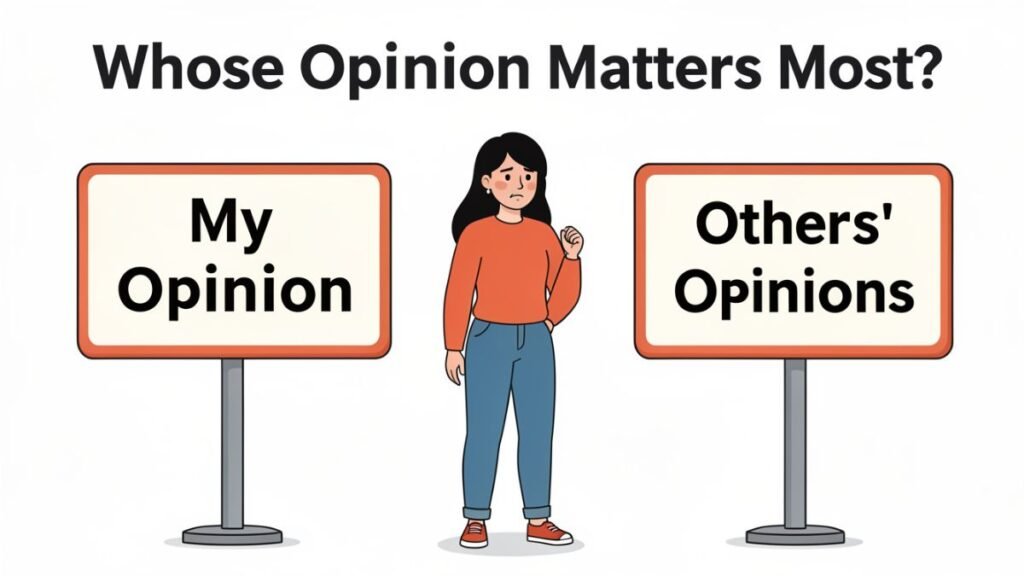
Many people rely on external validation and trust others’ opinions more than their own self-assessment.
You know yourself better than anyone. You know your efforts, your intentions, your struggles, your growth. You know what you’ve overcome, what you’re working on, what you’re proud of.
But when it comes to deciding if you’re good enough, worthy, valuable—your opinion doesn’t count.
You can think you did well, but if someone else criticizes you, you believe them over yourself.
You can feel good about yourself, but if someone disapproves, their opinion overrides your self-assessment.
You can validate yourself internally, but if external validation doesn’t come, you doubt your own evaluation.
External validation matters more to you than your own opinion about yourself.
You’ve given everyone else authority over your worth—and surrendered your own voice in determining your value.

I see how powerless this makes you. How can you not trust yourself? You’re constantly seeking external confirmation because your own assessment doesn’t feel legitimate. You’ve made yourself dependent on others’ validation because you don’t trust your own.
And I see you wondering: “Why doesn’t my own validation feel real? Why do I trust everyone else’s opinion more than my own? How do I start believing in my own assessment of myself?”
Sis, you don’t trust yourself because you were taught not to. And that learned self-distrust is keeping you trapped in a cycle of seeking validation from everyone except the person whose opinion should matter most—you.
Let me help you understand why external validation matters more than your own, and how to reclaim authority over your own worth.
What’s Really Happening: The Self-Distrust Trap
Let me be straight with you: Your opinion about yourself should be the most important one. You know yourself best. You’re the authority on your own experience, effort, and worth.
But you’ve been taught to distrust yourself and defer to external opinions.
And now you’re powerless over your own sense of worth—because you’ve given everyone else the power to define you.
Here’s what’s really going on:
You Were Taught to Distrust Yourself
Think about what you learned growing up:
Maybe:
- Your feelings were invalidated (“You’re not actually upset”)
- Your perceptions were contradicted (“That didn’t happen”)
- Your self-assessment was corrected (“You didn’t do as well as you think”)
- Adults’ opinions overrode yours (“I know better than you”)
- Your internal experience wasn’t trusted
You learned: “I can’t trust my own judgment. Others know better than I do. External validation is more accurate than my self-assessment.”
Now as an adult, you automatically defer to others’ opinions because you were taught yours don’t count.
You Were Gaslighted
If adults consistently:
- Denied your reality
- Made you doubt your perceptions
- Told you your feelings were wrong
- Contradicted your experience
You learned to doubt yourself and trust external reality over internal reality.
You can’t trust your own validation now because you were taught your internal compass is broken.
That’s gaslighting—and it destroyed your ability to trust yourself.
Love Was Conditional on External Approval
Maybe you learned:
- You were loved when others approved of you
- You were valued when you met external standards
- Your worth was determined by others’ assessment
- Your own opinion of yourself didn’t matter—only theirs did
So you learned to:
- Seek external validation constantly
- Distrust your own assessment
- Wait for others to tell you if you’re good enough
External validation became synonymous with worth and love.
You Internalized the Critic
Think about the voice in your head that invalidates you.
That’s not your authentic voice—it’s an internalized critic (usually a parent, teacher, or authority figure who criticized you).
When you try to validate yourself:
- The internalized critic says: “Who do you think you are?”
- It questions your right to feel good about yourself
- It tells you your self-assessment is arrogant or delusional
You’ve internalized the external invalidation—so now you invalidate yourself before anyone else can.
You’re Terrified of Being Delusional
You fear:
- What if I think I’m good but I’m actually not?
- What if my self-assessment is inflated?
- What if I’m deluding myself?
- What if everyone else is right and I’m wrong?
So you don’t trust your own validation—you need external confirmation to prove you’re not delusional.
But this fear is often just internalized shame telling you you’re not allowed to think well of yourself.
You Seek Objectivity Outside Yourself
You believe:
- I’m too close to myself to assess accurately
- I’m biased in my own favor
- External observers are more objective
- Others can see me more clearly than I can see myself
So you trust their assessment over yours.
But external observers are also biased:
- By their own issues and projections
- By limited information about you
- By their relationship to you
- By their own agendas
They’re not more objective—they’re just external.
You’re Avoiding Responsibility for Your Worth
If your worth comes from external validation:
- You’re not responsible for creating or maintaining it
- You can blame others when you don’t feel worthy
- You don’t have to do the hard work of building self-worth
If your worth comes from internal validation:
- You’re responsible for believing in yourself
- You can’t blame others for your lack of worth
- You have to do the work of self-validation
Trusting external validation more is easier than taking responsibility for validating yourself.
You’ve Never Practiced Self-Validation
You might not even know how to validate yourself:
- What does internal validation feel like?
- How do you self-validate?
- What does it sound like to trust your own assessment?
You’ve spent your whole life seeking external validation—you’ve never developed the muscle of self-validation.
External validation matters more because you don’t know how to generate internal validation.
Why This Pattern Is Destroying You
You’re powerless over your own worth. Whether you feel valuable depends entirely on external opinions you can’t control.
You can never feel secure. External validation is unstable—opinions change, people leave, approval disappears. You’re always vulnerable.
You’re exhausting yourself. Constantly seeking external validation while ignoring your own is mentally and emotionally draining.
You can’t trust yourself. You doubt your own perceptions, feelings, and assessments because you’ve learned they’re not legitimate.
You’re performing instead of being. You’re trying to be what will get external validation rather than being yourself.
You attract people who know you need their validation. People who withhold approval have power over you.
You can’t make good decisions. If you don’t trust your own judgment, you can’t make choices confidently.
You’ve abandoned yourself. You’ve given everyone else authority over you—except yourself.
You’re trapped. You’re imprisoned by a need for external validation that can never create stable, lasting worth.
What You Need to Do
Step 1: Recognize You’ve Been Taught Self-Distrust
Say this out loud:
“I don’t trust my own validation because I was taught not to. But that teaching was wrong. I am the authority on my own worth. My opinion about myself matters most.”
Acknowledge the programming so you can start to undo it.
Step 2: Identify Where You Learned to Distrust Yourself
Reflect on:
- Who taught you not to trust yourself?
- When were your perceptions invalidated?
- How did you learn that external validation matters more?
- What messages did you receive about your own judgment?
Understanding the origin helps you see it’s learned, not inherent truth.
Step 3: Practice Self-Validation Daily
Build the self-validation muscle:
Daily:
- Acknowledge something you did well
- Validate your effort (not just outcome)
- Tell yourself you’re enough
- Appreciate something about yourself
Do this even when it feels fake or uncomfortable.
You’re retraining yourself to value your own opinion.
Step 4: Challenge External Validation
When you get external validation or criticism:
Ask:
- Does this match my own assessment?
- Do I agree with this evaluation?
- Is this person’s opinion more valid than mine?
- What do I think about myself, independent of this feedback?
Start questioning whether external validation should override your internal assessment.
Step 5: Notice When You Discount Yourself
Catch yourself doing this:
You: “I think I did well.”
Them: “It was okay.”
You immediately: “Oh, I guess it wasn’t that good.”
Notice when you automatically trust their assessment over yours.
Then practice: “I still think I did well, even if they don’t.”
Step 6: Experiment With Trusting Yourself
Make small decisions based on your own judgment:
- Trust your assessment of how you feel
- Trust your evaluation of your effort
- Trust your opinion about yourself
See what happens when you believe yourself instead of waiting for external confirmation.
Step 7: Talk Back to the Internalized Critic
When the internal voice says, “Who do you think you are to feel good about yourself?”
Respond: “I’m someone worthy of my own validation. I’m allowed to feel good about myself. My opinion matters.”
Challenge the internalized invalidation.
Step 8: Work on Core Self-Trust
- Healing from gaslighting
- Building self-trust
- Learning to validate yourself
- Understanding why you learned to distrust yourself
This is deep work that benefits from professional support.
What You Need to Understand
Your Opinion Should Matter Most
You are the authority on:
- Your experience
- Your effort
- Your intentions
- Your worth
Other people can have opinions—but your opinion about yourself should matter most because you know yourself best.
External Validation Is Unreliable
External validation:
- Changes based on others’ moods
- Is influenced by others’ issues
- Can be withheld manipulatively
- Disappears when people leave
- Is often based on incomplete information
Internal validation:
- Is stable
- Is based on complete information (you know everything about yourself)
- Can’t be withheld by others
- Stays with you always
Internal validation is more reliable—but you have to trust it.
Self-Validation Isn’t Arrogance
You might fear that validating yourself is:
- Arrogant
- Delusional
- Self-centered
But self-validation is:
- Healthy
- Necessary
- Acknowledging your own worth
- Self-respect
Arrogance is demanding that others validate you without deserving it. Self-validation is acknowledging your own value.
You Can Trust Yourself
The lie you were taught: “You can’t trust your own judgment.”
The truth: “You’re the most qualified person to assess yourself. Your internal experience is valid. Your self-assessment matters.”
You can trust yourself—but you have to practice doing it.
What You Deserve
You deserve to trust your own validation.
You deserve to be the primary authority on your own worth.
You deserve to value your opinion about yourself over others’ opinions.
You deserve freedom from dependence on external validation.
That freedom is possible. But it requires reclaiming authority over your own worth.
The Bottom Line
Sis, validation from others matters more than your own because:
- You were taught to distrust yourself
- You were gaslighted into doubting your perceptions
- Love was conditional on external approval
- You’ve internalized the criticism
- You’re avoiding responsibility for your own worth
But you are the authority on yourself. Your validation matters most.
Practice self-validation. Challenge external authority. Trust yourself.
Choose yourself, sis. Your opinion about yourself matters most.
FAQ
Q: How do I know if my self-assessment is accurate or if I’m being delusional?
Check with trusted people occasionally, but notice: if you consistently doubt yourself while everyone says you’re fine, you’re probably not delusional—you’re just conditioned to distrust yourself.
Q: What if my self-validation contradicts everyone’s external feedback?
Consider the feedback, but remember: you know your effort, intentions, and context better than they do. Your internal assessment matters. Don’t automatically defer to external opinion.
Q: Is it healthy to ignore external feedback completely?
No—feedback can be useful. But it should inform your self-assessment, not override it. Integrate useful feedback while maintaining primary authority over your self-worth.
Q: How do I start trusting my own validation when it feels so unfamiliar?
Start small. Validate yourself in low-stakes areas. Build the muscle gradually. It will feel fake at first—do it anyway. Trust builds through practice.
Q: What if I validate myself but still crave external validation?
That’s normal during the transition. Keep practicing self-validation while acknowledging the craving. Over time, external validation becomes nice-to-have instead of necessary.