
Sis, let me describe something you’ve probably stopped expecting to change.
You’re overwhelmed. Not mildly stressed. Not having a bad afternoon. Overwhelmed — the kind that sits on your chest, blurs your thoughts, and makes the simplest tasks feel impossible. Work is crushing you. Family is draining you. Life is piling up faster than you can process. And you need the one thing that every overwhelmed person needs from the person they love — to feel understood.
Not fixed. Not lectured. Not told to “just relax” or “stop stressing.” Understood. Seen in the struggle. Met with the kind of “I feel you” energy that doesn’t solve anything but somehow makes everything more bearable because at least you’re not carrying it alone.
So you turn to him. And what you get is — nothing.
Not cruelty. Not dismissal in the obvious sense. Just blankness. A man who looks at you in your most overwhelmed state and responds like you just told him the weather forecast. No emotional resonance. No visible recognition that the woman he loves is struggling. No shift in his energy, his attention, his priorities that would indicate he’s registered the weight you’re carrying.
He might say words. “That sucks.” “I’m sorry you’re going through that.” “You’ll figure it out.” But the words arrive without temperature. Without the warmth that would indicate they traveled through his heart before reaching his mouth. They’re technically appropriate and completely empty. Like a greeting card he didn’t write. Signed with his name. Delivered without his soul.
That’s an empathy deficit in relationships. And it’s not one conversation or one bad day. It’s a pattern — a consistent, predictable inability to feel what you feel when you’re at your most transparent about needing him to feel it.
What an Empathy Deficit Looks Like
It doesn’t always look like a man who doesn’t care. Sometimes it looks like a man who’s trying — and failing in a way that makes the trying feel worse than the absence.
He hears you but doesn’t feel you. You describe your overwhelm in detail. He listens. He nods. He may even reflect back what you said. But the reflection is cognitive, not emotional. He processes your pain as information rather than experience. He understands that you’re overwhelmed the way he understands that traffic is bad — as a fact that exists outside of him, noted and categorized, but not felt. An empathy deficit in relationships doesn’t always mean a man who ignores your pain. Sometimes it means a man who acknowledges it without ever being touched by it.
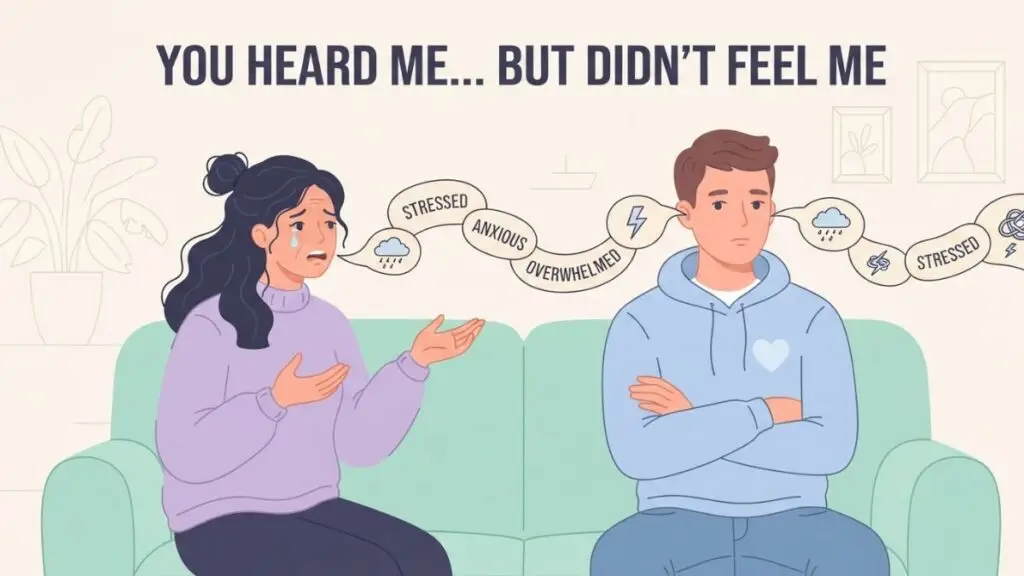
He jumps to solutions when you need presence. “Have you tried making a list?” “Maybe you should talk to your boss.” “Just prioritize what matters and let the rest go.” He’s in fix-it mode before you’ve finished your second sentence. And while problem-solving has its place, deploying it during the moment you need to feel heard is its own form of absence. The solution isn’t what you asked for. You asked to be met. To be felt. To have someone sit in the heaviness with you instead of immediately trying to engineer the heaviness away. His solutions aren’t empathy. They’re escape routes — paths away from the emotional content he doesn’t want to sit in.
He compares your overwhelm to his own or to something “worse.” “I had a hard day too.” “At least you’re not dealing with what my coworker is going through.” “Everyone is stressed right now — it’s not just you.” The comparison doesn’t comfort. It diminishes. It takes your specific, personal experience of overwhelm and drowns it in context designed to make it seem unremarkable. An empathy deficit in relationships often shows up through comparison — the subtle suggestion that what you’re feeling isn’t special enough to warrant the empathy you’re asking for.
He seems annoyed by your emotional state rather than moved by it. You’re overwhelmed and his response carries a tinge of irritation. Not at what’s overwhelming you — at the fact that you’re overwhelmed. The heavy energy you’re bringing into the room disrupts his comfort. Your struggle isn’t registering as something he should help you with. It’s registering as something he has to endure. And the annoyance — however subtle — communicates something your overwhelmed heart absorbs immediately: your pain is his inconvenience.
Why He Can’t Feel What You Feel
He was never taught to attune to another person’s emotional state. Empathy isn’t automatic. It’s developed — through childhood experiences of having your emotions mirrored, validated, and met by caregivers who demonstrated what attuning to someone else’s pain looks like. If he grew up in a household where emotional attunement was absent — where nobody modeled what it looks like to feel with someone rather than at them — he didn’t develop the neural pathways that empathy requires. An empathy deficit in relationships is often a developmental gap, not a personality choice. He’s not choosing to be unempathetic. He’s operating without the software that empathy runs on. But a grown man who’s been shown that his lack of empathy is hurting the woman he loves and won’t pursue the therapeutic work that could develop it has moved from gap to choice.
Your overwhelm activates his shutdown response, not his connection response. When you’re overwhelmed, the emotional temperature in the room rises. For a man with healthy empathy, that rising temperature activates attunement — he moves toward you, not away. But for a man with limited emotional capacity, the rising temperature activates something else entirely — self-protection. His system reads your overwhelm as a demand it can’t meet. An emotional wave it can’t survive. So it shuts down. The blankness you see isn’t indifference. It’s his nervous system going offline to protect itself from an emotional experience it wasn’t built to process. An empathy deficit in relationships that stems from shutdown isn’t a lack of caring. It’s a lack of capacity. But the result for you is identical — you’re drowning and the man on shore isn’t coming in.
He processes life cognitively, not emotionally. Some men live almost entirely in their heads. They think about things. They analyze. They evaluate. But they don’t feel into them. When you share your overwhelm, he runs it through his cognitive system — categorizing, problem-solving, comparing — because that’s the only processing system he has. The emotional system that would allow him to feel your pain alongside you is either underdeveloped or deliberately suppressed. An empathy deficit in relationships with a cognitive processor isn’t about the man being cold. It’s about the man running all of life’s inputs through the wrong operating system. Your pain needs an emotional response. He can only produce a cognitive one. And the gap between what you need and what he can deliver is the gap your loneliness lives in.
Your pain triggers his own buried pain and he can’t access either. When you’re overwhelmed, something inside him stirs — not empathy exactly, but recognition. Your pain touches his pain. Your struggle resonates with his own buried struggles. And instead of that resonance producing connection — the “I feel you because I’ve felt something like that too” response — it produces retreat. Because accessing your pain would mean accessing his. And his pain has been buried, avoided, and suppressed for so long that touching it feels lethal. An empathy deficit in relationships is sometimes a man who can’t feel your pain because feeling yours would unlock his own. And his own has been sealed shut since long before you arrived.
He doesn’t see emotional presence as part of his role. In his framework of partnership, he provides. He protects — physically, financially, practically. He shows up for logistics. He handles problems that have solutions. But sitting with someone in their feelings? Holding space for emotions that don’t have a fix? Being present to pain without an action item attached? That’s not in his job description. Not because it shouldn’t be. Because nobody ever told him it should be. An empathy deficit in relationships driven by role confusion isn’t intentional cruelty. It’s a man operating from a definition of partnership that’s missing its most essential component. He thinks he’s showing up. He genuinely believes he’s doing his part. But his definition of “showing up” doesn’t include the one thing you need most — emotional presence during your hardest moments.
He’s emotionally exhausted and empathy requires energy he doesn’t have. Empathy isn’t passive. It requires active engagement — listening, processing, attuning, responding. And a man who’s emotionally depleted — from work, from stress, from his own unprocessed struggles, from a lifetime of running on empty — may genuinely lack the energy empathy demands. He’s not withholding it. He’s depleted of it. An empathy deficit in relationships that stems from exhaustion is a capacity issue, not a character issue. But the woman on the receiving end — the one who’s overwhelmed and being met with nothing — doesn’t experience the distinction between “he can’t” and “he won’t.” Both produce the same result: she’s alone with her pain inside a relationship that’s supposed to mean she doesn’t have to be.
He learned that emotions are problems to be solved, not experiences to be shared. If his upbringing treated emotions as obstacles rather than information — things to be overcome, suppressed, fixed, or avoided — he internalized that framework. Your overwhelm isn’t something to sit with. It’s something to solve. And when his solutions are rejected — when you say “I don’t want you to fix it, I want you to feel it with me” — he’s genuinely confused. Because in his framework, feeling things together isn’t a thing. Feelings are problems. Problems get solved. And if the problem can’t be solved right now, then the conversation serves no purpose. An empathy deficit in relationships built on this framework isn’t malicious. It’s a fundamental misunderstanding of what emotional partnership requires.
What His Empathy Deficit Is Doing to You
You’ve stopped sharing when you’re overwhelmed. Not because the overwhelm stopped. Because sharing it with him made it worse. His blankness. His solutions. His comparisons. His subtle annoyance at your emotional state. All of it added weight to something already heavy. Reaching for him and finding nothing was more painful than carrying the weight alone. So you stopped reaching. And now your overwhelm lives in silence — unshared, unprocessed, unseen by the one person whose seeing would have made the difference.
You feel fundamentally unseen by the person closest to you. Other people get it. Your friends feel it when you’re struggling. Your family picks up on your energy. Even coworkers sometimes notice. But him? The man who shares your bed, your home, your daily life? He looks at you in your most transparent moment and sees nothing worth responding to. That experience — being invisible to the person who knows you most — does damage that goes far deeper than any individual moment of unmet empathy. It changes how you see yourself. A woman who isn’t felt by the person closest to her starts wondering whether she’s someone worth feeling for.
You’ve become your own emotional support system. Processing alone. Soothing alone. Managing overwhelm alone. Not because you prefer solitude — because the partnership that should be supplementing your internal resources has been running empty for so long you’ve stopped checking for fuel. You’ve built an emotional life that functions entirely without his participation. And the independence you’ve developed isn’t strength born from choice. It’s resilience born from neglect.
You carry resentment that’s hardening by the day. Every moment of overwhelm that he didn’t meet. Every cry that he didn’t feel. Every reach that he didn’t reciprocate. It’s all accumulating into something heavier than the original pain — a resentment toward a man who could have shown up and chose — or defaulted to — not showing up. The resentment isn’t dramatic. It’s quiet. It’s the kind that changes how you look at him across the dinner table. The kind that slowly replaces warmth with something colder. Something permanent. Something that becomes very difficult to reverse once it’s set.
What You Need to Do
Name what you need specifically. Don’t assume he knows. He probably doesn’t. “I don’t need you to fix this. I need you to sit with me in it. I need to feel like you understand how heavy this is for me right now. I need your presence, not your solutions.” Be explicit. An empathy deficit in relationships sometimes persists because the man genuinely doesn’t understand what’s being asked for. If naming it specifically and he still can’t deliver — that’s the information you need.
Stop accepting cognitive responses as emotional engagement. “That sucks” isn’t empathy. Problem-solving isn’t presence. Comparison isn’t validation. Stop letting his cognitive responses fill the space where emotional engagement should be. When he offers solutions instead of empathy, redirect: “I hear the suggestion. But what I actually need right now is for you to tell me you feel what I’m going through. Can you do that?” His response tells you everything.
Stop carrying everything alone inside the relationship. Every time you process your overwhelm without inviting him into it, you’re adapting to his deficit. Stop adapting. Let the overwhelm be visible. Let the need be stated. Let his inability to meet it sit in the room without you rushing to manage it yourself. His deficit becomes undeniable when you stop covering for it.
Seek empathy from people who provide it. Friends who feel what you feel without being asked. A therapist who sits in your experience without solving it. Family members who hold you without trying to fix you. You need those connections right now — not as replacements for the relationship, but as reminders that empathy exists. That being felt is possible. That the deficit you’re experiencing at home isn’t the standard for human connection.
Require professional help. An empathy deficit in relationships at this level isn’t something that resolves through better communication. It requires therapy — specifically work focused on emotional attunement, attachment, and the developmental gaps that created the deficit. If he’s willing to pursue that, the deficit can improve. If he’s not, the pattern continues indefinitely. And your continued tolerance of it doesn’t inspire his growth. It confirms that growth isn’t necessary.
Decide what your life looks like without his empathy. Project forward. Five years. Ten. Twenty. Every overwhelmed moment met with blankness. Every hard day processed alone. Every crisis survived without his emotional partnership. Can you sustain that? Is that the life you’re choosing? Not the life you’re enduring — the life you’re actively choosing. Because staying is a choice. And choosing it consciously is different from defaulting into it because leaving feels harder than staying lonely.
What You Need to Understand
An empathy deficit in relationships isn’t about you being too needy. It’s about him being too empty. Your need to be felt during overwhelm isn’t excessive. It’s foundational. It’s the thing partnerships are built for — so that no one has to carry everything alone. His inability to provide it isn’t a reflection of your worth. It’s a reflection of his development. And development he refuses to pursue becomes a limitation he’s choosing to impose on you.
You can’t feel your way into someone else’s empathy. Your vulnerability doesn’t create his capacity. Your tears don’t unlock his attunement. Your overwhelm doesn’t teach him how to sit with discomfort. Either he develops empathy through the internal work that builds it — or it remains absent. And absent empathy inside an intimate relationship creates one of the most specific and painful forms of loneliness that exists.
The right man feels what you feel. Not identically. Not perfectly. But genuinely. He sits in your overwhelm without trying to escape it. He holds the weight with you because watching you carry it alone is something he can’t tolerate. He doesn’t need you to be more articulate or less emotional or better at explaining your pain. He just feels it — because that’s what love does when it’s connected to someone who matters.
What You Deserve
You deserve a man who feels it when you’re struggling. Who doesn’t need you to explain your overwhelm in perfect language because he already senses it. Who walks into the room and says “something’s wrong — talk to me” before you’ve said a word.
You deserve empathy that arrives without being asked for. Presence that shows up without being demanded. A partner whose emotional attunement is so dialed in that your overwhelm activates his care, not his absence.
You deserve to be felt, sis. Deeply. Consistently. By a man whose emotional presence during your hardest moments isn’t something you have to beg for — it’s something he gives because withholding it was never an option.
The Bottom Line
He lacks empathy when you’re overwhelmed because an empathy deficit in relationships reflects a developmental gap he never filled, because your emotional pain activates his shutdown instead of his connection, because he processes life cognitively while you need him to process it emotionally, and because his model of partnership doesn’t include the thing you need most — someone who feels it with you.
Stop carrying alone. Stop adapting around his absence. Stop accepting a partnership where the most human thing you can ask for — to be felt — is the one thing that’s consistently missing.
Your overwhelm is real, sis. Your need to be met in it is valid. And a man who watches you drown from shore without getting wet isn’t a man standing beside you. He’s a man watching from a distance he chose.
FAQ
Q: Can someone with an empathy deficit learn to be more empathetic?
Yes — empathy is a skill that can be developed through therapy, mindfulness practices, and intentional relational work. But the person has to recognize the deficit and want to address it. A man who dismisses his lack of empathy as “just how I am” isn’t positioned for growth. Growth requires acknowledging the gap.
Q: Is an empathy deficit the same as narcissism?
Not necessarily. Narcissistic personality disorder includes a persistent lack of empathy as a core feature, but empathy deficits can also result from emotional neglect, alexithymia, autism spectrum traits, depression, or simply never having developed emotional attunement skills. The label matters less than the impact — and the impact on you is the same regardless of the cause.
Q: What if he shows empathy toward others but not toward me?
Selective empathy is particularly painful and revealing. If he can attune to friends, family, or strangers but not to you, the deficit isn’t about capacity. It’s about priority. He has the skill. He’s choosing not to deploy it in your direction. That selective deployment tells you exactly where you rank in his emotional hierarchy.
Q: How do I stop feeling like my emotional needs are too much?
Recognize that the “too much” label was installed by a man who provides too little. Your needs aren’t excessive. His provision is deficient. Surround yourself with people who meet your emotional needs naturally — their response will recalibrate your sense of what’s reasonable. A therapist can also help untangle the self-doubt his deficit has created.
Q: What if he’s empathetic during crises but not during everyday overwhelm?
Crisis empathy without daily empathy suggests he can mobilize for emergencies but hasn’t integrated emotional attunement into his everyday functioning. Emergency empathy is reactive. Daily empathy is relational. A man who only shows up during disasters but is absent during the daily weight of life isn’t a partner — he’s a first responder. And you need a partner.