
Sis, let me describe a dynamic you’ve probably stopped questioning because it’s been running so long it feels like just how things work.
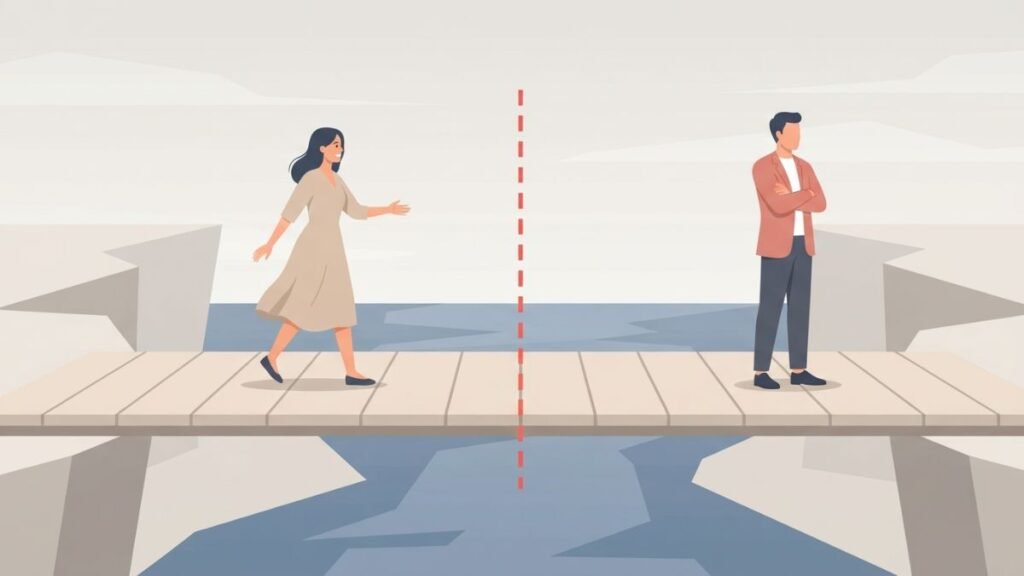
You compromise. Regularly. Willingly. Not because you’re weak — because you understand that two people sharing a life can’t both get everything they want all the time. So you bend. You adjust. You find the middle ground. You give a little here so the relationship can gain something there. You do the thing healthy adults do when they love someone — you meet them halfway.
And he doesn’t meet you back.
Not halfway. Not a quarter of the way. Not any measurable distance from where he started. He holds his position like a man defending a hill — not because the hill matters, but because moving from it would mean admitting he can be moved. And in his mind, being moved is the same as being defeated.
You suggest a compromise. He hears a concession. You offer to meet in the middle. He interprets it as you asking him to lose. You present a solution that honors both perspectives. He receives it as a challenge to his authority. And every time — without exception — the negotiation ends one of two ways: you give in completely or the conversation goes nowhere.
That’s not a man who can’t compromise. That’s a man who won’t. Because compromise in relationships, to him, isn’t a tool for building something together. It’s a threat to something he’s protecting — his ego, his control, his rigid sense of self that can’t survive the flexibility that partnership requires.
What Refusal to Compromise Looks Like
It doesn’t always look like a dramatic standoff. Sometimes it’s so embedded in the relationship’s operating system that you’ve stopped noticing how consistently you’re the only one who bends.
He frames your compromises as his victories. When you give ground, he doesn’t acknowledge the sacrifice. He receives it as confirmation that his position was right all along. “See? That wasn’t so hard.” “I knew you’d come around.” Your flexibility isn’t received as generosity. It’s received as surrender. And the framing ensures that every compromise you make reinforces a dynamic where his rigidity gets rewarded and your flexibility gets exploited.
He treats your requests for middle ground as unreasonable. You suggest splitting a decision — he sees it as you not supporting him fully. You propose alternating whose preference gets priority — he sees it as you trying to control the arrangement. You offer a solution that gives both people something — he sees it as you taking something from him. Compromise in relationships requires both people to view mutual concession as healthy. He views it as defeat. And anything that looks like defeat gets resisted with the full force of his ego.
He only “compromises” when the stakes don’t matter. He’ll let you pick the restaurant. He’ll agree to your choice of movie. He’ll bend on trivial decisions that don’t touch his sense of control. But on anything significant — finances, lifestyle, parenting approaches, family dynamics, how the relationship operates — his position is granite. The small concessions are strategic. They create the appearance of a man who compromises while maintaining absolute control over everything that actually matters.
He uses your willingness to compromise against you. Because you’re the flexible one, he’s learned that patience wins. If he holds firm long enough, you’ll eventually bend. His rigidity doesn’t need to be aggressive. It just needs to outlast your resistance. And it always does — because you’ve been conditioned to believe that someone has to give and it might as well be you. Compromise in relationships has been reduced to a one-player game. You play. He waits for the result. And the result is always the same.
Why He Sees Compromise as Weakness

His identity is built on never yielding. For a man whose self-concept depends on strength, control, and unwavering certainty, compromise feels like structural failure. Bending — even slightly, even when it’s the healthiest response — registers as crumbling. He’s constructed an identity around being unmovable. And unmovable men don’t meet people halfway. They hold their ground. They stand firm. They win. Compromise in relationships would require him to loosen a grip his entire sense of self depends on maintaining. And loosening that grip doesn’t feel like flexibility to him. It feels like falling apart.
He conflates compromise with submission. In his framework, relationships have a power structure. Someone leads. Someone follows. And compromise disrupts that structure by introducing equality — the idea that both people’s needs carry the same weight. For a man who needs to lead, equality feels like demotion. Meeting you halfway means standing on the same level. And standing on the same level means he’s not above you anymore. Compromise in relationships requires mutual respect. His framework requires hierarchy. And those two things can’t coexist in the same dynamic.
He was taught that flexibility is weakness. If he grew up in an environment where bending was mocked — where a father who compromised was seen as “whipped,” where cultural messages equated masculinity with immovability, where the adults around him treated concession as something to be avoided rather than practiced — he internalized rigidity as strength. Not dysfunction. Strength. He’s not choosing inflexibility because he’s evaluated all options and determined it’s the best approach. He’s choosing it because it’s the only model of strength he was given. And any model that includes bending feels like a downgrade from the one he was taught.
Compromise requires empathy and his empathy has limits. Genuine compromise demands the ability to see the other person’s perspective — to understand that their needs, their preferences, their comfort matter as much as yours. It requires holding two viewpoints simultaneously and finding a space where both can coexist. That’s an empathic skill. And if his empathy is limited — if he can only fully access his own perspective, if your viewpoint registers as an obstacle rather than an equal input — then compromise doesn’t feel like collaboration. It feels like capitulation. Because in his single-perspective system, there’s only one valid position. And adjusting it to accommodate yours means abandoning something he believes is right in favor of something he believes is wrong.
He experienced compromise as loss in his past. If previous relationships taught him that compromise led to being taken advantage of — if he gave an inch and someone took a mile, if flexibility was exploited rather than reciprocated — his nervous system coded compromise as dangerous. Not collaborative. Dangerous. So now he refuses it preemptively. Not because your request is unreasonable. Because his body remembers what happened the last time he bent — and bending again feels like opening a wound he’s been protecting. Understanding this origin doesn’t mean accepting its impact. A man whose past made compromise feel unsafe has a reason. But he also has a responsibility — to heal the wound rather than force you to live around it indefinitely.
Winning feels better than connecting. Compromise produces connection. Winning produces satisfaction. And for a man whose emotional reward system is wired for conquest rather than closeness, the satisfaction of holding his position outweighs the connection that bending would create. He’d rather win the argument than deepen the relationship. He’d rather maintain his stance than strengthen the partnership. Compromise in relationships produces something subtle — mutual respect, collaborative energy, shared investment. Winning produces something immediate — the dopamine hit of being right, of holding firm, of not giving in. And he consistently chooses the hit over the investment.
Your flexibility has taught him that his rigidity works. This is the feedback loop that sustains the entire dynamic. Every time you compromised alone — every time you gave in because fighting was too exhausting, every time you bent because he refused to — the system got reinforced. He learned that holding firm produces your concession. That rigidity is rewarded with compliance. That compromise in relationships is something you do, not something he needs to. Your flexibility, offered in good faith, has been absorbed into a structure that exploits it. And the structure will continue operating as designed until one of its components changes.
What His Refusal to Compromise Is Doing to You
You’ve become the only person who adjusts. In every disagreement, every decision, every difference of preference — you’re the one who moves. Not because your position was weaker. Because his refusal to move made your movement the only option. And after enough rounds of being the sole adjuster, the adjustment stops feeling like compromise. It starts feeling like erasure. Your preferences. Your needs. Your perspective. All of it systematically displaced by a man whose position never shifts regardless of the situation.
You feel like your needs don’t carry weight. When every negotiation ends with his preference winning and yours being abandoned, the message is consistent — what he wants matters more than what you want. And that message, absorbed over months and years, rewrites your internal sense of value. You stop expecting your preferences to be honored because they never have been. You stop advocating for your needs because advocacy has proven futile. You stop believing your perspective has merit because his has overridden it so consistently that yours feels irrelevant by comparison.
You’ve lost the ability to distinguish between genuine agreement and conditioned compliance. When he says “what do you want to do?” and you say “whatever you want” — is that genuine preference or learned surrender? You can’t tell anymore. Because compromise in relationships has been so one-sided for so long that your authentic preferences have been buried under years of automatic concession. You don’t know what you actually want in many situations because what you want has been irrelevant for so long it stopped forming.
Resentment is building in the exact places where compromise should have lived. Every decision that went his way without your input. Every preference you abandoned because fighting was too expensive. Every moment where meeting in the middle would have strengthened the relationship but his refusal forced you to cross the entire distance alone. All of it accumulates. And accumulated resentment from years of one-sided compromise doesn’t look like anger. It looks like withdrawal. Emotional distance. The quiet decline of warmth toward a man who’s taken everything while giving nothing.
What You Need to Do
Stop being the only one who bends. The next time a decision arises that requires compromise, state your position and hold it. Not aggressively. Not as a power play. As a simple exercise in equality. “This is what I want. I’d like us to find a middle ground.” If he refuses to move, don’t fill the gap by moving yourself. Let the stalemate exist. His discomfort with the stalemate will reveal whether he’s capable of bending or committed to your bending for both of you.
Name the pattern. “I’ve noticed that I’m always the one who compromises. Every disagreement ends with my preference being set aside and yours being honored. That’s not partnership — it’s a one-way system. And I need it to change.” Say it plainly. Not during a fight. During a calm moment where the observation can land without the heat of a specific disagreement clouding it.
Stop accepting small concessions as evidence of flexibility. He lets you pick the restaurant and calls it compromise. Don’t accept that framing. Compromise in relationships means meeting in the middle on things that matter — finances, lifestyle, decisions about the future, the emotional fabric of the partnership. Flexibility on trivia while maintaining rigidity on substance isn’t compromise. It’s performance. And the performance has been convincing you that he bends when he doesn’t.
Reconnect with your own preferences. Start identifying what you actually want — independent of what he’d prefer, independent of what would avoid conflict, independent of the automatic concession your conditioning produces. Journal your preferences. Notice which ones you abandon before they’re fully formed. Rebuild the muscle of wanting things for yourself. That muscle has atrophied not because you stopped wanting. Because wanting became a luxury the dynamic couldn’t afford.
Set a standard for mutual compromise. “Going forward, I need us to take turns. When we disagree, sometimes your preference wins and sometimes mine does. And on important decisions, we find the middle together. Anything else isn’t sustainable.” This isn’t a demand for control. It’s a demand for balance. And his response to the demand tells you whether balance is something he’s willing to participate in or something he’ll resist because it threatens the arrangement he prefers.
Evaluate whether partnership is possible without mutual flexibility. Can two people build a life together when only one of them bends? Can intimacy survive when one person’s needs consistently override the other’s? Can love grow in a dynamic where compromise is treated as defeat? The answer to all three is no. Compromise in relationships isn’t optional. It’s structural. Without it, the relationship is a dictatorship with shared furniture. And you deserve more than a vote that never counts.
What You Need to Understand
Compromise in relationships isn’t weakness. It’s the mechanism that allows two different people with two different perspectives to build one shared life without one person being erased in the process. Every healthy relationship runs on it. Every functional partnership depends on it. It’s not losing. It’s investing. And a man who can’t see the difference between losing and investing doesn’t understand what partnership requires.
His rigidity isn’t strength. It’s fragility disguised as strength. A truly strong man can bend. Can hear another perspective and let it shift his position. Can hold his view loosely enough that new information — including the needs of the woman he loves — changes it. Strength is flexibility under pressure. Rigidity under pressure is just brittleness waiting to break. And a man too brittle to bend is a man too brittle to build with.
You’ve been carrying the flexibility for two people. And the weight of that has been collapsing something inside you — your preferences, your voice, your sense of what you’re worth inside your own relationship. You didn’t lose those things by accident. They were compressed by a dynamic where one person’s immovability required the other person’s constant displacement.
What You Deserve
You deserve a man who meets you in the middle. Who can hold his perspective without requiring you to abandon yours. Who views compromise as collaboration rather than capitulation. Who understands that bending toward you isn’t losing himself — it’s building something with you.
You deserve mutual flexibility. A dynamic where both people adjust. Both people give. Both people receive. Where your preferences carry the same weight as his and the middle ground is where you meet, together, equally.
You deserve to stop being the only one who bends, sis. Because a relationship where only one person flexes isn’t flexible. It’s broken in a way that only looks stable because you’ve been holding the pieces together alone.
The Bottom Line
He sees compromise as weakness because his identity depends on never yielding, because he conflates flexibility with submission, because winning feels better than connecting, because empathy limitations prevent him from honoring your perspective equally, and because your consistent bending has confirmed that his rigidity works.
Stop bending alone. Start requiring mutual movement. Name the imbalance. Reconnect with your own preferences. And if partnership without mutual compromise isn’t possible with this man, accept that truth before another year of one-sided concession erases any more of who you are.
Compromise isn’t defeat, sis. It’s the thing that makes love livable. And a man who can’t do it isn’t protecting his strength. He’s revealing his limitation.
FAQ
Q: What if he says he does compromise but I don’t see it?
Ask for specifics. “When did you last compromise on something that mattered to you?” If his examples are trivial — restaurant choices, movie picks — while every significant decision went his way, the compromise is cosmetic. Real flexibility shows up where it costs something. If it only shows up where it’s free, it’s not compromise. It’s strategy.
Q: Is refusing to compromise always a bad thing?
Some things shouldn’t be compromised — core values, safety, fundamental needs. But within the everyday negotiations of a shared life — schedules, finances, social plans, household decisions — an inability to find middle ground isn’t principled. It’s rigid. The distinction is whether he’s protecting a genuine value or just protecting his preference from having to share space with yours.
Q: Can a man who refuses to compromise learn to?
With genuine self-awareness and therapeutic work focused on flexibility, ego, and relational skills — yes. But learning to compromise requires accepting that his current approach is damaging. Most men who refuse to compromise view their behavior as strength rather than dysfunction. Until that perception shifts, compromise will continue to be something only you provide.
Q: What if I’ve stopped knowing what I want because I always defer?
That’s a common consequence of years of one-sided compromise. Start rebuilding by making small daily decisions purely for yourself. What you eat. What you watch. How you spend a free hour. Let your preferences form without his influence. Over time, the practice restores the connection to your own desires that his rigidity suppressed.
Q: What if compromise feels like I’m giving up on getting what I need?
Healthy compromise doesn’t mean abandoning your needs. It means both people adjusting to create a solution that honors both. If “compromise” in your relationship consistently means your needs being entirely abandoned while his are fully met — that’s not compromise. That’s compliance. And compliance wearing the label of compromise is the most common disguise one-sided dynamics use.