
Sis, let me tell you something about the boundary you set that he just called “dramatic.”
It wasn’t dramatic. It was necessary. And the fact that he treated it like an overreaction tells you more about him than it does about the boundary.
You said “I’m not okay with that.” You said “I need this to stop.” You said “this is a line I need you to respect.” You said it calmly. Clearly. Without hostility. Without ultimatums. Just a woman defining what she will and won’t accept in her own life — which is literally the most basic act of self-respect a human being can exercise.
And his response? “You’re overreacting.” “You’re being too much.” “Why do you always have to make things a big deal?” “It’s not that serious.” “You’re so dramatic.”
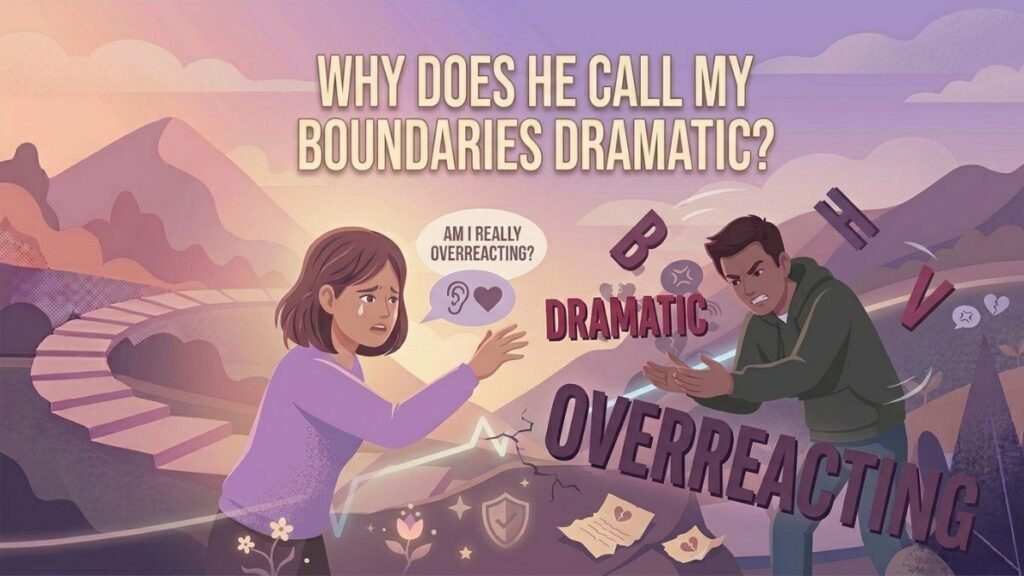
One sentence from him and suddenly the boundary you gathered courage to set feels ridiculous. Suddenly you’re the problem — not for tolerating something unhealthy, but for deciding not to tolerate it anymore. He didn’t just dismiss your boundary. He made you feel ashamed for having one.
And that shame is doing exactly what it’s designed to do — making you retract. Lower the standard. Accept what you just said was unacceptable. Because his comfort matters more than your limits. Because boundaries in relationships, according to him, are only valid when they’re convenient for the person being bounded.
They’re not. Boundaries aren’t about his convenience. They’re about your survival. And a man who treats your limits as problems to eliminate rather than lines to respect has shown you exactly where you rank in his priorities.
What Boundary Dismissal Looks Like
It doesn’t always sound like “you’re overreacting.” Sometimes it’s more subtle — woven into responses that sound reasonable enough to make you question whether you were being unreasonable.
He reframes your boundary as control. You say “I’m not comfortable with you texting your ex” and he says “you’re being controlling.” Now the conversation isn’t about a boundary you set. It’s about a character flaw he assigned you. Your limit got repackaged as your dysfunction — and suddenly you’re defending your right to have standards instead of him addressing the behavior that required them.
He compares you to someone who wouldn’t have this boundary. “My ex never cared about stuff like this.” “Other women wouldn’t make a big deal out of this.” “You’re the only person who has a problem with it.” He invokes a fictional standard — a woman with zero limits who accepts everything — and uses her as evidence that your boundaries are abnormal. That woman doesn’t exist. But she’s incredibly useful as a weapon against the woman who does.
He agrees to the boundary and then violates it anyway. He says “okay, fine” with a tone that communicates he thinks you’re being ridiculous. And then nothing changes. The behavior continues. The line you drew gets stepped over like it was never there. He treated your boundary like a suggestion and your enforcement of it like an inconvenience. Boundaries in relationships that get agreed to verbally and violated behaviorally aren’t being respected. They’re being managed — just enough acknowledgment to quiet you, zero follow-through to honor you.
He punishes you for setting it. After you establish a boundary, his energy shifts. Cold. Distant. Resentful. He doesn’t yell about the boundary. He just makes you pay for it with his mood. And over time, you learn that setting boundaries comes with emotional consequences — not because boundaries are wrong, but because he’s decided that your limits are an offense against his freedom.
Why He Dismisses Your Boundaries
Your boundaries require him to change and he doesn’t want to. Every boundary you set draws a line around a behavior he’s been getting away with. Your limit isn’t just a standard — it’s an interruption to his comfort. He’s been operating freely in the space your boundary now occupies. And adjusting to your limit means adjusting his behavior, which means effort he doesn’t want to invest. Dismissing boundaries in relationships is the laziest response to accountability. Instead of doing the work of respecting your limit, he does the much easier work of making you feel unreasonable for having one.
He views your boundaries as threats to his control. In a relationship where one person has been operating without limits, boundaries feel like a power shift. Before your boundary, he moved freely. After it, he has a constraint. And for a man who equates freedom with control, any constraint — even a healthy one — feels like a loss of power. He doesn’t dismiss your boundary because it’s unreasonable. He dismisses it because it redirects power back to you. Boundaries in relationships are inherently equalizing. They say “my needs matter as much as yours.” And for a man who’s been operating as though his needs matter more, equality feels like oppression.
He was never taught to respect other people’s limits. If he grew up in an environment where boundaries were nonexistent — where parents didn’t have them, where personal space wasn’t honored, where saying “no” was either punished or ignored — he genuinely might not understand what a boundary is. In his programming, there are no lines. People just accommodate. Adjust. Give. And anyone who draws a line is being difficult rather than healthy. He’s not consciously choosing to disrespect your boundaries. He’s operating from a model that doesn’t include them. But a grown man who’s been shown that his partner has limits and continues violating them has moved beyond ignorance into choice.
Calling your boundary an overreaction shuts down the conversation instantly. This is the tactical function that makes dismissal so effective. The moment he labels your boundary as dramatic or excessive, the conversation shifts entirely. You’re no longer establishing a limit. You’re defending your right to have one. You’re explaining why the boundary is reasonable. You’re proving that you’re not overreacting. And while you’re doing all of that, the boundary itself never gets addressed. He never has to respond to the actual limit you set — because he redirected the entire conversation to your character instead. Boundaries in relationships can’t survive when the person they’re applied to is allowed to litigate their validity every time they’re established.
Your boundaries expose his behavior and he can’t tolerate that exposure. When you say “I’m not okay with this,” you’re implicitly naming a behavior as problematic. And that naming threatens his self-image. If your boundary is valid, his behavior is a problem. If his behavior is a problem, he’s the problem. And his ego can’t survive being the problem. So he attacks the boundary instead. Makes it the issue. Makes you the issue. Anything to avoid sitting with the implication that what he’s been doing required you to build a wall against it.
He benefits from you having no limits. A woman without boundaries is a woman who accepts everything. She tolerates disrespect. She absorbs mistreatment. She adjusts to whatever he gives her without complaint. And that’s the most convenient version of you he can have. Your boundary disrupts that convenience. It introduces a standard he has to meet. An expectation he has to navigate. A limit he has to work within. Dismissing boundaries in relationships is how he tries to return you to the version of yourself that made his life easiest — the limitless one. The one who accepted whatever he offered and called it enough.
He interprets your boundaries through the lens of rejection. When you set a limit, he doesn’t hear “I need this for my wellbeing.” He hears “you’re not good enough.” Your boundary feels like rejection — not of a behavior, but of him as a person. And his response to that perceived rejection is to attack the source. If he can make your boundary seem unreasonable, it’s not really a rejection. It’s your overreaction. And that reframe protects him from the painful feeling that the woman he’s with has needs his current behavior can’t meet.
What His Boundary Dismissal Is Doing to You
You’ve stopped setting boundaries. Not because you stopped needing them. Because the cost of setting them became higher than the cost of living without them. Every time you drew a line and he dismissed it, mocked it, violated it, or punished you for it — a part of you died a little. The part that believed your limits mattered. The part that trusted your own judgment about what’s acceptable. That part has gone quiet. And the woman who remains doesn’t set boundaries because she’s learned they won’t be respected anyway.
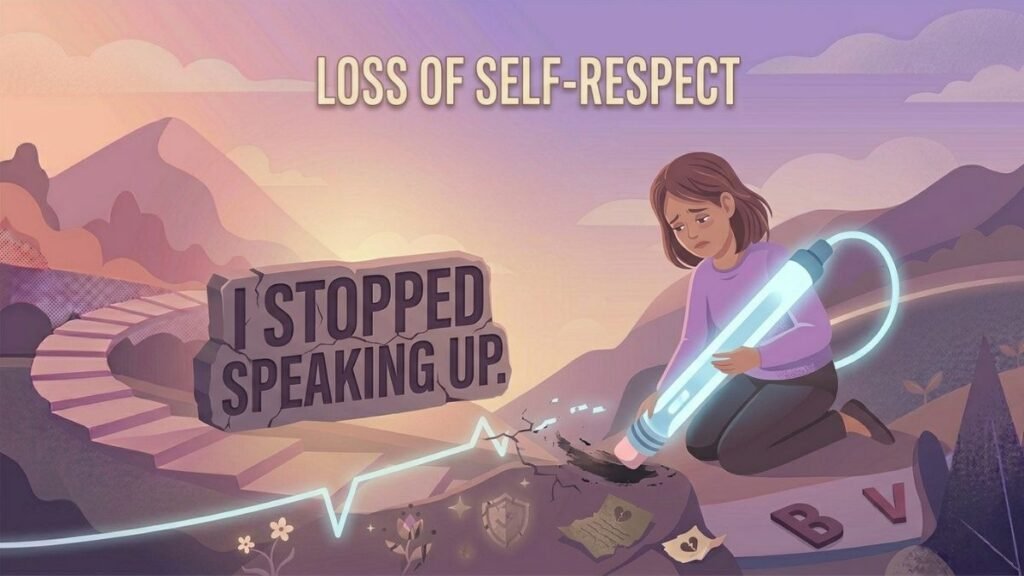
You feel guilty for having standards. His consistent message — that your limits are excessive, that you’re being dramatic, that normal women don’t have these kinds of expectations — has landed deep enough that you genuinely question whether your standards are reasonable. You feel guilty for wanting basic respect. Ashamed of having non-negotiables. Embarrassed by the fact that you need limits at all. And that guilt was manufactured by a man who benefits from you having none.
You’ve become a version of yourself you don’t recognize. The woman who used to know what she would and wouldn’t accept has been replaced by a woman who accepts everything. Who tolerates things she never would have tolerated before. Who makes excuses for behavior she once would have walked away from. His dismissal of your boundaries didn’t just affect the relationship. It reshaped who you are. And the reshape happened so gradually you didn’t notice until you couldn’t find the woman you used to be.
Your resentment is building silently. Every violated boundary. Every dismissed limit. Every “you’re overreacting” that made you put the standard down and walk away feeling small. All of it accumulates. And resentment that can’t be expressed — because expressing it would just get dismissed again — doesn’t dissolve. It calcifies. It changes how you see him. How you feel about the relationship. How much of yourself you’re willing to invest in a man who doesn’t respect the lines you draw.
What You Need to Do
Set the boundary anyway. Even if he dismisses it. Even if he calls it dramatic. Even if his reaction makes you feel unreasonable. Set it. Because boundaries in relationships aren’t requests for someone else’s approval. They’re declarations of what you will and won’t accept. His agreement isn’t required. His respect is — but if he won’t give it, his agreement still isn’t the point. The boundary is for you. Set it and hold it regardless of his response.
Stop defending the boundary after you’ve stated it. This is where he gets you every time. You set the boundary. He challenges it. And then you spend thirty minutes defending your right to have it — proving it’s reasonable, explaining why it matters, justifying your own limits to a man who’s already decided they’re invalid. Stop. State the boundary. If he dismisses it, don’t argue. “This is my limit. It doesn’t require your approval.” End of conversation. His dismissal doesn’t invalidate what you’ve established. It just reveals his character.
Watch his behavior, not his words. If he agrees to the boundary but violates it repeatedly, his words are meaningless. Boundaries in relationships are only as real as the behavior that follows them. If the behavior doesn’t change, the boundary hasn’t been respected — regardless of what he said in the moment.
Stop accepting “overreaction” as a valid response. It’s not a response to your boundary. It’s a dismissal of it. And dismissal isn’t engagement. The next time he calls your limit an overreaction, don’t absorb the label. “My boundary isn’t an overreaction. It’s a requirement. And calling it an overreaction doesn’t make it go away.” Let that sit.
Enforce consequences without warning. You’ve warned enough. You’ve explained enough. You’ve given enough chances. At some point, the boundary has to mean something beyond words — and that meaning comes from what happens when it’s violated. Not punishment. Consequences. The natural outcome of crossing a line someone drew with intention. What those consequences look like depends on your situation. But they have to exist. Because boundaries without consequences are just suggestions. And suggestions don’t protect you.
Get professional support. A therapist can help you rebuild the boundary-setting muscle that his dismissal has weakened, reconnect you with the self-trust his mockery has eroded, and support you in holding limits that he’s spent the relationship trying to tear down.
What You Need to Understand
Boundaries in relationships aren’t overreactions. They’re self-preservation. They’re the lines that define where you end and someone else begins. They’re the difference between a relationship that respects you and one that consumes you. Any man who treats your boundaries as problems to eliminate is a man who needs access to parts of you that healthy limits would protect.
A man who respects you respects your boundaries — even when they’re inconvenient for him. Especially when they’re inconvenient for him. Because respecting a boundary that costs him nothing is easy. Respecting one that requires him to change behavior, adjust expectations, or sacrifice convenience — that’s where real respect lives. And if he only “respects” the boundaries that don’t affect him, he doesn’t respect boundaries at all. He respects convenience.
Your limits aren’t excessive just because he says they are. His assessment of your boundaries is filtered through one lens — how they affect his freedom. That’s not an objective evaluation. That’s a self-interested complaint dressed as relationship advice. Stop accepting his inconvenience as evidence of your unreasonableness.
You’re allowed to have limits. Full stop. Not limits he approves of. Not limits that don’t bother him. Not limits that adjust based on his comfort. Your limits. Non-negotiable, self-determined, rooted in your own sense of what’s acceptable. That’s not dramatic. That’s human.
What You Deserve
You deserve a man who hears your boundary and says “I hear you — I’ll respect that.” Not perfectly every time. But genuinely. A man who treats your limits as information about how to love you better, not obstacles to overcome or overreactions to dismiss.
You deserve to set a limit without bracing for punishment. To draw a line without having to defend its existence. To say “this isn’t okay with me” and have that sentence be enough — without the follow-up argument about whether it’s reasonable.
You deserve boundaries that are honored, sis. Not tolerated. Not challenged. Not mocked. Honored. By a man who understands that your limits aren’t an attack on his freedom — they’re the foundation of your self-respect.
The Bottom Line
He dismisses your boundaries because they require change he won’t invest in, because your limits redirect power back to you, because calling them overreactions shuts down the conversation before accountability arrives, and because a woman without boundaries is the most convenient version of you for him.
Stop apologizing for having standards. Stop defending limits that don’t require defense. Stop accepting a relationship where the most basic act of self-respect gets treated like a character flaw.
Your boundaries aren’t the problem, sis. His resistance to them is. And that resistance tells you everything about what kind of man he is and what kind of relationship he’s capable of.
FAQ
Q: How do I know if my boundaries are reasonable?
Ask yourself: would a healthy, loving partner consider this limit unreasonable? If the answer is no — if most people would respect the boundary without conflict — it’s reasonable. Also check with trusted friends or a therapist. If everyone outside the relationship validates your boundary and only he challenges it, the distortion is his, not yours.
Q: What if he says my boundaries are controlling?
Boundaries and control are opposites. Control dictates what someone else does. Boundaries define what you will accept. Saying “I’m not okay with this” isn’t telling him what to do — it’s telling him what you’ll tolerate. If he frames your self-respect as control, he’s revealed that he needs unrestricted access to you to feel comfortable. That’s his problem, not your flaw.
Q: Can a boundary-dismissive man learn to respect limits?
With genuine self-awareness, therapeutic work, and sustained effort — yes. But he has to see boundary dismissal as a problem first. Most men who dismiss boundaries don’t think they’re doing anything wrong — they think the woman having boundaries is doing something wrong. If that perception doesn’t shift, respect won’t follow.
Q: What if he respects some boundaries but not others?
Selective respect is still disrespect. If he honors the boundaries that don’t cost him anything but dismisses the ones that require actual change, he’s not respecting your limits. He’s tolerating the easy ones and fighting the ones that matter. Real respect doesn’t cherry-pick which limits to honor.
Q: What if I feel guilty every time I set a boundary?
That guilt was installed by a dynamic that punished your self-respect. Boundaries shouldn’t produce guilt in the person setting them. If they do, it’s because someone — him, or patterns that predate him — taught you that having limits is selfish. It’s not. A therapist can help you untangle the guilt from the boundary and reconnect you with the truth that self-respect is not something to apologize for.