

You’re allowed to bring up a problem in your relationship without being treated like you created it by speaking. Healthy conflict in relationships leaves room for a concern to be heard, even when the conversation is uncomfortable. You don’t have to pretend everything is fine just because he’d rather not talk about what happened.
Maybe you need to discuss a broken agreement. Maybe a decision affected you and you weren’t included. Maybe something keeps happening after you’ve already explained why it matters. Calling the discussion drama doesn’t tell you whether the concern is fair. It just gives you something else to defend.
And that can wear you down. You start asking yourself whether saying anything is worth it. The issue is still there, but now bringing it up feels like another thing you’ll be blamed for.
You can look at the actual problem without accepting that any disagreement makes you difficult. You can also look honestly at your own part. Neither of those things requires dropping every concern that makes him uncomfortable.
Bringing up the problem isn’t the same as causing it
There’s a difference between something happening and somebody finally talking about it. If he agreed to tell you about a change that affected your plans, the conversation about being left waiting didn’t create the broken agreement. It brought it into the open.
That doesn’t mean your first understanding is always the complete story. He may have information you didn’t have. You may remember an agreement differently. You might realize you expected something you never actually discussed. Those are things a real conversation can help you sort out.
But you can’t sort them out if the whole subject gets thrown away as drama. There’s no explanation to consider, no misunderstanding to clear up, and no honest disagreement to think about. You’re just being told that mentioning it was the problem.
You don’t need to prove that every concern is serious enough to upset everybody else. What matters is what happened, how it affected you, what you understood, and what you’re asking for now. Those details deserve more attention than a label about the kind of woman you are.
What a useful disagreement makes room for
If you’re asking what is healthy conflict, start with whether both people can actually discuss the issue. Can you say what bothered you? Can he explain his view? Can either of you ask a question or correct a detail without the whole discussion being treated as an attack?
A useful disagreement doesn’t have to be pleasant. He might be disappointed by what you say. You might not like his answer. You can both need time to think. Healthy conflict gives you a chance to understand the difference between you instead of requiring one person to pretend it isn’t there.
For example, you may want more time together than he wants to commit. Talking about that isn’t automatically an accusation. He can be honest about what he can offer, and you can be honest about whether that works for you. Neither person has to invent agreement to keep the conversation comfortable.
You also don’t have to call every disagreement healthy just because something important is being discussed. Threats, insults, intimidation, and pressure don’t become acceptable ways to get an answer. The subject can matter while the way someone is behaving still needs to stop.

Read this quote as text
You call every concern drama, then wonder why she barely tells you anything. She’s tired of having to defend her right to speak before you’ll even discuss what happened.
Look at the concern before you judge yourself for having it
When he says it’s nothing, it can help to get clear with yourself about what “it” actually is. A specific action is easier to consider than a whole argument about whether you complain too much.
Was an agreement broken? Were you affected by a choice you weren’t told about? Is this a preference you haven’t explained yet? Are you asking for consideration, or asking him to agree to something he hasn’t agreed to? You don’t need a perfect answer immediately. You need enough honesty to see the issue clearly.
Something can matter to you without making him automatically wrong. You might be hurt by a difference that neither of you caused on purpose. You might need to change an arrangement together. Or you might be dealing with conduct he has already agreed to stop. Those situations need different answers.
His label doesn’t settle which situation you’re in. And being upset doesn’t settle it either. You’re allowed to examine the facts while still expecting to be spoken to with respect. You don’t have to decide that your concern was ridiculous just because he refused to discuss it.
Disagreeing with you should still sound like an answer
He doesn’t have to share every conclusion you reach. But there’s a difference between disagreeing with your point and dismissing the fact that you have one.
He can explain that he understood the plan differently. He can say a request doesn’t work for him. He can acknowledge the effect of his choice while giving you information you didn’t know. You may still disagree afterward, but at least you have something real to consider.
Calling you dramatic doesn’t do that. Neither does announcing that relationships should be easy whenever you bring up something inconvenient. You still don’t know what he thinks about the actual concern or whether there’s any willingness to work through it.
Respectful communication includes making room for an answer you don’t like. It also includes being willing to give an answer instead of putting the whole topic off-limits. You’re not asking for automatic agreement when you ask to talk about something that affects you.
Not arguing doesn’t always mean the problem is settled
There are times when letting something go is your honest choice. You get more information, decide it doesn’t matter as much as you first thought, or choose to accept a difference. You don’t have to turn every disappointment into a long discussion.
That’s different from dropping it because every attempt to talk gets shut down. The room might be quiet afterward, but the agreement is still unclear. The same issue may still affect your next week, your trust in a plan, or a decision you need to make.
Avoiding conflict can make a moment easier without making the underlying problem smaller. You’re allowed to notice the difference. An unresolved conflict doesn’t become resolved just because you stopped asking about it.
You don’t have to keep pushing until he admits that. You can recognize that a conversation hasn’t happened and decide what that means for you. Silence tells you that the discussion stopped. It doesn’t tell you that the two of you reached an understanding.
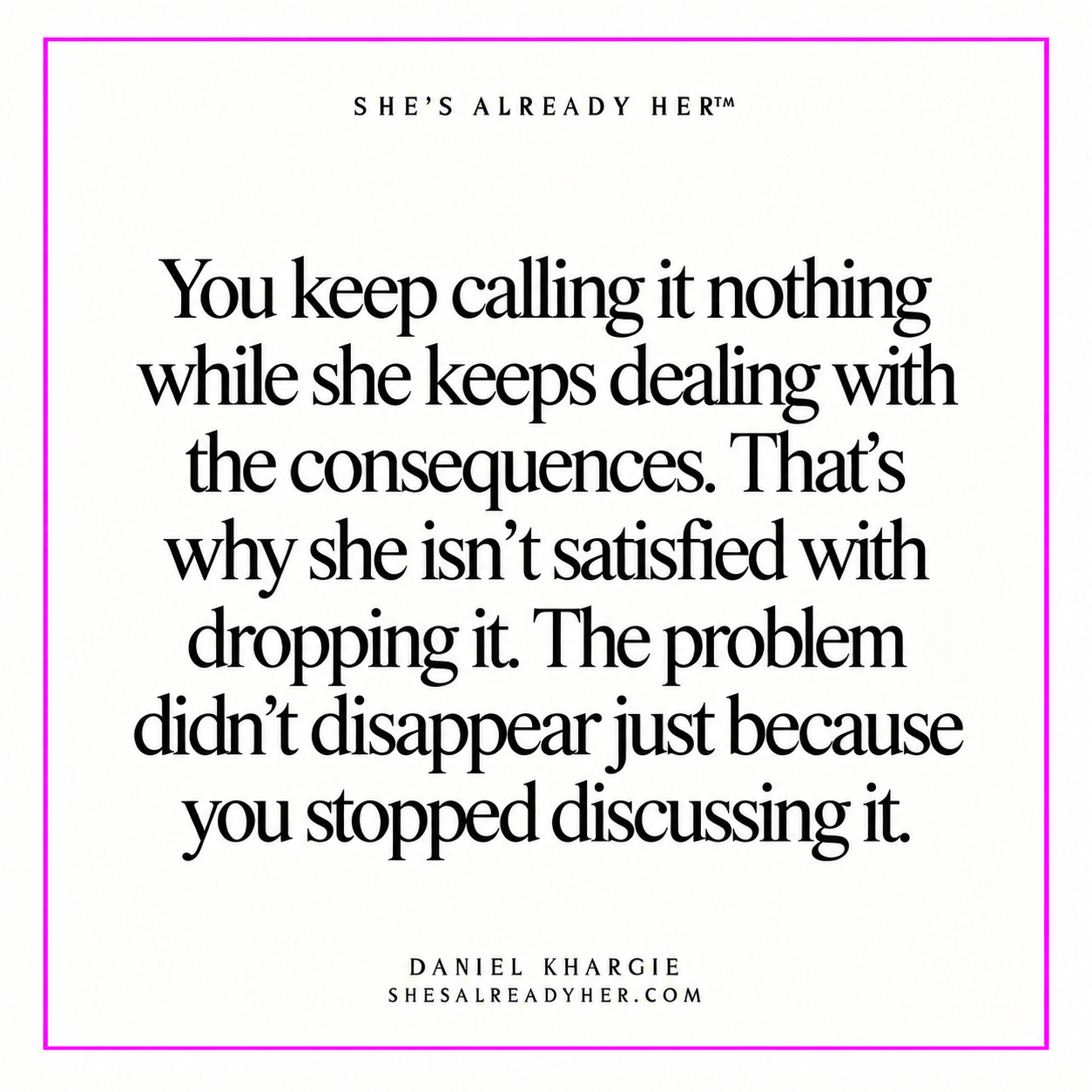
Read this quote as text
You keep calling it nothing while she keeps dealing with the consequences. That’s why she isn’t satisfied with dropping it. The problem didn’t disappear just because you stopped discussing it.
Choosing another time is different from refusing the subject
Nobody can have every difficult conversation at any moment. Someone may be working, exhausted, driving, or unable to give the discussion proper attention. A request to talk later can be reasonable.
If you’re wondering what is conflict avoidance, look at whether the issue ever gets a place in the relationship. Does choosing another time lead to an actual conversation? Or does later keep moving until you’re expected to forget why you asked?
You don’t need a formal meeting for every concern. But there should be some workable way to bring up an issue without being told that the issue itself is unnecessary trouble. Being unavailable right now and being unwilling to discuss it at all are different things.
You can respect a reasonable delay without pretending the matter is finished. And he can need a break without calling you difficult for remembering that there’s still something to discuss. Both people’s time and attention matter. So does the concern waiting for an answer.
You can own your part without agreeing the whole issue is drama
You may realize that you made an accusation before checking a fact. You may have interrupted, exaggerated, or brought in something unrelated. Owning that is part of having an honest conversation. It doesn’t require pretending you never had a concern worth discussing.
You can correct the detail you got wrong and look again at what remains. Sometimes that changes the whole issue. Sometimes it changes one part while another part still needs attention. You don’t have to know which before you’re allowed to listen and think.
The same applies to him. Acknowledging that something affected you doesn’t mean he has agreed with every claim you’ve made. There’s room for both people to take responsibility for what they actually did without turning the discussion into a contest over who is entirely right.
If the conversation keeps becoming a judgment of your tone or emotion, read about your reaction becoming the problem. Here, the question is more basic: is there room to raise a concern at all, or does any disagreement get dismissed before it can be considered?
Notice what happens after you’ve made the concern clear
You can spend a lot of energy trying to make a concern impossible to dismiss. You explain it another way. You make it shorter. You leave out details. You hope that if you find the right words, he’ll finally agree it’s worth talking about.
Clear words can help someone who wants to understand. They can’t supply that willingness for him. Once the issue is clear enough to discuss, you’re allowed to notice whether he participates instead of treating every failed conversation as proof you explained it badly.
Does he answer a question? Offer his side? Admit a part he needs to own? Tell you honestly what he will and won’t agree to? Or does the discussion keep ending with the same label and no attention to the issue?
One difficult exchange doesn’t tell you everything about a relationship. But a repeated refusal gives you information about what is available right now. You can think about the arrangement you’re in, the choices you have, and the support you need. You don’t owe an endless argument to prove you care.
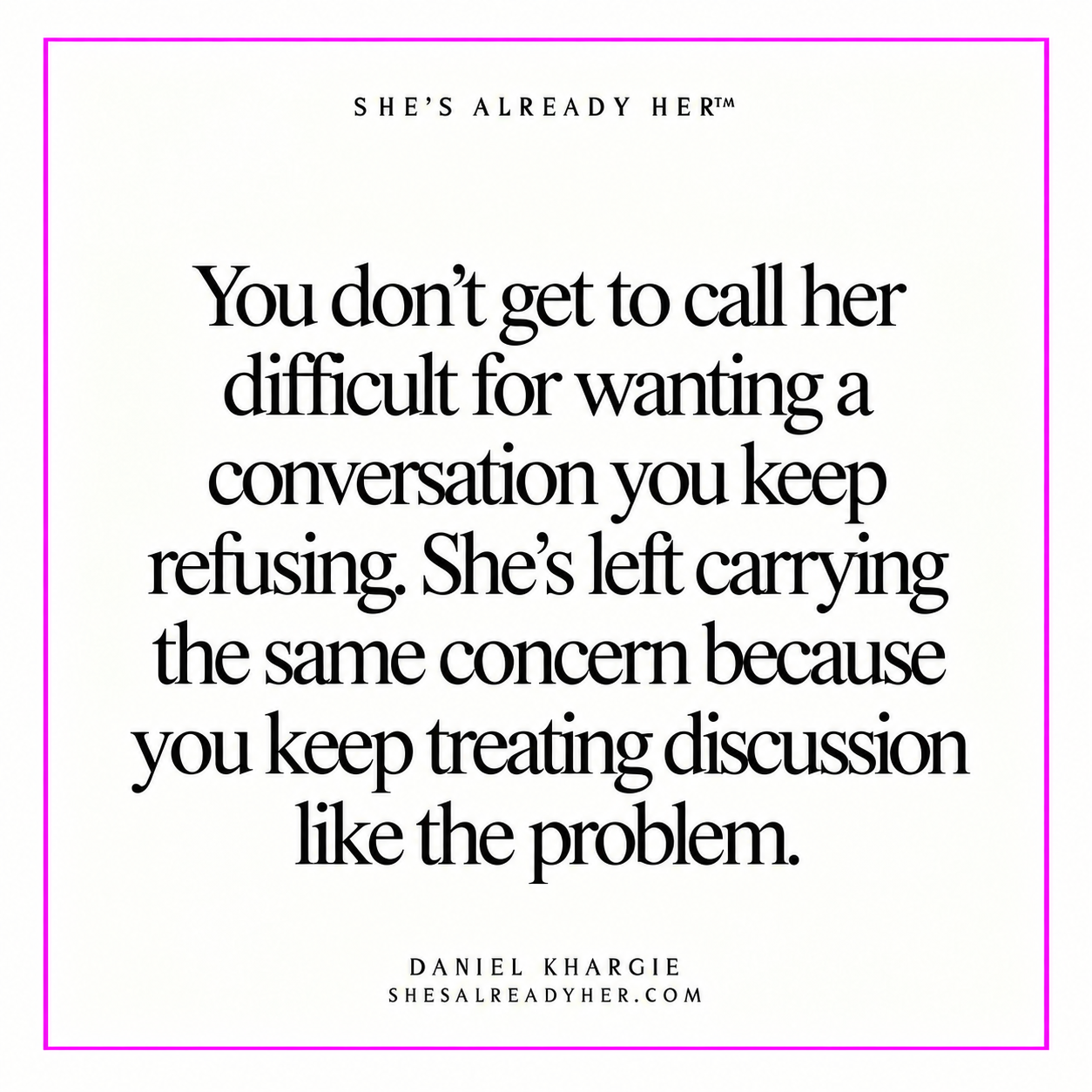
Read this quote as text
You don’t get to call her difficult for wanting a conversation you keep refusing. She’s left carrying the same concern because you keep treating discussion like the problem.
A guide for sorting out what still needs an answer

If these conversations leave you unsure which part belongs to you, When He Blames You for Your Reaction offers space to look at the pieces separately. The 117-page Book + Guide includes 12 chapters, guided reflection, and work on the event, impact, reaction, responsibility, and repair.
It also includes sections on what belongs to him, what belongs to you, your own accountability plan, and safety and support. That can be useful when the original event keeps getting lost and you leave thinking only about how the conversation went.
It’s an optional resource for your own reflection. It can help you examine your part without taking on his part too. It can’t make him discuss an issue, and it isn’t a complete course in solving conflict together.
You don’t have to call silence peace when something still hurts
You’re allowed to want a relationship where a concern can be raised without the person raising it becoming the enemy. That doesn’t mean you expect no disagreements. It means you want enough honesty to know what you’re actually disagreeing about.
You can be open to correction. You can decide something is worth letting go. You can hear an answer you don’t like and take time to think about it. Those choices should come from considering what happened, not from being worn down until you stop mentioning it.
You also get to consider what is practical and safe for you. You don’t have to force a discussion or announce a decision to prove you’re taking yourself seriously. If talking brings threats or retaliation, support and safety can come before another attempt to explain.
Bringing up what hurts you doesn’t mean you’re trying to ruin the relationship. Sometimes you’re trying to deal with something that is already hurting it. You deserve room to find out what’s true, what can change, and what you can honestly accept.
Frequently asked questions
What is healthy conflict when he calls every concern drama?
It’s disagreement where both people can discuss the actual issue, hear each other’s view, and consider what happens next without threats or humiliation. It doesn’t require agreement on everything. A concern can be fair to discuss even if one person doesn’t share the other’s conclusion. Calling the whole topic drama doesn’t explain or resolve the difference.
What is conflict avoidance, and is asking to talk later the same thing?
It means moving away from a disagreement rather than addressing it. Asking for another time isn’t automatically avoidance. Someone may genuinely need time or privacy. Look at whether there is a workable return to the issue. A repeated delay that leaves every concern permanently undiscussed is different from choosing a better moment.
How can I have a difficult conversation when he calls it drama?
Learning how to have difficult conversations can help you identify one specific concern and make room for both views. It cannot guarantee that another person will participate. You can consider a reasonable time, explain what affected you, and hear his response. If the response remains dismissal, you don’t have to keep repeating yourself or force a discussion that feels unsafe.
How can we disagree respectfully if we see the issue differently?
Thinking about how to disagree respectfully means allowing honest differences while staying specific about what happened. Either person can correct a fact, decline a request, or explain their understanding without insulting the other. Being heard isn’t the same as getting everything you ask for. It means the actual concern receives an answer you can consider.
How can I respond when he dismisses the issue as nothing?
If you’re working out how to respond to invalidation, separate his label from the concern you were trying to discuss. You can consider whether you have the facts right and what you’re asking for without agreeing that caring makes you dramatic. You can also stop an unproductive exchange. Being repeatedly dismissed when you share your feelings is covered more fully in that article.