
Sis, I need to talk to you about something that might sound contradictory, but I know you’re feeling it.
You feel like you’re too much for him:
- Too emotional
- Too needy
- Too sensitive
- Too intense
- Too demanding
- Too complicated
And at the exact same time, you feel like you’re not enough:
- Not pretty enough
- Not interesting enough
- Not successful enough
- Not easy-going enough
- Not confident enough
- Not desirable enough
You’re simultaneously too much AND not enough.
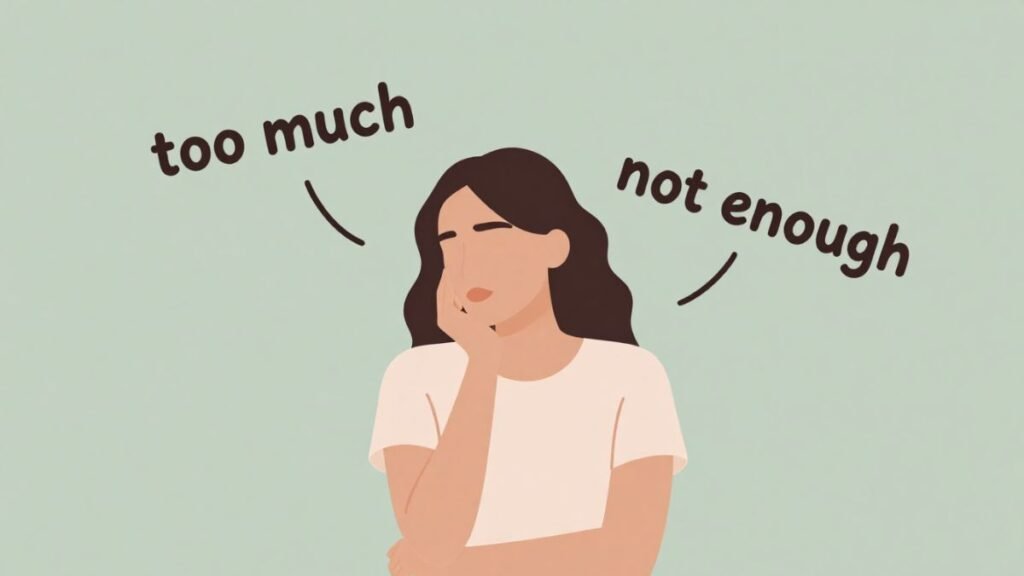
It’s like you’re taking up too much space while also being invisible. Like you’re overwhelming while also being inadequate. Like your very existence is both excessive and insufficient.
I see you trying to solve this impossible equation. Trying to be less of what’s “too much” while being more of what’s “not enough.” Shrinking yourself in some ways while expanding yourself in others. Exhausting yourself trying to find the magical balance where you’re finally just right.
And it’s destroying you.
Because here’s the truth: This isn’t actually about finding the right balance. This is about being with someone who makes you feel wrong no matter what you do.
Let me explain what’s really happening and why you need to see this clearly.
What’s Really Happening: The Too Much/Not Enough Trap
As a man who understands healthy relationships, let me tell you something critical: In healthy relationships with the right person, you don’t feel like you’re too much or not enough. You feel like you’re exactly right.
The right person doesn’t make you feel excessive OR insufficient. They make you feel accepted, valued, and just right as you are.
So if you’re feeling both too much and not enough simultaneously, here’s what’s actually going on:
He’s Giving You Contradictory Messages
Think about what he actually says and does:
When you have needs or feelings:
- “You’re so needy.”
- “You’re too sensitive.”
- “Why do you make everything so dramatic?”
- “You’re too emotional.”
Message: You’re too much.
But also:
- “Why aren’t you more like [other woman]?”
- “Can’t you just be more chill?”
- “You need to work on yourself.”
- Comparing you to his ex or other women
Message: You’re not enough.
See what’s happening? He’s creating an impossible standard where your authentic self is “too much,” but the person he wants you to be is someone you’re not—making you “not enough.”
You can’t win this game because the game is rigged. No matter what you do, there’s a criticism waiting. Express yourself? Too much. Hold back? Not enough.
You’re With Someone Who Can’t Handle Your Humanity
Your emotions, needs, desires, complexity, depth—that’s not “too much.” That’s human.
But he can’t handle normal human needs and emotions. He’s emotionally immature, unavailable, or incapable of being in a real relationship with a real person.
So when you show up as a complete human being with feelings and needs, he experiences you as too much because his emotional capacity is too small.
And because he can’t handle your humanity, he wants you to be someone simpler, easier, less complex—which makes you feel not enough because he’s asking you to be less than who you are.
The problem isn’t that you’re too much or not enough. The problem is he’s emotionally inadequate to be in a relationship with a whole person.
You’re Trying to Fit Into a Role That Isn’t You
Think about who he wants you to be:
- Never upset
- Always happy
- No needs
- No complaints
- No emotions that inconvenience him
- No depth requires him to show up emotionally
That’s not a girlfriend. That’s a fantasy woman who doesn’t exist.
You’re a real person. With feelings, needs, complexity, depth. You’re “too much” because you’re real, and he wants fantasy.
And you’re “not enough” because no real person can live up to the fantasy version he wants.
You’re not too much and not enough. You’re just real. And he can’t handle real.
You’ve Internalized His Impossible Standards
Here’s where it gets insidious: You’ve started believing him.
His messages that you’re too much when you have needs? You’ve internalized that. Now you police your own emotions, suppress your own needs, call yourself “too needy” before he even can.
His messages that you’re not enough compared to some ideal? You’ve internalized that too. Now you constantly try to improve, change, and become better, believing you’re inadequate.
You’re both shrinking yourself (too much) and pushing yourself (not enough) to meet impossible standards that were never legitimate to begin with.
This Is How Emotional Abuse Works
Let me be direct: Making someone feel like they’re simultaneously too much and not enough is a classic abuse tactic.
It keeps you:
- Off balance (never knowing if you’re doing it right)
- Constantly trying to change (to be less or more)
- Focused on yourself as the problem (instead of on his treatment of you)
- Dependent on his approval (to tell you when you’ve finally got it right)
- Unable to trust yourself (because you’re apparently both excessive and insufficient)
It’s designed to keep you controllable and insecure. And it’s working.
You’re Comparing Your Real Self to His Fantasy Standards
He’s holding you to standards he doesn’t even meet himself:
He wants you to:
- Never be emotional (while he’s allowed to be moody)
- Have no needs (while he expects you to meet all his)
- Be always positive (while he’s allowed to complain)
- Look perfect (while he puts in minimal effort)
- Be independent (while he benefits from your dependence)
The standards are impossible and hypocritical. And you’re trying to meet them while he doesn’t hold himself to any standard at all.
You’re not too much or not enough. He’s asking for the impossible while giving the minimum.
Why This Is Destroying You
You can’t be yourself. You’re constantly monitoring, adjusting, trying to be less here and more there. The real you has disappeared under the weight of impossible expectations.
You’re exhausted. Managing this contradiction—be less, be more, shrink here, expand there—is mentally and emotionally draining.
You’ve lost your sense of self. When you’re told you’re both too much and not enough, you stop knowing who you actually are. Your identity becomes about what he wants instead of who you are.
You accept terrible treatment. Believing you’re too much makes you accept his unavailability. Believing you’re not enough makes you accept his criticism. Either way, you stay.
You can never relax. There’s no “right” version of you that will make this stop because the problem isn’t you—it’s the impossible standard.
You’re trapped in a cycle of self-improvement that leads nowhere. You work on being “less needy” and then get criticized for being “too distant.” You work on being “more confident” and get told you’re “too demanding.” Nothing you do is right.
You lose your self-worth. How can you value yourself when you’re simultaneously excessive and insufficient? When your very existence is wrong?
The Truth You Need to Hear
You’re Not Too Much
Your emotions aren’t too much. Your needs aren’t too much. Your depth isn’t too much. Your humanity isn’t too much.
You’re a normal human being with normal human needs and feelings.
If someone experiences that as “too much,” their capacity is too small. Not your humanity too big.
The right person won’t make you feel like you’re too much. They’ll have room for all of you.
You’re Not Not Enough
You’re not lacking. You’re not insufficient. You’re not inadequate.
You’re a complete person exactly as you are.
If someone makes you feel like you’re not enough, their appreciation is too small. Not your value.
The right person won’t make you feel like you need to be more. They’ll see you as more than enough exactly as you are.
The Problem Is the Relationship, Not You
You’re not defective. You’re not impossible. You’re not the problem.
The relationship where you feel both too much and not enough is the problem.
It’s the wrong relationship. With the wrong person. Who can’t handle your real self and won’t value your actual self.
And no amount of changing yourself will fix a fundamentally broken dynamic.
What You Need to Do
Step 1: Recognize the Impossibility
You can’t be both less and more at the same time. The standard is impossible by design.
Stop trying to achieve the impossible. It’s not that you’re failing—it’s that success isn’t possible.
Step 2: Stop Internalizing His Criticisms
When he says you’re “too needy” or “not enough,” reject it.
You’re not too much. You’re human.
You’re not not enough. You’re complete.
His inability to see that is his problem, not proof of your deficiency.
Step 3: Be Yourself Fully
Stop shrinking. Stop expanding. Stop managing yourself to fit his impossible standards.
Just be you. Fully. Authentically. With all your emotions, needs, complexity, and depth.
If he can’t handle the real you, he can leave. Better that than you losing yourself trying to be someone you’re not.
Step 4: Demand to Be Accepted As You Are
“I’m not too much and I’m not not enough. I’m exactly who I am. If you can’t accept me as I am—emotions, needs, and all—then this relationship isn’t going to work.”
Set the boundary. You’re not changing to meet impossible standards anymore.
Step 5: Recognize This Might Be Abuse
If he’s systematically making you feel both too much and not enough, if he’s constantly criticizing you from both directions, if you can never do anything right—that’s emotional abuse.
Name it. And get out.
Step 6: Leave
If you’re in a relationship where you feel perpetually wrong—too much and not enough simultaneously—it’s time to leave.
You cannot fix this. You cannot change enough to make it work. The dynamic itself is toxic.
Choosing yourself isn’t giving up. It’s refusing to accept a relationship that requires you to be both less and more than who you are.
What You Deserve
You deserve someone who experiences you as exactly right.
Someone who doesn’t make you feel like your emotions are too much or your self is not enough.
Someone who has room for all of you—the emotions, the needs, the complexity, the depth.
Someone who values you as you are instead of wishing you were different.
That person exists. But you’ll never find them while you’re exhausting yourself trying to be simultaneously less and more for the wrong person.
The Bottom Line
Sis, if you feel like you’re too much and not enough at the same time:
You’re not actually either. You’re exactly right. You’re a complete human being with normal needs and emotions.
The problem is you’re with someone who can’t handle your humanity and won’t value your wholeness.
Stop trying to solve the impossible equation. Stop shrinking and expanding and changing and managing yourself.
Be yourself. Fully. Unapologetically.
And leave anyone who makes you feel like being yourself is simultaneously too much and not enough.
You are not too much. You are not enough. You are exactly right for the right person.
Choose yourself, sis. The right person will experience you as perfect, exactly as you are.
FAQ
Q: What if I really am too needy and also not good enough?
“Too needy” usually means “has normal human needs with someone who can’t meet them.” And “not good enough” is rarely objectively true—it’s about someone’s inability to appreciate you. If trusted friends/therapists don’t see you this way, you’re not the problem.
Q: How do I know if it’s him or if I actually need to work on myself?
Self-improvement is great—but not to meet someone’s contradictory, impossible standards. Work on yourself for YOU, not to stop being “too much” or become “enough” for someone who keeps moving the goalposts.
Q: What if he’s right and I need to be less emotional AND more confident?
Even if both were true (they’re probably not), the fact that you feel simultaneously criticized for being too much AND not enough means the criticism is about control, not about genuine concerns. Healthy feedback doesn’t come from both directions at once.
Q: Can I fix this dynamic?
Only if he’s willing to stop the contradictory criticism and accept you as you are. However, this dynamic usually exists because he fundamentally can’t or won’t accept the real you. That’s not fixable by you changing.
Q: How do I stop believing I’m both too much and not enough?
Therapy. Distance from the person telling you this. Time with people who accept you fully. Reconnecting with who you are outside his impossible standards. It’s a process of unlearning what he taught you.