
Sis, let me describe the moment that happens every single time you try to slow down.
You give yourself permission. Maybe for the first time in weeks. You decide — consciously, deliberately — that today you’re going to take it easy. Not push so hard. Not fill every minute. Not operate at the pace your body has been begging you to abandon for months.
And for about ninety seconds, it works. The shoulders drop slightly. The breath deepens marginally. The body starts to receive the signal that the sprint might be over — at least for now.
Then the label arrives.
“Lazy.”
Not from anyone in the room. Not from anyone who’s watching. Not from any external voice that has any authority over how you spend your time. From inside. From the place where your most deeply held beliefs about your worth live — the place that’s been running the same program since before you knew it was running. The place that says: a woman who slows down is a woman who’s failing. And failing is the one thing you cannot afford to do.
So you speed up again. The permission gets revoked. The shoulders re-tighten. The breath re-shallows. And the moment of slowing down becomes another moment of evidence — evidence that you can’t rest, can’t pause, can’t operate at anything less than maximum without your own mind attacking you for it.
Self compassion exercises aren’t about adding another practice to your already-overloaded schedule. They’re about understanding why the schedule is overloaded in the first place — why your system treats deceleration as a character flaw, and why the woman who most needs to slow down is the woman whose internal wiring makes slowing down feel like the most dangerous thing she can do.
What “Slowing Down Feels Like Laziness” Actually Looks Like
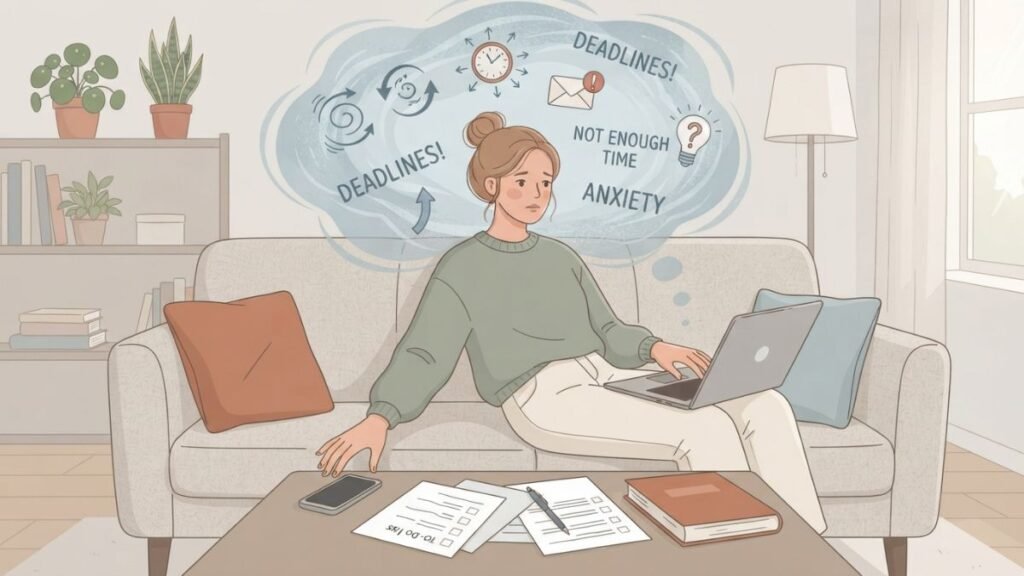
It doesn’t look like someone who can’t relax. From the outside, you might even look calm. But inside, the alarm system is screaming.
You physically cannot sit still without reaching for something to do. Your hands need a task. Your mind needs a problem. Your body needs motion. Stillness doesn’t produce peace — it produces restlessness so intense it almost qualifies as physical pain. Not because you have energy to burn. Because your system reads stillness as a threat state that requires immediate correction. Self compassion exercises would tell you to sit with the restlessness. Your wiring says sitting with it means something is wrong with you.
You compare your slow days to other people’s productive days. You took a morning off and she posted about her 5 AM workout. You rested on Saturday and he accomplished fifteen things before noon. The comparison fires automatically — converting your necessary rest into evidence of your inferiority. Self compassion exercises begin with recognizing this comparison as the wound’s commentary — not an accurate measurement of your value against theirs. But the recognition is hard to hold when the comparison produces such immediate, visceral shame.
You feel guilty for enjoying a slow pace. Not just guilty for resting — guilty for liking it. When the slowness feels good — when the unstructured hour produces pleasure rather than anxiety — the guilt doubles. Because enjoying the slowness must mean you’re naturally lazy. Must mean the productivity you normally maintain is forced rather than authentic. Must mean that the real you — the one who emerges when the pace drops — is the indulgent version your critic has been warning you about. Self compassion exercises would celebrate the enjoyment. Your system pathologizes it.
You immediately plan compensatory productivity after any period of slowness. You rested for two hours on Sunday. Monday’s list is twice as long. You took an afternoon off. Tomorrow you’ll wake up an hour early to make up for it. The compensatory planning isn’t conscious strategy. It’s automatic — your system’s way of restoring the productivity balance that the slowing down disrupted. Self compassion exercises would say the rest doesn’t need to be compensated for. Your programming says every moment of slowness creates a debt that must be repaid through equivalent or greater output.
Why Slowing Down Feels Like Laziness
Your nervous system was calibrated for constant output during childhood. The calibration didn’t happen through a single event. It happened through the daily rhythm of an environment where motion equaled safety and stillness equaled risk. A household where busy children were good children and idle children were problems. A family system where your value was demonstrated through what you did — not who you were. The calibration runs at the nervous system level — deeper than thought, deeper than belief, in the wiring that determines what your body reads as safe and what it reads as threatening. Slowing down triggers the threat response because your nervous system was trained to equate stillness with the condition that preceded correction, withdrawal of love, or disapproval. Self compassion exercises can’t be effective until the nervous system understands — through repeated experience, not just through logic — that slowness is safe.
You received love proportional to your output. When you were productive, love flowed. When you weren’t, it diminished. Maybe not dramatically — maybe just a slight cooling, a subtle withdrawal, a barely perceptible shift in a parent’s warmth that your developing brain registered with seismographic precision. The equation installed itself through thousands of micro-moments: productive = loved. Unproductive = less loved. And now, decades later, slowing down doesn’t just feel lazy. It feels like the beginning of love being withdrawn. Self compassion exercises that involve slowing down trigger the same neural pathway that was activated when output dropped and love cooled. You’re not fighting laziness when you try to slow down. You’re fighting the fear that slowing down will cost you the love you’ve been earning through motion your entire life.
The culture you live in has pathologized rest and glorified exhaustion. “I’ll sleep when I’m dead.” “Hustle culture.” “If you have time to rest, you have time to do more.” The messaging is relentless, gendered, and deeply damaging — particularly to women who were already carrying the belief that their worth is tied to their output. Self compassion exercises exist in direct opposition to this cultural current. Slowing down when the world says speed up requires a level of self-trust that the culture actively undermines. And when your internal programming agrees with the cultural messaging — when both your wound and your world are saying “laziness is the worst thing you can be” — the self compassion exercise of slowing down becomes an act of rebellion that most people don’t have the internal support to sustain.
You’ve confused your pace with your identity. “I’m a hard worker.” “I’m always on the go.” “I’m not the type to sit around.” These feel like personality descriptions. They’re actually pace descriptions — and they’ve been elevated to identity status because the pace has been running for so long that you can’t separate who you are from how fast you’re moving. Slowing down doesn’t just feel lazy. It feels like identity erosion — like the woman who emerges at a slower pace is a different woman. A lesser woman. A woman you don’t recognize and aren’t sure you’d respect. Self compassion exercises that involve deceleration require a renegotiation of identity — the willingness to discover that the woman at a slower pace isn’t lesser. She’s just unfamiliar. And unfamiliar isn’t the same as unworthy.
Laziness was the worst thing you could be labeled in your formative environment. Every family has its cardinal sin — the one label that carried more weight, more shame, more consequence than any other. In your family, that label might have been “lazy.” The kid who didn’t try hard enough. The person who took the easy way. The one who rested when there was still work to be done. And the threat of that label — the shame it carried, the disapproval it activated — was enough to keep you moving through exhaustion, through burnout, through the body’s most urgent signals to stop. Self compassion exercises require directly confronting the label — examining whether “lazy” was ever an accurate description of a woman who’s been running at maximum capacity for decades, or whether it was always a threat deployed to keep you performing at a pace that served someone else’s needs.
Slowing down produces feelings you’ve been outrunning. At full speed, you don’t feel much. There isn’t time. The pace itself is an anesthetic — keeping the emotions at bay through sheer motion. But when the pace drops, the feelings catch up. The sadness. The grief. The anger about years spent running from a label that was never accurate. The exhaustion that you’ve been masking with momentum. Self compassion exercises that involve slowing down don’t just create space for rest. They create space for feeling. And the feelings have been accumulating behind the pace — patient, persistent, waiting for the exact moment of stillness that the guilt has been preventing.
You’ve never seen someone slow down without consequence. If the models in your life — parents, mentors, partners — never demonstrated healthy deceleration, you have no reference point for what slowing down looks like when it goes well. Every example you’ve witnessed might have involved consequence — the parent who was criticized for resting, the colleague who was passed over for not hustling hard enough, the cultural narrative that equates slowness with failure. Self compassion exercises require building a reference point that doesn’t exist yet — the experience of slowing down and having it be not just acceptable but beneficial. That reference point has to be created through your own experience, because nobody modeled it for you.
What the Laziness Label Is Doing to You
You’re burning out while calling it dedication. The exhaustion isn’t a temporary consequence of a busy season. It’s the permanent state of a woman who’s been sprinting without recovery for years. The burnout doesn’t announce itself dramatically. It reveals itself through gradual erosion — less patience, less creativity, less joy, less capacity to engage with the people and experiences that are supposed to make life meaningful. Self compassion exercises are the antidote to the burnout. But the antidote requires the very thing the burnout was produced by avoiding — slowing down.
Your body is breaking down under the pace your guilt demands. The tension that never releases. The headaches that persist. The digestive issues. The sleep disruption. The immune system that’s been compromised by the chronic stress of operating without adequate rest. Your body isn’t being dramatic. It’s being accurate — reporting the consequences of a pace that was never sustainable, maintained by a guilt system that treats your body’s needs as optional.
You can’t enjoy anything because enjoyment without productivity feels indulgent. A beautiful morning exists and you can’t sit inside it because sitting means not doing. A meal is prepared and you eat it while working because eating without multitasking is wasted time. A moment of genuine pleasure arrives and the guilt intercepts it before it can register fully. Self compassion exercises would tell you that pleasure without productivity is healthy. Your system says it’s evidence of the laziness you fear most.
Your relationships are shallow because depth requires a pace you can’t sustain. Real connection — the kind that builds intimacy, trust, and genuine knowing — requires slowness. Slow conversations. Slow evenings. Slow presence that allows another person to be seen without the distraction of your internal productivity monitor running in the background. Self compassion exercises that involve slowing down aren’t just about your wellbeing. They’re about your capacity for the depth your relationships deserve but don’t receive because the pace won’t allow it.
You’ve lost touch with what you actually need because needs require stillness to surface. When you’re moving at maximum speed, needs don’t register. They can’t — because the motion drowns them out. You don’t know you’re hungry until you’re starving. Don’t know you’re tired until you’re collapsing. Don’t know you’re sad until you’re breaking. The needs were there all along. They just couldn’t surface through the noise of constant production. Self compassion exercises create the space for needs to become visible — and visible needs can be met. Invisible ones can’t.
What You Need to Do
Rename the feeling. When “lazy” arrives the moment you slow down — catch it. Rename it. “That’s not laziness. That’s recovery.” “That’s not failing. That’s functioning.” “That’s not wasted time. That’s invested time — invested in the resource that everything else depends on.” Self compassion exercises start with language — because the language your wound uses is the language that keeps you running. Change the language and the running loses its urgency.
Practice five minutes of deliberate non-productivity daily. Not rest that’s disguised as something else. Not meditation that’s framed as a performance optimization tool. Five minutes of doing nothing. No phone. No podcast. No task. Just five minutes of existing without output. And when the guilt arrives — because it will, within seconds — let it exist beside you without dictating your behavior. “The guilt is here. I’m still sitting.” Self compassion exercises are built through repetition. And five minutes, repeated daily, creates a foundation that eventually supports longer periods of guilt-free stillness.
Track what happens when you slow down versus what the guilt predicts. The guilt says slowing down will produce falling behind, failure, loss. Track the actual outcome. Did you fall behind after resting? Did something catastrophic happen because you took an afternoon off? Did the world punish you for sitting down? The tracking creates data. And data, accumulated over time, contradicts the guilt’s predictions with evidence rather than argument. Self compassion exercises grounded in evidence are more effective than those grounded in affirmation — because your system trusts evidence more than it trusts words.
Separate your identity from your pace. “I am not my productivity.” Say it until it stops feeling wrong. Because the equation your wound created — I am what I produce — is the engine driving the guilt. And the engine needs to be replaced with a different equation — one where your value exists independently of your speed. Self compassion exercises that involve identity work are the deepest form of the practice. Because identity-level change outlasts every other intervention. Once you genuinely believe that you’re valuable at any pace, the guilt loses its foundation.
Find one person who models healthy slowness. Someone who rests without apology. Who takes mornings off without guilt. Who operates at a pace that sustains rather than depletes. Watch them. Not with judgment — with curiosity. How do they navigate the guilt you feel? How do they resist the cultural pressure that tells them to speed up? What does their life look like at a pace that includes rest? Self compassion exercises need models. And if the models weren’t provided in childhood, they can be found in adulthood — through friends, through community, through the deliberate seeking of people who’ve figured out what the guilt has been preventing you from learning.
Get professional support. The laziness label that fires every time you slow down — if it traces to childhood conditioning, if it’s tied to identity and worth, if it’s producing burnout, physical symptoms, and relational distance — requires therapeutic intervention. A therapist can help you trace the label’s origin, separate pace from identity, develop self compassion exercises that address the nervous system rather than just the thinking, and build a relationship with rest that feels like freedom rather than failure.
What You Need to Understand
Slowing down isn’t laziness. It’s the opposite of laziness. Laziness is the absence of effort. Slowing down — deliberately, consciously, against the full force of your guilt programming — is one of the most effortful things you can do. It requires defying decades of conditioning. Resisting a culture that celebrates exhaustion. Tolerating the discomfort of stillness while your nervous system screams that stillness is dangerous. A woman who slows down against that kind of internal opposition isn’t lazy. She’s brave.
Self compassion exercises aren’t about becoming less productive. They’re about becoming sustainable. The pace you’ve been maintaining — the sprint without recovery, the output without input, the constant motion without rest — has an expiration date. Every system that runs without maintenance eventually fails. Your body. Your mind. Your relationships. Your capacity for the work you love. All of it runs on energy that rest generates. And the guilt that prevents rest is the single greatest threat to the very productivity it claims to protect.
The woman who slows down isn’t falling behind. She’s pulling ahead — of the burnout, the depletion, the relational distance, and the health consequences that the never-stopping version of her was accelerating toward. The slow version isn’t the lesser version. She’s the version that lasts.
What You Deserve
You deserve to slow down without the label. Without the guilt. Without the internal voice that converts necessary rest into evidence of a character flaw you don’t actually have.
You deserve to exist at a pace that sustains you rather than depletes you. To move through your days without the constant pressure of a system that treats every moment of stillness as a threat to your worth.
You deserve to be slow sometimes, sis. Quietly, peacefully, unapologetically slow. Not because you’ve earned the slowness through enough productivity. Because slowness is part of being alive. And being alive was always the only credential rest required.
Self compassion exercises don’t need to be complicated. They need to be permitted. And the permission starts with one sentence you’ve never been able to say without the guilt rewriting it:
“I’m allowed to slow down. And slowing down doesn’t make me less.”
Say it. Mean it. And then — slowly, deliberately, without apologizing — sit down.
The Bottom Line
Slowing down feels like laziness because your nervous system was calibrated for constant output, because love was proportional to productivity, because the laziness label was the most threatening one your childhood could deliver, because the culture reinforces the equation between motion and worth, and because the feelings you’ve been outrunning are waiting in the stillness the guilt keeps preventing.
Self compassion exercises are the practice of defying that programming. Sitting when the guilt says stand. Pausing when the critic says push. Resting when the label says lazy. And trusting — not just intellectually, but in your body — that the woman at a slower pace is not a woman in decline. She’s a woman in recovery. And recovery is where everything that matters gets rebuilt.
Stop running from the label, sis. The label was never accurate. You were never lazy. You were just surviving inside a system that used the threat of laziness to keep you performing at a pace that was never about your wellbeing.
It was always about theirs.
Your wellbeing starts the moment you slow down.
FAQ
Q: How do I slow down when I genuinely have too much to do?
Start by auditing the “too much.” How much of the list is genuinely urgent? How much is the guilt-driven expansion of tasks that could wait? Often the list feels non-negotiable because the guilt has inflated everything to equal urgency. Self compassion exercises include honest prioritization — identifying what actually requires your energy today and what exists on the list because your guilt won’t let you have a short one.
Q: What if slowing down makes me anxious instead of restful?
That’s the nervous system encountering unfamiliar territory. The anxiety isn’t evidence that slowing down is wrong for you. It’s evidence of how long you’ve been running. Stay in the slowness despite the anxiety. Let the anxiety prove itself wrong by not producing the catastrophe it predicts. The anxiety decreases with repeated exposure to consequence-free rest.
Q: Is it possible to be productive and practice self compassion?
Absolutely. Self compassion exercises don’t replace productivity. They sustain it. A woman who rests produces better work, makes clearer decisions, and sustains her effort longer than a woman who sprints without recovery. The two aren’t in competition. They’re partners. Productivity is the output. Self compassion is the infrastructure that keeps the output possible.
Q: What if my partner or family judges me for slowing down?
Their judgment is their conditioning — the same cultural and familial programming that produced your guilt. Their discomfort with your rest says something about their relationship with stillness, not about your right to practice it. Some may need time to adjust. Others may need to examine their own guilt systems. Either way, their judgment doesn’t override your body’s need for recovery.
Q: How long until slowing down stops feeling wrong?
It varies. Some women find the guilt weakening within weeks of consistent practice. Others need months — particularly if the conditioning is deep and childhood-rooted. The timeline doesn’t matter as much as the direction. Every moment of guilt-defying rest, no matter how uncomfortable, moves you closer to the point where slowness feels natural rather than criminal. The discomfort is temporary. The freedom on the other side of it is permanent.