
Sis, let me point out something that might be hiding in plain sight.
The person who criticizes you most isn’t the man who let you down. It isn’t the friend who disappointed you. It isn’t the parent whose approval you’ve been chasing. It isn’t anyone out there. It’s you.
You are the voice that says “not good enough” more times per day than any external source ever has. You are the one who replays your mistakes at 2 AM with a precision that would impress a prosecutor. You are the one who catalogs your flaws with more accuracy than any critic who’s ever evaluated you. You are by a margin so wide it’s almost comical the harshest judge you’ve ever stood in front of.
And here’s what makes that devastating rather than just uncomfortable. The self-criticism isn’t running in a vacuum. It’s running alongside love that’s trying to reach you. Right now. Today. From people who see you clearly, who value you genuinely, who are offering the kind of regard that should settle into your chest and quiet the noise. But it can’t land. Because the self-criticism is so loud, so constant, so well-practiced that it drowns out the love before the love can reach the part of you that needs it most.
How to receive love isn’t a lesson about opening your heart to romantic partners. It’s a lesson about what happens when the loudest voice in your life — your own — has been saying “you’re not worth it” so consistently that every external voice saying “you are” gets treated as noise to be filtered out rather than truth to be absorbed.
The love is there. It’s being offered. The problem isn’t that nobody’s giving it. The problem is that the woman it’s being offered to has a security system so thorough that the love can’t get past the front door.
What Self-Criticism That Blocks Love Looks Like
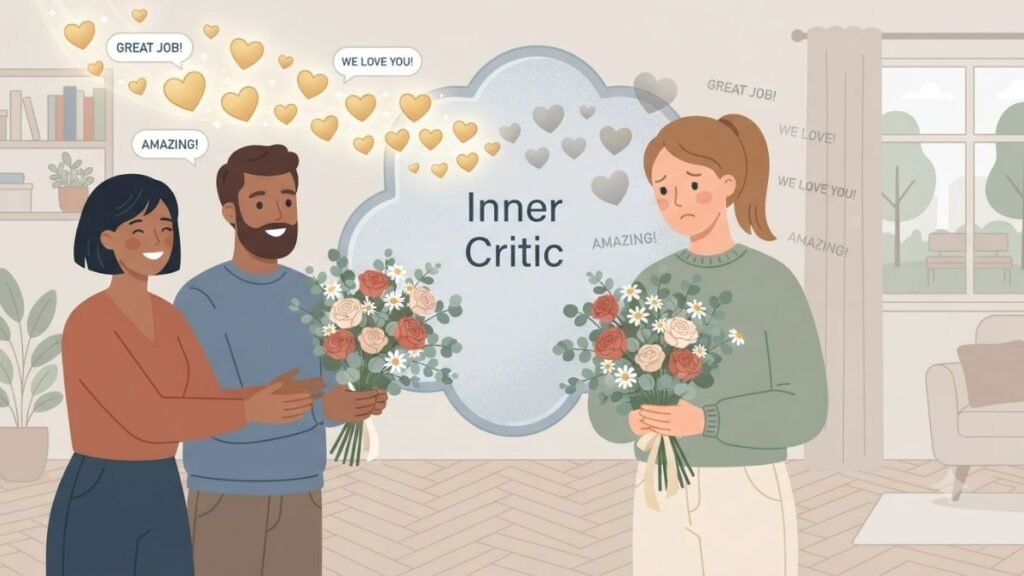
It doesn’t look like someone who hates herself not from the outside. It looks like a woman who’s thoughtful, self-aware, and high-functioning. The self-criticism hides behind qualities the world admires.
You filter every loving gesture through the critic before it can reach you. Someone says “I love you.” The critic adds “they wouldn’t if they knew the real you.” Someone shows up for you. The critic adds “they’re going to stop once they see your flaws.” Someone treats you well. The critic adds “you don’t deserve this and eventually they’ll figure that out.” How to receive love is blocked by a filtration system that intercepts positive input, attaches a “but” to it, and delivers the diminished version to your self-concept instead of the original.
You trust criticism more than compliments. Tell you something negative about yourself and you absorb it instantly. No resistance. No filter. Direct access to the self-concept, where it’s filed as confirmed truth. Tell you something positive and the system deploys full defenses. Suspicion. Deflection. The assumption that the compliment is either inaccurate, premature, or motivated by something other than genuine regard. How to receive love means understanding that the asymmetry between how easily you absorb criticism and how aggressively you reject love isn’t about accuracy. It’s about which input matches the narrative your wound has been running.
You preemptively identify your flaws so nobody else has the power to discover them. If you name your shortcomings first before a partner can, before a friend notices, before anyone has the chance to identify what’s wrong with you the discovery can’t hurt you. You’ve already found it. Already cataloged it. Already held it up to the light and said “I know this is here and I know it’s a problem.” The preemptive self-criticism feels like protection. It functions as a barrier one that prevents anyone from getting close enough to see you without the disclaimer you’ve already attached. How to receive love requires lowering the disclaimer. Letting someone see you without the preface that says “here’s everything wrong with me before you decide whether to stay.”
You apologize for needing love. “Sorry for being needy.” “Sorry for wanting reassurance.” “Sorry for wanting to feel close.” The apologies precede your most basic human needs as though wanting love is an imposition. As though the act of needing to be held, affirmed, or valued is something you should feel embarrassed about rather than entitled to. How to receive love means stopping the apology that arrives before the need because the apology is the critic’s way of ensuring that even when love arrives, it arrives as a concession rather than an offering.
Why You Criticize Yourself More Than Anyone Else
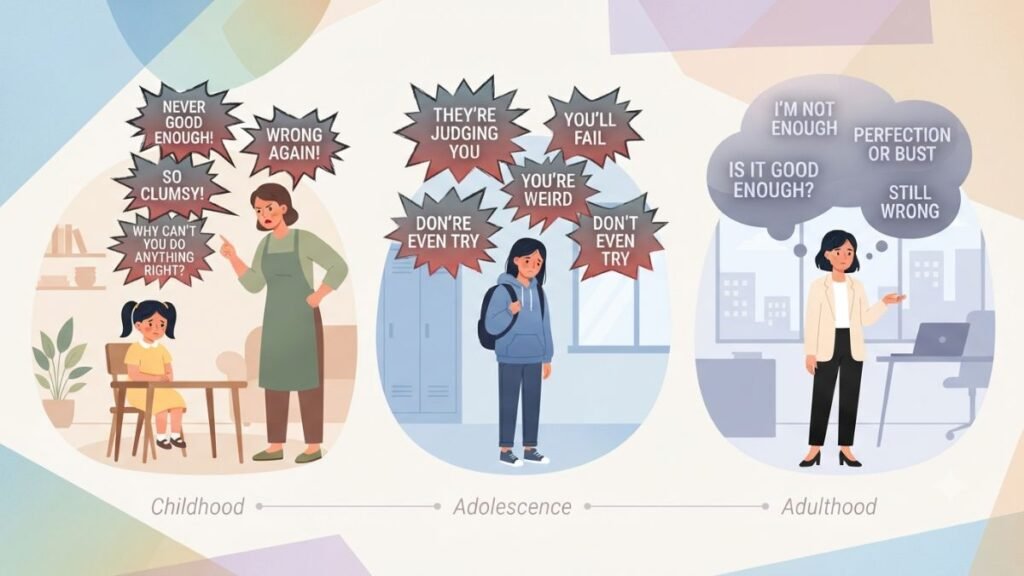
You internalized someone else’s critical voice so deeply it became your own. Every self-critical thought you have carries a signature an origin that predates you. A parent who corrected more than they praised. A caregiver who highlighted what was wrong rather than what was right. A household where feedback was delivered through criticism and love was expressed through the absence of disapproval rather than the presence of affirmation. The voice you hear inside your head the one that catalogs flaws, intercepts joy, and says “not enough” before you’ve finished trying isn’t yours. It belongs to someone who gave it to you before you were old enough to refuse delivery. How to receive love starts with recognizing that the critic you’ve been listening to your entire life is speaking in someone else’s dialect. You just forgot it wasn’t yours because you’ve been hearing it since before you could talk.
Self-criticism became your way of maintaining connection with the person who modeled it. This is the paradox that makes the pattern so hard to break. If a parent was critical if the primary way they engaged with you was through correction, evaluation, and the identification of what needed fixing then your self-criticism isn’t just a habit. It’s a relational bond. Criticizing yourself the way they criticized you maintains the connection. It keeps their voice alive inside you. It preserves the dynamic even long after the person is no longer actively critiquing you. How to receive love sometimes means grieving the connection that self-criticism maintains because releasing the critic might feel like releasing the person who installed it. And that release can feel like a different kind of loss.
You believe you don’t deserve the love being offered. Not intellectually you know you’re “supposed to” accept love. But at the level where beliefs live beneath logic, beneath reason, in the place where your earliest experiences formed the template the belief is clear. Love is for people who’ve earned it. People who’ve fixed enough. People who don’t have the flaws you carry. And since you haven’t fixed enough since the critic keeps finding new flaws, which means the fixing is never complete the love being offered feels premature. Undeserved. Like a payment received before the work is done. How to receive love requires confronting this belief directly not with affirmations, but with the honest recognition that the belief was installed by conditional love and maintained by a self-critical system that benefits from your continued unworthiness.
Self-criticism gives you a sense of control that vulnerability doesn’t. Criticizing yourself is predictable. You know what the critic will say. You know where it will point. You control the narrative about your flaws which means nobody else’s critique can surprise you. But love? Love is unpredictable. It arrives without warning. It asks you to trust someone else’s assessment of your worth over your own. It requires the surrender of the control that self-criticism provides. How to receive love is an act of vulnerability and vulnerability feels dangerous to a woman whose self-criticism has been functioning as armor. Letting love in means letting the armor down. And letting the armor down, for a woman who’s been wearing it since childhood, feels like agreeing to be wounded.
You’ve been in relationships that confirmed the critic rather than countering it. A partner who was critical. A friend who took more than they gave. A dynamic where your effort was met with evaluation rather than appreciation. Each relationship that confirmed the critic’s assessment “see, they found flaws too” deepened the critic’s authority and weakened your capacity to receive love from anyone, including yourself. How to receive love means recognizing that the relationships that confirmed the critic were selected by the same wound that installed it. The confirmation wasn’t evidence. It was a pattern. And patterns can be broken when the wound that drives the selection is addressed.
Receiving love would mean accepting that the critic has been wrong. This is the one your system resists most forcefully. If you let love in if you accept that you’re worthy of it, that it’s deserved, that the people offering it are seeing you accurately then the critic was wrong. Not occasionally wrong. Fundamentally wrong. Wrong about your worth. Wrong about your lovability. Wrong about every flaw it identified as disqualifying. And accepting that the critic was wrong means accepting that you’ve spent years maybe decades listening to a voice that was lying. Punishing yourself based on false information. Rejecting love based on inaccurate assessment. That realization isn’t just freeing. It’s grief-inducing. How to receive love sometimes means mourning the years the critic stole the love that was offered and rejected, the joy that was available and refused, the peace that was possible and blocked.
You’ve never experienced love without conditions, so unconditional love doesn’t compute. Every version of love you’ve received came with conditions perform, comply, achieve, maintain. And conditioned love created a system where love and criticism are intertwined. Being loved and being evaluated were the same experience. So when love arrives without criticism when someone offers regard without evaluation, affection without correction, presence without conditions your system doesn’t recognize it as love. It recognizes it as an error. As something that will be corrected once the conditions reveal themselves. How to receive love means building the capacity to recognize unconditional regard as real rather than suspicious. And that capacity is built through experience through staying present with love that doesn’t come with a report card attached, long enough for your nervous system to update its definition of what love actually is.
What Self-Criticism That Blocks Love Is Doing to You
You’re starving while food is on the table. Love is being offered by friends, by partners, by people who see you clearly and value what they see. And you can’t eat. The critic has convinced you the food is poisoned. Or undeserved. Or temporary. Or a setup for the moment when the food disappears and the starvation returns. So you sit at a table full of nourishment and stay hungry not because the nourishment isn’t real, but because your system won’t let you take it in.
You’re slowly eroding the relationships that could heal you. When love is consistently rejected when a friend offers warmth and gets deflection, when a partner offers affection and gets “I don’t deserve this,” when someone tries to celebrate you and gets met with minimization the offerings eventually slow down. Not because the love stopped. Because the rejection taught the giver that their love doesn’t land. How to receive love isn’t just about you. It’s about protecting the relationships that are trying to reach you from the damage your deflection produces. People can only offer what’s rejected so many times before they stop offering.
Your self-concept is built entirely on the critic’s testimony. Every belief you hold about yourself every “I’m not enough,” every “I’m too much,” every “they’ll leave when they see the real me” was entered into evidence by the critic. And the critic is the only witness your self-concept has ever heard from. How to receive love means calling a different witness. One whose testimony includes your strength, your depth, your capacity for devotion, your specific irreplaceable value. A witness who sees the full picture not just the flaws the critic has been spotlighting while keeping everything else in darkness.
You’re teaching yourself that love is something other people get. After enough rounds of blocking, deflecting, and refusing the love that’s offered, a belief solidifies love happens to other people. Other people get to feel valued. Other people deserve affection without asterisks. Other people can sit inside someone’s love without the critic whispering “this isn’t for you.” The belief isn’t conscious. It’s the accumulated residue of years of love-blocking. And it produces exactly the outcome it predicts because a woman who believes love isn’t for her will ensure, through her own deflection, that love never reaches her. The prophecy fulfills itself. Not because the prophecy is true. Because the behavior it produces makes it true.
What You Need to Do
Start letting one piece of love through per day. Not all of it. One piece. A compliment you don’t deflect. An act of kindness you don’t minimize. A moment of regard you let land without the critic’s commentary. “Thank you. I’ll take that in.” One breach in the wall per day. How to receive love isn’t about demolishing the defenses overnight. It’s about creating small openings repeated daily until the openings become large enough for love to flow through naturally.
Talk back to the critic with the same energy it talks to you. The critic says “you don’t deserve this.” Your response: “That’s your opinion. Not the truth.” The critic says “they’ll leave when they see the real you.” Your response: “They’re seeing the real me right now and they’re staying.” The critic says “this love isn’t for you.” Your response: “This love is being offered to me. And I’m accepting it.” How to receive love includes an active, ongoing, deliberate practice of disputing the critic’s claims with the same confidence the critic uses to deliver them.
Stop apologizing for needing love. You need it. Everyone does. The need isn’t an imposition. It isn’t evidence of weakness. It isn’t something that requires a disclaimer before it’s expressed. Say what you need without the apology: “I need closeness right now.” “I need to hear that you love me.” “I need to feel valued.” Period. No “sorry for being needy.” How to receive love means presenting your needs as the legitimate human requirements they are not as the inconveniences your critic has relabeled them as.
Examine whose love you’re blocking and why. Not all love is equally difficult to receive. Some people’s regard lands easier than others. Track the pattern. Whose love do you deflect most aggressively? And what about their offering triggers the critic? Often, the love that’s hardest to receive is the love that most closely mirrors what was missing in childhood because receiving it would mean acknowledging the absence. And acknowledging the absence means feeling the grief of what you didn’t get. How to receive love sometimes means letting the grief arrive alongside the love and holding both.
Build a relationship with yourself that models reception rather than rejection. How do you talk to yourself when something good happens? How do you respond to your own accomplishments, your own growth, your own moments of beauty? If the internal response is critical — if you treat your own goodness the same way you treat incoming love from others — the pattern is self-reinforcing. Start receiving your own goodness. Celebrating your own growth. Acknowledging your own worth without the critic’s editorial commentary. How to receive love from others starts with receiving it from yourself.
Get professional support. How to receive love at the deepest level — where the blocking connects to childhood conditioning, where the critic has been the dominant internal voice for decades, where love deflection has become automatic — requires therapeutic intervention. A therapist can help you trace the critic’s origin, develop the capacity to receive without deflecting, and rebuild the internal relationship that makes receiving possible.
What You Need to Understand
The self-criticism isn’t accuracy. It’s a legacy — inherited from an environment that taught you evaluation is how love operates. But evaluation isn’t love. It’s the condition that was attached to love in a system that didn’t know how to offer it freely. And you’ve been running that system inside yourself ever since — applying the evaluation to yourself more harshly than anyone else ever would because the original evaluator trained you so thoroughly that you became your own most effective critic.
How to receive love means understanding that the love being offered to you right now — by the people who see you, who value you, who show up for you — is accurate. Not premature. Not misguided. Not based on an incomplete picture that will change once they see the “real” you. Accurate. They’re seeing the real you. And the real you is someone worth loving. The critic disagrees. The critic is wrong. And the people offering love are closer to the truth than the voice inside you that’s been arguing against it.
You can learn to receive. Not by forcing yourself to feel worthy. By creating enough small openings in the critic’s wall that love begins to seep through. By staying present with incoming love long enough for your nervous system to register that it’s safe. By letting one compliment land. Then another. Then another. Until receiving isn’t an act of courage anymore — it’s just how your system works.
What You Deserve
You deserve to receive the love that’s already being offered to you. Not deflect it. Not minimize it. Not filter it through a critic whose job is to prevent it from reaching you. Receive it. Fully. Without disclaimers. Without suspicion. Without the reflexive “but” that dismantles everything good before it can take root.
You deserve to be loved without needing to apologize for the receiving. To be held without questioning whether you’ve earned the holding. To be valued without the internal audit that checks whether the valuing is premature.
You deserve to let love in, sis. Not because you’ve finally fixed enough to qualify. Because the love was always meant for you the real, unedited, imperfect version of you that the critic keeps hiding behind the flaws it insists on spotlighting.
The love is at the door. It’s been knocking. The critic’s been pretending nobody’s home.
Open the door. She’s been out there long enough.
The Bottom Line
You criticize yourself more than anyone else because someone else’s critical voice was internalized so deeply it became your own, because self-criticism gives you control that vulnerability doesn’t, because you believe you haven’t earned the love being offered, because receiving love would mean accepting that the critic has been wrong for decades, and because every model of love you received came with conditions that taught you love and evaluation are the same thing.
How to receive love? Start by reducing the critic’s authority. One disputed claim at a time. One accepted compliment at a time. One moment of letting love land without the filter converting it to something you have to earn.
The critic has been running the reception desk of your heart for your entire life turning away every delivery of love with the same message: “she’s not ready for this yet.”
You’ve been ready, sis. The critic just never told you. Because a woman who knows she’s ready is a woman who opens the door. And an open door is the one thing the critic can’t survive.
FAQ
Q: Why is it easier to believe criticism than love?
Because criticism matches the narrative your wound has been running. When something confirms what you already believe about yourself “I’m not enough” it slides in without friction. When something contradicts that belief “you’re wonderful” it encounters the full resistance of a system that’s been organized around the opposite conclusion. The ease of absorbing criticism isn’t about accuracy. It’s about familiarity.
Q: How do I know if I’m being self-aware or self-critical?
Self-awareness says “here’s something I notice about myself I can work with this.” Self-criticism says “here’s something wrong with me I should feel bad about this.” Awareness observes without judging. Criticism judges without mercy. If the voice makes you want to grow, it’s awareness. If it makes you feel deficient, it’s the critic.
Q: What if I start receiving love and it gets taken away?
That fear is the critic’s most effective argument that receiving love creates vulnerability to its loss. And the fear isn’t irrational. Love can be lost. But blocking love to prevent losing it doesn’t protect you from loss. It guarantees it. You lose the love before it arrives. The risk of receiving is the possibility of losing. The certainty of blocking is the guarantee of never having.
Q: Can I learn to receive love even if I never received it growing up?
Yes. The capacity for receiving love isn’t destroyed by childhood deficits. It’s suppressed. And suppressed capacities can be recovered through therapy, through corrective relational experiences, through the gradual practice of letting love land in small amounts until the system recalibrates. You’re not starting from zero. You’re starting from suppressed. And suppressed is recoverable.
Q: What if the self-criticism feels like it’s protecting me?
It is from vulnerability. But the protection costs more than the vulnerability would. The critic keeps you safe from the risk of being loved and disappointed. It also keeps you safe from the experience of being loved and held. The protection is real. Its price is everything.