
Sis, let me ask you something that might sound simple but isn’t.
When’s the last time you looked at yourself not your accomplishments, not your progress, not the version of you that’s improved or achieved or overcome and said “this is enough. Right now. As is. Without anything added or removed or fixed. This version of me is acceptable”?
If you can’t remember, that’s not a failure of effort. You’ve been trying to accept yourself your entire life. Reading the books. Doing the journaling. Repeating the affirmations. Following the accounts that tell you to love yourself. You know the theory of self-acceptance the way a medical student knows anatomy thoroughly, technically, comprehensively. But knowing it and living inside it are different things. And you’ve been stuck in the knowing for years while the living keeps eluding you.
Because every time you get close to acceptance every time the “I’m enough” almost settles into your chest something interrupts it. A voice. An old one. One that sounds like yours but carries someone else’s judgment. It says “not yet.” “Not like this.” “Maybe after you fix this one more thing.” And the thing never gets fixed because the voice never stops finding new things. New flaws. New insufficiencies. New reasons why the woman you are today isn’t quite the woman who deserves the acceptance you keep reaching for.
How to be kinder to yourself isn’t a strategy problem. It’s a permission problem. You know how to be kind. You do it for everyone else without hesitation. The struggle isn’t a missing skill. It’s a missing permission the deep, foundational, bone-level permission to treat yourself with the same gentleness you offer the rest of the world without a second thought.
And that permission was supposed to be given to you before you were old enough to ask for it. By the people who loved you first. And it wasn’t.
What Struggling to Accept Yourself Actually Looks Like
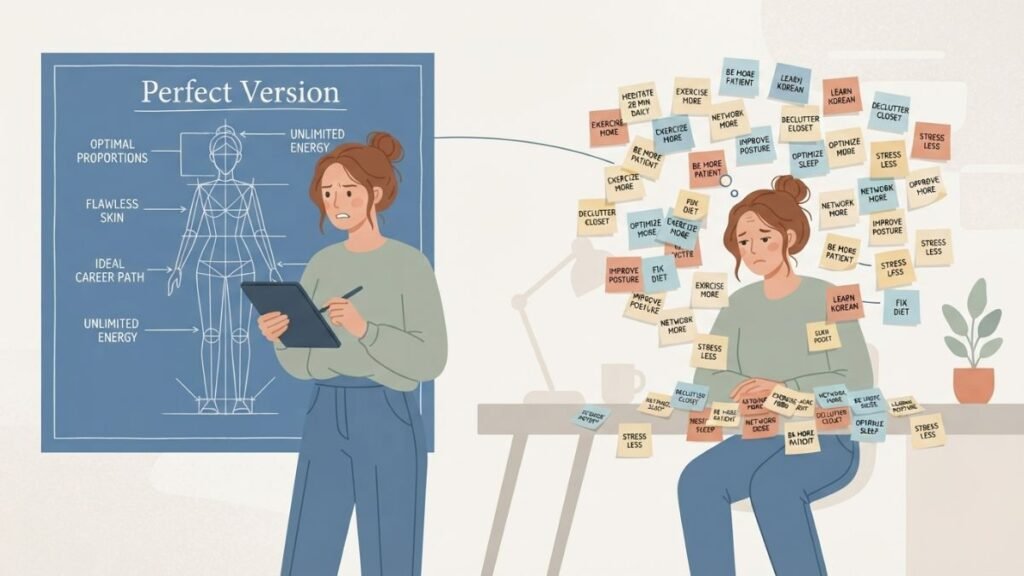
It doesn’t look like self-hatred at least not from the outside. It looks like a woman who’s always improving, always reaching, always striving to become someone slightly different from who she currently is.
You relate to yourself as a project rather than a person. There’s always something being worked on. Always a goal being chased. Always a version of yourself in progress that’s slightly better than the version that exists right now. And the version that exists right now? She’s tolerated. Endured. Treated as the rough draft of a woman who will finally be acceptable once enough revisions have been made. How to be kinder to yourself starts with recognizing this pattern the pattern of treating your current self as temporary. As a placeholder for the improved version. As someone who’s close but not quite close enough to stop working on.
You deflect compliments with corrections. Someone says “you look beautiful.” You hear the compliment and your brain immediately adds a “but” “but I need to lose weight.” “But my skin is terrible today.” “But she’s just being nice.” The deflection isn’t humility. It’s the self-acceptance deficit in action a system so practiced at identifying what’s wrong that it can’t absorb what’s right. How to be kinder to yourself means letting a compliment land without immediately dismantling it with a correction you didn’t ask for and nobody else sees.
You forgive everyone except yourself. A friend makes a mistake you offer understanding. A family member falls short you offer patience. A stranger screws up — you offer grace. You make a mistake you offer punishment. The asymmetry is stark. And it operates so automatically that you don’t notice the double standard until someone else points it out. How to be kinder to yourself isn’t about learning a new skill. It’s about applying a skill you already possess in the one direction you’ve been refusing to aim it — toward yourself.
You rest only when you’ve earned it — and you never feel like you’ve earned it. Rest requires permission. And permission, in your framework, requires justification. You can’t rest because you want to. You can rest because you’ve done enough. But “enough” is a moving target that your inner critic keeps pushing further away. So you work until you’re empty. Then you rest — not from satisfaction, but from collapse. And the rest carries guilt rather than peace because the critic says you should have done more before you stopped. How to be kinder to yourself means resting without a resume. Without proving you deserve the pause. Without the guilt that turns every moment of stillness into evidence of laziness.
Why You Struggle to Accept Yourself as You Are
Acceptance was never modeled for you. You can’t practice what you’ve never witnessed. If the adults in your life — parents, caregivers, the people whose behavior taught you how to relate to yourself — didn’t model self-acceptance, you never received the template. Instead, you received whatever they did model. Self-criticism. Perfectionism. The constant striving toward a version of themselves they could finally approve of. And you absorbed that model as normal. How to be kinder to yourself was never demonstrated by the people who should have demonstrated it first. So you learned their language — the language of perpetual dissatisfaction — and you’ve been speaking it to yourself ever since.
You were accepted conditionally, so you accept yourself conditionally. If love in your childhood was tied to performance — good grades earned approval, good behavior earned warmth, compliance earned attention — you absorbed a fundamental equation. Worth equals performance. Acceptance requires conditions being met. And since the conditions were set by someone else and kept shifting, you internalized a version of self-acceptance that can never be achieved — because the conditions for achieving it were designed to keep moving. How to be kinder to yourself means recognizing that the conditions you’re trying to meet weren’t yours. They were installed by someone whose love came with terms. And those terms were never the prerequisite for self-acceptance. They were the obstacle to it.
You’ve confused self-acceptance with complacency. Somewhere in your development, a dangerous equation formed: accepting yourself as you are means giving up on becoming better. If you accept this version, you’ll stop growing. Stop improving. Stop reaching. And stopping feels dangerous — because stopping means living with the version of yourself your inner critic has spent years telling you isn’t sufficient. How to be kinder to yourself requires dismantling this equation. Self-acceptance and growth aren’t opposites. They’re partners. You can accept who you are right now and still want to develop. The acceptance doesn’t prevent growth. It changes the fuel — from “I’m not enough and I need to fix that” to “I’m enough and I want to expand on that.” Same direction. Entirely different energy.
Your inner critic has been running the show since before you could question it. The voice that interrupts every moment of self-acceptance — the one that says “not yet,” “not like this,” “maybe after you fix this” — wasn’t born when you were an adult. It was installed during childhood. By a parent’s expectations. By a teacher’s corrections. By the specific emotional environment that taught a developing brain that self-scrutiny was necessary for survival. The critic became so integrated, so automatic, so embedded in your internal dialogue that you stopped recognizing it as a foreign voice and started experiencing it as your own. How to be kinder to yourself starts with recognizing that the critic isn’t you. It’s a passenger you’ve been letting drive.
You compare your insides to other people’s outsides. She seems so comfortable in her own skin. He seems so at ease with who he is. They seem to accept themselves without the warfare you wage internally every day. And the comparison produces a specific conclusion — everyone else has figured out the thing you can’t. Self-acceptance is available to them but not to you. How to be kinder to yourself means recognizing that the comparison is structurally flawed. You’re comparing your private inner experience — the full, unedited chaos of self-doubt — to their public presentation. You’re not seeing their inner critic. You’re seeing their curated exterior. And measuring your interior against someone else’s exterior will always make you feel like you’re losing a race everyone else has already won.
You’ve been rewarded for self-improvement and penalized for self-acceptance. The world reinforces your struggle. “Always be improving.” “Never settle.” “Hustle harder.” “You’re not where you should be yet.” The messaging is relentless — from social media, from professional culture, from the wellness industry that profits from your perpetual dissatisfaction. And mixed into the messaging is a subtle punishment for contentment — a framing that positions acceptance as laziness and satisfaction as settling. How to be kinder to yourself means pushing against a current that flows in the opposite direction. The world profits from your self-criticism. Your peace profits from your self-acceptance. And the two are in direct competition.
You’re afraid of what you’d feel if you actually stopped fighting yourself. Beneath the constant striving and self-criticism and relentless improvement, there’s something you might be avoiding. The grief of having spent years at war with yourself. The sadness of never having been told you were okay as you were. The anger at the people who installed the conditions that made self-acceptance feel unreachable. Acceptance doesn’t just bring peace. It brings everything you’ve been suppressing while the fighting kept you busy. How to be kinder to yourself might require sitting with emotions you’ve been outrunning — emotions that the constant self-improvement was, in part, designed to prevent you from feeling.
What the Struggle Against Self-Acceptance Is Doing to You
You’re exhausted by the war you’re waging against yourself. The energy consumed by self-criticism — the constant internal monitoring, the deflecting of every positive input, the relentless pursuit of a version of yourself that might finally be acceptable — is staggering. And the exhaustion doesn’t present as tired. It presents as heavy. As a weight you can’t name that sits on everything you do. The heaviness isn’t from your life’s demands. It’s from the internal battle that runs underneath those demands — consuming resources that should be available for living rather than fighting.
You can’t be present because you’re always becoming. Every moment is oriented toward the future version — the improved one, the fixed one, the one who will finally be enough. And the orientation toward becoming prevents the experience of being. You can’t enjoy today because today’s version of you is the one that hasn’t been completed yet. You can’t celebrate now because now is the construction zone. How to be kinder to yourself means allowing the present version to exist as a complete entity — not a work in progress waiting for the renovation to finish.
You absorb criticism easily but can’t absorb love. Criticism confirms what the inner critic has been saying. It fits. It matches. It slides into place without friction. Love doesn’t fit. It bounces off the surface your self-criticism has hardened. Compliments feel suspicious. Affection feels undeserved. Positive regard feels like a mistake that will be corrected once they see the real you — the one your critic has been cataloging so thoroughly. How to be kinder to yourself means softening the surface enough that love can penetrate it. Not by forcing yourself to believe compliments. By weakening the critic’s case enough that the compliments can compete.
You’ve lost access to genuine self-compassion. You can perform it. You can say the affirmations. You can journal the prompts. But the felt experience of looking at yourself with genuine warmth — the internal version of a mother looking at her child with unconditional love — is missing. It’s not that you’re incapable of it. It’s that the pathway to it has been blocked by years of self-criticism that hardened over the opening. How to be kinder to yourself isn’t about generating compassion from nothing. It’s about clearing the path to compassion that was always available but has been obstructed by the critic’s accumulated debris.
What You Need to Do
Stop waiting to be finished before you accept yourself. You will never be finished. Human beings aren’t projects that reach completion. They’re processes that continue until they end. And if your self-acceptance is conditional on completion, it will never arrive — because completion doesn’t exist. Accept the unfinished version. Accept the version with the flaws the critic identified and the ones it hasn’t found yet. How to be kinder to yourself means accepting yourself mid-renovation. With the scaffolding still up. With the rough edges still visible. With the parts you wish were different still being exactly what they are.
Identify the critic’s voice and reduce its authority. Start catching the moments when the critic speaks. “You should have done better.” “That wasn’t good enough.” “Look at what she achieved — why haven’t you?” Catch it. Label it: “That’s the critic. Not me.” Then offer the alternative — the compassionate response that the critic’s voice overrides. “I did my best today. My best was enough.” How to be kinder to yourself requires a daily practice of interrupting the critic and replacing its commentary with something accurate rather than punishing.
Practice accepting one thing about yourself daily without conditions. Not something you’ve improved. Something that exists as is. Your laugh — even if it’s loud. Your body — even if it doesn’t match the standard. Your sensitivity — even if someone called it too much. Your way of loving — even if it’s been unmatched. One thing. Every day. Accepted without the word “but” anywhere near it. How to be kinder to yourself is built through micro-practices that accumulate into something larger — the gradual expansion of the territory inside you where acceptance is allowed to live.
Stop using other people’s approval as the prerequisite for self-acceptance. You’ve been waiting for external permission — for enough people to tell you you’re okay before your system will believe it. But external approval is unreliable, inconsistent, and always subject to the other person’s limitations. How to be kinder to yourself means generating the permission internally. Not because external validation doesn’t matter. Because it can’t be the foundation. The foundation has to come from you. External approval can decorate the house. It can’t build it.
Let yourself feel the grief underneath the striving. The constant self-improvement has been keeping something at bay — the sadness of having spent years at war with someone who deserved peace. Let it surface. Not all at once. In manageable doses. With support. The grief isn’t weakness. It’s the natural emotional response of a woman who’s finally seeing how long she’s been fighting herself — and how unnecessary the fight always was. How to be kinder to yourself sometimes means crying for the version of you who never received the kindness she was always giving everyone else.
Get professional support. How to be kinder to yourself at the deepest level — where the struggle connects to childhood conditioning, where the critic has been running for decades, where the permission for self-acceptance was never granted by the people who should have given it first — requires therapeutic intervention. A therapist can help you identify the critic’s origin, develop self-compassion practices that reach beneath the surface, and rebuild the relationship with yourself from adversarial to allied.
What You Need to Understand
Self-acceptance isn’t the finish line of self-improvement. It’s the starting line. Everything you build after acceptance is built on solid ground. Everything you build without it is built on a foundation that’s always shifting — because the foundation is conditional, and conditions that keep changing can never support anything permanent.
How to be kinder to yourself isn’t a technique. It’s a revolution — against the internal regime that’s been governing your self-relationship with rules you didn’t write, standards you can’t meet, and conditions that were never designed to be satisfied. The regime was installed by someone else. And overthrowing it is your right. Not because you’ve earned the revolution through enough improvement. Because the regime was illegitimate from the start.
You are acceptable right now. Not the future version. Not the version that loses the weight, gets the promotion, fixes the flaw, achieves the milestone. This version. The one reading these words with the critic running in the background saying “but you still need to…” You. As you are. In this moment. With everything the critic has cataloged and everything it hasn’t. Acceptable. Worthy of the kindness you’ve been giving away to everyone except the one person who needed it most.
What You Deserve
You deserve to accept yourself without conditions. Without the prerequisite of perfection. Without the requirement of completion. Without the approval of someone whose opinion your inner critic has been waiting for since childhood.
You deserve to look at yourself — the real, unedited, unfinished version — and feel warmth instead of judgment. To see your flaws and call them human instead of unacceptable. To acknowledge your imperfections without them disqualifying you from the kindness you extend to everyone else automatically.
You deserve your own gentleness, sis. Not the performed kind. Not the kind that exists on a journal page but can’t be felt in your chest. The real kind. The kind that looks at you on your worst day and says “I see you. I accept you. And nothing you could fix, improve, or change would make you more deserving of this than you already are.”
How to be kinder to yourself? Start here. With the woman you are right now. She’s been waiting for your kindness her entire life.
Stop making her wait.
The Bottom Line
You struggle to accept yourself as you are because acceptance was never modeled, because love in your childhood was conditional, because your inner critic was installed before you could question it, because you’ve confused self-acceptance with complacency, and because the world profits from your perpetual dissatisfaction while your peace requires the opposite.
How to be kinder to yourself isn’t about adding another self-help strategy to the pile. It’s about removing the obstacle that prevents every strategy from working — the fundamental belief that you haven’t earned the right to be kind to yourself yet.
You’ve earned it. You earned it before the earning started. You earned it before the first condition was set. You earned it by existing — which was always the only qualification kindness toward yourself required.
The critic forgot to tell you that. But the truth didn’t change just because the critic didn’t mention it.
You were always enough. The kindness was always deserved. And the permission you’ve been waiting for was always yours to give.
FAQ
Q: Why can I be kind to others but not to myself?
Because the kindness you extend outward was developed in a different part of your emotional system than the one that governs self-treatment. Your empathy for others was encouraged. Your empathy for yourself was discouraged — through modeling, through conditional love, through a culture that rewards self-sacrifice and punishes self-compassion. The skill exists. The permission to aim it inward doesn’t. Therapy can help bridge that gap.
Q: Isn’t being hard on myself what made me successful?
Partially — self-criticism can drive achievement. But research consistently shows that self-compassion produces more sustained motivation with less psychological damage. You succeeded in spite of the harshness, not because of it. And the cost of that harshness — the exhaustion, the inability to enjoy achievements, the perpetual dissatisfaction — is higher than any success it produced. You can be driven and kind to yourself simultaneously. They’re not mutually exclusive.
Q: What if accepting myself feels fake?
It will — at first. Not because it’s fake, but because it’s unfamiliar. Your system has been running self-criticism for so long that self-acceptance triggers the same “this doesn’t fit” response that any new experience produces. The fakeness is the gap between what you’ve been practicing and what you’re starting to practice. The gap closes with repetition. Not immediately. But genuinely.
Q: How do I know the difference between self-acceptance and settling?
Self-acceptance says “I’m worthy of love and belonging as I am right now.” Settling says “this situation doesn’t serve me but I’ll stay because I don’t deserve better.” One is about your relationship with yourself. The other is about your relationship with circumstances. Accepting yourself fully actually makes you less likely to settle — because a woman who knows her worth doesn’t tolerate situations that don’t reflect it.
Q: What if my inner critic is so loud I can’t hear anything else?
That loudness is the critic’s power — but it’s also its vulnerability. A voice that has to be that loud is a voice that’s fighting to stay relevant. Start building the alternative voice — the compassionate one — even if it starts as a whisper. Over time, with practice and therapeutic support, the compassionate voice strengthens. The critic doesn’t need to be silenced entirely. It just needs to be outweighed by something truer.