
Sis, let me describe something you do to yourself that nobody else requires of you.
You punish yourself. Constantly. Quietly. With a ruthlessness that would horrify you if you directed it at anyone else. You hold yourself to standards so high that failure is built into the structure because the standards weren’t designed to be met. They were designed to keep you striving. Keep you proving. Keep you running on a treadmill of self-improvement that never produces the moment where you stop and say “I’m enough now. I can rest.”
You criticize yourself for things that don’t warrant criticism. Replay conversations searching for what you did wrong. Audit your own behavior with the precision of a woman who believes every misstep is evidence of a larger deficiency. You’re harder on yourself than any boss, any partner, any friend has ever been and the harshness feels justified. Because somewhere deep inside, a voice says “if you were better, you wouldn’t always be the backup option. If you were enough, someone would have made you the first choice by now.”
And that voice the one that connects your self-criticism to your position in other people’s lives is the engine driving everything. Why am I so hard on myself? Because you believe the backup position is your fault. That being the second choice, the fallback, the one people turn to when their preferred option isn’t available is a reflection of something deficient in you rather than something limited in them. And the self-punishment isn’t random cruelty you inflict for no reason. It’s the corrective measure your wound prescribes the belief that if you criticize yourself hard enough, fix yourself thoroughly enough, and improve yourself relentlessly enough, you’ll finally become the woman someone chooses first.
But the self-punishment hasn’t produced that result. Not once. Because the backup position was never about your quality. It was about their vision. And no amount of self-improvement changes someone else’s ability to see what’s standing right in front of them.
What Being Hard on Yourself as the Backup Option Looks Like
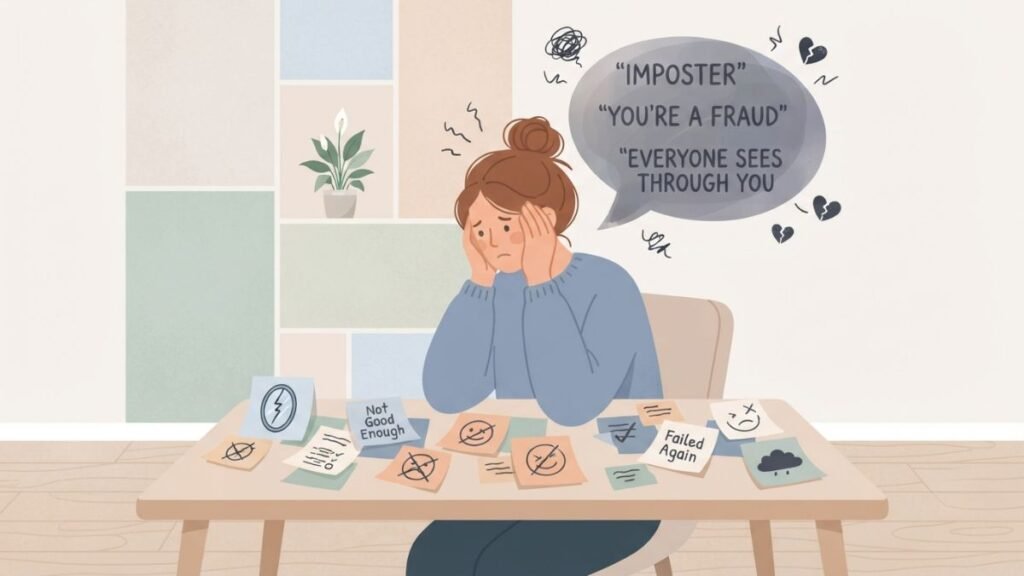
It doesn’t look like obvious self-destruction. It looks like a woman who’s incredibly driven, impossibly disciplined, and perpetually unsatisfied with herself because satisfaction would mean accepting a version of herself that she’s been taught isn’t enough.
You catalog your flaws with surgical precision. Every perceived shortcoming has been identified, labeled, and filed. Your appearance. Your personality. Your emotional patterns. Your relationship history. You know your deficiencies the way a mechanic knows an engine intimately, technically, with an awareness designed to fix problems. Except the “problems” you’re cataloging aren’t mechanical failures. They’re human qualities that your wound has reclassified as defects. Why am I so hard on myself? Because you’ve been maintaining a detailed inventory of everything that might explain why you’re the backup and the inventory keeps growing because the wound keeps finding new items to add.
You interpret every setback as confirmation of your inadequacy. He didn’t call back proof that you’re not compelling enough. The friendship faded proof that you’re not valuable enough to pursue. The opportunity went to someone else proof that your best doesn’t compete with other people’s average. Every setback, regardless of its actual cause, gets processed through the backup filter the lens that converts every disappointment into evidence that you’re inherently second-tier. Why am I so hard on myself? Because the filter is running constantly, converting life’s normal disappointments into a personalized indictment that never stops building its case.
You apologize for things that don’t require apologies. “Sorry for bothering you.” “Sorry for taking up space.” “Sorry for having a need.” “Sorry for existing at a volume that requires acknowledgment.” The apologies aren’t responses to actual offenses. They’re pre-emptive submissions offerings designed to soften your presence before it triggers the rejection you’re anticipating. Why am I so hard on myself? Because being the backup taught you that your natural presence is an imposition and apologies are the tax you pay for existing at a level that might inconvenience someone.
You hold yourself to standards you’d never impose on anyone you love. Your friend makes a mistake you offer compassion. Your sister falls short you offer grace. Someone you care about struggles you offer patience. But when you make a mistake? When you fall short? When you struggle? The compassion evaporates. The grace disappears. The patience you extend to everyone else gets replaced by a severity that would qualify as cruelty if you directed it outward. Why am I so hard on myself? Because the standard you hold yourself to isn’t a standard of excellence. It’s a standard of punishment designed not to help you improve but to ensure you never stop trying to deserve something your wound has convinced you doesn’t belong to you.
Why You’re So Hard on Yourself
Being the backup taught you that your default self needs correction. The first time you realized you were someone’s second choice — whether a parent who favored a sibling, a friend who preferred someone else, a man who chose you only after his first option fell through — your brain drew a specific conclusion. Not “they have limited vision.” Not “the selection says something about them.” Your brain concluded: “something about me, as I naturally exist, is insufficient. And the insufficiency is why I’m the backup.” From that moment, self-improvement became self-correction. Not growth for its own sake. Growth aimed at fixing the thing about you that you believe keeps producing the backup position. Why am I so hard on myself? Because you’re trying to correct a deficiency that doesn’t exist — using tools of self-criticism that were never going to reach the actual problem, which lives in their capacity, not yours.
Self-criticism became your coping mechanism for powerlessness. When you can’t control whether someone chooses you — when the decision about your position in someone’s life lives entirely in their hands — the powerlessness is unbearable. So your brain does what brains do with unbearable powerlessness — it finds something to control. And the thing it finds is you. Your appearance. Your behavior. Your personality. Your emotional output. If you can’t control their choosing, at least you can control your quality. And controlling your quality through relentless self-criticism creates the illusion that the outcome is in your hands. Why am I so hard on myself? Because self-criticism is the only lever your wound could find in a situation where all the other levers belong to someone else.
The self-punishment feels productive even when it’s destructive. There’s a paradox inside self-criticism that keeps it running. The harshness feels like action. Like you’re doing something about the problem. Like the internal voice that catalogs your flaws and demands improvement is a coach driving you toward the version of yourself that finally gets chosen first. But the coach isn’t coaching. It’s abusing. And the “improvement” it produces isn’t growth — it’s exhaustion disguised as progress. Why am I so hard on myself? Because the harshness mimics productivity. It feels like work. And work feels better than the alternative — sitting with the truth that your backup position was never about your quality and therefore isn’t fixable through self-improvement.
You absorbed someone else’s inability to see you as your personal failure. A parent who couldn’t see your worth. A partner who couldn’t recognize your value. A friend who couldn’t appreciate your depth. In each case, their vision was the limitation. But you didn’t process it that way. You processed it as: “I wasn’t worth seeing. I wasn’t valuable enough to recognize. My depth wasn’t deep enough to appreciate.” Why am I so hard on myself? Because you internalized other people’s visual limitations as your personal deficiency. And the self-criticism you carry is the corrective response to a deficiency that was never yours — it was theirs, projected onto you through the absence of the seeing you deserved.
Perfectionism became the survival strategy for conditional love. If love in your experience was conditional — awarded for achievement, compliance, performance — then perfectionism isn’t a personality trait. It’s a survival mechanism. The self-criticism that drives it isn’t optional. It’s essential — because in the conditional love framework, any imperfection is a risk factor. Any flaw is a potential reason for the love to be revoked. Any moment of being less than perfect is a moment where the backup position becomes permanent. Why am I so hard on myself? Because the love I received taught me that my worth fluctuates with my performance. And the self-criticism is the quality control system that ensures my performance never drops below the threshold where love gets withdrawn.
You’ve never experienced someone being gentle with your imperfections. You’ve been corrected. Criticized. Held to standards that shifted every time you got close. But have you been held in your imperfection? Has someone looked at your flaws — your real ones, not the manufactured ones your wound invents — and said “these are part of you and I love you with them, not despite them”? If that experience is missing, the template you’re operating from says imperfection is intolerable. And intolerable imperfection requires constant surveillance — which your self-criticism provides. Why am I so hard on myself? Because nobody ever showed you that gentleness with yourself was an option. Every model you received for handling your imperfections involved harshness. So harshness is the only tool in your kit.
You believe that being hard on yourself prevents other people from being harder. If you criticize yourself first — if you identify every flaw before anyone else can — then nobody else’s criticism can surprise you. You’ve pre-empted the rejection by rejecting yourself. You’ve beaten the judges to the verdict by convicting yourself in advance. Why am I so hard on myself? Because self-criticism, in your framework, is preemptive defense. If you’ve already identified everything wrong with you, nobody can hurt you by finding it first. The harshness isn’t self-improvement. It’s armor. And the armor costs you the very tenderness you deserve most.
What Being Hard on Yourself Is Doing to You
You can’t enjoy your own accomplishments. You finish something. Hit a goal. Achieve something meaningful. And before the satisfaction can settle — before the joy can arrive — the critic shows up. “It wasn’t that impressive.” “Other people do this all the time.” “You should have done it sooner.” “It doesn’t make up for everything else you haven’t accomplished.” The self-criticism intercepts your joy before it can form. And a woman who can’t enjoy her own accomplishments is a woman whose self-worth will never stabilize — because every piece of evidence that could strengthen it gets dismantled by the internal critic before it can be absorbed.
You’re exhausted from the constant internal monitoring. The critic never sleeps. It runs during conversations — analyzing what you said for errors. During downtime — reviewing your day for failures. During moments of rest — scanning for evidence that rest was undeserved. Why am I so hard on myself? Because the monitoring system that produces the harshness operates twenty-four hours a day with no off switch. And the energy consumed by that monitoring is energy not available for living, creating, connecting, or simply existing without the exhausting burden of self-surveillance.
You accept treatment from others that mirrors your self-treatment. A man who’s critical of you? Familiar. A friend who’s harsh? Tolerable. A dynamic where your flaws are regularly highlighted? Normal. Because the treatment you receive from others matches the treatment you give yourself. And matching treatment feels deserved rather than abusive. The self-criticism hasn’t just damaged your relationship with yourself. It’s calibrated your tolerance for mistreatment from others — because a woman who punishes herself daily has no basis for recognizing when someone else’s punishment crosses a line she should be defending.
You’ve created an identity around never being enough. “I’m the woman who tries hard but falls short.” “I’m the one who’s close but never quite there.” “I’m the backup.” The identity isn’t something you chose. It’s something the wound constructed — and you’ve been living inside it so long that it feels permanent rather than installed. Why am I so hard on myself? Because the identity of not-enough requires constant maintenance through self-criticism. And the maintenance has become so automatic that it feels like personality rather than pathology.
Your relationship with yourself is adversarial. You are simultaneously the defendant and the prosecutor. The accused and the judge. The person who fails and the person who punishes the failure. There is no defense attorney in this courtroom. No one arguing for leniency. No voice that says “the defendant has shown extraordinary effort and deserves compassion.” The case is always the same. The verdict is always guilty. And the sentence is always more criticism.
What You Need to Do
Start noticing the critic’s voice as separate from your own. The voice that catalogs your flaws, intercepts your joy, and delivers the harshest possible assessment of your worth isn’t yours. It was installed — by a parent, a partner, a system that profited from your self-punishment. Start separating the voice from your identity. When the criticism arrives, catch it: “That’s the wound speaking. Not me. Not the truth.” The separation won’t happen instantly. But every time you identify the critic as foreign rather than native, you weaken its authority. Why am I so hard on myself? Because a voice that isn’t mine has been speaking from inside my head for so long I forgot it wasn’t mine.
Talk to yourself the way you talk to someone you love. You know how to be gentle. You do it for everyone except yourself. Start redirecting that gentleness inward. When you make a mistake, say what you’d say to your best friend: “That’s okay. You’re human. This doesn’t change your value.” When you fall short of a standard, offer what you’d offer a sister: “You did your best. Your best is enough.” Why am I so hard on myself? Because gentleness was never modeled as something I direct inward. Start modeling it now. For yourself. By yourself. With the same fierceness you bring to defending everyone else.
Stop trying to fix the thing that makes you “the backup.” The thing doesn’t exist. The backup position wasn’t produced by your deficiency. It was produced by other people’s limited vision. Stop treating yourself as a renovation project — something that needs enough work to finally qualify for first-choice status. You already qualify. You qualified before the self-improvement marathon started. Why am I so hard on myself? Because I’ve been trying to fix a deficiency that was never mine. Stop fixing. Start accepting. The woman you are right now — imperfect, human, unfinished — is enough.
Challenge the backup narrative directly. “I am not the backup. I’ve been treated as the backup by people who couldn’t see my value. Their inability to choose me first was about their vision, not my worth.” Say it. Write it. Repeat it until the narrative shifts from “I’m the backup because I’m insufficient” to “I was treated as the backup by people who were insufficient.” Why am I so hard on myself? Because the narrative was never rewritten. Rewrite it now.
Create evidence against the critic. The critic runs on evidence — selectively gathered, heavily filtered, exclusively negative. Start building a counter-file. Every time you did something well. Every time someone valued you. Every time your effort produced something meaningful. Every time you showed up and it mattered. The counter-file doesn’t need to be dramatic. It needs to be real. And over time, the accumulated evidence weakens the critic’s case — because the case was always built on selective data.
Get professional support. Why am I so hard on myself? Sometimes the answer requires excavation a woman can’t do alone. A therapist can help you trace the critic to its origin, separate the installed voice from your actual self-assessment, develop self-compassion practices that replace the harshness with something sustainable, and rebuild the relationship with yourself from adversarial to allied.
What You Need to Understand
Being hard on yourself isn’t strength. It’s a wound response — the internalized version of someone else’s failure to see your worth. The critic that runs inside your head wasn’t born there. It was placed there — by environments that rewarded your self-punishment, by relationships that confirmed your backup position, by a culture that tells women their worth is conditional and their flaws are comprehensive.
Why am I so hard on myself? Because someone was hard on you first. And the harshness got internalized so deeply that it feels like your own voice when it’s actually an echo of theirs. The criticism you deliver to yourself daily isn’t accurate assessment. It’s inherited abuse — directed inward instead of outward, running on autopilot instead of through conscious choice.
You deserve gentleness from the person who knows you best — which is you. Not the dismissive gentleness of “just be positive.” The real kind. The kind that holds your imperfections without needing to fix them. That acknowledges your shortcomings without converting them into identity. That says “you’re trying and that matters” instead of “you should have tried harder.” The same gentleness you offer everyone else without hesitation. Directed inward. For the first time. Not because you’ve earned it through enough improvement. Because you deserve it as you are.
What You Deserve
You deserve to stop punishing yourself for other people’s limited vision. To stop treating their inability to choose you first as evidence of your insufficiency. To stop running a renovation project on a woman who was never the thing that needed renovating.
You deserve to rest inside your own self-assessment. To look in the mirror and see what’s there — not perfection, but plenty. Not flawlessness, but fullness. Not a backup option, but a woman whose worth was always first-choice material — stationed in front of people who didn’t have the range to see it.
You deserve your own compassion, sis. The same compassion you pour into everyone around you without hesitation. Turned inward. Applied daily. Given freely. Not because you’ve finally fixed enough to deserve it. Because you deserved it the whole time.
You were never the backup. You were the answer — standing in rooms full of people who kept asking the wrong question.
The Bottom Line
You’re so hard on yourself because being the backup option installed a belief that your default self needs correction, because self-criticism became your coping mechanism for the powerlessness of being unchosen, because perfectionism was the survival strategy conditional love required, because you internalized other people’s inability to see you as your personal failure, and because no one ever showed you that gentleness with yourself was an option.
Why am I so hard on myself? Because a wound that was never yours convinced you that the harshness was necessary. That the punishment was productive. That the relentless self-improvement would eventually produce the woman someone chooses first.
But you were always that woman. Before the improvement started. Before the criticism began. Before the backup position was assigned by people whose judgment was never qualified to determine your worth.
Stop punishing yourself for their verdict, sis. Their verdict was about their vision. Your worth was always about your existence. And your existence — unimproved, unpolished, exactly as it is today — was always enough.
The critic just forgot to mention that part.
FAQ
Q: How do I start being kinder to myself when the self-criticism feels automatic?
Start by catching the critic mid-sentence. You won’t be able to stop it from starting — the automation is too practiced. But you can interrupt it once you notice it’s speaking. “That’s the critic. Not me. Not the truth.” Then deliberately offer the alternative — the compassionate response you’d give anyone else. The interruption is the practice. And the practice, repeated daily, weakens the automation over time.
Q: What if I’m afraid that being easier on myself will make me lazy or complacent?
The critic has sold you this fear — that self-compassion produces mediocrity. Research shows the opposite. Self-compassion produces more sustained motivation than self-criticism because it doesn’t deplete the emotional resources that effort requires. You’re not lazy when you’re gentle with yourself. You’re resourced. And resourced people outperform depleted people every time.
Q: Why can I be compassionate with everyone except myself?
Because the self-criticism was installed before the compassion for others developed. The harshness toward yourself lives at a deeper, earlier layer of programming than the kindness you extend outward. Reaching it requires going back further — to the origin of the critic, to the first moment when harshness was the only response available for your imperfections. A therapist can help you access that layer.
Q: What if being the backup option keeps happening in my current relationships?
Look at who you’re choosing. If the backup position keeps recurring, the pattern is in your selection — drawn to people whose limited capacity recreates the familiar dynamic. You’re not being chosen as the backup because you’re backup material. You’re being chosen as the backup because you’re choosing people whose capacity for choosing is limited. Change the selection. The position changes with it.
Q: Can the inner critic ever be silenced completely?
Silenced completely? Probably not — the voice has been running too long to disappear entirely. But it can be reduced to a whisper that you hear and dismiss rather than a command you hear and obey. The critic becomes background noise rather than the dominant voice. Your own voice — the compassionate, accurate, fair one — becomes louder. And eventually, when the critic speaks, you respond with something the critic never expected: “I hear you. And I disagree.”