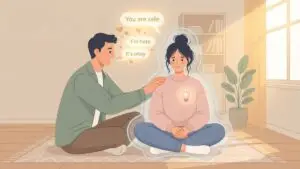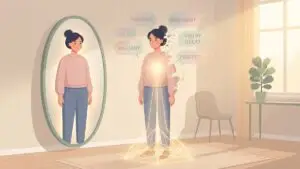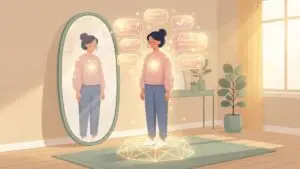
Sis, let me describe something you’ve been doing so long it doesn’t even register as a choice anymore.
You make yourself smaller.
Not physically although maybe that too. Emotionally. Energetically. You walk into rooms and compress. You enter relationships and contract. You show up to your own life and immediately begin the process of reduction editing your personality, softening your presence, muting the parts of you that feel too loud, too visible, too much for the space you’ve been told you’re allowed to occupy.
You laugh quieter than you want to. You share less than you feel. You hold opinions you don’t voice. You carry needs you don’t express. You take up less space than your body, your mind, and your heart actually require because somewhere deep inside you, a belief operates like a law of physics: the smaller I am, the safer I am. The less of me that’s visible, the less of me that can be rejected. The less space I occupy, the less likely I am to be told I’m taking up too much.
And the cruelest part? It works. The shrinking does produce a version of love. People don’t leave the small version of you. They don’t get overwhelmed by her. They don’t look at her and say “that’s too much.” The small version is easy. Convenient. Manageable. Loved — in the way that managed things are loved. The way you love something that doesn’t inconvenience you. The way you love something that stays exactly where you put it.
But that’s not love, sis. That’s tolerance. And the difference between being loved and being tolerated is the difference between a woman who’s fully alive inside her own life and a woman who’s slowly disappearing inside it.
What Shrinking to Be Loved Looks Like
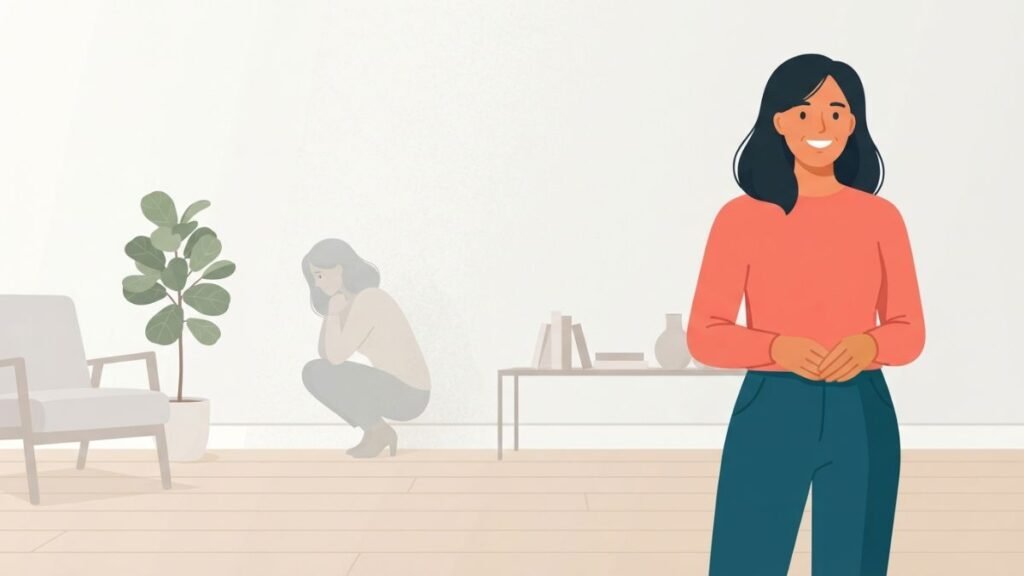
It doesn’t look like weakness from the outside. Sometimes it looks like grace. Like flexibility. Like a woman who’s “easygoing.” But underneath the easygoing surface is something much more painful.
You edit your personality based on who you’re with. You’re one version with friends — louder, funnier, more alive. You’re a different version with him — quieter, more careful, more contained. The editing isn’t conscious. It’s automatic — a program that runs the moment you enter a dynamic where your full self might be too much. Why do I feel invisible? Because the visible version of you has been systematically replaced by a version that’s been trimmed to fit inside someone else’s comfort level.
You suppress your needs before they’re fully formed. Something hurts. Something bothers you. Something needs addressing. And before the need can crystallize into words, a voice inside — one that sounds like yours but was installed by someone else — says “don’t.” Don’t bring it up. Don’t make it a thing. Don’t be the one who creates discomfort. The need gets swallowed. The issue gets buried. And the woman who needed something adds it to the invisible pile of things she carries alone because expressing them would make her too visible in a dynamic that rewards her invisibility.
You celebrate yourself quietly — if at all. An accomplishment. A milestone. Something you’re proud of. And instead of owning it — fully, loudly, with the joy it deserves — you minimize it. “It’s not that big a deal.” “I got lucky.” “Other people do way more impressive things.” The minimization isn’t humility. It’s the shrinking reflex applied to your own joy. Because even joy — expressed at full volume — feels too visible for a woman who’s been taught that visibility is dangerous.
You feel most comfortable when you’re in the background. Not because you prefer it. Because the background is where you’ve learned the least amount of rejection lives. Center stage means being seen fully. Being seen fully means being evaluated. Being evaluated means potentially being told you’re too much. The background avoids all of that. It’s safe. It’s quiet. And it’s slowly erasing you.
Why You Feel Like You Have to Shrink to Be Loved
Someone punished your full self before you knew there was a smaller version to perform. This is the origin. Not your last relationship. Not your social anxiety. The first moment — maybe a collection of moments — where being fully yourself produced a consequence. A parent who responded to your energy with “calm down.” A caregiver who responded to your emotions with “you’re too much.” A household where the most loved version of the child was the quiet one. The manageable one. The one who didn’t take up space that the adults needed for themselves. Why do I feel invisible? Because someone looked at the full version of me and communicated — through words, through withdrawal, through the specific energy of displeasure — that full wasn’t welcome. And the smaller version that was welcome became the version I learned to be.
Being “too much” was punished while being “not enough” was rewarded. Think about the incentive structure your childhood created. When you were loud, you were corrected. When you were quiet, you were praised. When you expressed big emotions, you were told to tone it down. When you managed your emotions invisibly, you were called “mature” or “easy” or “good.” The reward system was clear — the less of you that was visible, the more approval you received. Why do I feel invisible? Because the visibility was systematically discouraged through a reward structure that made smallness the price of love and fullness the cause of its withdrawal.
A relationship taught you that your expansion threatened his position. Maybe he didn’t say “be smaller.” Maybe he communicated it through subtler channels. He got quiet when you were passionate. Withdrew when you were confident. Became cold when you shined in ways that drew attention. Your growth — professionally, personally, socially — didn’t inspire his admiration. It triggered his insecurity. And his insecurity taught you that your expansion was dangerous. That a woman who takes up space takes something from the man beside her. That love requires you to stay small enough that his ego never feels threatened by your size. Why do I feel invisible? Because a man whose love was conditional on your smallness taught you that visibility is what costs you the thing you need most.
You’ve been socialized to believe that good women are small women. Culture has been delivering this message for generations. Good women are quiet. Good women don’t take up too much space. Good women put others first. Good women don’t draw attention. Good women manage, accommodate, defer, soften, shrink. The socialization isn’t always explicit. Sometimes it lives in the way loud women get labeled “aggressive” while loud men get labeled “confident.” In the way women who advocate for themselves get called “difficult” while men who advocate for themselves get called “leaders.” Why do I feel invisible? Because the world has been telling women — through a thousand channels, since birth — that the most lovable version of a woman is the least visible one.
You’ve confused disappearing with belonging. In your framework, belonging means fitting in. And fitting in means adjusting yourself to match the contour of whatever space you’re entering. You don’t enter rooms as you are. You enter rooms as whoever the room requires you to be. The shape-shifting has been so thorough, so practiced, so automatic that you’ve lost track of your original shape. Why do I feel invisible? Because belonging, in your experience, has always meant erasing the parts of yourself that don’t match the environment. And the erasure has been happening for so long that the erased parts might not be accessible anymore without deliberate effort to recover them.
Your full self was never mirrored back to you as valuable. A child learns her worth through reflection — through the responses of caregivers who see her fully and communicate, through consistent behavior, that what they see is precious. If that reflection was absent — if nobody looked at the full, loud, emotional, alive version of you and said “yes, all of this is wonderful” — you never developed the internal sense that your fullness deserves space. Why do I feel invisible? Because nobody ever held a mirror up to the complete version of me and said “this is exactly who you should be.” Without that mirror, fullness feels risky. Because fullness without validation feels like exposure without armor.
Shrinking has been your survival strategy for so long it feels like your identity. You don’t experience the shrinking as a behavior anymore. You experience it as who you are. “I’m just a quiet person.” “I don’t like attention.” “I’m more of a background person.” These feel like personality descriptions. They’re not. They’re survival strategies that calcified into identity. Why do I feel invisible? Because the strategy I used to survive an environment that punished my visibility has become so embedded that I can’t tell the difference between who I chose to be and who I was trained to become.
What Shrinking Is Doing to You
You’re living as a fraction of yourself. The full you — the one with opinions, with volume, with presence, with needs that deserve space — exists somewhere underneath the reduced version. But the reduced version has been running the show so long that the full version feels theoretical rather than accessible. You know she’s there. You’ve caught glimpses — in safe spaces, with safe people, in moments where the surveillance momentarily dropped. But in the day-to-day reality of your relationships and your life, she’s buried. Invisible. Which is the entire point of the question — why do I feel invisible? Because you are. Not because you don’t exist. Because the version of you that exists in public is a fraction of the version that exists inside.
You attract people who are comfortable with your smallness. The reduced version of you draws a specific kind of person — one who benefits from your self-editing, your silence, your accommodation. A partner who prefers you quiet. Friends who like you manageable. People who enjoy the version of you that doesn’t challenge, doesn’t disrupt, doesn’t take up the space that healthy human beings are entitled to take up. The smallness attracts people whose love depends on it. And those people will resist your expansion with the same energy that the original wound used to install the shrinking.
You feel invisible even when you’re seen — because the version being seen isn’t really you. People see the edited version. The managed version. The carefully constructed presentation that was designed to be lovable by being invisible enough not to trigger rejection. They see someone — but that someone isn’t you. She’s the character you play. And being seen as a character produces a specific kind of loneliness — the loneliness of being watched while being hidden. Of being present while being absent. Of being in the room while the real you exists somewhere the room will never reach.
You carry a specific grief for the life your full self would have lived. The career you would have pursued if you weren’t afraid of being too visible. The relationship you would have demanded if you weren’t afraid of taking up too much space. The friendships you would have deepened if you weren’t afraid of being too much to hold. The joy you would have expressed if you weren’t afraid of being seen enjoying your own life too loudly. The grief isn’t for something that was taken. It’s for something that was never allowed to form — because the shrinking prevented its development before it could begin.
Your body holds what your behavior suppresses. The tension in your jaw from words you didn’t say. The tightness in your chest from feelings you didn’t express. The knot in your stomach from needs you swallowed before they could surface. Your body is a warehouse for everything your shrinking wouldn’t let through. And the warehouse is full. The physical symptoms you can’t explain — the anxiety, the fatigue, the heaviness — are the body’s version of the question your mind keeps asking. Why do I feel invisible? Because everything real about me has been stored inside my body instead of expressed through my life.
What You Need to Do
Start taking up space deliberately. Not aggressively. Deliberately. Speak when the impulse to stay quiet fires. Share the opinion your filter is trying to catch. Express the need your programming is trying to suppress. One act of visibility per day. That’s the practice. Not a dramatic transformation overnight. One daily choice to let the full version of you exist in a space where the reduced version has been operating. The discomfort will be real. The instinct to retract will be strong. That instinct is the wound protesting. Let it protest. And take up the space anyway.
Stop editing your personality for other people’s comfort. You’ve been adjusting yourself to match whatever environment you enter. Stop. Walk into the room as you are. Not the loud version you think you should be. Not the quiet version you’ve been trained to be. The actual version — wherever she falls on the spectrum today. Let that version exist without modification. The people who receive her without needing her adjusted are the people whose presence is safe to be full inside.
Identify whose voice tells you to shrink. When the impulse to reduce hits — to talk quieter, to need less, to hide your accomplishment, to suppress your opinion — whose voice is driving it? A parent’s? A partner’s? A culture’s? Identify it. Not to blame. To separate. That voice isn’t yours. It was installed. And installed voices can be turned down — not immediately, but progressively — once you recognize them as foreign rather than native.
Start celebrating yourself at full volume. The next time you accomplish something, own it. Without disclaimers. Without minimization. Without the reflexive shrinking that converts your proudest moments into something small enough to be acceptable. “I did that. I’m proud. And my pride doesn’t need to be quiet to be valid.” Celebrating yourself at full volume is a direct challenge to the belief that your visibility is dangerous. Every celebration you don’t shrink is a step toward the full version of you.
Surround yourself with people who want more of you, not less. You need people in your life who respond to your fullness with enthusiasm rather than discomfort. Friends who say “tell me more.” A partner who says “I love this side of you.” Community that makes your visibility feel like a gift rather than a risk. These people exist. And finding them requires you to show enough of yourself that they can recognize you — which means the shrinking has to stop being the first thing you do when someone gets close.
Get professional support. A therapist can help you trace the shrinking to its origin, separate survival strategy from identity, and rebuild the capacity for fullness that the wound has been suppressing. Why do I feel invisible is a question that often requires professional excavation — because the invisibility wasn’t chosen. It was constructed. And deconstructing it requires guided work that reaches the places the construction lives.
What You Need to Understand
You’re not invisible because you’re small. You’re invisible because you made yourself small — in response to environments that punished your fullness. The invisibility isn’t a feature of who you are. It’s a feature of what you learned. And what you learned can be unlearned — not through force, not through pretending to be bigger than you feel, but through the gradual, supported process of allowing the full version of you to exist in spaces where the reduced version has been running on autopilot.
Your fullness is not too much. The environments that told you it was were too little. A household that couldn’t hold a child’s energy. A relationship that couldn’t hold a woman’s confidence. A culture that couldn’t hold a woman’s voice. They were too small for you — not the other way around. And you’ve been living as though their smallness was your excess. It wasn’t. It was their limitation. And their limitation was never your instruction to shrink.
The right people don’t need you smaller. They need you full. They’re drawn to your volume, your presence, your opinions, your unapologetic aliveness. They don’t experience your visibility as a threat. They experience it as a gift. And they would never — not once — ask you to reduce what they fell in love with to protect something fragile inside themselves.
What You Deserve
You deserve to take up space. Full, unapologetic, un-edited space. In rooms. In relationships. In your own life. Without shrinking. Without monitoring. Without the constant surveillance that calculates how much of you is safe to reveal before the rejection arrives.
You deserve to be visible. Not the managed version. The real one. The one with the loud laugh. The strong opinions. The big feelings. The full presence that fills a room because she stopped trying to fit in the corner.
You deserve to be loved at full volume, sis. Not the reduced version someone trained you to perform. The complete, unedited, fully alive version who was always there — waiting underneath the smallness for someone to say what nobody said early enough: you don’t need to shrink. You never did. The world just wasn’t big enough for you yet. But your life is. And it’s time to fill it.
The Bottom Line
You feel like you have to shrink to be loved because someone punished your fullness before you were old enough to question whether fullness was the problem. Because relationships confirmed that visibility is dangerous. Because culture rewarded your smallness and penalized your presence. Because the survival strategy that kept you safe as a child became the identity that’s erasing you as an adult.
Stop shrinking. Start expanding. Not for anyone else. For you. For the woman who’s been living at a fraction of her capacity because the full version was told she was too much by people who were too little.
You were never too much, sis. The spaces that couldn’t hold you were too small. And it’s time to stop fitting yourself into spaces that require your reduction — and start building a life that fits your actual size.
FAQ
Q: How do I know if I’m naturally introverted or shrinking from a wound?
Introversion is a preference for how you recharge — it feels peaceful. Shrinking is a fear response — it feels restrictive. An introvert enjoys quiet because it nourishes her. A shrinking woman endures quiet because expansion feels dangerous. The test is whether the smallness produces peace or tension. If you feel relief in the background, that’s introversion. If you feel resignation, that’s the wound.
Q: What if taking up space feels terrifying?
The terror is the wound’s alarm system. It’s telling you that visibility is dangerous — because in your history, it was. But the current environment isn’t the original one. The people around you now aren’t the people who punished your fullness then. The terror is real. And it’s outdated. Take up the space anyway — small amounts at first — and let your nervous system update its data. The terror will diminish as the new data replaces the old.
Q: What if the people in my life push back when I stop shrinking?
They will. The people who benefited from your smallness will resist your expansion. That resistance isn’t evidence that your expansion is wrong. It’s evidence that your smallness was serving them. Let them resist. And let the resistance reveal who was there for the real you and who was there for the managed version.
Q: Can I recover the full version of myself after years of shrinking?
Yes. She’s not gone. She’s suppressed. And suppressed isn’t the same as destroyed. Through therapy, through safe relationships, through the daily practice of choosing visibility over invisibility — she surfaces. Gradually. Sometimes uncomfortably. But she surfaces. Because the full version of you was always the real one. The small version was just the costume.
Q: What if I don’t know who the full version of me even is?
That’s a common and valid place to start. Years of shrinking can make the full self feel inaccessible. Begin with small recoveries. What do you like — genuinely, without filtering through someone else’s preference? What do you think — honestly, without pre-screening for acceptability? What do you feel — fully, without suppressing for someone else’s comfort? The full version reveals herself through these small acts of authenticity. One recovered piece at a time.