
Sis, let me say something about the fear you carry that you probably haven’t said out loud.
You feel replaceable.
Not in the way people talk about casually “oh, everyone feels insecure sometimes.” Deeper than that. In the bone-level, stomach-dropping, can’t-fully-exhale way that lives underneath everything you do in relationships. The quiet belief that the person you love could find someone just as good maybe better without much effort. That your presence in their life isn’t essential. That if you disappeared tomorrow, the space you left would fill quickly and cleanly, like water closing over something that slipped beneath the surface.
You don’t say it because saying it sounds dramatic. Sounds like fishing for reassurance. Sounds like the kind of insecurity people dismiss with “you just need to love yourself more” as if self-love is a switch you haven’t bothered to flip rather than a foundation that was never built for you in the first place.
But the feeling is real. And it’s constant. It lives in the way you over-give in relationships pouring more, doing more, being more because somewhere inside you, a voice says “if you stop being extraordinary, they’ll find someone who is.” It lives in the way you scan for signs that someone’s interest is fading interpreting every slow reply, every distracted evening, every shift in energy as the beginning of the replacement process you’ve been bracing for since the relationship started.
Feeling unworthy of irreplaceable love isn’t a personality flaw. It’s a wound. And the wound has been running your relationships from underneath for longer than you realize.
What Feeling Replaceable Actually Looks Like
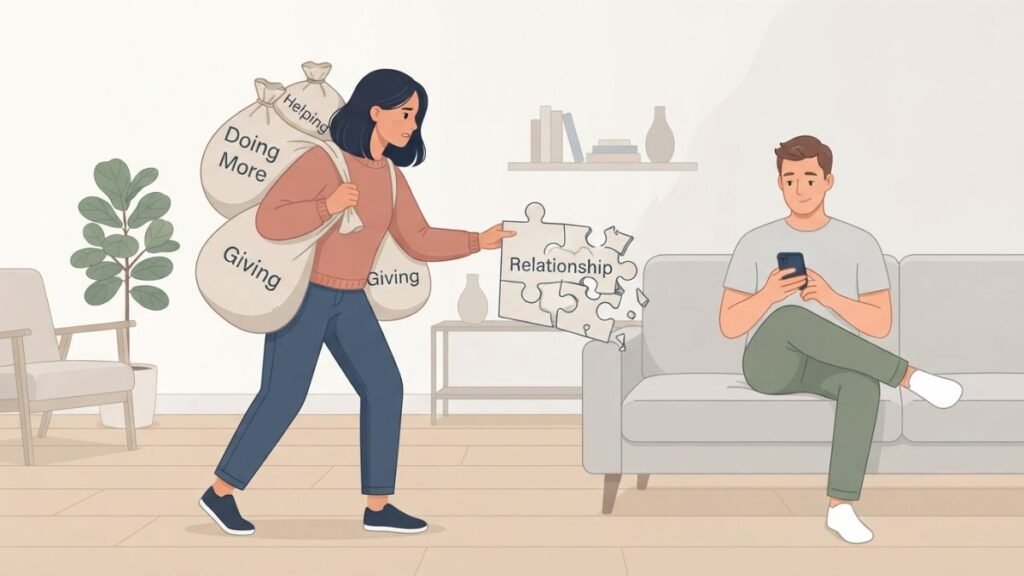
It doesn’t always look like obvious insecurity. Sometimes it hides behind behaviors that the world reads as strength but that you know are survival strategies designed to prevent the replacement you’re convinced is coming.
You over-function to justify your presence. You don’t just show up in relationships. You overdeliver. You’re the partner who remembers everything, handles everything, anticipates everything. Not because you naturally enjoy being the relationship’s entire infrastructure because you believe that if you stop being indispensable, you become disposable. Feeling unworthy converts your love into labor. Because love alone just your presence, just your being doesn’t feel like enough to keep someone. So you add value through output. Constantly. Exhaustingly. Hoping that the accumulation of everything you do will compensate for the insufficiency of who you are.
You compare yourself to every woman in his orbit. Not consciously. Automatically. Her appearance. Her energy. Her ease. Her confidence. Every woman who exists near the man you love gets evaluated not as a person, but as a potential replacement. And the evaluation always ends the same way she’s more. More attractive. More interesting. More effortless. More of whatever you’ve decided you’re not enough of. Feeling unworthy turns every other woman into a mirror that reflects your perceived inadequacy rather than a person who has nothing to do with your worth.
You stay in situations that confirm the belief. Relationships where you’re treated as optional. Friendships where you give more than you receive. Dynamics where your presence is tolerated rather than celebrated. You gravitate toward arrangements that match your internal narrative because a situation that treats you as replaceable feels familiar. And familiar, even when it hurts, feels safer than the unfamiliar experience of being treated as irreplaceable.
You brace for the ending before it begins. Every new relationship enters your life already shadowed by the anticipation of its departure. You don’t fully invest because full investment in something that’s going to leave is too painful. You hold back a piece of yourself the deepest, most vulnerable piece because handing it over to someone who’s eventually going to replace you feels like volunteering for devastation. Feeling unworthy doesn’t just affect how you behave in relationships. It affects whether you ever fully enter them.
Why You Feel Easy to Replace
Someone made you feel replaceable before you could evaluate whether it was true. The feeling didn’t start in your adult relationships. It started in the first place where your worth was supposed to be established childhood. If a parent made you feel like an afterthought. If a sibling received the attention you craved. If a caregiver’s love was inconsistent enough that your developing brain concluded “I’m not the important one here.” If you watched someone who was supposed to prioritize you consistently prioritize something or someone else. The feeling of replaceability was installed before you had the cognitive tools to question it. And by the time you were old enough to question, the feeling had already become fact in your nervous system. Feeling unworthy at this depth isn’t an opinion you hold. It’s a reality your body lives inside.
A relationship confirmed what your childhood suggested. The wound started early. Then someone came along and reopened it. A partner who kept you as an option while pursuing others. A man who made you feel chosen on Monday and disposable by Friday. Someone whose attention was so inconsistent that your brain concluded again that you’re the kind of woman people keep until something better arrives. Feeling unworthy in adulthood is often the childhood wound getting restamped by a relationship that pressed on the same bruise. The adult confirmation didn’t create the belief. It validated it. And validated beliefs become almost impossible to dislodge because now the evidence spans your entire life.
You’ve been measuring your worth comparatively instead of intrinsically. Your value, in your internal framework, isn’t determined by who you are. It’s determined by how you rank. Against other women. Against his exes. Against the fictional standard of the woman who would be better for him than you are. Feeling unworthy thrives on comparison — because comparison always produces a loser. And you’ve appointed yourself to that position permanently. You’re not evaluating yourself against a fixed standard of human worth. You’re evaluating yourself against every other woman in the room — and the evaluation always concludes that you fall short. Not because you do. Because the evaluation was designed to produce that conclusion.
You’ve confused being left with being replaceable. Someone left you. Maybe more than one someone. And your heart drew a specific conclusion they left because I could be replaced. Because what I offered wasn’t unique enough. Because the space I occupied in their life wasn’t shaped specifically enough for me that someone else couldn’t fill it. But people don’t leave because you’re replaceable. They leave because of their own limitations, their own wounds, their own inability to recognize what they had. Their departure wasn’t a review of your value. It was a revelation of theirs. Feeling unworthy after being left is the most natural response in the world and the most inaccurate. Because the leaving said everything about them and nothing about you.
You’ve been loved for what you provide rather than who you are. If your experience of love has been transactional — valued for your body, your support, your labor, your emotional management, your ability to make someone else’s life easier — then of course you feel replaceable. Because functions can be replaced. Another body. Another supporter. Another emotional manager. When love is tied to function, replaceability is built into the structure. Feeling unworthy in this context isn’t irrational. It’s the logical conclusion of being loved for output rather than essence. But the conclusion is about the quality of love you received — not about the quality of who you are.
You don’t see what other people see. This is the gap that might be hardest to close. Other people see your warmth, your depth, your loyalty, your intelligence, your specific way of loving that can’t be duplicated. You see the flaws. The perceived inadequacies. The things you wish were different. The catalog of reasons someone might upgrade. Feeling unworthy operates through a filter that amplifies your deficits and mutes your assets. You see yourself through a lens that was distorted by whoever first made you feel replaceable — and the distortion is so thorough that the real image can’t get through.
You’ve never been told — convincingly, consistently, by someone who mattered — that you’re irreplaceable. Not just with words. Through sustained behavior that communicated “there is no substitute for you. You’re not interchangeable. What you bring to my life can’t be replicated by another person.” If that message was never delivered — or was delivered by someone whose behavior contradicted it — you have no experiential reference for irreplaceability. Feeling unworthy in the absence of that reference isn’t a failure of self-love. It’s the absence of a foundation that someone else was supposed to build with you. You can’t reference something you’ve never experienced. And you can’t believe in your own irreplaceability when nobody has ever demonstrated it.
What Feeling Replaceable Is Doing to You
You exhaust yourself trying to be irreplaceable through effort. Since you can’t trust that who you are is enough, you overcompensate with what you do. More giving. More managing. More anticipating. More being everything to everyone so that the fear of being replaced gets held at bay by the sheer volume of your contribution. But the exhaustion compounds. And the tragedy is that the effort doesn’t actually quiet the fear — it just delays the next wave of it. Because the effort-based security has no resting state. The moment you stop performing, the fear returns. Feeling unworthy has turned your love life into a treadmill you can never step off.
You accept less than you deserve because you believe less is what you’re worth. When someone treats you as optional, you don’t leave. You adjust. When someone gives you crumbs, you don’t demand more. You recalibrate your appetite downward. When someone shows you through their behavior that you’re not a priority, you don’t question their investment. You question your value. Feeling unworthy lowers your standards to match your self-assessment — and the lower standards attract the exact kind of love that confirms the wound.
You can’t receive love without suspicion. When someone treats you as irreplaceable — when they show up consistently, prioritize you genuinely, love you without conditions your system doesn’t relax into it. It interrogates it. “Why? What do they see that I don’t? When will they realize their mistake? How long until they find someone better?” Feeling unworthy doesn’t just affect how you give love. It makes receiving love feel dangerous because receiving something you don’t believe you deserve creates a vulnerability your wound can’t tolerate.
You’ve stopped believing in your own uniqueness. The specific combination of qualities that makes you you your humor, your depth, your way of seeing the world, your particular brand of love has been flattened by the belief that you’re interchangeable. You’ve stopped seeing yourself as irreplaceable because the wound has been louder than the truth for so long that the truth can’t get through. Feeling unworthy has stolen something more than your confidence. It’s stolen your ability to see yourself accurately.
You carry the exhaustion of never being able to rest in love. Every relationship is maintained through hypervigilance. Scanning for signs. Monitoring his attention. Tracking the trajectory for evidence that the replacement is coming. You can’t relax. Can’t sink into love. Can’t experience the peace that comes from knowing you’re secure because feeling unworthy has made security impossible. Not because the relationship is insecure. Because your belief about your own value doesn’t allow security to form regardless of what the relationship provides.
What You Need to Do
Stop trying to earn what should be inherent. Your value isn’t performance-based. It doesn’t increase with your output or decrease when you rest. You don’t become more irreplaceable by doing more you become more exhausted. Start practicing the most radical thing a woman who feels unworthy can do existing without justifying her existence. Sit in a relationship and offer your presence without the compulsive need to add labor on top of it. See what happens when you stop earning and start just being.
Challenge the comparison every time it fires. When the internal comparison activates “she’s prettier, she’s more interesting, she’s more together” catch it. Name it. “That’s the wound talking. Her existence has nothing to do with my worth.” The comparison is a reflex, not a fact. And reflexes can be interrupted with awareness. You won’t stop comparing overnight. But you can start catching the comparison before it completes its loop before it reaches the conclusion that you’re lesser.
Trace the feeling to its origin. Where did replaceable start? Who made you feel like the backup? The afterthought? The one who could be swapped without consequence? Identify them. Not to blame to separate their treatment of you from the truth about you. Their behavior was about their capacity, not your value. And the feeling they installed in you belongs to their limitation, not your identity.
Start listing what’s irreplaceable about you. Not what you do. Who you are. Your specific humor. The way you love. The depth of your loyalty. The unique lens through which you see the world. The things about you that can’t be replicated because they emerged from your specific history, your specific wounds, your specific healing. Feeling unworthy makes these things invisible. Make them visible on paper, in your own handwriting, in your own words. And read them on the days the wound speaks loudest.
Stop staying in dynamics that confirm the wound. If a relationship treats you as replaceable if a man’s behavior communicates that your presence is optional rather than essential stop interpreting it as evidence about your worth and start interpreting it as evidence about his capacity. Then leave. Not because you’re running from pain. Because you’re running toward the standard your worth actually warrants.
Get professional support. Feeling unworthy at this depth the kind that runs your relationships, distorts your self-perception, and keeps you on a treadmill of earning love you already deserve requires therapeutic intervention. A therapist can help you trace the wound, separate installed beliefs from actual identity, and rebuild a self-concept that reflects reality rather than the distortion the wound has been producing.
What You Need to Understand
Feeling unworthy isn’t a character flaw. It’s a wound response created by experiences where your value wasn’t reflected back to you accurately. The people who made you feel replaceable were revealing their limitations, not your worth. Their inability to treat you as irreplaceable was a statement about their capacity not a verdict on your value.
You are not interchangeable. The specific combination of everything you are your history, your depth, your way of loving, your resilience, your humor, your pain, your healing can’t be replicated. Nobody else has your fingerprint. Nobody else has your heart. Nobody else brings exactly what you bring to the people who are lucky enough to receive it. Feeling unworthy has been telling you a story about yourself that contradicts reality. The story is loud. Reality is quiet. But reality is still true even when the story drowns it out.
The right people know you’re irreplaceable without you having to prove it. They see what the wound has been preventing you from seeing that your presence in their life occupies a space no one else could fill. Not because you’re perfect. Because you’re specific. And specific can’t be substituted. The love you deserve doesn’t require you to earn it through exhausting yourself. It requires you to show up as yourself and let that be the thing that makes you irreplaceable.
What You Deserve
You deserve to feel irreplaceable. Not through performance. Not through labor. Not through being so useful that replacing you would be inconvenient. Through being so uniquely yourself that the concept of replacement doesn’t apply.
You deserve a man who looks at you and knows — without question, without comparison, without you having to demonstrate it daily that what you bring to his life can’t be found anywhere else. Not because you’re the only woman in the world. Because you’re the only you.
You deserve to stop auditioning for a role you’ve already been cast in, sis. The role of being loved. The role of being irreplaceable. The role of being enough not through effort, but through existence. You were cast the moment you were born. You just never got the memo because someone forgot to send it.
Consider this the memo.
The Bottom Line
You feel easy to replace because feeling unworthy was installed early by people whose limited love made you conclude that your unlimited worth wasn’t enough. Because relationships confirmed the wound instead of healing it. Because you’ve been measuring yourself comparatively against every other woman instead of intrinsically against your own irreplaceable truth. Because being left taught you that leaving meant you were substitutable when leaving only ever meant they couldn’t see what they had.
Stop earning. Stop comparing. Stop bracing for the replacement that was never about your value. Stop accepting love from people who treat you as optional because their treatment is about their poverty, not yours.
You were never replaceable, sis. The people who made you feel that way were just too limited to see what they were holding. And their blindness was never your mirror. It was their loss.
FAQ
Q: How do I stop comparing myself to other women?
Start by recognizing the comparison as a reflex, not a fact. When it fires, interrupt it: “This comparison isn’t telling me the truth about my value. It’s running a program my wound installed.” Redirect your attention to what’s unique about you not what you perceive as lacking. Over time, the interruption weakens the reflex. A therapist can also help you dismantle the comparative framework at its root.
Q: What if I’ve been told I’m replaceable by someone I loved?
That statement however it was delivered was about their cruelty, not your value. A person who tells you you’re replaceable is revealing the quality of their love, not the quality of your worth. People who see you clearly don’t use your fear against you. They hold it with care. The person who said that wasn’t seeing you. They were using you. And their words deserve to be filed under their character, not your identity.
Q: Can feeling unworthy actually attract unhealthy relationships?
Yes. Feeling unworthy calibrates your attachment system to seek dynamics that confirm the wound. Consistent, unconditional love feels unfamiliar and triggers suspicion. Conditional, inconsistent love feels recognizable and triggers attachment. The wound doesn’t attract bad people on purpose it makes unhealthy dynamics feel like home. Therapy can recalibrate what “home” feels like so that healthy love becomes recognizable.
Q: How do I stop over-giving to prove my worth?
Start small. In one relationship romantic, friendship, family give exactly what you’d give if you knew with certainty that you were enough. No extra. No compensation. No labor designed to prevent abandonment. Notice the anxiety that surfaces when you stop overdelivering. That anxiety is the wound protesting. Let it protest. And let the relationship reveal whether it survives on your presence alone or whether it only survives on your output.
Q: What if I know I’m valuable intellectually but can’t feel it?
The gap between knowing and feeling is the wound’s territory. Your mind has the information. Your body hasn’t absorbed it. Closing the gap requires body-level work — therapy, somatic practices, corrective relational experiences where you’re treated as irreplaceable consistently enough that your nervous system begins to update its programming. The knowing came first. The feeling will follow. But it follows at the pace of healing, not at the pace of logic.