
Sis, let me describe the pattern that’s been driving you to the edge and then punishing you for arriving there.
There’s a problem. You both know it exists. It’s been sitting between you visible, growing, taking up more space every day. You’ve mentioned it. Maybe once, maybe five times. Calmly. Clearly. With the kind of measured delivery that should have opened a conversation and produced a resolution.
And he did nothing.
Not “he tried and failed.” Not “he addressed it imperfectly.” Nothing. He heard you. He acknowledged hearing you maybe with a “yeah, I know” or a “we’ll talk about it later.” And then he acted as though the conversation never happened. The problem continued. The behavior persisted. The issue that could have been resolved with a fifteen-minute conversation three months ago now sits between you like a wall neither of you can see over.
And eventually because you’re human, because patience has a lifespan, because ignored problems don’t dissolve they compound you reach your breaking point. The calm version of you who raised the issue five times without response finally breaks through into the version who can’t hold it anymore. The tears come. The frustration erupts. The volume increases. The emotion that’s been managed and measured and contained for months finally spills over.
And that’s when he engages. Not with the problem. With your reaction.
“Why are you always so dramatic?” “You went from zero to a hundred.” “I can’t talk to you when you’re like this.” “See this is why I don’t bring things up.”
He ignored the problem for months. You carried it alone for months. And now that you’ve finally reached the breaking point his avoidance created he’s using your reaction to prove that you’re the problem. Not the issue he ignored. Not the pattern he refused to address. You. Your emotion. Your “overreaction” to something that wouldn’t require a reaction at all if he’d addressed it the first time you raised it.
That’s conflict avoidance in relationships. And it’s one of the most sophisticated manipulation dynamics that exists because it creates the explosion it then uses as evidence against you.
What Conflict Avoidance Looks Like
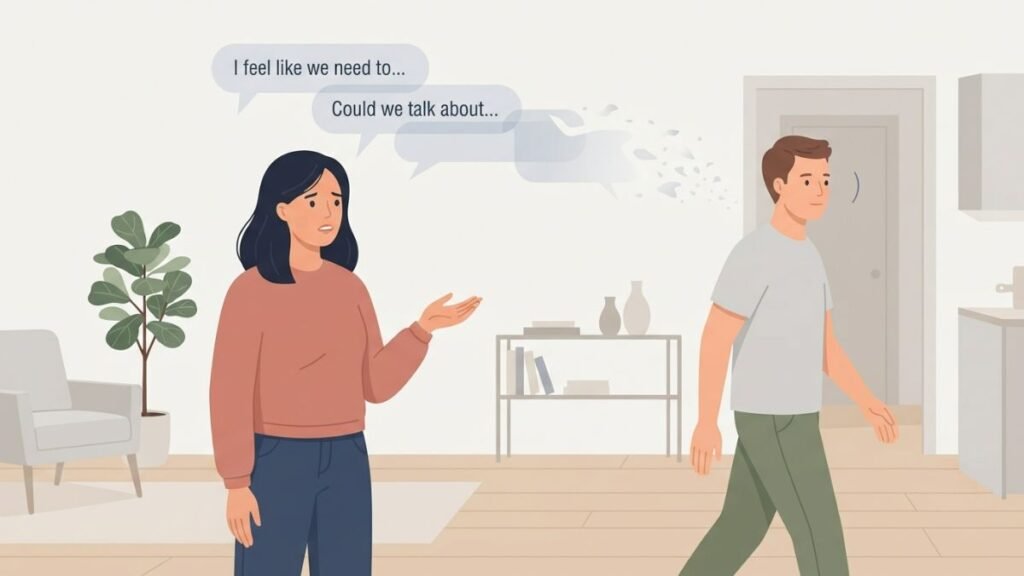
Conflict avoidance in relationships doesn’t look like a man who’s keeping the peace. It looks like a man who’s postponing the war and stockpiling the ammunition your frustration will eventually provide.
He hears you and does nothing. You raise an issue. He nods. Maybe says “okay.” Maybe says “I hear you.” And then nothing. No follow-up. No behavioral change. No revisiting the conversation. No evidence that your words existed in any meaningful way beyond the moment they were spoken. Conflict avoidance in relationships operates through acknowledgment without action the performance of having received your concern coupled with the complete absence of response to it.
He delays until you stop asking. “We’ll talk about it later.” “I need to think about it.” “Now isn’t a good time.” The delays are always reasonable-sounding in isolation. But stacked together delay after delay after delay they form a clear pattern. He’s not finding the right time. He’s running out the clock. He’s waiting for your urgency to fade. For the issue to become old enough that raising it again feels like beating a dead horse. Conflict avoidance in relationships uses time as a weapon not dramatically, but through the quiet erosion of your persistence until the issue feels too stale to revisit.
He treats your calm raising of issues as optional input. When you bring something up gently measured tone, careful words, respectful delivery it gets received as a suggestion rather than a concern. Something he can take or leave. Something he’ll get to eventually. Maybe. If he remembers. If he feels like it. Your calm delivery, instead of making the conversation more productive, actually makes it easier for him to dismiss. Because your calm doesn’t carry the urgency his avoidance requires to activate a response. Conflict avoidance in relationships penalizes healthy communication because the healthier your delivery, the easier it is for him to ignore.
He only engages after you’ve escalated. The problem gets addressed if it gets addressed at all only after you’ve reached the point of tears, raised voices, or visible distress. Not because the escalation convinced him the issue was valid. Because the escalation disrupted his comfort enough that he couldn’t avoid it anymore. And then crucially the conversation becomes about your escalation rather than the issue that caused it. Conflict avoidance in relationships creates a perverse dynamic where the only communication that produces a response is the unhealthy kind. And then the unhealthy communication gets used as evidence that you’re the problem.
Why He Ignores Problems Until You Reach Your Breaking Point
Avoidance is cheaper than engagement. Addressing a problem requires effort. Listening. Processing. Acknowledging his role. Potentially changing a behavior. Potentially sitting with the discomfort of hearing that something he’s doing is causing harm. All of that costs emotional energy. Ignoring the problem costs nothing at least not to him. The cost falls entirely on you in frustration, in accumulated resentment, in the emotional labor of carrying unresolved issues alone. Conflict avoidance in relationships is fundamentally about cost distribution. He avoids the cost of engagement. You absorb the cost of avoidance. And the arrangement continues because you keep paying.
Your breaking point provides the evidence he needs to make you the problem. This is the mechanism that elevates conflict avoidance from laziness to strategy. He ignores the issue. You carry it until you can’t. You break. And the breaking the tears, the frustration, the elevated emotion becomes his evidence. “See how she reacts? See why I don’t bring things up? She can’t handle anything without getting emotional.” Your breaking point isn’t an inconvenience to him. It’s an asset. It provides the material he needs to reframe the entire dynamic from “I ignored a problem” to “she has an emotional regulation issue.” Conflict avoidance in relationships doesn’t just dodge accountability. It creates a narrative where the person seeking accountability is discredited by the very frustration the avoidance manufactured.
He genuinely believes that ignored problems resolve themselves. If his family of origin handled conflict through avoidance if the unspoken rule was “don’t name it and it goes away” he internalized that framework as functional. Problems don’t need addressing. They need time. They need silence. They need people to stop talking about them so they can dissolve naturally. In his model, you’re not being ignored. You’re being given the gift of time. And your insistence on talking about things is the disruption not the issue itself. Conflict avoidance in relationships built on this model isn’t intentional neglect. It’s a man running the only operating system he was given. But an operating system that damages his partner consistently and goes unexamined becomes a choice.
Engaging with conflict produces anxiety he can’t manage. For some men, the prospect of conflict even healthy, constructive conflict activates anxiety so intense that avoidance becomes the only viable option. His heart races. His thinking narrows. His body enters a state that makes productive engagement physiologically difficult. Conflict avoidance in relationships driven by anxiety isn’t strategic. It’s a fear response one that was likely conditioned through early experiences where conflict produced devastating outcomes. He’s not choosing avoidance because it’s comfortable. He’s choosing it because engagement feels dangerous. But a man who knows his anxiety around conflict is damaging his relationship and refuses to pursue therapeutic help for it has chosen his comfort over your wellbeing.
He’s waiting for you to fix it yourself or drop it entirely. Either outcome works for him. If you solve the problem alone handle it internally, adjust your expectations, manage around his behavior the issue disappears without his participation. If you drop it give up on getting a response, swallow the concern, accept that it’s never getting addressed the issue disappears without his participation. Conflict avoidance in relationships often includes an implicit bet that your patience will either resolve the problem or your exhaustion will bury it. Either way, he never has to engage. And your labor whether it’s solving or surrendering does the work his avoidance refuses to.
Your calm delivery doesn’t create enough discomfort to motivate his response. This is the paradox that makes conflict avoidance in relationships so maddening. When you deliver your concern calmly — the way healthy communication recommends — he experiences no urgency. No disruption. No pressure that would motivate a response. Your calm makes ignoring easy. It’s only when your frustration boils over — when the emotion rises, when the delivery shifts from measured to raw — that his comfort gets disrupted enough to produce engagement. But by then, the engagement isn’t about the issue. It’s about your “overreaction.” The dynamic punishes healthy communication and only responds to unhealthy communication — then uses the unhealthy communication to discredit you.
He’s protecting a version of the relationship where nothing is wrong. In his narrative, the relationship is fine. Good, even. Whatever issues you’ve raised are minor inconveniences that you’re amplifying through attention they don’t deserve. Engaging with the problem would mean acknowledging that the relationship has a real issue — and that acknowledgment threatens the “everything is fine” story he’s been telling himself. Conflict avoidance in relationships is sometimes about protecting a narrative more than avoiding discomfort. If he never engages with the problem, the problem never officially exists. And a relationship where problems don’t officially exist is one he doesn’t have to work on.
What His Avoidance Is Doing to You
You’ve been positioned as the unstable one. After enough cycles of being ignored until you break and then being blamed for breaking, a narrative has formed — one where he’s the reasonable partner and you’re the emotional one. You “always overreact.” You “can’t let things go.” You “make everything a big deal.” That narrative didn’t form organically. It was constructed by a dynamic where your only options were silence or explosion — and both options produced evidence against you. Silence meant accepting the problem. Explosion meant becoming the problem. Conflict avoidance in relationships creates a binary where neither choice produces resolution and both choices produce blame aimed at you.
You carry every unresolved issue alone. Every problem he ignored is still alive inside you. Still taking up space. Still consuming energy. Still waiting for a conversation that his avoidance has ensured will never happen productively. The inventory of unaddressed issues isn’t just emotionally heavy. It’s cognitively consuming. You carry the full catalog of everything wrong in the relationship while he walks through life as though nothing needs attention. The asymmetry of that burden is staggering once you see it clearly.
You’ve started questioning whether you’re too emotional. His framing — that your escalation is the problem rather than his avoidance — has penetrated deep enough that you genuinely question your emotional proportionality. “Am I overreacting?” “Should I just let this go?” “Is this worth the fight?” You’re evaluating your own responses through a lens he installed — one that treats your emotion as the disruption while treating his avoidance as the norm. But your emotion isn’t disproportionate to months of being ignored. It’s proportional. And the fact that it looks extreme by the time it surfaces is evidence of how long you carried it in silence — not evidence that the carrying was unnecessary.
You’ve stopped trusting your own approach to communication. You’ve tried calm. It got ignored. You’ve tried direct. It got deflected. You’ve tried emotional. It got used against you. No approach works — because the issue was never your approach. It was his avoidance. But after enough failed attempts, you stop trusting your ability to communicate effectively. Conflict avoidance in relationships erodes the communicator’s confidence — not through critique of her words but through the complete non-response that makes every delivery feel inadequate.
Resentment has replaced the love that was supposed to live where resolution should. Every ignored issue left a residue. Every dismissed concern left a mark. Every breaking point he blamed you for left a scar. The accumulation isn’t just emotional weight. It’s relational poison — transforming the way you see him, the way you feel about the partnership, the way you engage with a relationship that has been asking everything of you while offering nothing in return.
What You Need to Do
Stop raising the same issue more than twice. You’ve been repeating yourself to a man who’s shown he doesn’t respond to repetition. Saying it a third, fourth, fifth time doesn’t increase the odds of engagement. It increases the odds of your exhaustion. Raise it once. Follow up once. If nothing changes after two clear communications, the issue isn’t your delivery. It’s his decision to ignore. Direct your energy toward decisions rather than additional conversations.
Stop managing your delivery to avoid triggering his avoidance. You’ve been softening, timing, calibrating — hoping the perfect approach will penetrate his avoidance. It won’t. Because the avoidance isn’t about your delivery. It’s about his unwillingness to engage. Stop optimizing your communication for a man who isn’t going to receive it regardless. Say what you need to say. Clearly. Once. And let his non-response be the information it is.
Name the pattern explicitly. “You ignore problems until I break, and then you blame me for breaking. The issue isn’t my reaction — it’s the months of avoidance that created it. If you’d engaged the first time I raised it, we wouldn’t be here.” Say it during a calm moment. Let the observation land. His response tells you everything about whether he sees the pattern or is committed to perpetuating it.
Stop accepting “later” as a valid response. “Later” is not a timeline. It’s an escape. “When can we talk about this specifically?” puts a pin in the deflection. If he can’t commit to a specific time — or if the specific time arrives and he avoids again — “later” has revealed itself as “never” wearing a more polite outfit.
Stop blaming yourself for your breaking point. Your frustration after months of being ignored isn’t an overreaction. It’s a proportional response to a pattern of neglect. A woman who carries unresolved issues alone for months and eventually reaches her limit isn’t emotionally dysregulated. She’s emotionally exhausted. And the exhaustion was created by a man who decided his avoidance was more important than her peace.
Get professional support. A therapist can help you process the accumulated burden of carrying every unresolved issue, rebuild trust in your own communication approach, and decide whether this dynamic can be restructured — or whether his avoidance is permanent enough to warrant a permanent decision on your end.
What You Need to Understand
Conflict avoidance in relationships isn’t peacekeeping. It’s problem-stockpiling. Every issue he ignores gets added to a pile that grows heavier by the day — and you’re the one carrying the pile while he walks beside you empty-handed. The “peace” he’s maintaining is his peace. Yours was sacrificed the moment he decided your concern wasn’t worth addressing.
The explosion he blames you for is the explosion his avoidance built. You didn’t create the breaking point. He did — through months of non-engagement that left you no option except escalation or surrender. And then he positioned the escalation as your flaw rather than his consequence. The cycle is elegant in its cruelty — he creates the conditions for your frustration and then uses the frustration as evidence that you’re the problem.
The right man doesn’t wait for the breaking point. He engages at the first mention. Not perfectly. Not always with the right words. But he engages — because letting his partner carry an issue alone while he avoids it isn’t something his integrity allows. He says “let’s talk about this” because he knows that unaddressed problems become unresolvable ones. And he’d rather sit in fifteen minutes of discomfort than watch the woman he loves carry months of unnecessary pain.
What You Deserve
You deserve a man who addresses problems when they’re small — before they become the crises his avoidance turns them into. Who hears your concern the first time and responds with engagement instead of delay. Who understands that the calm version of the conversation is the gift — and the explosive version is what happens when the gift keeps getting returned unopened.
You deserve to raise a concern and have it received as important. Not filed under “later.” Not dismissed as unnecessary. Not tolerated until it fades. Received. Engaged with. Addressed — imperfectly, maybe, but genuinely.
You deserve resolution, sis. The kind that comes from two people sitting with a problem together and working through it before it becomes the kind of weight that breaks the person carrying it alone.
That’s what partnership looks like. And you’ve been carrying a one-woman version of it for far too long.
The Bottom Line
He ignores problems until you reach your breaking point because conflict avoidance in relationships is cheaper than engagement, because your breaking point provides the evidence he needs to make you the problem, because his framework treats ignored problems as resolved problems, because your calm delivery doesn’t disrupt his comfort enough to motivate response, and because the entire cycle serves him while destroying you.
Stop carrying alone. Stop blaming yourself for breaking under weight he created. Stop accepting a dynamic where the only version of your communication that produces a response is the one that gets used against you.
Your concerns were valid the first time you raised them, sis. And the seventy-fifth time. The man who ignored them seventy-four times doesn’t get to blame you for finally running out of patience with his avoidance.
The problem was never your volume. It was always his silence.
FAQ
Q: What if he says he avoids conflict because he doesn’t want to fight?
Not wanting to fight and not wanting to engage are different things. Conflict resolution doesn’t require fighting. It requires conversation. If his definition of “avoiding a fight” includes avoiding all difficult conversations — even calm, productive ones — he’s not preserving peace. He’s preserving his comfort at the expense of your needs.
Q: Is conflict avoidance always harmful?
Temporarily stepping back from an escalated moment to cool down is healthy. Systematically ignoring concerns raised calmly and repeatedly — allowing them to compound until the other person breaks — is harmful. The distinction is between a pause and a pattern. One is regulation. The other is neglect.
Q: How do I stop being the one who always brings things up?
You can’t. In a dynamic with a conflict-avoidant partner, the non-avoidant partner will always be the one who initiates. The question isn’t how to stop bringing things up. It’s whether you want to spend your life as the sole initiator of every important conversation in your own relationship. If he can’t share that responsibility, the load is permanent.
Q: What if he engages but only to end the conversation quickly?
Engagement designed to terminate the conversation isn’t engagement. It’s another form of avoidance — meeting the minimum threshold of participation to earn the right to stop participating. “Okay, fine, I’ll work on it” delivered without intention or follow-through is avoidance wearing engagement’s clothes. Measure his engagement by what changes afterward — not by what he says during.
Q: Can a conflict-avoidant man learn to engage with problems?
With sustained therapeutic work focused on anxiety management, communication skills, and the childhood experiences that made conflict feel threatening — yes. But learning requires his genuine recognition that avoidance is damaging the relationship. Most conflict-avoidant men view their avoidance as maturity — “I don’t like drama.” Until he sees it as the neglect it is rather than the virtue he believes it to be, the pattern continues.