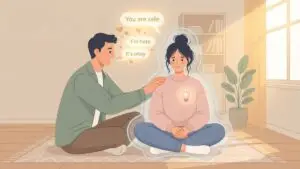
Sis, let me describe something most people don’t have language for.
You don’t feel safe. Not physically he doesn’t hit you. Not verbally he doesn’t scream. Not in the ways that other people would recognize if you described it. There’s no dramatic scene to point to. No bruise. No recording of raised voices. No evidence that would satisfy anyone’s definition of danger.
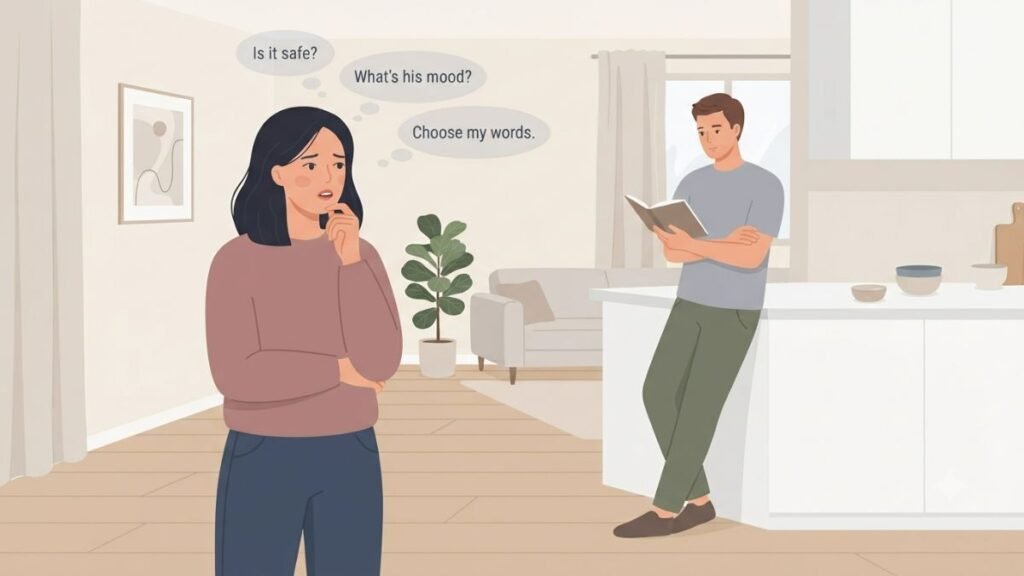
But the unsafety is real. It lives in your body. In the tightness across your chest when he walks in the room. In the way your breathing shallows when you sense his mood shifting. In the unconscious scanning you do before you speak measuring his energy, calculating risk, assessing whether this moment is safe enough for you to be yourself.
You can’t relax in his presence. Can’t say what you think without pre-screening it through the filter of his likely reaction. Can’t exist as yourself fully, naturally, unedited because something about the dynamic has taught your body that being yourself comes with a cost. A cost that’s never delivered through volume. Through fists. Through anything the outside world would call harmful.
The harm arrives through subtlety. Through the raised eyebrow that communicates disapproval. Through the silence that follows your vulnerability. Through the dismissal that erases your experience. Through the mood shift that punishes your honesty. Through the withdrawal that follows your boundary. Through the pattern relentless, quiet, consistent that has taught your nervous system one devastating lesson: this man is not safe to be real with.
That’s the absence of emotional safety in relationships. And it’s one of the most damaging dynamics a woman can experience because the damage is invisible. There’s nothing to point to. Nothing to photograph. Nothing that would make anyone on the outside understand why you feel afraid of a man who’s never raised his voice.
But you know. Your body knows. And the knowing is the evidence even when nobody else can see it.
What Emotional Unsafety Without Yelling Looks Like
It doesn’t look like the abuse people recognize. It looks like nothing from the outside. From the inside, it looks like everything.
His mood controls the household without a word being spoken. He doesn’t announce his displeasure. He radiates it. Through posture. Through energy. Through the specific quality of silence that communicates “something is wrong and you’re the reason.” The entire household recalibrates around his unspoken mood you adjust, you soften, you tiptoe, you manage all without a single instruction being given. Emotional safety in relationships is impossible when one person’s mood functions as an invisible dictator that everyone serves without being asked.
Your honesty produces consequences you’ve learned to fear. Not dramatic consequences. Atmospheric ones. You share a genuine feeling and his energy shifts. You express a concern and the temperature drops. You set a boundary and warmth gets withdrawn. You disagree and the rest of the evening carries a heaviness that wasn’t there before you spoke. The consequences aren’t verbal. They’re environmental — shifts in the emotional climate so consistent that your body has memorized the pattern. Speak honestly → atmosphere changes → discomfort follows. Emotional safety in relationships requires honesty to be met with engagement. His framework meets honesty with punishment — delivered so quietly that nobody hears the blow but you.
You edit yourself constantly. Before you speak, an internal process runs — faster than conscious thought, installed by months or years of atmospheric consequences. “Is this safe to say?” “Will this trigger a mood shift?” “Can I afford the energy cost of being honest right now?” The editing isn’t something you chose. It was conditioned into you by a man whose reactions taught your system that authenticity is dangerous. Emotional safety in relationships means being able to speak without a risk assessment running in the background. If the assessment is running — if every sentence gets pre-screened for safety before it leaves your mouth — the safety doesn’t exist.
He’s never technically done anything “wrong.” This is the part that makes you feel crazy. If you listed his behaviors individually, none of them would sound abusive. A mood shift. A withdrawal. A dismissal. A look. A silence. Each one is small enough to seem insignificant. Each one is deniable enough to seem unintentional. But together — accumulated across hundreds of interactions, layered into a pattern so consistent it has restructured your nervous system — they create something enormous. Something that controls your behavior as effectively as any overt threat would. Emotional safety in relationships isn’t destroyed by one blow. It’s destroyed by a thousand paper cuts — each one too small to bleed visibly, all of them together enough to drain you dry.
Why He Makes You Feel Unsafe Without Raising His Voice
His control operates through atmosphere, not aggression. He doesn’t need to yell because his mood does the work for him. When he’s displeased, the entire emotional environment shifts — and everyone around him adjusts. He doesn’t issue commands. He issues energy. And the energy is so consistently tied to his displeasure that it functions as a command system — one that produces compliance without ever being explicit enough to challenge. Emotional safety in relationships can’t exist inside an atmosphere controlled by one person’s mood. Because the atmosphere itself becomes the mechanism of control — invisible, pervasive, and completely deniable.
He’s learned that quiet control is more effective than loud control. Yelling produces resistance. It gives you something to push against. Something to name. Something that clearly crosses a line others would recognize. But quiet control — the mood shift, the pointed silence, the withdrawal of warmth — produces compliance without resistance. Because there’s nothing to push against. Nothing to name. Nothing that rises to the level of “abuse” in any framework you’ve been given. He’s discovered the most efficient form of control that exists — the kind that controls your behavior while remaining invisible to everyone, including sometimes you. Emotional safety in relationships destroyed by quiet control is the hardest form of unsafety to name — because naming it requires you to articulate something most people don’t have vocabulary for.
He uses emotional withdrawal as a discipline system. When you do something he approves of — when you’re compliant, agreeable, easy — warmth flows. When you do something he doesn’t approve of — when you set a boundary, express a need, disagree, assert yourself — warmth gets removed. The system is elegant in its simplicity. Behavior that pleases him gets rewarded with emotional presence. Behavior that challenges him gets punished with emotional absence. He doesn’t need to yell. The reward-punishment system operates entirely through the presence or absence of his warmth. Emotional safety in relationships can’t coexist with a system where affection is conditional on compliance. Because conditional affection isn’t love. It’s behavioral conditioning with romantic packaging.
His reactions are just unpredictable enough to keep you vigilant. If his responses were perfectly predictable — if you always knew what would trigger a mood shift and what wouldn’t — you could at least navigate with certainty. But the unpredictability is part of the design. Sometimes a comment produces no reaction. Sometimes the same comment produces withdrawal. Sometimes honesty is received neutrally. Sometimes it triggers coldness that lasts for days. The inconsistency ensures you can never fully relax — because you can never fully predict. Emotional safety in relationships requires predictability. Not rigidity — predictability. The reasonable confidence that your partner’s responses will fall within a range you can anticipate. His unpredictability eliminates that confidence entirely.
He doesn’t see himself as harmful because harm requires evidence he doesn’t produce. In his self-concept, he’s not abusive. He doesn’t yell. Doesn’t hit. Doesn’t call names. His behavior, measured against the visible markers of harm, comes up clean. And because he passes his own test — the test that only counts the obvious forms of damage — he genuinely doesn’t believe he’s doing anything wrong. Emotional safety in relationships destroyed by a man who passes his own harm assessment is particularly dangerous because the man causing the damage genuinely can’t see it. He’s measuring his behavior against a bar set so low that everything below screaming qualifies as harmless. And the damage happening below that bar — the atmospheric control, the conditional warmth, the quiet punishment — gets perpetuated by a man who’s convinced himself it doesn’t exist.
His childhood modeled exactly this dynamic. If he grew up in a household where one parent controlled the other through mood, silence, withdrawal, and atmospheric dominance — without ever yelling — he absorbed that model as normal. Not harmful. Normal. The quiet parent was the “reasonable” one. The parent who expressed things openly was the “dramatic” one. He internalized that the person who controls through silence is the mature one — and the person who names the control is the problem. Emotional safety in relationships is often destroyed by a man running a program he was installed with in childhood. He’s not choosing quiet control. He’s replicating the only relational model he was given. But replication without examination — especially after the impact has been named — becomes choice.
Your safety isn’t something he’s thought about. This is the most unsettling possibility. He might not be creating emotional unsafety strategically. He might simply never have considered his partner’s emotional safety as something he’s responsible for. It’s not on his radar. Not in his framework. Not part of his definition of what a partner should provide. Emotional safety in relationships requires both people to actively cultivate an environment where the other person can be authentic without fear. If he’s never considered that cultivation as part of his role, the unsafety isn’t intentional. It’s the default product of a man who’s never thought about the emotional climate his behavior creates.
What Emotional Unsafety Is Doing to You
You’ve developed hypervigilance that never turns off. Your system scans constantly. His posture. His tone. His facial expression. The energy he carries when he walks through the door. The micro-changes in his mood that signal which version of him you’re getting today. The scanning isn’t something you chose to develop. It was installed by a dynamic that punished you for not anticipating his reactions — and the only way to anticipate was to monitor every signal he produces. Emotional safety in relationships is what turns off the scanning. Its absence is what keeps it running permanently.
You’ve lost access to your authentic self. The woman you are around friends — open, expressive, full of personality — isn’t the woman you are around him. Around him, you’re managed. Edited. Compressed into a version of yourself that’s been optimized for his comfort rather than your authenticity. You perform pleasantness. You suppress frustration. You swallow truths that deserve to be spoken. And the woman who remains after all that editing isn’t who you are. She’s who his unsafety requires you to be.
You feel exhausted in a way rest doesn’t fix. The tiredness isn’t physical. It’s the exhaustion of maintaining constant vigilance inside a dynamic that should feel restful but doesn’t. Relationships are supposed to be safe harbors. Yours is a storm you navigate daily — one that requires all your energy just to survive the atmospheric shifts, the conditional warmth, the quiet consequences that follow your authenticity. Emotional safety in relationships provides rest. Its absence provides the specific kind of fatigue that comes from never being able to let your guard down with the person you share your life with.
You’ve started believing you’re the problem. His consistency in responding to your authenticity with atmospheric punishment has produced a specific conclusion in your brain: you’re too much. Too honest. Too emotional. Too real. If you were different — calmer, less expressive, more managed — the atmosphere wouldn’t shift. The punishment wouldn’t arrive. The unsafety wouldn’t exist. You’ve internalized his control as your flaw. And a woman who believes her authentic self is the problem is a woman who’ll keep editing herself to fit inside a space that was never designed to hold her.
You feel alone in a way you can’t explain. Not lonely exactly — though that’s part of it. Alone in the specific sense that the person closest to you is the person you feel least safe with. The person whose presence should create the most security creates the most vigilance. The person who should know you best knows the edited version. And the gap between who you are and who you perform around him is the loneliest space a woman can occupy — because it means the real you is hidden inside your own relationship.
What You Need to Do
Name what you feel without needing him to validate it. “I don’t feel emotionally safe with you. Not because you yell. Because your mood controls the household. Because my honesty produces consequences. Because I edit myself around you in ways I don’t with anyone else.” You don’t need him to agree that the unsafety exists. You need to hear yourself say it. Because naming it — even to a man who might deny it — anchors you in the reality his quiet control has been trying to distort.
Stop editing yourself to prevent his atmospheric shifts. This is the most important intervention. The editing has been keeping you safe — or at least keeping the atmosphere stable. But the stability you’ve been maintaining is his stability. Yours has been destroyed by the effort of constant self-management. Start speaking authentically. Let the atmosphere shift. And instead of rushing to repair it — instead of softening, retracting, managing his mood — let the shift sit. His discomfort with your authenticity is his to manage. Not yours.
Document how his behavior makes you feel. Write it down. Not what he does — because what he does sounds insignificant in isolation. How it makes you feel. “I felt afraid to speak today.” “I spent thirty minutes choosing my words before talking to him.” “I changed my plans because I could sense his mood.” “I felt like a different person the moment he walked in.” Emotional safety in relationships that’s been destroyed by quiet patterns requires documentation of impact — because the behaviors themselves are too subtle to catalog while the feelings they produce are undeniable.
Talk to a professional who understands covert emotional dynamics. Not every therapist recognizes the kind of control that operates through atmosphere rather than aggression. Seek one who understands covert emotional abuse — the kind that doesn’t produce visible evidence but produces measurable psychological impact. They can help you see the pattern clearly, validate the experience your body has been reporting, and develop strategies for either addressing or exiting the dynamic.
Stop measuring his behavior against the bar of overt abuse. “He doesn’t yell” isn’t evidence of safety. “He doesn’t hit” isn’t evidence of care. The bar that separates acceptable from unacceptable isn’t set at the level of violence. It’s set at the level of safety. Do you feel safe? Can you be authentic? Can you speak freely? Can you exist as yourself without consequences you’ve learned to fear? If the answer to those questions is no, the behavior has crossed the line — regardless of how far below yelling it operates.
Evaluate whether emotional safety is achievable in this relationship. Can a man whose control operates through atmosphere learn to create safety instead? With genuine self-awareness, professional help, and sustained commitment to changing the emotional climate he produces — possibly. But the man has to see the pattern. Has to see the impact. Has to want to change the air quality in a room he’s been controlling without realizing it. If he can’t see it — or won’t — the emotional unsafety is permanent. And permanent unsafety inside an intimate relationship produces permanent damage to the woman living inside it.
What You Need to Understand
Emotional safety in relationships isn’t the absence of violence. It’s the presence of conditions that allow both people to be fully themselves without fear of consequences. It’s the knowledge that your honesty will be met with engagement, not punishment. That your boundaries will be respected, not retaliated against. That your feelings will be held, not dismissed. That your presence in the relationship is valued as you are — not as the edited version his control has shaped you into.
You’re not crazy for feeling unsafe around a man who’s never raised his voice. Your body is reporting accurately. It’s detected a pattern of consequences that operate through mood, silence, withdrawal, and atmospheric control — and it’s responding appropriately to that detection. The absence of volume doesn’t mean the absence of harm. Some of the deepest damage in relationships is delivered at a whisper — or without any sound at all.
The right man doesn’t make you feel unsafe through quiet control. He makes you feel safe through quiet consistency. His presence calms rather than activates. His energy stabilizes rather than destabilizes. His response to your authenticity is warmth — not atmospheric punishment. And you know you’re safe not because he told you so, but because your body tells you so. Through the absence of vigilance. Through the ability to breathe fully. Through the experience of being completely yourself and feeling more loved for it, not less.
What You Deserve
You deserve to feel safe with the man who shares your life. Not physically safe — though that matters too. Emotionally safe. The kind of safe where your body relaxes when he walks in the room. Where your breathing doesn’t change when his mood shifts. Where speaking honestly feels like the most natural thing in the world because the person receiving your honesty has never made you pay for it.
You deserve to stop scanning. Stop editing. Stop managing. Stop performing a version of yourself calibrated to survive someone else’s atmospheric control.
You deserve to exist as yourself inside your own relationship, sis. Fully. Without consequence. Without the thousand paper cuts that nobody else can see but you feel every single day.
That’s emotional safety. And you’ve been living without it for too long.
The Bottom Line
He makes you feel emotionally unsafe without yelling because emotional safety in relationships can be destroyed through quiet mechanisms — mood control, conditional warmth, atmospheric punishment, unpredictable withdrawal — none of which produce evidence the outside world would recognize as harmful but all of which produce damage your nervous system reports accurately every day.
Stop measuring his behavior against the bar of overt abuse. Stop accepting “he doesn’t yell” as evidence of safety. Stop believing you’re the problem because the real problem operates too quietly for anyone else to hear.
Your body has been telling you the truth, sis. The unsafety is real. The control is real. The damage is real. And the fact that it arrives without volume doesn’t reduce its impact. It just makes it harder to name. But now you have the name. And naming it is where everything changes.
FAQ
Q: How do I know if I’m genuinely unsafe or just anxious?
Check whether the vigilance is specific to him. If you feel relaxed with friends, calm at work, and at ease in other environments but activated around him specifically, the unsafety is relational — not generalized anxiety. Your body is responding to his pattern, not to the world in general. Emotional safety in relationships that’s absent only with one person points directly to that person as the source.
Q: Can emotional unsafety exist even if he’s never done anything overtly harmful?
Yes. Emotional unsafety doesn’t require overt harm. It requires a pattern of consequences — however subtle — that teaches your nervous system to associate authenticity with risk. Mood shifts, withdrawal, conditional warmth, and atmospheric control all create unsafety without producing the kind of evidence most people associate with harm. The damage is real regardless of its visibility.
Q: What if he says I’m too sensitive and that’s why I feel unsafe?
That response is itself evidence of the dynamic. A man who responds to “I don’t feel safe” with “you’re too sensitive” has just dismissed the most important thing you’ve ever told him about the relationship. Emotional safety in relationships is never restored by dismissing the person who reports its absence. If he can’t receive your experience without minimizing it, the unsafety isn’t going to change.
Q: Can a man who creates quiet emotional unsafety learn to create safety?
With deep self-awareness, sustained therapeutic work, and the genuine recognition that his atmospheric behavior produces real harm — change is possible. But the change requires him to see something he’s likely never seen: that his silence, his mood shifts, and his withdrawal aren’t neutral. They’re controlling. And until he sees that — until he understands that the absence of yelling doesn’t equal the presence of safety — the pattern continues underneath a surface that looks calm but feels anything but.
Q: What if I’ve normalized the unsafety and don’t fully recognize it anymore?
That normalization is one of the most dangerous consequences of living in it long-term. When unsafety becomes baseline, you stop identifying it as abnormal. A therapist who understands covert control dynamics can help you re-sensitize to what you’ve been living in — to see the vigilance, the editing, the atmospheric management for what they are. The unsafety didn’t disappear because you stopped noticing it. You stopped noticing it because it became the air you breathe.