
Sis, let me describe the hunger you’ve been living with.
He loves you. You know that. Or at least — you know it sometimes. During the moments when his affection is present. When he reaches for you. When he says something tender. When he touches you in a way that communicates “you matter to me.” Those moments exist. They’re real. And they’re powerful enough to sustain you through the stretches of nothing that follow.
Because the stretches of nothing always follow.
The man who held you with intention last night is the man who barely acknowledges your presence this morning. The man who said “I love you” with weight behind it on Saturday is the man whose energy is flat and distant by Monday. The man whose affection fills you up in one moment is the same man whose absence empties you in the next — and the cycle between full and empty has been running so long you’ve stopped expecting anything in between.
That’s inconsistent affection. Not the absence of love. The unreliable delivery of it. Love that arrives in bursts — intense, convincing, real — and disappears without explanation, without transition, without the gradual dimming that would at least let you adjust before the darkness comes.
And the cruelest part isn’t the absence. It’s the presence. Because the moments of affection are so genuine, so warm, so exactly what you need that they make the empty stretches survivable. You hold onto the memory of the last tender moment like a candle in a blackout — knowing it’ll go dark again, hoping it’ll reignite, living in the space between light and darkness and calling it a relationship.
What Inconsistent Affection Looks Like
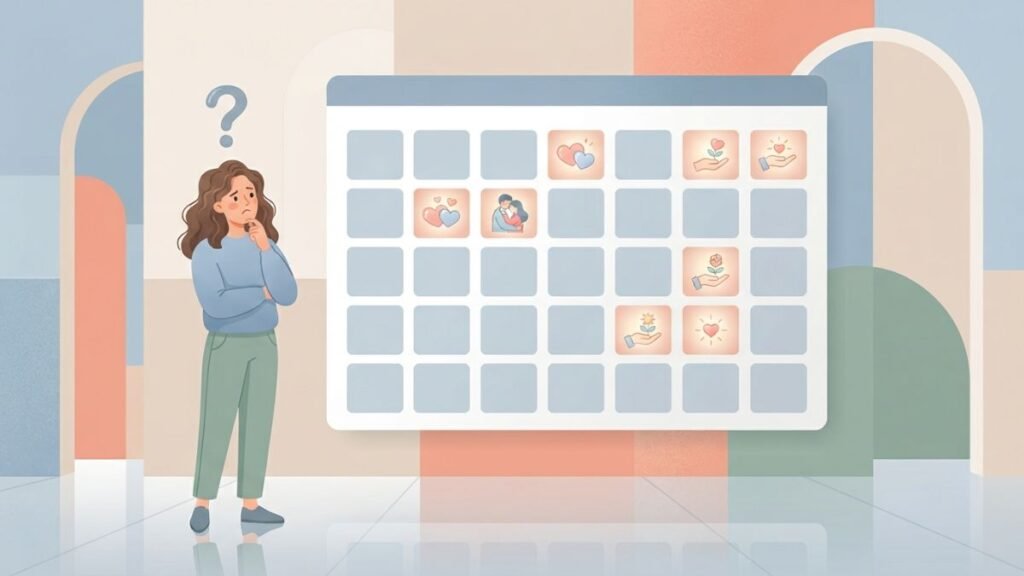
It doesn’t always look like dramatic fluctuation. Sometimes it’s subtle enough that you question whether the shift is even real — until the accumulation of shifts becomes undeniable.
His physical affection operates on a schedule you can’t predict. Some days he’s tactile — holding your hand, pulling you close, initiating contact that feels natural and purposeful. Other days he stiffens when you reach for him. Pulls away when you lean in. Creates physical distance that communicates “not now” without words. Inconsistent affection in its physical form is especially confusing because touch is primal. When it’s present, your body relaxes. When it’s absent, your body registers rejection at a level deeper than language.
His verbal affection appears and vanishes without pattern. “You’re beautiful.” “I’m lucky to have you.” “I love you.” These words arrive on certain days with warmth that makes your chest expand. On other days — or sometimes the same day — the warmth is gone. The words stop. Or worse, they’re delivered mechanically, stripped of the feeling that once accompanied them. The “I love you” that made you melt last week is the same phrase that lands flat today — same words, completely different energy. Inconsistent affection that lives in language is disorienting because the vocabulary stays the same while the emotional content behind it fluctuates without explanation.
He’s affectionate after conflict but absent during stability. After a fight — when repair is needed, when the relationship feels threatened, when his access to you is at risk — the affection flows. He’s warm. He’s physical. He says the things you’ve been needing to hear. But during peaceful stretches — when nothing is wrong, when the relationship is calm, when affection should be the easiest thing in the world to provide — he’s distant. Cool. Unreachable. Inconsistent affection that tracks with conflict suggests a man whose warmth is reactive, not constitutional. He produces it when he needs to. Not when you need him to.
He’s affectionate in private but distant in public — or vice versa. The inconsistency sometimes splits along context. Behind closed doors, he’s warm. In front of others, he’s detached — or the reverse. The version of affection you receive depends on the audience, not on his feelings. Inconsistent affection that shifts based on who’s watching reveals that his warmth is performative in at least one context. And if it’s performed somewhere, you can’t be certain it’s genuine anywhere.
Why His Affection Comes in Bursts Instead of Steadily

Consistent affection requires emotional availability he doesn’t sustain. Affection isn’t just a behavior. It’s a state — one that requires emotional presence, openness, and the willingness to be soft on an ongoing basis. For a man whose emotional availability operates in cycles — present sometimes, depleted others — consistent affection is structurally impossible. The bursts represent the moments when his emotional system is accessible enough to produce warmth. The gaps represent the periods when it’s shut down. Inconsistent affection driven by capacity limitations isn’t about his feelings for you changing. It’s about his access to those feelings fluctuating in ways he hasn’t learned to stabilize.
He uses affection as a tool rather than expressing it as a state. For some men, affection isn’t something they feel and express naturally. It’s something they deploy — during conflict resolution, during moments when your loyalty seems uncertain, during situations where warmth is required to maintain the relationship. The affection is real in the sense that it produces real impact. But it’s instrumental — turned on when needed and turned off when the need passes. Inconsistent affection that appears strategically reveals a man who’s learned that warmth is a tool for managing the relationship rather than a natural expression of love flowing through it.
He associates consistent affection with vulnerability he can’t maintain. Being consistently warm means being consistently soft. And for a man whose emotional system treats softness as exposure, sustained warmth feels unsustainable. The bursts of affection are his system briefly allowing vulnerability. The withdrawals are his system snapping back to its defended position. He’s not choosing to be cold. His system is choosing for him — toggling between the vulnerability affection requires and the protection his default state provides. Inconsistent affection is often the behavioral expression of a nervous system oscillating between openness and self-defense.
He learned affection in an environment where it was inconsistent. If love in his childhood was delivered unpredictably — a parent who was warm sometimes and absent others, a caregiver whose affection was conditional on mood or circumstance — he internalized that pattern as normal. Affection doesn’t flow steadily in his programming. It surges and recedes. Arrives and departs. Shows up powerfully and disappears completely. He’s not choosing to replicate an unhealthy pattern. He’s running the only model of affection he was given. Inconsistent affection inherited from childhood isn’t intentional cruelty. But it produces the same result — a woman who can’t trust the warmth because it never stays.
Consistent affection would deepen the intimacy beyond his comfort threshold. If he were warm every day — touching, speaking tenderly, expressing love regularly — the relationship would deepen naturally. Intimacy would build. Emotional closeness would increase. And for a man whose system treats depth as threat, that progression is precisely what the inconsistency prevents. The gaps in affection interrupt the deepening. They create emotional distance that keeps the relationship shallow enough for his comfort. Inconsistent affection isn’t a failure of love. It’s a regulation of depth — his system’s way of ensuring the relationship never gets close enough to trigger the vulnerability that sustained closeness would require.
He’s comfortable receiving affection but uncomfortable providing it. Watch the asymmetry. When you initiate affection — when you reach for him, tell him you love him, offer physical warmth — he receives it. Often eagerly. The receiving side works fine. The providing side is where the inconsistency lives. Because providing requires giving. Initiating. Being the one who opens the door to vulnerability. And the opening is where his system falters. Inconsistent affection that flows reliably in one direction — from you to him — and unreliably in the other reveals a man who can consume warmth but can’t consistently produce it.
The inconsistency keeps you attached at a level consistency never would. Unpredictable affection creates neurological hooks that steady warmth doesn’t. The burst of tenderness after a stretch of coldness triggers a dopamine response that consistent warmth wouldn’t produce — because the relief of receiving after deprivation is more intense than the comfort of receiving regularly. Inconsistent affection creates a specific kind of attachment — one that’s rooted in the cycle of deprivation and reward rather than the steady nourishment of reliable love. You’re not attached to his affection. You’re attached to the pattern of its appearance and disappearance. And the pattern, neurologically, operates like an addiction.
What Inconsistent Affection Is Doing to You
You’ve started measuring your worth by his warmth. When he’s affectionate, you feel valued. When he’s cold, you feel worthless. Your self-assessment has become tethered to his emotional output — rising and falling with each burst and each withdrawal. Inconsistent affection has externalized your self-worth, placing it in the hands of a man whose delivery system is fundamentally unreliable. You’re sourcing your value from the most unstable supply possible.
You’ve become hypervigilant about his mood and energy. You scan constantly. Is he in a warm phase or a cold one? Is today a day he’ll reach for you or a day he’ll pull away? Will the hand on your back arrive tonight or will you go to bed untouched? The monitoring is exhausting — not because any single scan costs much energy, but because the scanning never stops. Your nervous system runs a permanent assessment of his emotional temperature because your sense of safety depends on the forecast.
You’ve started performing to trigger his affection. You’ve learned what sometimes produces warmth — wearing certain things, saying certain things, behaving in certain ways. And you’ve started performing those behaviors strategically, hoping to activate the affectionate version of him. Not because you enjoy the performance. Because the alternative — waiting for affection that arrives on its own schedule with no input from you — is unbearable. Inconsistent affection has turned you from a woman who receives love naturally into a woman who engineers conditions for its delivery.
You’ve normalized emotional starvation. After enough cycles of warmth and withdrawal, your expectations have adjusted downward. You’ve stopped expecting daily affection. Stopped expecting consistent warmth. Stopped expecting the steady, reliable tenderness that healthy relationships provide as baseline. You’ve adjusted your appetite to match his inconsistent offering — and now scraps feel like meals because you’ve been hungry so long you’ve forgotten what full tastes like.
You feel simultaneously loved and neglected. Both are true and both coexist. He loves you — you’ve felt it. He neglects you — you’ve felt that too. And the coexistence of love and neglect creates a specific kind of confusion that doesn’t resolve because both experiences are genuinely happening. Inconsistent affection isn’t pure neglect. It’s worse — it’s neglect with evidence of love woven through it, making the neglect harder to name and harder to leave.
What You Need to Do
Stop accepting bursts as evidence of consistent love. The burst is not the baseline. The baseline is the gap between bursts. Measure his affection by what he sustains, not by what he delivers at peak moments. If the sustained reality is coldness punctuated by occasional warmth, the sustained reality is what you’re actually living in — not the warmth.
Name the pattern directly. “Your affection comes and goes without explanation. I can’t predict when you’ll be warm and when you’ll be distant. And the inconsistency is more painful than the absence would be — because it gives me just enough to keep hoping and never enough to feel secure.” Say it during a neutral moment. Let the observation land without his warmth or coldness influencing the delivery.
Stop performing to activate his warmth. You shouldn’t have to engineer the conditions for the man who loves you to show it. Affection that requires your performance isn’t organic. It’s transactional. Stop performing. Let his affection — or his absence of it — exist without your effort to manufacture it. What remains after you stop performing is the truth about what he provides on his own.
Rebuild your self-worth from internal sources. Your value doesn’t live inside his inconsistent delivery of warmth. It lives inside you — in your character, your capacity, your depth, your strength. Start reconnecting with that internal source. Through affirmations that are specific and evidence-based. Through achievements that remind you of your capability. Through relationships with people whose warmth is reliable. Inconsistent affection can only hold your self-worth hostage if you keep sourcing your worth from it.
Set a private standard and honor it. “I deserve consistent warmth. Not perfect — consistent. If this man can’t provide a reliable baseline of affection, this relationship can’t give me what I need.” Hold that standard. Measure his behavior against it over weeks. And if the inconsistency remains the dominant pattern — if the bursts stay brief and the gaps stay long — let your standard inform your decision.
Get professional support. A therapist can help you untangle the neurological attachment his inconsistency has created, rebuild the self-worth his pattern has been eroding, and make decisions from clarity instead of the addictive pull of his next warm moment.
What You Need to Understand
Inconsistent affection isn’t love operating imperfectly. It’s love operating unreliably. And unreliable love — no matter how genuine the bursts feel — cannot sustain a healthy relationship. Relationships require a baseline of warmth that both people can count on. A floor beneath which the temperature never drops. A minimum that’s always present regardless of mood, circumstance, or internal fluctuation. If the baseline is cold and the warmth is the exception, the relationship is built on ice — not ground.
His bursts of affection aren’t evidence that you’re loved enough. They’re evidence that you’re loved intermittently. And intermittent love — however intense the moments — produces the same long-term impact as neglect. Because the gaps between the moments are where the damage accumulates. The loneliness between bursts. The self-doubt between warm phases. The hypervigilance between touches. The damage lives in the spaces his affection doesn’t occupy. And those spaces are where you spend most of your time.
The right man’s affection doesn’t operate on a schedule you can’t predict. It flows. Not perfectly. Not identically every day. But reliably. Steadily. In a way that lets you rest instead of scan. That lets you receive instead of perform. That lets you trust instead of brace. His warmth isn’t a surprise. It’s the weather — consistent enough that you stop checking the forecast because you already know what’s coming. More warmth.
What You Deserve
You deserve affection that you can count on. Not bursts that fuel you through gaps. Not warmth that arrives unpredictably and leaves without warning. Steady, reliable, consistent warmth from a man whose love shows up the same way every day — not because he’s performing, but because loving you visibly is as natural to him as breathing.
You deserve to stop scanning. Stop performing. Stop measuring your worth by which version of his affection shows up today. You deserve to know — every morning, every evening, every ordinary moment in between — that the man beside you is warm. Present. Reaching for you. Not sometimes. Always.
You deserve to feel full, sis. Not temporarily fed by moments that burn bright and fade fast. Full. Consistently. From a man whose love doesn’t arrive in bursts because it never left.
The Bottom Line
His affection comes in bursts because inconsistent affection reflects emotional availability that operates in cycles, because consistent warmth would deepen the intimacy beyond his comfort threshold, because the pattern creates neurological attachment stronger than consistency would, and because he can receive affection reliably but can’t produce it steadily.
Stop living on bursts. Stop normalizing the gaps. Stop measuring the relationship by its peak moments while the valleys consume your self-worth.
The bursts aren’t the relationship, sis. The gaps are. And the gaps have been telling you the same thing every time — he can love you, but he can’t love you consistently. And love without consistency isn’t love you can build on. It’s love you survive between.
FAQ
Q: What if his affection is consistent in some ways but not others?
Partial consistency is still inconsistency if the missing dimension is one you need. If he’s physically affectionate but verbally absent — or verbally warm but physically distant — the inconsistency in the missing dimension still creates hunger. Love needs to show up across the channels that matter to you, not just the ones that are easy for him.
Q: Could inconsistent affection be caused by stress or depression?
Both can affect emotional availability. But stress and depression that are communicated — “I’m going through something and it’s affecting how I show up” — are different from inconsistent affection that arrives without explanation and leaves without acknowledgment. The first is a partner managing difficulty. The second is a pattern operating unchecked.
Q: How do I stop craving his affection during the cold phases?
Recognize the craving as a neurological response to intermittent reinforcement — not as evidence of deep love. The craving is the cycle talking, not your heart. Fill the gaps with reliable sources of warmth — friendships, self-care, professional support. The craving weakens as the alternative sources of connection strengthen.
Q: What if he’s affectionate with others but inconsistent with me?
Selective affection is particularly painful and revealing. If warmth flows reliably toward friends, family, or social situations but unreliably toward you, the inconsistency isn’t about his capacity. It’s about his allocation. He can sustain warmth. He’s choosing not to sustain it in your direction.
Q: Can inconsistent affection become consistent?
With genuine self-awareness, therapeutic work on attachment and emotional regulation, and sustained commitment to showing up differently — yes. But consistency is built through daily practice over months, not through promises that produce another temporary burst. If his “I’ll be more affectionate” produces a week of warmth followed by the same pattern, the promise was another burst — not a change.