
Sis, let me describe the disappearing act you’ve been watching on repeat.
Things get serious. Not in a bad way in a good way. The relationship deepens. The conversations get more real. The future starts forming in the space between you. Something shifts from casual to meaningful, from surface to substance, from “seeing where this goes” to “this is going somewhere.” And right at the moment where most people would lean in where the natural response to deepening love would be to meet it with more presence, more commitment, more vulnerability he vanishes.
Not always physically. Sometimes physically. But always emotionally. The warmth cools. The engagement drops. The man who was showing up consistently suddenly becomes inconsistent. The future he was starting to reference becomes a topic he avoids. The vulnerability he was beginning to offer gets retracted pulled back behind walls that went up so fast you didn’t even see them being built.
And you’re left bewildered. Because nothing went wrong. No fight. No betrayal. No conflict. Things were going right. That’s what makes it so disorienting the disappearance isn’t a response to damage. It’s a response to depth. He’s not running from something broken. He’s running from something real.
That’s avoidant attachment. And it’s one of the most confusing relational patterns a woman can encounter because it punishes the exact behavior that healthy relationships are built on. The closer you get, the further he goes. The more real it becomes, the less available he is. And the love that should be pulling him toward you is the very thing pushing him away.
What Avoidant Attachment Looks Like When Things Get Serious

The disappearance doesn’t always look dramatic. Sometimes it’s so incremental you don’t notice the withdrawal until he’s already halfway gone.
He was consistent during the casual phase and unreliable during the serious phase. Early on when things were light, fun, undefined he showed up. Texted regularly. Made plans. Was present. But the moment the relationship crossed some invisible threshold into “serious” territory, the reliability collapsed. The casual version of him could sustain connection. The serious version can’t. Avoidant attachment reveals itself in the difference between how a man behaves when depth is optional and how he behaves when depth becomes expected.
He creates distance without a clear reason. You haven’t done anything wrong. The relationship is in a good place. And yet he’s pulling back subtly at first, then noticeably. Less communication. Fewer plans. A general cooling that doesn’t attach to any specific event. The distance isn’t reactive. It’s preemptive his system creating space before the closeness can reach a level his attachment system can’t tolerate. Avoidant attachment doesn’t need a reason to create distance. Closeness itself is the reason.
He deactivates emotionally right when emotions are most needed. You share something vulnerable. He goes flat. You express what the relationship means to you. He changes the subject. You talk about the future. He gets vague. The moments where emotional presence matters most — where the relationship needs his engagement to deepen — are exactly the moments he checks out. His emotional deactivation isn’t random. It’s specifically triggered by the conditions that serious relationships produce.
He finds flaws to justify the distance. Suddenly you’re “too much.” Too emotional. Too needy. Too available. Qualities that didn’t bother him during the casual phase become problems during the serious one — not because they changed, but because he needs a reason to justify the withdrawal his system is demanding. Avoidant attachment often manufactures complaints about the partner as a rationalization for the distance the attachment system requires. The flaws he’s finding aren’t real assessments of you. They’re exit ramps his system is constructing.
Why He Disappears When Things Get Serious
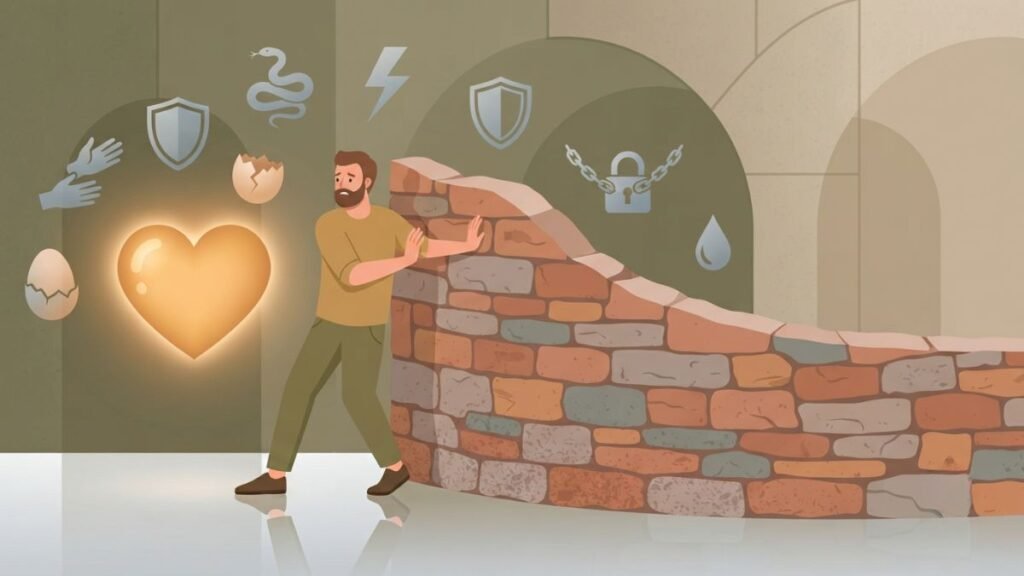
Seriousness activates a threat response encoded in his nervous system. Avoidant attachment isn’t a personality trait. It’s a nervous system configuration — one that developed in early childhood as a response to caregiving that was inconsistent, emotionally unavailable, or rejecting. His developing brain learned that depending on someone leads to disappointment. That closeness isn’t safe. That the safest position is emotional self-sufficiency. And that learning runs deeper than any adult decision he could make — it’s wired into his body at a level that operates below conscious awareness. When the relationship gets serious, his nervous system doesn’t process it as “my partner and I are getting closer.” It processes it as “danger — dependency forming — activate distance protocols.” He doesn’t choose to disappear. His system makes the choice before his conscious mind has time to override it.
He equates dependency with vulnerability and vulnerability with danger. For a man with avoidant attachment, needing someone is the most dangerous state he can imagine. Not because the person is dangerous — because the need itself is. Needing someone means depending on them. Depending means being vulnerable to their absence. And vulnerability to absence — in his attachment history — has always preceded pain. So when the relationship reaches the point where need begins forming — where he starts wanting you in a way that feels like needing you — his system shuts down the wanting. The disappearance isn’t about you. It’s about the need itself. He’s running from the experience of needing someone — not from the specific someone he needs.
Seriousness creates expectations he doesn’t believe he can meet. A casual relationship has flexible expectations. A serious one has standards. Consistency. Reliability. Emotional presence. Follow-through. And a man with avoidant attachment looks at those standards and sees a performance he’s bound to fail. Not because he’s incapable — because his attachment system has convinced him he is. He doesn’t believe he can sustain the emotional demands that seriousness requires. So rather than try and fail — rather than disappoint you visibly and confirm his deepest fear about himself — he preemptively withdraws. Avoidant attachment often produces departure not from lack of caring but from overwhelming fear of inadequacy. He’d rather disappear than be found wanting.
His autonomy feels threatened by commitment. Avoidant attachment is deeply intertwined with a need for independence — not the healthy kind that coexists with partnership, but the defensive kind that operates as a substitute for it. He’s built his sense of self around self-sufficiency. Around not needing anyone. Around being complete alone. And seriousness threatens that construction. It asks him to share his life. To merge parts of his identity with another person’s. To become an “us” where he’s only ever been an “I.” The disappearance is his system’s attempt to preserve the autonomy that seriousness would require him to share. He’s not protecting himself from you. He’s protecting himself from the loss of the independence his identity depends on.
He’s been here before and it didn’t end well. If previous relationships that reached the serious stage ended in pain — in betrayal, in abandonment, in the devastating confirmation that closeness leads to loss — his nervous system has data points that reinforce the avoidance. Getting serious led to getting hurt. Getting deep led to getting damaged. His attachment system isn’t making predictions based on you. It’s making predictions based on history. And history says that serious relationships are the setup for the most damaging kind of pain. Avoidant attachment doesn’t distinguish between the woman who hurt him and the woman who loves him. Both reach for him. Both trigger the same alarm.
He associates the early phase with safety and the deepening phase with entrapment. The beginning was comfortable. Light. Easy. No expectations. No obligations. Just connection without consequences. The deepening phase introduced weight — the weight of commitment, of being known, of having someone close enough to see his flaws, of being responsible for someone else’s emotional wellbeing. And weight, to a man whose attachment system is calibrated for lightness, feels like entrapment. Avoidant attachment doesn’t process deepening love as enrichment. It processes it as enclosure. The walls of the relationship are closing in — not because you’re closing them, but because his system interprets depth as the walls getting closer.
He’s trying to manage something he can’t articulate. One of the most painful aspects of avoidant attachment is that the man experiencing it often can’t explain what’s happening. He feels the pull to withdraw. He feels the discomfort when things get serious. He feels the impulse to create distance. But if you asked him why — genuinely, directly — he might not be able to tell you. Because the avoidance operates below language. Below conscious thought. At the level of his nervous system, which learned its lessons long before he had words for anything. He’s not refusing to explain. He might genuinely not have the vocabulary for what’s driving his behavior.
What His Disappearance Is Doing to You
You’ve learned to fear the good times. After enough cycles of deepening followed by disappearance, your nervous system has been rewired. Good moments don’t produce peace anymore. They produce anxiety. “How long until he pulls away?” “What happens when this gets too real?” “Is this the moment where he starts to leave?” Avoidant attachment doesn’t just damage the man experiencing it. It damages the woman who loves him — by teaching her that closeness is the precursor to loss.
You blame yourself for the withdrawal. Every time he disappears, you run the analysis. Were you too available? Too eager? Too emotionally open? Did you say “I love you” too soon? Did you mention the future too directly? The self-audit is relentless — and misdirected. Because his withdrawal wasn’t a response to your behavior. It was a response to his system’s inability to hold what was building between you. But his pattern has trained you to look inward for answers that only exist inside him.
You’ve started holding back to prevent his disappearance. You measure how much you share. You calculate how much vulnerability is safe. You perform a version of yourself that’s less available, less open, less emotionally present — hoping that a smaller version of you will be less threatening to a man whose system treats depth as danger. But the downsizing doesn’t work. And the woman you’ve become in the process — guarded, strategic, self-protective — isn’t who you want to be. She’s who his avoidance forced you to become.
You feel chosen and abandoned at the same time. He chose you — during the casual phase. He pursued you. He was present. He made you feel wanted. And then he abandoned the version of the relationship that needed him most — the serious one. The one where his presence mattered beyond companionship. The one where showing up required emotional depth. He chose the easy version of you and abandoned the deep one. And both of those realities coexist in your chest — feeling chosen and discarded simultaneously.
What You Need to Do
Stop chasing him into the withdrawal. Every pursuit during his retreat reinforces the cycle. It teaches his system that withdrawal produces pursuit — which paradoxically confirms the dynamic he’s trying to escape. Let him disappear. Don’t follow. Not as punishment — as protection. If he returns on his own, the return has the possibility of being genuine. If he doesn’t, the absence has given you essential information.
Stop making yourself smaller to prevent his departure. Your fullness isn’t the threat. His system is. Don’t reduce your emotional expression, your availability, or your vulnerability to accommodate his avoidance. You shouldn’t have to become less of yourself to keep someone present. Avoidant attachment creates the illusion that the solution is your reduction. The solution is his expansion. And that expansion is work only he can do.
Name the pattern without diagnosing. “Every time we get deeper, you pull away. I see it. I feel it. And I need to know whether you see it too — and whether you’re willing to address it.” Say it plainly. Not during the withdrawal — that’s the worst time because he’s already behind the wall. During a neutral moment where his defenses are lowest and the conversation has the best chance of landing.
Require professional intervention. Avoidant attachment at this level doesn’t resolve through patience, love, or better communication. It requires therapy — specifically work focused on attachment patterns, nervous system regulation, and the early experiences that created the avoidance. The attachment style was formed decades before you arrived. Your love doesn’t have the power to rewrite it. Only sustained professional work does.
Protect your attachment security. If you entered this relationship with a secure attachment style and you’re noticing yourself becoming anxious — hypervigilant, preoccupied, scanning for signs of his withdrawal — his pattern is infecting yours. Address that now. Through your own therapy. Through honest self-assessment. Before his avoidance permanently reshapes how you attach in every future relationship.
Decide what you can honestly sustain. A lifetime of reaching for a man who retreats. Of deepening love that triggers deeper distance. Of doing everything right and watching it produce the wrong result. Can you sustain that? Not hopefully. Honestly. Because avoidant attachment that goes untreated doesn’t improve with time. It calcifies. The withdrawals get more reflexive. The walls get thicker. And the woman standing in front of them gets more tired with every cycle.
What You Need to Understand
Avoidant attachment isn’t a choice. It’s a configuration — built in infancy, reinforced through childhood, and operating automatically in every intimate relationship the man enters. He doesn’t choose to disappear when things get serious. His system chooses for him. That doesn’t excuse the impact. But it explains why love, patience, and perfect behavior on your end don’t change the pattern. You’re not dealing with a choice you can influence. You’re dealing with wiring you can’t reach.
You can’t love a man through avoidant attachment. You can support him while he does his own work. But the work is his. The therapy is his. The daily, uncomfortable practice of overriding his system’s impulse to flee — that’s his. And until he chooses that work, the pattern continues regardless of how much love you pour into the space he keeps vacating.
The right man might feel the pull to withdraw — that’s human. But he overrides it. He says “I feel myself pulling away and I’m choosing to stay.” He fights his own wiring because losing you matters more than protecting himself from the vulnerability that staying requires. He doesn’t need you to chase him. He needs himself to stay. And the difference between a man with avoidant attachment who’s doing the work and one who isn’t is the difference between someone who’s fighting for the relationship and someone whose system is fighting against it.
What You Deserve
You deserve a man who stays when things get real. Who leans into seriousness instead of retreating from it. Who views the deepening of love as something to protect — not something to escape.
You deserve to be met at your depth. To share vulnerability without it triggering a disappearing act. To love fully without your fullness becoming the reason he leaves.
You deserve a man who chooses you over his fear, sis. Every single time. Not perfectly. Not without struggle. But consistently. Choosing presence over retreat. Choosing depth over distance. Choosing the hard, vulnerable, terrifying act of staying — because the woman in front of him is worth every ounce of discomfort staying requires.
The Bottom Line
He disappears when things get serious because avoidant attachment treats depth as danger, because his nervous system was wired in childhood to equate closeness with threat, because seriousness introduces expectations his system tells him he’ll fail at, and because withdrawal is the only response his attachment configuration has ever known.
None of that is your fault. None of it is yours to fix. And none of it changes without the kind of sustained professional work that he alone has to choose.
Stop chasing. Stop shrinking. Stop absorbing his disappearance as evidence of your inadequacy. You didn’t push him away by loving him well. His system rejected the love because love, at the depth you offer it, is the one thing his wiring was built to avoid.
Your love isn’t the problem, sis. His fear of it is. And until he fights the fear instead of running from it, the disappearance will continue — taking pieces of your openness with it every time it repeats.
FAQ
Q: How do I know if it’s avoidant attachment or if he’s just not that into me?
Avoidant attachment has a specific pattern — pursuit during the casual phase and withdrawal during the serious one. If he was genuinely engaged early on and pulled back only when depth approached, that’s avoidance. A man who’s simply not interested maintains consistent low investment throughout. The oscillation between pursuit and withdrawal is the marker.
Q: Can avoidant attachment be healed?
Yes — with sustained therapeutic work focused on attachment patterns, nervous system regulation, and the early relational experiences that built the avoidance. Earned secure attachment is real and documented. But it requires active, willing, prolonged engagement with the therapeutic process. It doesn’t happen through love alone.
Q: Should I become more avoidant to match his energy?
No. Matching his avoidance means abandoning your own emotional health. You’d be reshaping your attachment style to accommodate his dysfunction. The goal isn’t for both people to be avoidant. The goal is for both people to be secure. And security doesn’t come from meeting avoidance with more avoidance. It comes from one person getting help while the other maintains her own emotional integrity.
Q: What if he says he wants to change but keeps disappearing?
Wanting to change and doing the work to change are different things. If he’s expressed desire but hasn’t pursued therapy, hasn’t engaged in consistent self-work, and continues the same pattern — the desire is real but the follow-through is absent. Avoidant attachment doesn’t respond to intention alone. It responds to sustained intervention.
Q: What if I’ve developed anxious attachment because of his pattern?
That’s a common and well-documented dynamic — the anxious-avoidant trap. His avoidance activates your anxiety. Your anxiety activates his avoidance. The cycle feeds itself. Address your own attachment responses through therapy before they become your permanent relational style. Your anxiety wasn’t there before his avoidance created the conditions for it.