
Sis, how many times has he looked you in the eyes and said “I’ll change”?
Not once. Not twice. Enough times that you’ve lost count. Enough that the words themselves have become a sound you recognize but no longer believe like a song you’ve heard so many times the lyrics have lost all meaning. He says “I’ll do better” and your body doesn’t soften anymore. It braces. Because you know from direct, repeated, documented experience that the promise and the follow-through live in two different universes.
He promised to communicate better. He didn’t. He promised to stop the behavior that hurt you. He didn’t. He promised to go to therapy. He didn’t. He promised that this time this time would be different. It wasn’t. The words were delivered with conviction. The eyes looked sincere. The tone carried just enough gravity to make you believe that this moment was the turning point.
And then nothing changed.
The behavior resumed. The pattern continued. The promise dissolved into the same air it was spoken into. And you’re left standing in the wreckage of another cycle wondering how a man who sounded so certain about changing can remain so committed to staying the same.
That’s empty promises in relationships. Not occasional failures to follow through — those are human. This is a pattern. A consistent, predictable cycle where the promise of change is deployed as a tool — not to create change, but to prevent the consequences of not changing. He doesn’t promise to become a better man. He promises to keep you from leaving while he remains exactly the man he’s always been.
What Empty Promises Look Like
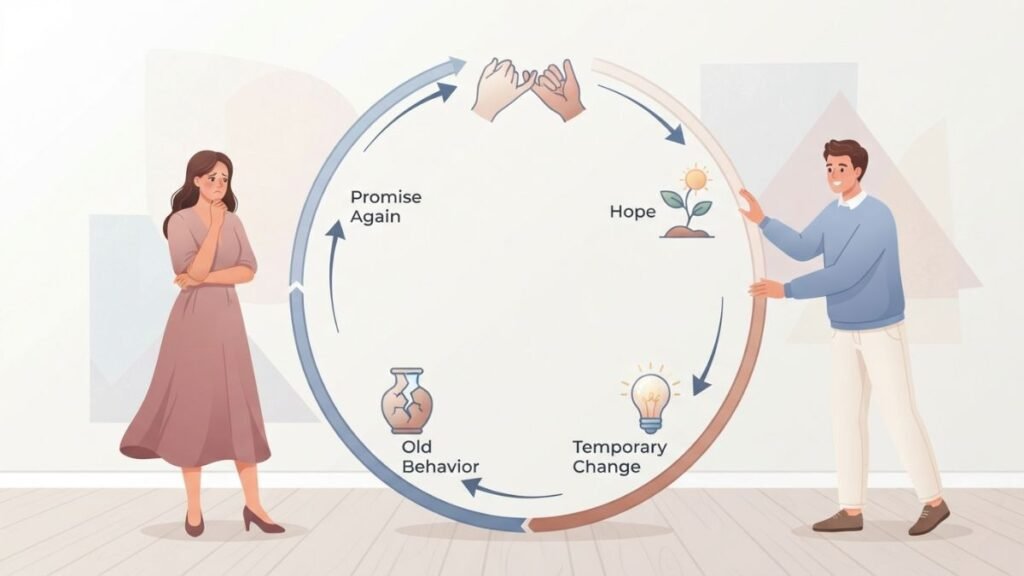
Empty promises in relationships don’t always arrive as grand declarations. Sometimes they’re quieter — woven into conversations so naturally that you absorb them as real before your body has time to remind you that real is something his promises have never been.
The promise arrives at the exact moment you’re about to leave. You’ve reached your limit. You’ve communicated clearly — maybe for the tenth time — that something needs to change or you’re done. And right on cue, the promise appears. “I hear you. I’m going to change. I’ll do whatever it takes.” The timing isn’t coincidental. It’s strategic. Empty promises in relationships are almost always deployed at the departure point — the moment when your leaving becomes real enough that his comfort is threatened. The promise isn’t motivated by genuine desire to grow. It’s motivated by the immediate need to prevent your exit.
The promise is vague enough to avoid accountability. “I’ll be better.” “I’ll work on it.” “Things will be different.” Better how? Work on what? Different in which specific ways? The vagueness isn’t accidental. Specific promises can be measured. Vague promises can’t. “I’ll stop raising my voice during arguments” can be evaluated. “I’ll do better” can mean whatever he needs it to mean — including nothing at all. Empty promises in relationships survive on ambiguity. The less specific the promise, the harder it is to hold accountable when it’s broken.
The initial effort lasts just long enough to reset your hope. After the promise, there’s a window — maybe a few days, maybe a week — where he shows effort. He communicates more. He’s more present. He does the thing he said he’d do. And the effort feels genuine enough that your hope resets. You think “maybe this time.” You soften. You reinvest. And then the effort fades. Not dramatically. Gradually. Like a volume knob being turned down so slowly you don’t realize the music has stopped until the silence has been going on for a while.
The same behavior returns without acknowledgment. The thing he promised to change reappears — sometimes within weeks, sometimes within days — without any recognition that a promise was broken. He doesn’t say “I know I said I’d change and I haven’t.” He doesn’t acknowledge the gap between what was promised and what was delivered. He just resumes the behavior as though the promise never existed. And if you bring it up, the response is either a new promise — the cycle restarting — or defensiveness that makes you the problem for expecting follow-through.
Why He Promises Change But Repeats the Same Behavior
The promise is a pressure valve, not a commitment. When you’re at the breaking point — upset, exhausted, ready to walk — the pressure in the relationship peaks. His comfort is threatened. His access to you is at risk. And the fastest way to release that pressure is to say what you need to hear. “I’ll change.” The pressure drops. You soften. The crisis passes. And the promise has served its purpose — not as a commitment to grow, but as a mechanism to restore the status quo. Empty promises in relationships function like reset buttons. They don’t fix anything. They restart the same broken cycle from the beginning. And the cycle looks identical every time because the promise was never about the destination. It was about preventing the departure.
He genuinely believes the promise in the moment and can’t sustain it beyond it. This is the version that might be hardest to accept because it means his sincerity and his failure can coexist. In the moment of the promise — when your pain is visible, when the relationship is at stake, when the emotions are heightened — he means it. He feels it. He intends it. But intention without structure collapses. He has no plan for how to change. No therapeutic support. No accountability system. No understanding of what change actually requires beyond the feeling of wanting it. Empty promises in relationships are often the product of emotional sincerity without operational capacity. He’s a man who feels deeply in the moment and forgets completely by morning. Not because he doesn’t care. Because caring, without the tools to convert caring into action, produces the same result as not caring — which is nothing.
Change would require sustained discomfort he’s unwilling to endure. The promise costs nothing. Two sentences. A certain look in his eyes. A moment of what appears to be genuine vulnerability. But the follow-through? That’s expensive. It means sitting with his patterns honestly. Recognizing what he does and why. Attending therapy consistently. Doing the internal work that genuine transformation requires. It means discomfort — not for a moment, but for months. And he’s consistently chosen the cheap option. The promise. The words. The performance of intention. Because the performance produces the result he needs — your continued presence — without the cost that actual change would demand. Empty promises in relationships are always cheaper than real ones. And he’s been paying the minimum for the entire relationship.
Your forgiveness has made the cycle cost-free. Every time he promised and you believed — every time the behavior returned and you stayed — the lesson deepened: promises are enough. Follow-through is optional. Repetition carries no consequences. You absorbed each broken promise with patience, with hope, with the “maybe next time” optimism that his pattern has been feeding on since the beginning. Empty promises in relationships survive because they’re accepted as currency. And you’ve been accepting them at face value while their actual value has been zero.
He’s managing you, not growing himself. There’s a critical distinction between a man who’s working on himself and a man who’s working on keeping you. One produces internal change. The other produces external performance. His promises fall into the second category — calibrated not to create growth but to maintain access. He’s not saying “I’ll change” because he’s committed to being a different man. He’s saying it because it’s the most efficient way to keep the relationship intact without changing anything. Empty promises in relationships are relationship management disguised as personal development. And the disguise has been good enough to keep you invested cycle after cycle.
He’s done the math and the math works in his favor. The cycle is reliable. He behaves badly. You reach your limit. He promises change. You stay. The behavior returns. You reach your limit again. He promises again. You stay again. At no point in this cycle does he face a consequence that exceeds the cost of a promise. The promise is cheap. Your departure is expensive. As long as the cheap option prevents the expensive outcome, the math works. Empty promises in relationships continue because the person making them has calculated — consciously or not — that words cost less than change. And they’ll keep costing less as long as you keep accepting them as payment.
He doesn’t actually know how to change. This might be the most generous interpretation — and it might sometimes be true. He sees the behavior. He knows it hurts you. He wants, in some genuine part of himself, to be different. But he doesn’t know how. He doesn’t have the tools. He doesn’t understand the process of behavioral change — the therapy, the self-reflection, the daily practice of choosing differently. So he promises, because promising is the only thing he knows how to do. And when the promise fails — because promises without plans always fail — he’s left where he started, with the same deficit and the same behavior, ready to promise again the next time crisis arrives.
What Empty Promises Are Doing to You
You’ve lost the ability to trust words. Not just his. Anyone’s. When someone tells you “I’ll be there” or “I’ll do it” or “things will be different,” something inside you flinches. Because you’ve heard those words so many times from a man who never backed them up that your nervous system now treats all promises as suspect. Empty promises in relationships don’t just damage trust in the person making them. They damage trust in language itself — in the reliability of words as indicators of future behavior.
You’ve become the relationship’s memory keeper. You remember every promise. Every “I’ll change.” Every behavior that was supposed to stop and didn’t. Every cycle. Every repetition. You carry the full historical record of his broken commitments — not because you’re holding grudges, but because someone has to remember. And he’s conveniently forgotten every single one. Your memory has become the archive he refuses to maintain. And the weight of that archive is crushing.
Hope has become your enemy. Every cycle of promise-and-failure has weaponized your hope against you. You hope he’ll follow through. You hope this time is real. You hope the sincerity you heard was genuine. And every time that hope gets shattered, the shattering hurts worse — not because the behavior is worse, but because the hope was already damaged from the last time it was betrayed. You’re hoping on a broken mechanism. And the broken mechanism keeps producing the same result: disappointment dressed in expectation.
You feel stuck between what he says and what he does. His words say “I’m changing.” His behavior says “I’m the same.” And you’re trapped in the gap between those two realities — believing the words because you want to, seeing the behavior because you have to, and unable to reconcile the two into a clear decision. Empty promises in relationships create exactly this paralysis. They provide just enough verbal hope to prevent the behavioral evidence from producing action. And the paralysis keeps you locked in the cycle he needs you locked in.
What You Need to Do
Stop accepting promises as currency. Words are not evidence of change. They’re evidence of intent at best and manipulation at worst. The next time he says “I’ll change,” don’t absorb it as meaningful until behavior confirms it. “I hear the promise. But I’ve heard it before. What I need now isn’t your words. I need sustained different behavior. And I’ll be watching the behavior, not listening to the promise.”
Set a private timeline and measure behavior, not words. Give yourself a window — thirty days, sixty days. During that window, measure what he does, not what he says. Did the specific behavior stop? Did the communication improve measurably? Did the therapy appointment get made — and attended — consistently? If the behavior looks identical to pre-promise behavior at the end of your window, the promise was empty. And your response to that should be different from every previous time.
Stop forgiving prematurely. You’ve been forgiving at the promise stage — before the change has been demonstrated. Forgiveness before evidence is premature. It releases the pressure that should be motivating his follow-through. Hold your forgiveness until the behavior change is visible, sustained, and consistent. Not as punishment. As protection.
Name the cycle explicitly. “This is the same promise you made last time. And the time before that. And the time before that. The words aren’t the issue. The repetition is. I can’t keep believing something that has never been true.” Say it clearly. Without anger. With the bone-deep exhaustion of a woman who’s heard the same speech enough times to have it memorized.
Get professional support. A therapist can help you process the accumulated damage of years of broken promises, rebuild your relationship with trust, and make decisions about whether this cycle is something you’re willing to continue living inside.
Decide what your breaking point actually is — and honor it. Not the theoretical breaking point you’ve announced but never enforced. The real one. The one where the behavior returns after the promise and you choose differently than you have every time before. Empty promises in relationships only end when the person receiving them stops accepting them. You are the only variable that can change this equation. And changing it means choosing yourself over his promise for the first time.
What You Need to Understand
Empty promises in relationships aren’t communication failures. They’re manipulation successes. Every promise that prevented your departure without producing genuine change accomplished exactly what it was designed to accomplish — keeping you present without requiring him to be different.
A man who changes doesn’t need to promise repeatedly. He promises once — or doesn’t promise at all — and then demonstrates through sustained behavior that something has shifted. The change is visible. The growth is observable. The difference between who he was and who he’s becoming is measurable without anyone needing to narrate it. If you need a promise to know change is coming, the change isn’t coming. It’s just being announced. Again.
The right man doesn’t cycle through promises. He cycles through progress. He doesn’t tell you things will be different. He shows you. Through daily behavior. Through consistent effort. Through the kind of quiet, sustained transformation that doesn’t need a speech because the evidence speaks for itself.
What You Deserve
You deserve a man whose words and actions live in the same reality. Who doesn’t need to promise change because his behavior already reflects it. Who follows through not because you demanded it but because his integrity won’t allow anything less.
You deserve to trust again. To hear “I’ll do better” and actually believe it — because the man saying it has a track record that supports belief rather than destroys it.
You deserve proof, sis. Not promises. Not words delivered with convincing eyes and empty hands. Proof. The kind that shows up every day. The kind you don’t have to chase. The kind that looks like a man who actually became what he said he would — without needing to say it again.
The Bottom Line
He promises change but repeats the same behavior because empty promises in relationships cost nothing and prevent the only thing that would cost him something — your departure. Because the promise is a pressure valve not a commitment. Because your forgiveness has made the cycle consequence-free. Because managing your hope is cheaper than managing his growth. And because the math works perfectly in his favor as long as you keep accepting words as payment for behavior you never receive.
Stop accepting. Stop believing without evidence. Stop resetting the clock every time he delivers the same speech with different words.
His promises aren’t commitments, sis. They’re receipts for purchases he never made. And you’ve been holding those receipts long enough to know that the product was never coming.
Put the receipt down. And start shopping somewhere that delivers.
FAQ
Q: How do I tell the difference between a genuine promise and an empty one?
A genuine promise comes with a plan. Specifics. Steps. A timeline. Accountability structures. “I’ll change” without details is a feeling, not a promise. “I’ve scheduled a therapy appointment for Thursday and I’m going to work on this specific behavior” is a plan. The presence of specifics — and the follow-through on them — distinguishes genuine commitment from empty performance.
Q: What if he’s trying but failing?
Genuine effort looks like incremental progress with acknowledged setbacks. “I slipped up, I’m aware of it, and here’s what I’m doing differently going forward.” Empty promises look like full repetition of the same behavior with no acknowledgment that the promise was broken. The difference is whether the failure produces growth or just another identical cycle.
Q: Should I give him another chance after multiple broken promises?
That’s a decision only you can make. But base it on behavior, not words. If his behavior after the last promise looked identical to his behavior after the promise before that — and the one before that — additional chances are just additional cycles. The pattern has shown you what it produces. Trust the pattern more than the promise.
Q: What if he says I’m being unfair by not believing him?
Belief is earned through behavior. A man who’s broken the same promise multiple times and calls you unfair for not believing the next one is confusing his desire to be believed with his right to be. Trust isn’t a gift you owe him. It’s a structure he builds through follow-through. If the structure has collapsed repeatedly, your caution isn’t unfairness. It’s wisdom.
Q: What if I’ve stayed because I keep hoping this time will be different?
Hope is beautiful when it’s grounded in evidence. When it’s ungrounded — when it survives only on promises that have never been kept — it becomes the chain that keeps you in the cycle. Recognize the hope as a product of the cycle itself, not evidence that the cycle is about to end. Every cycle produces hope. That’s how cycles survive. Breaking the cycle means choosing reality over hope — and letting your next decision be informed by what he’s done, not what he’s said he’ll do.