
Sis, let me name the loneliness nobody believes exists.
You’re not single. You have a partner. You share a home, a bed, a life. From the outside, everything looks intact two people together, building something. And if you told anyone “I’m lonely,” they’d look at you confused. How can you be lonely? He’s right there.
But he’s not right there. Not in the way that matters. His body occupies the same space. His name is on the same lease. His side of the bed is warm when you reach for it at night. But the man behind the presence — the one who’s supposed to see you, hear you, know you, connect with you — isn’t home. Hasn’t been home in a long time. Maybe was never fully home to begin with.
And the loneliness you feel isn’t the kind that comes from being alone. It’s the kind that comes from being with someone and still feeling unseen. Unheard. Unmet. Existing beside a man who shares your physical space while occupying an entirely different emotional universe.
That’s feeling alone in a relationship. And it’s worse than being actually alone — because at least alone, the loneliness makes sense. At least alone, there’s no one who should be filling the space but isn’t. At least alone, you’re not lying next to someone at night wondering why the closest person to you physically is the furthest person from you emotionally.
What Feeling Alone in a Relationship Actually Looks Like
It doesn’t always look like abandonment. Sometimes it looks like everything is fine — until you notice the emptiness underneath the surface.
He’s present but not engaged. He sits across from you at dinner scrolling his phone. He’s in the room while you talk but his attention is somewhere else. He answers when spoken to but never initiates. You’re together in every measurable way — same room, same table, same evening — and utterly alone in every way that matters. Feeling alone in a relationship isn’t about physical absence. It’s about emotional vacancy. He’s there. And somehow that makes the aloneness heavier than if he weren’t.
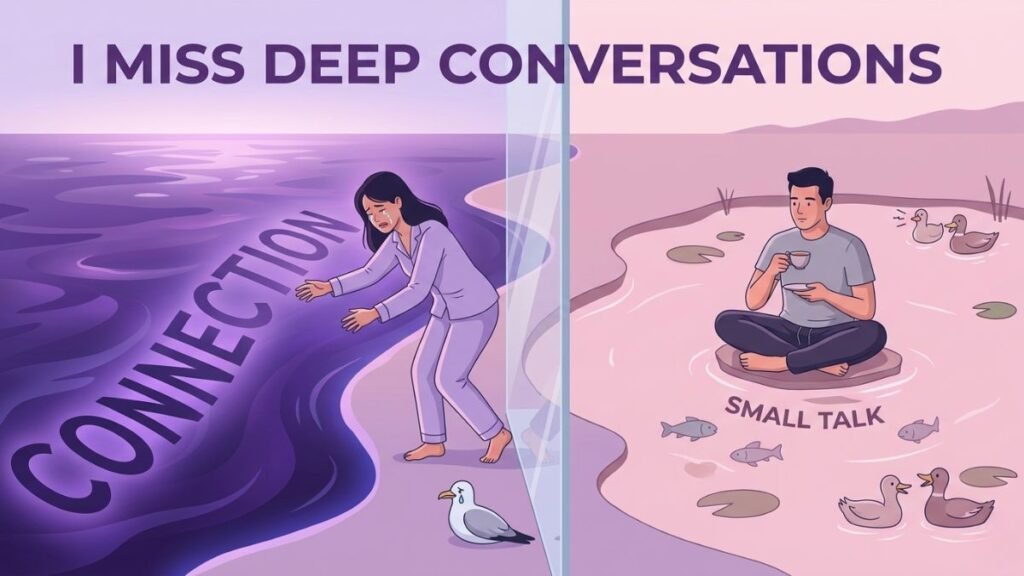
Conversations stay surface-level no matter how deep you try to go. You ask about his day and get the same three words — “it was fine.” You share something that moved you and receive a nod that could mean anything or nothing. You try to deepen the connection — ask a real question, share a real feeling, introduce a topic that requires more than autopilot participation — and the depth gets rejected. Not explicitly. Through disengagement. Through the kind of polite non-response that communicates “I’m not going that deep with you.” The surface is all he offers. And you’ve been drowning in shallow water for so long you’ve forgotten what depth feels like.
He’s emotionally available to everything except you. He’s engaged at work. Animated with his friends. Energized by his hobbies. Attentive to his phone. Present to everything in his life that isn’t the woman sitting beside him waiting to feel included in his aliveness. Feeling alone in a relationship becomes especially painful when you can see his capacity for connection being deployed everywhere except in your direction. He’s not incapable of engagement. He’s choosing where to direct it. And you’re consistently last on the list.
You carry everything emotional alone. Good news — you process alone. Bad news — you process alone. Decisions, fears, celebrations, grief — all handled by you, without his participation. Not because you didn’t invite him. Because every invitation was met with the same vacant non-response that communicates “handle it yourself.” The emotional life of the relationship is a one-person operation. And the operator has been running it alone so long she’s forgotten that it was supposed to be shared.
Why He Makes You Feel Alone Even When He’s Right There
He’s physically present because proximity is easy. Emotionally present because connection is hard. Sitting in the same room requires nothing. Being emotionally present requires everything — attention, vulnerability, engagement, the willingness to be affected by another person’s experience. He chose the easy version of partnership. The one where showing up means being in the building rather than being in the relationship. Feeling alone in a relationship with a man like this isn’t a failure of the relationship’s structure. It’s a failure of what he fills the structure with — which is his body. That’s it. The rest of him — his attention, his emotional life, his genuine presence — lives somewhere you’re not invited.
He doesn’t know how to connect because he was never taught. Emotional connection is a skill built in childhood through consistent, attuned interaction with caregivers who modeled what it looks like to be truly present with another person. If his childhood lacked that — if the adults in his life were physically present but emotionally absent, if love looked like proximity without engagement, if “being there” meant existing in the same house rather than existing in the same emotional reality — he absorbed that model as sufficient. He’s giving you what he was given. And what he was given was never enough. He doesn’t know what genuine emotional presence feels like because he never received it. And you can’t give what you never got — unless you actively learn it. Which he hasn’t.
He’s emotionally depleted and you’re getting the leftovers. His energy is finite. And by the time he’s given to work, to friends, to social media, to the demands of his daily life — the tank is empty. You get what’s left. Which is the scraps of a man whose engagement has been fully consumed by everything he encounters before he encounters you. Feeling alone in a relationship that runs on leftovers isn’t about you being unimportant. It’s about you being deprioritized so consistently that the version of him you receive has nothing left to offer. You’re not getting his worst intentionally. You’re getting his worst because everyone else got his best first.
Your presence has become so reliable that he’s stopped investing in it. He doesn’t worry about losing you. You’re there. Every day. Consistently. Reliably. And because your presence is guaranteed, he’s stopped treating it as something that requires nurturing. He stopped watering a plant he knows won’t leave the windowsill. Feeling alone in a relationship sometimes happens not because a man doesn’t value you, but because he’s stopped actively valuing you. The appreciation has gone dormant. The effort has been retired. And the woman who once received his full attention now receives his passive acknowledgment — which looks, from where you’re standing, exactly like being ignored.
He’s avoiding intimacy by maintaining emotional distance. Real connection — the kind that makes you feel seen instead of alone — requires vulnerability. It requires him to open up, let you in, share the parts of himself he keeps locked down. And if he’s avoiding that vulnerability — whether from fear, from habit, or from a fundamental unwillingness to be known at that depth — the result is a relationship that feels hollow. Feeling alone in a relationship isn’t always about what he’s doing wrong. Sometimes it’s about what he’s not doing at all — namely, the vulnerable, uncomfortable, ego-exposing work of genuine emotional engagement. He’s present without being open. Available without being accessible. There without being truly there.
He’s compartmentalized you into a role that doesn’t include emotional partnership. In his mind, the relationship has a function. Companionship. Domesticity. Physical intimacy. Social acceptability. Someone to share responsibilities with. And within that framework, he’s showing up — for the logistics, for the routine, for the functional aspects of sharing a life. But emotional partnership isn’t part of his framework. It’s not in his job description. He didn’t sign up for the role of emotional co-pilot. He signed up for the role of co-inhabitant. And a co-inhabitant who shares space without sharing himself is a man whose partnership produces loneliness by design.
His own emotional world is shut down and he can’t share what he doesn’t access. Some men aren’t withholding emotional presence. They genuinely don’t have it to give — because they don’t have it at all. Their inner emotional world is compressed, suppressed, or so deeply buried that they live on the surface of their own experience. They’re not being distant from you specifically. They’re distant from themselves. And a man who’s disconnected from his own emotions can’t connect with yours. Feeling alone in a relationship with a man like this is the external consequence of an internal vacancy he may not even recognize exists.
What Feeling Alone in a Relationship Is Doing to You
You’ve started questioning whether loneliness is just what relationships feel like. This is the most dangerous adaptation — the normalization. You’ve been alone inside this relationship so long that you’ve stopped expecting anything different. You look at other couples and wonder if they feel the same way underneath the surface. You tell yourself that maybe this is what long-term partnership becomes — two people coexisting without connection. But it’s not. What you’re experiencing isn’t the inevitable reality of commitment. It’s the specific reality of being committed to a man who isn’t emotionally available for partnership.
You feel guilty for wanting more. He’s there. He comes home. He doesn’t yell. He doesn’t leave. And you feel like you should be grateful for the physical stability — even though the emotional emptiness is eating you alive. Feeling alone in a relationship produces a particular kind of guilt — the guilt of wanting what you theoretically already have. You have a partner. You’re not supposed to be lonely. So the loneliness must be your problem. Your neediness. Your unreasonable expectations. Except your expectations aren’t unreasonable. They’re foundational. And a relationship without emotional connection isn’t a relationship you should feel grateful for enduring.
You’re emotionally starving beside someone who could feed you. That’s the specific cruelty of this dynamic. He has the capacity — you’ve seen it with others, you’ve seen flashes of it with you. He could be present. He could engage. He could turn toward you instead of away. But he doesn’t. And the knowledge that the nourishment exists but isn’t being offered makes the hunger worse than if it didn’t exist at all.
You’ve started building an emotional life without him. Not as a choice. As a survival mechanism. You share things with friends instead. You process alone. You celebrate without him. You grieve without his comfort. You’ve constructed an entire emotional infrastructure that functions around his absence — and the infrastructure works. Which is its own heartbreak. Because the fact that you’ve learned to live without his emotional partnership while living with him proves that the partnership was never there.
What You Need to Do
Name the loneliness honestly. Not to him — not yet. To yourself. “I feel alone in this relationship. Not because I’m single. Because the man beside me isn’t present with me in the ways that matter.” Naming it internally is the first step toward deciding what to do about it. Because you can’t address what you haven’t admitted exists.
Tell him what you’re experiencing without blame. “I feel alone even when you’re right here. I don’t think you’re doing it on purpose. But the disconnection is real and it’s affecting me every day.” Say it during a calm moment. Without accusation. Without listing everything he’s failing at. Just the truth of your experience laid out with enough honesty that ignoring it would require deliberate effort. If he dismisses it — if he laughs it off, minimizes it, or tells you you’re overthinking — that response is the relationship answering the question you’ve been afraid to ask.
Stop accepting proximity as connection. He’s in the room. That doesn’t mean he’s in the relationship. Stop letting physical presence substitute for emotional engagement. Stop telling yourself “at least he’s here” when “here” means nothing if he’s emotionally somewhere else. Feeling alone in a relationship is worse than feeling alone alone. Stop treating his body in the room as evidence that the partnership is functioning.
Stop building emotional workarounds for his absence. Every time you handle something emotionally without him — not by choice but because his vacancy forced it — you’re adapting to a deficiency that shouldn’t exist. Stop adapting. Start requiring. “I need to share this with you. Not with my friend. Not with my journal. With you. Because you’re my partner. And partners hold things together.”
Invest in connections that actually fill you. Not as a replacement for the relationship. As a reminder of what being seen feels like. Friendships where your voice matters. Conversations where your experience is met with presence. Communities where you feel included rather than adjacent. You need those experiences to recalibrate your sense of what connection is supposed to feel like — because his absence has been distorting it for too long.
Evaluate whether this loneliness is the life you’re choosing. Not the life you’re enduring. The life you’re choosing. Because every day you stay inside a relationship that makes you feel alone is a day you’ve chosen loneliness with company over the possibility of connection without it. That’s a valid choice if you make it consciously. But if you’re staying because you haven’t paused long enough to realize how alone you actually are — pause now. Feel it. Let the full weight of the isolation register. And then decide whether this is a loneliness you’re willing to carry for the rest of your life.
What You Need to Understand
Feeling alone in a relationship isn’t a sign that you’re too needy. It’s a sign that the relationship isn’t meeting a fundamental human requirement — emotional connection. Every healthy relationship includes regular moments where both people feel seen, heard, and known by each other. If those moments have disappeared — or never existed — the loneliness isn’t your dysfunction. It’s the relationship’s failure. And you’re the one absorbing the consequences.
His presence doesn’t equal partnership. A man who shares your space without sharing himself isn’t partnering with you. He’s cohabitating. He’s co-existing. He’s occupying the physical role of partner while leaving the emotional role entirely unfilled. And the gap between what he’s providing and what partnership requires is the gap your loneliness lives in.
You deserve to be seen by the person closest to you. Not monitored. Not observed. Seen. Known. Understood. Met with the kind of emotional presence that makes loneliness impossible because connection fills every room you’re both standing in. That experience exists. You’ve probably had it — in friendships, in family relationships, maybe in the early days of this relationship before his engagement faded. It’s real. It’s possible. And you’re allowed to want it.
What You Deserve
You deserve a man whose presence fills the room — not just occupies it. Who turns toward you because you’re the most interesting thing in his world, not because you asked him to put down his phone. Who engages with your inner world because your inner world is where he wants to live.
You deserve to feel accompanied. Not just housed. Not just beside someone. Accompanied — through the joy, through the difficulty, through the ordinary moments that become extraordinary when someone you love is actually present for them.
You deserve to stop feeling alone, sis. Not by leaving the relationship necessarily — but by finally being in one where the man beside you makes loneliness impossible instead of inevitable.
The Bottom Line
He makes you feel alone even when you’re together because feeling alone in a relationship happens when physical proximity replaces emotional connection, because he’s depleted from investing everywhere except in you, because his model of partnership doesn’t include emotional presence, and because your reliable presence has made him complacent about the effort love actually requires.
Stop accepting proximity as partnership. Stop telling yourself loneliness is normal inside a relationship. Stop building workarounds for a man whose emotional absence forces you to function alone.
You’re not alone because you’re too needy, sis. You’re alone because the man beside you stopped showing up — and nobody noticed except you.
It’s time someone else noticed too. Starting with him.
FAQ
Q: Is feeling lonely in a relationship normal?
Occasional loneliness is normal — all partners have moments of disconnection. But chronic loneliness — the persistent feeling of being unseen and unmet despite your partner’s physical presence — is a sign that emotional connection has broken down. If the loneliness is the baseline rather than the exception, the relationship is failing at its most essential function.
Q: What if he says he shows love differently?
Different love languages are real. But no love language is expressed through emotional absence. If his “way of showing love” consistently leaves you feeling alone, unseen, and unconnected — the method isn’t different. It’s deficient. Love expressed in a language that never reaches you isn’t love you’re receiving. It’s love he’s keeping.
Q: Can a relationship recover from chronic emotional disconnection?
With both people committed to the repair — typically through couples therapy, individual self-work, and sustained effort to rebuild emotional connection — yes. But the recovery requires him to see the disconnection as real and important. If he dismisses your loneliness, minimizes your experience, or denies the problem exists, recovery isn’t possible because he hasn’t acknowledged what needs recovering.
Q: What if I feel guilty for feeling lonely when he’s “not doing anything wrong”?
He may not be doing anything visibly harmful. But the absence of emotional engagement is itself the harm. You don’t need him to be cruel to feel lonely. You just need him to be absent. And emotional absence — even without overt mistreatment — is still a relational failure that produces real suffering.
Q: How do I know if the loneliness is about him or about me?
Check whether you feel alone in other relationships too. If loneliness is specific to this relationship — if you feel seen and connected with friends, family, or colleagues but consistently alone with him — the loneliness is relational, not personal. The dynamic is producing the isolation. Not your wiring.