
Sis, let me describe the cruelest timing in your relationship.
You’re hurting. Something happened — maybe inside the relationship, maybe outside it — and you need him. Not to fix it. Not to solve it. Just to be there. To hold the weight with you for a moment. To remind you that you’re not carrying everything alone. To be the partner he signed up to be during exactly these moments.
So you turn toward him. You reach. You open the door to your vulnerability and invite him in. Maybe with words — “I’m struggling and I need to feel connected to you right now.” Maybe without words — leaning into him, seeking closeness, showing through your body what your voice can’t articulate.
And he goes blank.

Not angry. Not defensive. Not even cold in the deliberate way that signals punishment. Just gone. Vacant. Like someone unplugged him the exact moment you needed him powered on. His eyes shift. His body stiffens. His presence — the warmth, the aliveness, the man who was just right there — recedes behind something invisible that drops between you faster than either of you can name.
That’s an emotional shutdown. And the timing of it is what makes it so devastating — because it doesn’t happen during the easy moments. It happens precisely when you’re most vulnerable. When your need is clearest. When the gap between what you’re reaching for and what he’s offering is widest. He shuts down not when things are hard for him, but when things are hard for you. And the message that delivers — however unintentional — is one your nervous system absorbs and never forgets: when you need me most, I will be least available.
What Emotional Shutdown Looks Like When You Need Reassurance
It doesn’t always look dramatic. Sometimes it’s so quiet you almost miss the moment he leaves — even though he never moves from the room.
His face goes neutral and his eyes go distant. You’re mid-sentence. Sharing something that matters. Asking for comfort in the clearest way you know how. And you watch it happen — the animation drains from his expression. His gaze drifts. He’s looking at you but not seeing you. The man who was present thirty seconds ago has retreated somewhere behind his own eyes. An emotional shutdown during your vulnerability isn’t subtle to the person experiencing it — but it’s nearly invisible to anyone watching from the outside.
He offers hollow responses that feel like a script. “That sucks.” “I’m sorry.” “It’ll be okay.” The words are technically appropriate. The delivery is vacant. There’s no warmth behind them. No genuine engagement with what you’re sharing. He’s producing the sounds of comfort without the substance of it — like a man who memorized the lines but doesn’t understand the scene. You hear the words and feel nothing. Because the words without his presence behind them are just noise filling a space where connection should be.
He redirects away from the emotional content. You’re sharing something painful and he responds with logistics. “So what are you going to do about it?” “Have you tried calling them?” “You should probably just let it go.” The redirect isn’t malicious. It’s survival. He can’t sit in the emotional content so he steers toward practical territory where he feels competent. But you didn’t come to him for a plan. You came for presence. And the emotional shutdown that manifests as problem-solving isn’t engagement with your experience — it’s escape from it.
He physically distances during your emotional moments. Shifts to the other end of the couch. Picks up his phone. Turns toward the television. Gets up to get water — not because he’s thirsty, but because standing in the kitchen is easier than sitting in your pain. An emotional shutdown often has a physical signature. The body moves away from the source of emotional demand the same way it would move away from heat. You’re not radiating danger. You’re radiating need. And for him, need and danger live in the same neighborhood.
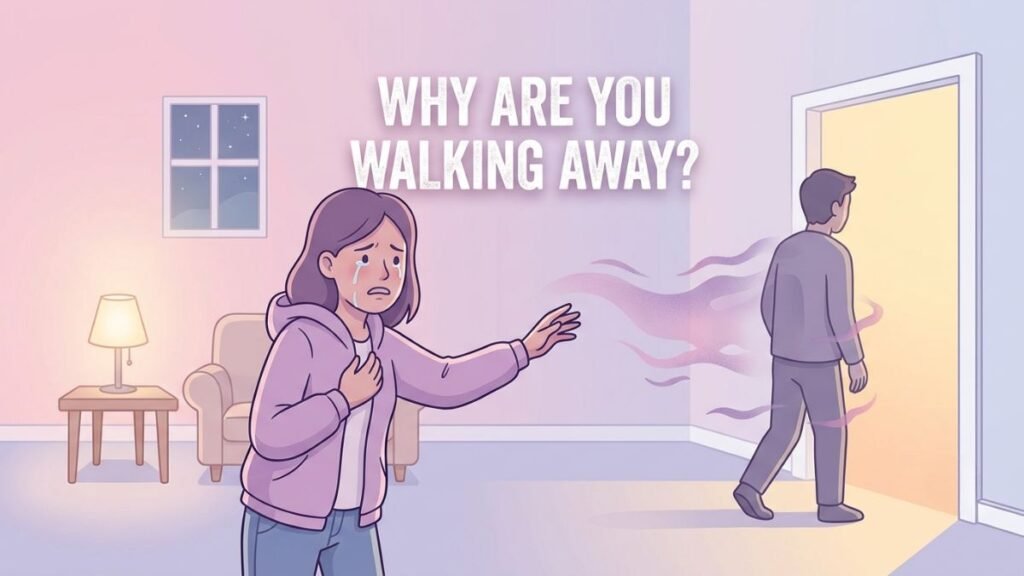
Why He Shuts Down When You Need Reassurance
Your emotional need activates a system that only knows how to flee. An emotional shutdown isn’t a choice in the way most people understand choice. It’s a nervous system response — a freeze or flight reaction that activates when emotional demand exceeds capacity. When you reach for him with vulnerability, his system doesn’t register “my partner needs comfort.” It registers “incoming emotional load I can’t process.” And the shutdown that follows isn’t him deciding you’re not worth engaging with. It’s his system hitting an emergency brake his conscious mind didn’t authorize. He doesn’t leave by choice. He leaves by wiring. But the destination is the same regardless of the route — he’s gone when you need him most.
He never learned how to hold someone else’s pain. Holding space for another person’s emotional experience is a skill. It requires the ability to be present to discomfort without being consumed by it. To listen without fixing. To feel alongside someone without being overwhelmed by what they feel. These skills are typically developed in childhood — through attuned caregiving, through watching adults hold each other’s pain with grace, through having your own pain held with enough consistency that you internalized the model. If none of that happened — if his childhood featured emotional neglect, dismissal, or caregivers who shut down when he needed them — he never built the internal architecture that holding space requires. An emotional shutdown during your vulnerability isn’t cruelty. It’s absence of a skill he was never taught. But an absence he refuses to address through therapy becomes a choice — and that choice is felt by you every time you reach for comfort and find nothing.
Your vulnerability triggers his own unprocessed pain. When you’re hurting, something inside him resonates — not with empathy, but with recognition. Your pain touches his pain. Your vulnerability activates his own buried wounds. And instead of processing that activation into something useful — compassion, presence, connection — his system does what it’s always done with his own pain. It shuts it down. And in shutting down his pain, it shuts down his capacity to be present to yours. An emotional shutdown during your vulnerable moments isn’t always about you being too much. Sometimes it’s about your pain being too familiar — too close to something inside him that he’s been running from his entire life.
He experiences your need as a demand he’s going to fail. When you say “I need you right now,” he doesn’t hear an invitation to connect. He hears a test he’s going to fail. An expectation he can’t meet. A performance requirement his emotional system isn’t equipped to satisfy. And the anticipation of failure — the certainty that whatever he offers won’t be enough — triggers the shutdown before he even tries. An emotional shutdown driven by anticipated failure is a preemptive retreat. He’s leaving before he can be found inadequate. Pulling away before his limitations get exposed. And the tragedy is that what you’re actually asking for — simple presence, not perfection — is far less than what he’s imagining you need. But his imagination has already convicted him of failing. So he doesn’t show up at all.
Being present to your pain would require him to feel something. An emotional shutdown isn’t just about avoiding your feelings. It’s about avoiding his own. If he sits with your pain — genuinely sits with it, lets it in, allows himself to be touched by your suffering — he’ll feel something. Sadness. Empathy. Maybe guilt if his behavior contributed to what you’re feeling. And feeling those things requires emotional access he’s spent his life blocking. He hasn’t shut down because your need is excessive. He’s shut down because meeting your need would require opening emotional channels he’s welded shut. Your vulnerability asks him to feel. And feeling is the one thing his system has been designed — through years of avoidance, suppression, and shutdown — to never do.
His model of masculinity doesn’t include emotional holding. If his definition of being a man centers on strength, stoicism, and control — if he absorbed the message that real men don’t sit in feelings, they solve problems — then your request for emotional presence doesn’t compute within his framework. You’re not asking for something he sees as his job. You’re asking for something he was taught is beneath him. An emotional shutdown during your vulnerability sometimes reveals not a lack of caring but a distorted definition of what caring looks like. In his model, caring means fixing. Protecting. Providing solutions. Sitting in feelings — being present to pain without an action plan — isn’t care in his framework. It’s weakness. And performing what he perceives as weakness in the moment you need him most feels impossible.
The shutdown has been reinforced because you always manage without him. Every time he’s shut down and you’ve handled it alone — soothed yourself, processed on your own, moved past the moment without his help — the shutdown was reinforced. He learned that his absence doesn’t produce consequences. You survive without him. The relationship continues. Nobody holds him accountable for disappearing during the moments that mattered most. An emotional shutdown that goes unchallenged becomes a permanent feature of the relationship. He doesn’t develop because development was never required. You adapted around his limitation instead of requiring him to grow past it.
What His Emotional Shutdown Is Doing to You
You’ve stopped turning toward him during difficult moments. Not because you don’t need comfort. Because the last time you reached for him — and the time before that, and the time before that — you got nothing. Reaching toward someone and being met with vacancy is worse than not reaching at all. So you’ve redirected your vulnerability. Away from him. Toward friends. Toward yourself. Toward anywhere that won’t produce the devastating experience of needing someone who’s already left before you finish asking.
You feel alone inside the relationship at the moments that matter most. The daily moments are fine. He’s present enough when things are light, easy, uncomplicated. But the moments where you need him — where something hurts, where you’re scared, where you need to feel held — those are the moments he disappears. And a relationship that functions during easy times but collapses during hard ones isn’t a partnership. It’s a fair-weather arrangement that looks solid until the weather changes.
You’ve started believing your emotional needs are excessive. His consistent shutdown has taught you that needing comfort is too much. That wanting reassurance is too demanding. That the kind of emotional holding you crave is unreasonable because the man you love can’t provide it. You’ve adjusted your expectations downward until wanting basic human comfort feels greedy. That adjustment isn’t maturity. It’s damage. And the damage was caused by a man whose limitations taught you that your needs are the problem.
You carry your pain alone and call it strength. You process everything internally. You self-soothe. You manage your own emotional experience without any support from the person who’s supposed to be your partner. And you’ve labeled this self-sufficiency as strength — when it’s actually the scar tissue of repeated emotional abandonment. Strength is choosing to handle things alone. What you’re doing is handling things alone because the alternative — reaching for him and finding nothing — hurts more than carrying the weight yourself.
Your trust in the relationship has been fundamentally damaged. Not trust in his fidelity or his honesty. Trust in his availability. Trust that when life gets hard, he’ll be there. Trust that the person beside you is a partner who shows up during the moments that define partnership. An emotional shutdown during your most vulnerable moments doesn’t just affect that moment. It erodes the foundational trust that everything else in the relationship is built on.
What You Need to Do
Name what happens without diagnosis or blame. “When I come to you during a difficult moment and you shut down, I feel abandoned. Not because you’re a bad person. Because your shutdown leaves me alone with something I needed to share with you.” Say it outside of a vulnerable moment. During a calm, neutral space where neither of you is activated. Let the observation land without packaging it as an accusation.
Stop adapting around his limitation. Every time you redirect your vulnerability away from him — handle it alone, call a friend instead, suppress the need — you’re building a relationship that functions without emotional partnership. That adaptation protects you in the short term. In the long term, it creates a dynamic where he never has to grow because you’ve built workarounds for his every deficit. Stop building workarounds. Let his limitation be visible. Let it sit in the room without you solving it.
Require him to pursue professional help. An emotional shutdown of this consistency isn’t something love, patience, or better communication will fix. It’s rooted in his nervous system, his attachment history, his relationship with his own emotions. Those roots require professional excavation. Therapy — specifically therapy focused on emotional regulation and attachment — is the intervention this pattern needs. If he won’t pursue it, the shutdowns will continue. And your continued adaptation will ensure they never have to stop.
Rebuild your belief that your emotional needs are valid. Work with your own therapist to undo the damage his shutdowns have caused to your relationship with your own needs. You deserve to need things. You deserve to express those needs without bracing for abandonment. You deserve to believe — in your bones, not just intellectually — that wanting comfort from your partner is one of the most basic, valid, human things a person can want.
Evaluate what this pattern costs you long-term. Can you spend decades with a man who disappears during your hardest moments? Can you face grief, loss, illness, career setbacks, and life’s inevitable difficulties with a partner whose emotional availability collapses under pressure? Those aren’t hypothetical questions. They’re the future this pattern is building — one where you handle everything alone while standing next to someone.
What You Need to Understand
An emotional shutdown during your most vulnerable moments isn’t about your needs being too intense. It’s about his capacity being too narrow. Your need for comfort is the most normal, human, legitimate thing a partner can express. His inability to meet it is a limitation — not a verdict on your worth or the reasonableness of what you’re asking for.
You can’t need him into availability. Your vulnerability won’t unlock his emotional channels. Your patience won’t expand his capacity. Either he does the work to develop the skills his childhood didn’t give him — or his shutdown remains the ceiling of his emotional offering. And his ceiling is far below the floor of what partnership requires.
The right man doesn’t shut down when you need him. He might not have perfect words. He might feel uncomfortable. He might even struggle initially to know what to do. But he stays. He’s present. He holds the discomfort because holding it is what love looks like during the moments that matter most. His presence isn’t perfect — but it’s there. And “there” is everything when the alternative has been absence.
What You Deserve
You deserve a man who stays present when things get hard. Who can sit with your pain without fleeing from it. Who holds you — physically, emotionally, with his full presence — during the moments when you most need to be held.
You deserve to reach for someone and find them there. Every time. Not perfectly. Not with scripted words. But there. Present. Available. Willing to be uncomfortable because your comfort matters more than his avoidance.
You deserve to be held during the hard moments, sis. Not handled afterward. Not managed from a distance. Held. By a man who understands that his presence during your pain is the most important thing he’ll ever offer you.
The Bottom Line
He shuts down when you need reassurance because an emotional shutdown is his nervous system’s response to demand it was never built to meet, because your vulnerability triggers unprocessed pain he’s been avoiding his entire life, because sitting in your feelings would require accessing his own, and because his model of love doesn’t include the one thing you need most — emotional presence during difficulty.
Stop adapting around his absence. Stop carrying your pain alone and calling it strength. Stop believing that your need for comfort is excessive because a limited man couldn’t meet it.
Your needs aren’t too much, sis. His capacity is too little. And the difference between those two things is the difference between a problem you need to fix and a limitation he needs to heal.
You’ve been reaching for a man who isn’t there. Start reaching for the life — and the love — that will be.
FAQ
Q: Is an emotional shutdown the same as stonewalling?
They overlap but aren’t identical. Stonewalling typically occurs during conflict — a deliberate withdrawal from disagreement. An emotional shutdown can happen during any emotionally charged moment, including non-conflict situations where you simply need support. Stonewalling often carries a punitive element. Emotional shutdown is more often a capacity collapse. Both leave you alone when you need connection.
Q: What if he shuts down because he’s overwhelmed, not because he doesn’t care?
Overwhelm is a real experience. But an overwhelmed man who cares communicates: “I’m overwhelmed right now but I want to be here for you — give me a moment.” A man who simply goes blank and offers nothing isn’t communicating overwhelm. He’s demonstrating the absence of tools. Caring without the skills to express it still leaves you alone.
Q: Can emotional shutdown patterns change?
With sustained therapeutic work focused on emotional regulation, attachment, and nervous system capacity — yes. These patterns are deeply rooted but not permanent. However, change requires his active participation. No amount of your patience or understanding substitutes for the professional intervention this pattern requires.
Q: What if I’ve started shutting down too?
That’s a sign his pattern has become contagious. When reaching out produces nothing repeatedly, your own system starts protecting itself through preemptive withdrawal. Recognize it as adaptive — and address it with professional support before it becomes your permanent default.
Q: How do I reconnect with my own emotional needs after years of suppressing them?
Start with a therapist who can create a safe space for your needs to exist without judgment. Practice naming what you feel daily — even to yourself. Let your emotions surface without running them through his filter. Reconnection is gradual. But the needs are still there. They just went underground because the surface wasn’t safe. A safe environment will draw them back out.