Sis, let me describe something that’s probably so familiar it hurts to read.
You’re telling him what hurt you. Not yelling. Not attacking. Just explaining — as clearly and calmly as you can — what happened and how it made you feel. And before you’ve even finished, his response is already forming. Not a response to your pain. A response designed to shrink it.
“It wasn’t that serious.” “You’re making a big deal out of nothing.” “I think you’re overreacting.” “That’s not what happened.” “You’re too sensitive.”
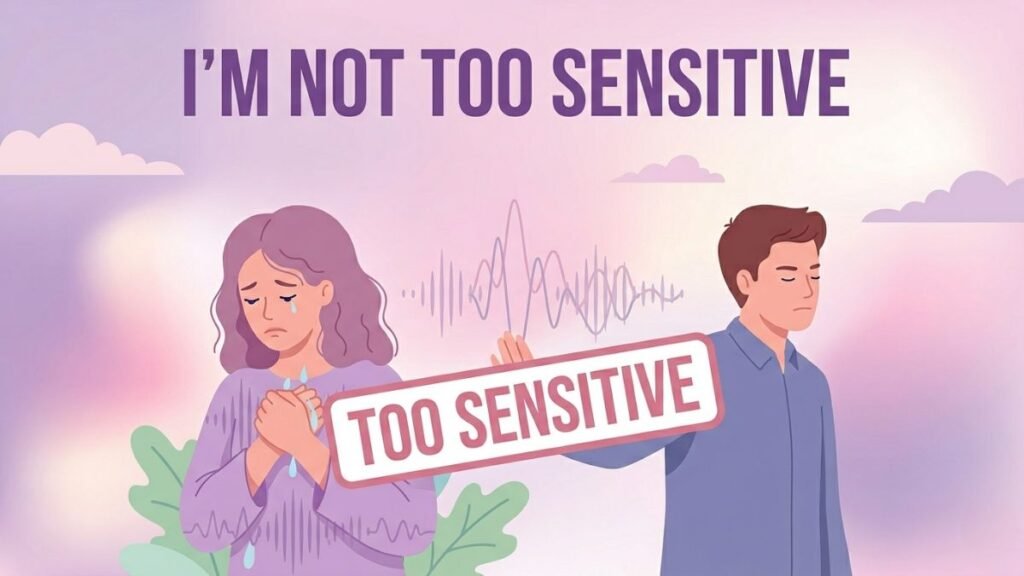
One sentence from him and suddenly the hurt you walked in carrying feels illegitimate. Like maybe it wasn’t that bad. Like maybe you are making too much of it. Like maybe the tears forming behind your eyes are evidence of a flaw in your wiring rather than a natural response to something that genuinely wounded you.
That’s emotional invalidation. And it’s not a disagreement about what happened. It’s a dismissal of what you felt about what happened. He’s not saying “I see it differently.” He’s saying “what you feel is wrong.” And those two things live in completely different universes — one respects your experience while offering another perspective. The other erases your experience entirely.
And after enough erasure, you stop bringing things up. Not because the feelings stopped. Because expressing them became more painful than carrying them alone. He didn’t resolve your hurt. He made it unspeakable. And unspeakable pain doesn’t disappear. It just goes underground where it does damage nobody can see.
What Emotional Invalidation Sounds Like
Emotional invalidation rarely announces itself as cruelty. It hides inside sentences that sound almost rational — until you feel the impact.
“You’re too sensitive” is probably the most common one. Three words that repackage your legitimate emotional response as a character defect. You’re not a woman who was hurt by something hurtful. You’re a woman whose emotional thermostat is broken — feeling things at the wrong temperature, reacting at the wrong volume. The problem isn’t what he did. The problem is how you’re wired. And with those three words, he’s moved the entire conversation from his behavior to your personality.
“It wasn’t that bad” is him deciding the severity of your experience for you. He wasn’t inside your body when it happened. He doesn’t live behind your eyes. He doesn’t carry your history or your wounds or the specific way something lands on a heart that’s been hurt before. But he’s appointed himself the judge of how much pain you’re allowed to feel — and he’s ruled that this amount doesn’t qualify for acknowledgment.
“I didn’t mean it that way, so you shouldn’t feel that way” is the one that sounds the most logical and does the most damage. Because it frames intent as the only thing that matters. If he didn’t mean to hurt you, the hurt shouldn’t exist. But impact doesn’t require intent. A man can step on your foot accidentally and it still hurts. His lack of intention doesn’t erase your bruise. And a man who uses his intent as a shield against your impact isn’t engaging with your experience. He’s dismissing it with a technicality.
“You always do this” transforms your emotional expression into a pattern of dysfunction. You’re not a woman raising a specific concern. You’re a woman with a chronic problem — always upset, always making things bigger than they are, always creating issues. The generalization buries the specific. And once your feelings are framed as a pattern rather than a response, they’re much easier to dismiss.
Why He Minimizes Your Feelings
Your feelings create accountability he’d rather avoid. When you say “that hurt me,” you’re drawing a line between his behavior and your pain. If he validates that connection — if he says “you’re right, that was hurtful” — he’s one step away from having to take responsibility. From having to apologize genuinely. From having to change. Emotional invalidation severs that line before accountability can follow it. If your feelings are an overreaction, his behavior isn’t the cause. If you’re too sensitive, nothing needs to change. Minimizing your feelings isn’t just dismissive — it’s preventive. It prevents accountability from ever arriving at his door.
He genuinely doesn’t understand emotional depth because he’s never accessed his own. Some men minimize feelings because they literally don’t comprehend emotional intensity. They’ve never sat with their own pain long enough to understand what it feels like. They’ve never processed grief, or examined a wound, or let sadness move through them without stuffing it down. So when you describe your emotional experience with depth and specificity, it doesn’t compute. It seems excessive to him — not because it is, but because his own emotional range is so compressed that anything beyond “fine” and “angry” seems like theatrical exaggeration. He’s not minimizing your feelings to be cruel. He’s minimizing them because he’s measuring them against his own stunted emotional capacity and concluding that you must be malfunctioning. He’s wrong. But his emotional illiteracy makes him genuinely unable to see that.
Minimizing gives him power over the emotional climate. When he gets to decide which feelings are valid and which are “too much,” he controls the entire emotional landscape of the relationship. He becomes the judge. Your feelings only exist if he approves them. Your pain only counts if it meets his threshold. Your experience only matters if he agrees it should. That authority — the authority to validate or invalidate another person’s emotional reality — is one of the most dangerous forms of power in a relationship. And he wields it every time he tells you that what you feel isn’t what you should feel. Emotional invalidation isn’t just dismissal. It’s domination of your inner world.
Your pain implies his failure and his ego rejects that. When you’re hurting — especially because of something connected to him — there’s an implicit message he can’t tolerate: something went wrong and you might be part of the reason. A secure man can absorb that. He can hear “that hurt me” without collapsing into shame or defensiveness. He can hold space for your pain without interpreting it as an indictment of his character. But a man who minimizes your feelings can’t do any of that. Your hurt threatens his self-image. So he shrinks it. Makes it smaller. Tells you it’s not that serious. Not because your pain is small — but because if it were real and valid, he’d have to face his role in causing it. And that’s a mirror he refuses to look into.
He was invalidated as a child and it’s all he knows. If he grew up hearing “stop crying,” “toughen up,” “you’re fine,” “it’s not a big deal” — he absorbed a template for how emotions should be handled. They should be minimized. Dismissed. Pushed through. Not honored. Not explored. Not held with care. So now he runs that same template on you. When you express pain, his automatic response is the one that was programmed into him decades ago — shrink it, dismiss it, move on. He’s not choosing emotional invalidation consciously. He’s running a program. But a grown man who knows his programming is hurting the woman he loves and refuses to rewrite it is making a choice — even if the original installation wasn’t his fault.
If your feelings were valid, he’d have to feel something too. Validating your pain means sitting with it. Being present to it. Letting it touch him enough that he feels uncomfortable alongside you. And he doesn’t want to feel uncomfortable. Minimizing your emotions keeps him at a safe distance from his own. If your hurt isn’t real, he doesn’t have to feel empathy. If you’re overreacting, he doesn’t have to sit in the heaviness of knowing he contributed to someone’s pain. Emotional invalidation is as much about protecting himself from feeling as it is about controlling what you feel.
Your emotional intelligence exposes his emotional absence. You can name what you feel. You can describe the nuance of your experience. You can articulate exactly what happened and how it landed. And every time you do, it’s a mirror reflecting everything he can’t do. Your depth highlights his shallowness. Your awareness exposes his avoidance. And instead of being inspired by your emotional capacity, he attacks it. Calling you “too sensitive” is really him saying “your ability to feel things I can’t feel makes me uncomfortable.” He’s not minimizing your feelings because they’re excessive. He’s minimizing them because they’re a reminder of everything missing in his own emotional world.
What Emotional Invalidation Is Doing to You
You’re losing connection to your own feelings. This is the deepest damage and it happens so gradually you might not see it until it’s advanced. After years of being told your emotions are wrong, your brain starts pre-screening them. Something hurts and before you even fully register it, a voice inside — his voice, now internalized — says “that’s not a big deal, you’re overreacting.” You’ve become your own invalidator. The filter he installed is running automatically now, catching your feelings before they fully form and dismissing them the way he would. That’s not emotional regulation. That’s emotional suppression wearing regulation’s uniform.
You’ve stopped sharing what you feel. Not just with him — with everyone. If the person who’s supposed to love you most treats your feelings like problems, something deep inside concludes that feelings ARE problems. You pull back from friends. You give surface answers when people ask how you are. You present a version of yourself that’s easy, low-maintenance, uncomplicated — because the real version, the one that feels deeply, has been punished too many times to risk exposure again.
You feel anxious in ways you can’t explain. When your emotional reality is consistently denied by the person who’s supposed to know you best, your nervous system stays activated. Something is wrong but you can’t name it — because every time you’ve tried to name it, you’ve been told nothing is wrong. You’re living in a gap between what you feel and what you’re told you should feel. That gap creates anxiety that doesn’t have an obvious source. But the source is obvious — it’s the relationship itself. It’s the man who keeps telling you the ground is solid while your body feels it shaking.
You question yourself before you question him. Every time something hurts, your first response isn’t “that was wrong.” It’s “am I overreacting?” He’s reversed your instincts. The natural flow — feel something, trust it, express it — has been disrupted. Now it’s feel something, doubt it, suppress it, wonder if you’re broken for feeling it in the first place. That reversal is the most lasting damage emotional invalidation produces.
What You Need to Do
Stop accepting his assessment of your feelings. Your emotions don’t need his approval to be real. He doesn’t get to decide what hurts you, how much it hurts, or whether your response is proportionate. The next time he minimizes, try this — internally or out loud: “My feelings are valid whether you understand them or not.” Then stop defending them. You don’t owe him an argument for why your emotions deserve to exist.
Name the invalidation directly. “When I tell you something hurt me and you say I’m overreacting, that’s emotional invalidation. My feelings don’t need your permission to be real.” Say it once. Clearly. Without softening it for his comfort. You’ve been softening your truth for long enough. Let this one land exactly as hard as it needs to.
Reconnect with your own emotional reality. Start journaling without filtering through his voice. Write what you feel without running it through the “is this an overreaction?” test he installed. Let your emotions exist on paper without anyone grading their validity. Over time, this practice rebuilds the trust in your inner world that his invalidation has been systematically eroding.
Stop shrinking your feelings to fit his comfort level. You’ve been downsizing your emotional experience, presenting the smallest possible version of your pain hoping he’ll engage with it if it’s small enough. Stop. Your feelings don’t need to be miniaturized for his convenience. Present them at full size. If he can’t hold them, that’s his limitation — not your instruction to feel less.
Surround yourself with people who validate. You need relationships where “I’m hurting” is met with “tell me about it” instead of “you’re too sensitive.” Friends, a therapist, community — anyone who receives your emotions as legitimate information about your experience rather than character evidence against you.
Evaluate whether this relationship allows you to be real. A relationship where you can’t feel what you feel is a relationship where you can’t exist as yourself. That’s not a communication gap. That’s a compatibility crisis dressed in a smaller outfit. Can you spend the rest of your life editing your emotional experience to survive someone else’s discomfort with it?
What You Need to Understand
Emotional invalidation isn’t a difference of opinion. It’s a pattern of erasure. A man who consistently tells you your feelings are wrong isn’t seeing things differently — he’s refusing to see your experience at all. And a relationship where one person’s inner world is systematically denied isn’t a relationship. It’s a performance where you pretend to feel less so he doesn’t have to deal with what you actually feel.
You are not too sensitive. That phrase has been weaponized against women for generations to keep them quiet, compliant, and disconnected from the emotional intelligence that would otherwise show them exactly what they’re dealing with. Your sensitivity isn’t a flaw. It’s an asset. It’s what tells you the truth when he’s trying to convince you everything is fine. Don’t let any man — especially one who benefits from your silence — convince you that your ability to feel is a weakness.
The right man doesn’t tell you what to feel. He asks what you feel — and listens like the answer matters. Because it does. Every single time.
What You Deserve
You deserve a man who hears “that hurt me” and leans in instead of pushing back. Who doesn’t rank your pain against his comfort level and decide yours doesn’t qualify. Who can sit with your feelings without needing to fix them, dismiss them, or minimize them into something more manageable for him.
You deserve to feel what you feel without being told you’re feeling it wrong. To cry without commentary. To hurt without being corrected. To be sad, frustrated, disappointed, or angry and have those emotions treated as valid — because they are.
You deserve emotional validation, sis. As the standard. Not the exception.
The Bottom Line
He minimizes your feelings because your pain creates accountability he won’t face, because his emotional capacity is too shallow to comprehend your depth, because controlling your emotional reality gives him power, and because validating you would require him to feel something he’s spent his entire life avoiding.
That’s emotional invalidation. It doesn’t leave marks anyone can see. But it leaves damage that takes years to undo — a woman disconnected from her own emotional truth because the man who was supposed to honor it told her it wasn’t real.
Stop believing him. Start believing yourself. Your feelings were valid the whole time. Every single one.
FAQ
Q: What if I really am more sensitive than most people?
Sensitivity is a trait, not a defect. Even if you feel things more intensely than average, that doesn’t make your feelings invalid. It makes them yours. A man who loves a sensitive woman learns to hold that sensitivity with care — not weaponize it as evidence that her emotions are broken.
Q: What’s the difference between emotional invalidation and a genuine disagreement?
Disagreement says “I see it differently but I respect your experience.” Invalidation says “your experience is wrong.” One acknowledges your feelings while offering another perspective. The other denies your feelings exist in a form worth acknowledging. If he can disagree without telling you what you should or shouldn’t feel, that’s healthy. If every disagreement ends with your feelings being the problem, that’s invalidation.
Q: Can an emotionally invalidating partner learn to validate?
With genuine desire, self-awareness, and sustained therapeutic work — yes. But the man has to see the pattern and want to change it. If he dismisses the concept of emotional invalidation the same way he dismisses your feelings, change isn’t on the table.
Q: How do I rebuild trust in my own emotions after years of invalidation?
Start small. Notice a feeling. Name it. Don’t judge it. Don’t run it through his filter. Just let it be. Over time, with practice and ideally with a therapist’s support, the connection to your emotional truth strengthens. It was always there. It just got buried under his dismissals. It can be uncovered.
Q: What if he validates sometimes but invalidates other times?
Inconsistent validation is still a problem. If he can validate when it’s convenient but minimizes when accountability is involved, the validation is selective — offered when it costs him nothing and withheld when it would require something from him. That’s not genuine. It’s strategic.