
Sis, I need to talk to you about the paralysis you’re experiencing.
The relationship ended. You know you need to start over. You know you need to rebuild.
But when you think about everything that entails, you freeze.
Because starting over isn’t one thing. It’s a thousand things:
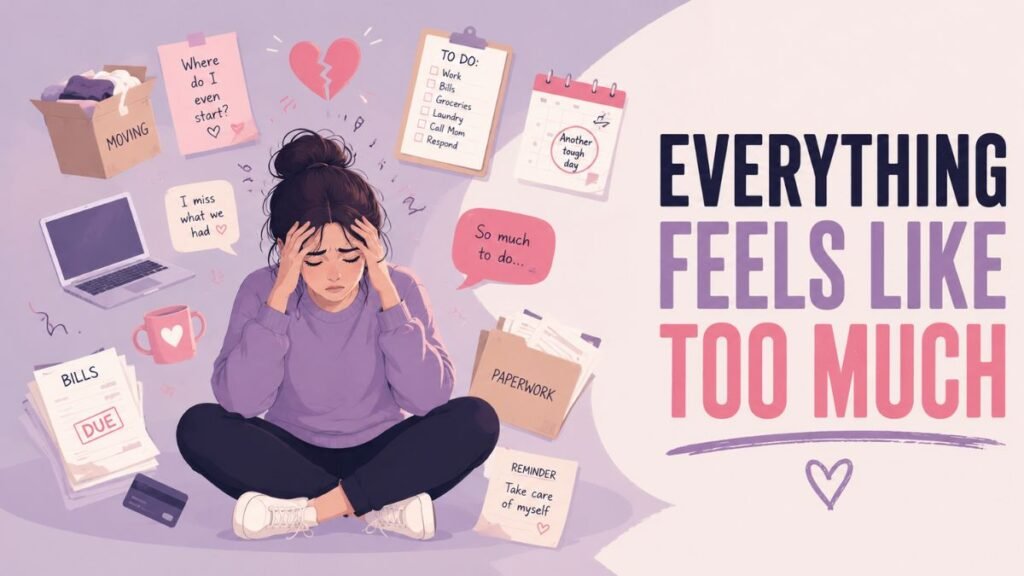
- Finding a new place to live (or making the current space feel like yours)
- Dividing belongings and memories
- Rebuilding routines that don’t include them
- Filling the time you used to spend together
- Rediscovering who you are alone
- Making decisions that used to be shared
- Explaining to everyone what happened
- Handling finances solo
- Creating a new social life
- Imagining a different future
- Processing the grief while also moving forward
- Healing while simultaneously rebuilding
And when you look at all of that it’s not just hard. It’s overwhelming.
So overwhelming that:
- You can’t figure out where to start
- You feel paralyzed by the enormity of it all
- You do nothing because everything feels like too much
- You stay stuck because moving forward seems impossible
The weight of “starting over” crushes you before you even begin.
And everyone keeps saying: “Just take it one day at a time. One step at a time.”
But you don’t even know what the first step is. And one day at a time still feels like climbing Everest when you can barely stand.
I see how heavy this is. How the sheer magnitude of starting over makes you want to give up before you begin. How you’re drowning in the endless list of things that need to happen. How you’re exhausted just thinking about it.
And I see you wondering: “Why does starting over feel so overwhelming? How do people do this? Where do I even start? Will it always feel this impossible?”
Starting over feels overwhelming because you’re looking at the entire mountain instead of the single step in front of you, sis. And because you’re trying to do everything while your energy is depleted. But you don’t have to rebuild everything at once. You just need to take the next smallest step. That’s all.
Let me help you understand why starting over feels overwhelming—and how to break it down into something manageable.
What’s Really Happening: The Rebuild Overwhelm
Let me be direct with you: Starting over feels overwhelming because it IS overwhelming. You’re not weak for feeling crushed by it. You’re trying to rebuild an entire life while simultaneously processing grief—and you’re doing it with depleted resources. The overwhelm is a realistic response to an enormous task.
But enormous doesn’t mean impossible. It just means you need to make it smaller.
Here’s what’s really going on:
You’re Looking at the Whole Mountain
When you think about starting over, you see:
Everything at once:
- All the logistics
- All the emotional work
- All the decisions
- All the changes
- All the unknowns
- The entire transformation
It’s like standing at the base of a mountain:
- You can see the entire climb ahead
- It looks impossible
- You can’t imagine reaching the top
- The distance between here and there is crushing
But you’re not supposed to see the whole mountain.
Starting over feels overwhelming because you’re looking at the entire journey instead of the single step in front of you—and the totality of what needs to happen paralyzes you from taking any action.
Everything Requires Decisions—And You’re Decision-Fatigued
Starting over requires constant decisions:
- Where will I live?
- What do I keep, what do I get rid of?
- How do I spend my weekends now?
- Do I stay in this city?
- What do I tell people?
- How do I handle mutual friends?
- Do I keep photos? Delete them?
- Change my routine or maintain it?
Every aspect of rebuilding requires choices.
But you’re already decision-fatigued:
- From the relationship ending (decision)
- From grief (emotionally draining)
- From daily survival (taking all your energy)
You have no bandwidth left for the endless decisions starting over requires.
Starting over feels overwhelming because it demands constant decision-making when your decision-making capacity is completely depleted.
You’re Trying to Do It All at Once
You believe you need to:
- Process all the grief immediately
- Rebuild your entire life quickly
- Figure out who you are right now
- Create the perfect new life today
- Have all the answers now
So you try to:
- Heal AND rebuild
- Grieve AND move forward
- Process AND progress
- Feel everything AND do everything
All at once.
Starting over feels overwhelming because you’re trying to do everything simultaneously instead of sequentially—grief, healing, rebuilding, discovering—and the attempt to do it all at once crushes you.
Normal Tasks Feel Impossible
Breakups deplete you:
- Physically (grief is exhausting)
- Emotionally (heartbreak drains)
- Mentally (rumination consumes bandwidth)
So tasks that were once easy:
- Feel monumental
- Require energy you don’t have
- Seem insurmountable
Starting over isn’t just new tasks—it’s tasks you have to do while running on empty.
Making dinner → Overwhelming
Doing laundry → Overwhelming
Getting out of bed → Overwhelming
Starting over feels overwhelming because your baseline capacity is so depleted that even normal tasks feel impossible—let alone the enormous task of rebuilding an entire life.
You Don’t Know What You’re Building Toward
When you have vision:
- Tasks have purpose
- Steps have direction
- The work has meaning
But after a breakup:
- You don’t know what you’re building
- You can’t see the future clearly
- You have no vision to work toward
So rebuilding feels aimless:
- Why am I doing this?
- Where is this going?
- What’s the point?
Starting over feels overwhelming because you’re trying to rebuild without a clear vision of what you’re building toward—and purposeless work feels heavier than directed work.
You’re Doing It While Grieving
Grief requires:
- Rest
- Processing
- Feeling
- Time
- Space
- Gentleness
Starting over requires:
- Energy
- Action
- Doing
- Forward movement
- Activity
- Effort
You’re trying to do both simultaneously:
- Grieve the loss
- Build the new
- Rest and recover
- Move and create
These are conflicting needs:
- Grief says: rest, feel, process
- Starting over says: move, do, create
Starting over feels overwhelming because you’re trying to grieve (which requires stillness) and rebuild (which requires movement) at the same time—and these opposing needs create impossible internal conflict.
You Have No Model for This
If you’ve never started over before:
- You don’t know what to expect
- You have no reference point
- You don’t know if you’re doing it “right”
- You can’t predict how long it takes
The unknown makes everything harder:
- Am I on track?
- Is this normal?
- Should it be easier by now?
- What comes next?
Starting over feels overwhelming because you’re navigating completely new territory without a map—and every step feels uncertain because you have no model for what this journey looks like.
You’re Comparing to Others Who Look Further Along
You see others who:
- Seem to have bounced back quickly
- Look like they’re thriving post-breakup
- Appear to have it all together
- Are already dating, happy, moved on
And you think:
- Why is this so hard for me?
- What’s wrong with me that I can’t do this?
- Everyone else can start over—why can’t I?
Starting over feels overwhelming because you’re comparing your beginning to others’ middle or end—and that comparison makes you feel like you’re failing at something others find easy.
Sis, if the overwhelm of starting over is keeping you frozen—if you need help breaking it down into manageable steps—you don’t have to figure this out alone.
💜 You Don’t Have to Do It All at Once
I know how crushing the overwhelm is. How looking at everything that needs to happen makes you want to give up before you begin. How you can’t see past the mountain of tasks. How exhausted you are by just thinking about it.
You don’t have to rebuild your entire life today. Just take the next small step.
She’s Already Hers Sisterhood is a community where women are learning to break down the overwhelming process of starting over into manageable pieces, to take tiny steps instead of giant leaps, and to rebuild one day at a time.
Inside the Sisterhood, you’ll find:
💜 Women who’ve felt crushed by overwhelm—now rebuilding piece by piece
💜 Tools to manage the overwhelm—how to break starting over into small, doable steps
💜 An 8-season transformational guide that walks you through rebuilding step by step
💜 Support when you need it—women who understand the paralysis and are moving forward anyway
You don’t need to see the whole path. You just need to take the next step.
Your first month is just $1. Find community, break down the overwhelm, and connect with women who are rebuilding. See if it’s aligned with where you are.
One step at a time, sis. That’s all you need.
Why This Pattern Is Hurting You
You’re paralyzed. Overwhelm keeps you from taking any action at all.
You’re staying stuck. If everything feels overwhelming, nothing gets done.
You’re reinforcing helplessness. Every day you tell yourself it’s too much, you believe it more.
You’re missing opportunities. Life is happening while you’re frozen.
You’re making it harder. The longer you wait, the more overwhelming it becomes.
You’re not healing. Healing requires forward movement—paralysis prevents healing.
You’re exhausting yourself. Thinking about everything is more exhausting than doing one thing.
You’re comparing yourself unfairly. You’re measuring yourself against impossible standards.
What You Need to Do
Step 1: Look at the Next Step, Not the Whole Journey
Don’t ask: “How do I rebuild my entire life?”
Ask: “What’s the one next small thing I can do?”
Examples:
- “I can pack one box today”
- “I can change my sheets”
- “I can take a 10-minute walk”
- “I can text one friend”
Focus only on the immediate next step—nothing beyond that.
Step 2: Break Everything Into Absurdly Small Tasks
“Start over” is too big.
Break it down:
- ~~Start over~~ → Move to new place
- ~~Move to new place~~ → Find apartment
- ~~Find apartment~~ → Look at 3 listings today
- ~~Look at 3 listings~~ → Open laptop and search for 15 minutes
Make the task so small it feels almost silly.
If it still feels overwhelming, make it smaller.
Step 3: Give Yourself Permission to Do It Slowly
You don’t have to:
- Rebuild everything this month
- Have it all figured out now
- Be “over it” by a certain time
You can:
- Take years to fully rebuild
- Figure it out as you go
- Still be healing a year from now
Slow progress is still progress.
Step 4: Separate Urgent From Eventually
Not everything needs to happen now.
Urgent (do soon):
- Find housing if needed
- Handle legal/financial necessities
- Basic self-care
Eventually (can wait):
- Redecorate
- Join new groups
- Figure out your entire identity
- Create the perfect new life
Focus on urgent. Let eventually wait.
Step 5: Alternate Grief Days and Action Days
You don’t have to do both every day.
Some days:
- Just grieve
- Rest
- Feel
- Process
Other days:
- Take small action
- Make one decision
- Do one task
Alternate as needed. Both are part of starting over.
Step 6: Get Help With Decisions
You don’t have to decide everything alone.
Ask for help:
- Have friends help you sort belongings
- Consult others on decisions
- Get input on choices
- Let others carry some of the decision-weight
You don’t have to bear all the decisions solo.
Step 7: Celebrate Microscopic Progress
Every tiny step counts:
- Got out of bed → Progress
- Showered → Progress
- Made one decision → Progress
- Took one small action → Progress
Acknowledge every small thing.
Small steps accumulate into transformation.
Step 8: Get Professional Support
If overwhelm is:
- Paralyzing you completely
- Leading to depression
- Making basic functioning impossible
Consider therapy focused on:
- Managing overwhelm
- Breaking down tasks
- Processing grief
- Building coping strategies
Sometimes overwhelm needs professional help to manage.
What You Need to Understand
Overwhelm Is Normal
Starting over IS overwhelming:
- For everyone
- Even people who look like they have it together
- Even people who seem to do it easily
You’re not failing because it’s overwhelming.
You’re having a normal response to an overwhelming situation.
You Don’t Need to See the Whole Path
You only need to see:
- The next step
- The immediate action
- What’s right in front of you
The path reveals itself as you walk it.
You don’t need the whole map to take the first step.
Slow Is Okay
Starting over doesn’t have a timeline.
Fast rebuilding isn’t better than slow rebuilding.
Your pace is valid—whether it’s:
- Weeks
- Months
- Years
Let it take as long as it takes.
Done Beats Perfect
You don’t need to:
- Make perfect decisions
- Rebuild perfectly
- Have the perfect plan
You need to:
- Make decisions (even imperfect ones)
- Take action (even small)
- Keep moving (even slowly)
Imperfect action beats perfect inaction.
What You Deserve
You deserve to rebuild at your own pace.
You deserve to take small steps without shame.
You deserve support in managing the overwhelm.
You deserve to start over without having it all figured out.
One step at a time. That’s all you need.
The Bottom Line
Sis, starting over feels overwhelming because:
- You’re looking at the whole mountain instead of the next step
- Everything requires decisions and you’re decision-fatigued
- You’re trying to do it all at once
- Normal tasks feel impossible when you’re depleted
- You don’t know what you’re building toward
- You’re doing it while grieving
- You have no model for this
- You’re comparing to others who look further along
It IS overwhelming. And you can still do it.
Take the next small step. Break it down. Go slowly. Get help.
Choose yourself, sis. One tiny step at a time.
FAQ
Q: What if I take small steps but still feel overwhelmed?
Make the steps even smaller. If “pack one box” feels overwhelming, try “put one item in a box.” There’s no step too small. Meet yourself where you are and adjust accordingly.
Q: How do I know what to prioritize?
Handle immediate survival needs first (housing, income, basic functioning), then work on emotional healing alongside gradual life rebuilding. Don’t try to do everything simultaneously. Sequential, not simultaneous.
Q: What if it’s been months and I still feel overwhelmed?
Overwhelm can last a long time after significant relationship loss. If it’s interfering with basic functioning or not improving at all, consider professional support. But months of overwhelm is normal for major life transitions.
Q: How do I start over when I don’t know what I want?
You don’t need to know what you want to take the first step. Start with what needs to happen (practical necessities), and clarity about what you want will emerge as you move forward. Action creates clarity.
Q: What if I’m overwhelmed by things I can’t control?
Focus only on what you CAN control. You can’t control the past, the other person, or how long healing takes. You can control: the next small action, asking for help, being gentle with yourself. Stay in your circle of control.