
Sis, I need to talk to you about the conversations that never happen when he refuses to talk about problems.
There’s a problem. Something that needs to be discussed. An issue that needs resolution. A hurt that needs healing. A decision that needs to be made together.
And he refuses to talk about it, which is why many wonder why he refuses to talk about problems.

Not just avoiding it. Not just delaying it. Flat-out refusing.
He says:
- “I don’t want to talk about this”
- “There’s nothing to discuss”
- “I’m done talking about it” (when you’ve barely started)
- “We’ve already talked about this” (when nothing was resolved)
- “Talking won’t change anything”
- “I’m not doing this”
And then he simply… won’t. He refuses to engage. He won’t discuss it. Period.
So problems pile up. Issues go unresolved. Hurts fester. Decisions get made unilaterally or not at all.
Because he refuses to talk things through.
You’ve tried everything:
- Asking calmly
- Picking better timing
- Explaining why it’s important
- Begging him to just talk
- Writing it out
- Suggesting therapy
But he still refuses. And you’re stuck in a relationship where problems can’t be addressed because he simply won’t talk.
I see how hopeless this feels. How you’re carrying the weight of unresolved issues alone. How you’re starting to wonder if you’re asking for too much by wanting basic communication. How isolated you feel trying to have a relationship with someone who won’t talk.
And I see you wondering: “Why won’t he just talk to me? How am I supposed to resolve anything? Is wanting to discuss problems unreasonable? Can a relationship survive without communication?”
No, it can’t, sis. And that’s the point. Communication is the foundation of relationships—without it, you have nothing. His refusal to talk isn’t a communication preference—it’s relationship sabotage. And you deserve someone who’s willing to work through problems, not someone who refuses to even discuss them.
Let me help you understand why he refuses to talk things through—and what you need to do about it.
What’s Really Happening: Communication Refusal & Stonewalling
Let me be direct with you: In healthy relationships, partners talk through problems. They might need breaks, they might struggle, but they engage. They understand that talking is how relationships survive.
Your partner refuses to engage at all. And that makes having a functional relationship impossible.
Here’s what’s really going on:
Refusing to Talk Maintains His Power
Think about what happens when he refuses to talk:
He maintains power over:
- What gets discussed (nothing he doesn’t want to)
- What gets resolved (nothing)
- What changes (nothing)
- The entire relationship dynamic
You’re powerless because:
- You can’t force him to talk
- Problems can’t be solved without communication
- You’re stuck with whatever he’s willing to give
- He controls everything through refusal
He refuses to talk things through because refusal gives him complete power—you can’t address anything without his cooperation, so he controls everything by withholding it.
Talking Requires Accountability
If he talked things through, he’d have to:
- Hear how he hurt you
- Acknowledge his behavior
- Take responsibility
- Apologize
- Commit to change
- Be vulnerable
By refusing to talk:
- He doesn’t have to hear your hurt
- No acknowledgment required
- No responsibility
- No apology
- No commitment to change
- No vulnerability
He refuses to talk things through because talking means accountability—and refusal is how he escapes being held responsible.
He Wants You to Give Up
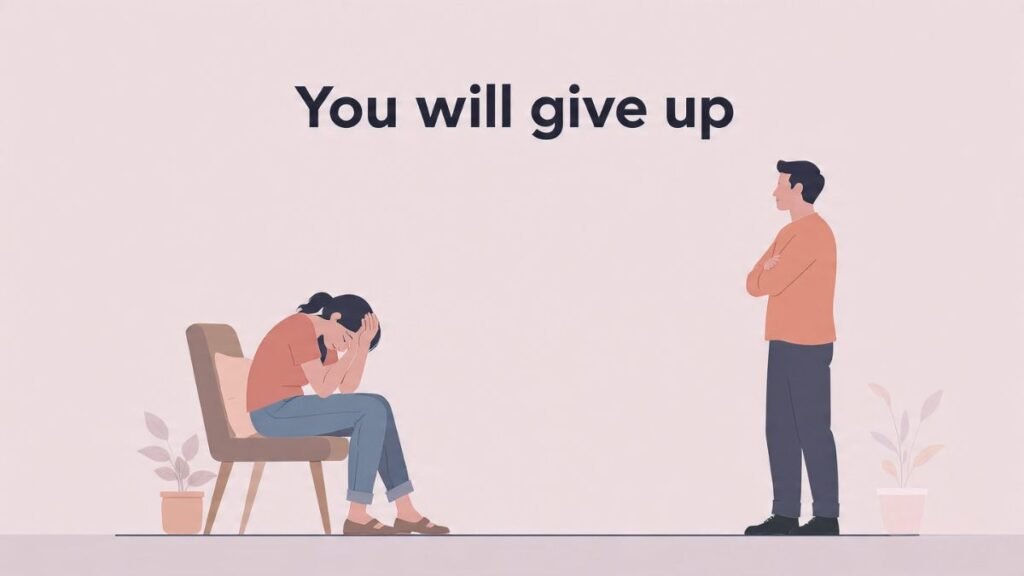
Watch the pattern he’s creating:
You try to talk → He refuses → You try again → He refuses again → You eventually give up
Over time:
- You bring up fewer issues
- You accept more without discussion
- You suppress your needs
- You stop expecting communication
He’s training you through refusal:
- Don’t expect communication
- Accept things as they are
- Stop trying to address problems
He refuses to talk things through because if he refuses long enough, you’ll give up trying—and then he never has to address anything.
He Doesn’t Care Enough to Try
Here’s the painful truth:
If he cared:
- He’d be willing to talk, even when it’s hard
- He’d push through discomfort to address your concerns
- He’d prioritize the relationship over his avoidance
- He’d do the work communication requires
He doesn’t.
His refusal to talk reveals:
- He doesn’t care enough about your feelings
- He doesn’t value the relationship enough to work on it
- He’s unwilling to do basic relationship maintenance
- Your need to address issues doesn’t matter to him
He refuses to talk things through because he doesn’t care enough about you or the relationship to put in the effort communication requires.
Talking Would Expose His Inadequacy
Difficult conversations might reveal:
- He’s failing as a partner
- He can’t meet your needs
- He’s in the wrong
- He’s the problem
He doesn’t want to face that.
Refusing to talk allows him to:
- Avoid confronting his failures
- Not face that he’s inadequate
- Maintain his self-image
- Never have to acknowledge he’s the problem
He refuses to talk things through because communication would expose his shortcomings—and refusal protects his ego from that reality.
He’s Conflict-Avoidant to the Extreme
Some people avoid conflict at all costs:
They believe:
- Any conflict is bad
- Talking about problems creates more problems
- Silence is safer than discussion
- Avoidance is better than engagement
When you want to talk about an issue:
- They see it as creating conflict
- They refuse because they can’t handle any conflict
- They’d rather let problems fester than discuss them
He refuses to talk things through because he’s so conflict-avoidant that he’d rather destroy the relationship through silence than risk the discomfort of discussion.
He Learned This Pattern
Think about where he might have learned this:
Maybe:
- His parents never talked things through
- Problems were handled by silence in his family
- Communication was met with punishment
- Refusal was modeled as acceptable
He’s replicating what he learned:
- Problem arises → Refuse to discuss
- Partner pushes → Refuse harder
- Eventually → Problem gets dropped
He refuses to talk things through because this is the only conflict pattern he knows—and he’s never developed better skills or seen the need to.
You’re Tolerating the Refusal
Here’s the hard truth: You’re staying in a relationship where communication is impossible.
Every time you:
- Accept his refusal without leaving
- Stay despite not being able to address problems
- Continue trying to talk to someone who won’t engage
- Remain in a relationship with no communication
You teach him: “I’ll stay even if you refuse to talk. Refusal works. You don’t actually have to communicate.”
The pattern continues because you’re accepting it as tolerable.
What You Need to Do
Step 1: Recognize This Is Relationship Death
Relationships cannot survive without communication.
Say clearly:
“Your refusal to talk through problems is killing this relationship. Without communication, we can’t resolve issues, grow, or even function. This is non-negotiable—you have to be willing to talk.”
Acknowledge this is a dealbreaker.
Step 2: Make One Final Clear Request
“I need to discuss [specific issue]. This is important and non-negotiable. I need you to engage in this conversation. When can you talk about this?”
Be specific:
- What you need to discuss
- That it’s non-negotiable
- Request a specific time
Give him one clear chance.
Step 3: Don’t Accept “I Don’t Want To”
When he refuses:
“I understand you don’t want to. But this needs to be discussed. Refusing to talk isn’t an option. When will you be ready to have this conversation?”
Press for a commitment.
If he still refuses:
“If you won’t discuss this, you’re telling me you’re not willing to work on this relationship. I need you to understand that.”
Step 4: Set a Deadline
“I need us to discuss this by [specific date/time]. If you’re unwilling to talk by then, I’ll make my own decisions about what happens next.”
Then stick to it.
If he refuses past your deadline—that IS his answer. He’s choosing not to engage.
Step 5: Stop Trying to Convince Him
Don’t:
- Beg him to talk
- Keep trying different approaches
- Exhaust yourself trying to get him to communicate
- Make it easier and easier hoping he’ll engage
You’ve already asked. He’s already refusing.
Don’t spend months trying to convince someone to do basic relationship functions.
Step 6: Make Decisions Without Him
If he won’t discuss things:
“Since you won’t discuss [issue], I’m making the decision myself. I’m choosing [your decision].”
Examples:
- Won’t discuss relationship problems → “I’m deciding we need couples therapy or I’m leaving.”
- Won’t discuss plans → “I’m making plans without you.”
- Won’t discuss finances → “I’m managing finances separately.”
His refusal to communicate doesn’t mean you’re stuck—it means you decide unilaterally.
Step 7: Consider If This Is Fixable
Ask yourself honestly:
Has he EVER been willing to talk things through?
- If no—he’s never going to start
- If yes, but stopped—something changed, but he’s unlikely to go back
Is he willing to get help (therapy)?
- If no—this won’t improve
- If yes—there’s a small chance, but he has to actually go and do the work
Most people who refuse to communicate won’t change.
Step 8: Leave When Communication Is Impossible
If he:
- Continues refusing to talk through problems
- Won’t commit to therapy
- Shows no willingness to communicate
- Makes clear talking isn’t happening
Leave.
You cannot have a relationship without communication. His refusal to talk is his decision to end the relationship—you’re just making it official.
What You Need to Understand
Communication Is Non-Negotiable
You can compromise on many things.
But the ability to talk through problems is foundational:
- Without it, nothing gets resolved
- Problems accumulate
- Resentment builds
- The relationship dies
Don’t accept refusal to communicate as acceptable.
This Is Stonewalling (A Form of Abuse, supported by research from the Gottman Institute)
Consistent refusal to communicate is:
- Stonewalling
- Emotional abuse
- Relationship sabotage
- A dealbreaker
The Gottman Institute identifies stonewalling as one of the “Four Horsemen”—behaviors that predict divorce.
His Refusal Is His Answer
You want to talk.
He refuses.
That refusal IS his communication:
- He’s not willing to work on the relationship
- He doesn’t care enough to try
- He’s choosing silence over partnership
- He’s telling you communication won’t happen
Believe his refusal. It’s his answer.
You Can’t Make Someone Communicate
You can:
- Ask
- Explain why it’s important
- Set boundaries
- Create consequences
But you can’t force someone to talk who refuses.
At some point, you have to accept: He won’t. And decide what that means for you.
What You Deserve
You deserve a partner willing to talk through problems.
You deserve someone who values communication.
You deserve to be able to address issues when they arise.
You deserve someone who works on the relationship, not someone who refuses to engage.
That partner exists. But it’s not someone who refuses to talk things through.
The Bottom Line
Sis, he refuses to talk things through because:
- Refusing maintains his power and control
- Talking requires accountability he won’t accept
- He wants you to give up trying so he never has to address issues
- He doesn’t care enough to put in the effort
- Talking would expose his inadequacy
- He’s conflict-avoidant to the point of relationship destruction
Refusal to communicate is relationship death.
Set deadlines. Make decisions without him. Leave if he won’t engage.
Choose yourself, sis. You can’t have a relationship with someone who refuses to talk.
FAQ
Q: What if he says talking makes things worse?
Talking poorly might make things worse temporarily. But NOT talking guarantees things stay bad permanently. If he won’t talk because he lacks skills—therapy. If he won’t talk period—leave.
Q: How long should I wait for him to be willing to talk?
You’ve already waited too long. Give one final clear deadline (days, not weeks). If he refuses past that—his refusal is permanent. Stop waiting.
Q: What if he’ll talk about some things but refuses to discuss specific issues?
Notice WHAT he refuses to discuss—usually it’s issues where he’d face accountability. Selective refusal is still manipulation. You need a partner who discusses hard things, not just easy ones.
Q: Should I just accept that he needs more time?
Needing time to process is valid IF communicated with a timeline: “I need two days, let’s talk Friday.” Indefinite “I need time” is refusal disguised as processing. Don’t accept indefinite delays.
Q: Can this pattern change?
Rarely without intensive therapy AND genuine desire to change. Most people who refuse communication don’t change because refusal gives them power. If he won’t even go to therapy—assume this is permanent.



One Comment
Truth! He came in like a breath of fresh air. Night in shining armor. Did all he could ro destroy me us our family. Even cheated emotional and physically. He could talk to others ne intimate on all levels but not me. Those were his choices. His choice his power to make me feel not enough. He can have all the others he wants. Cheating, while gaslighting, stonewalling all of it. Was the final straw.