
Sis, I need to talk to you about the movie that won’t stop playing in your mind.
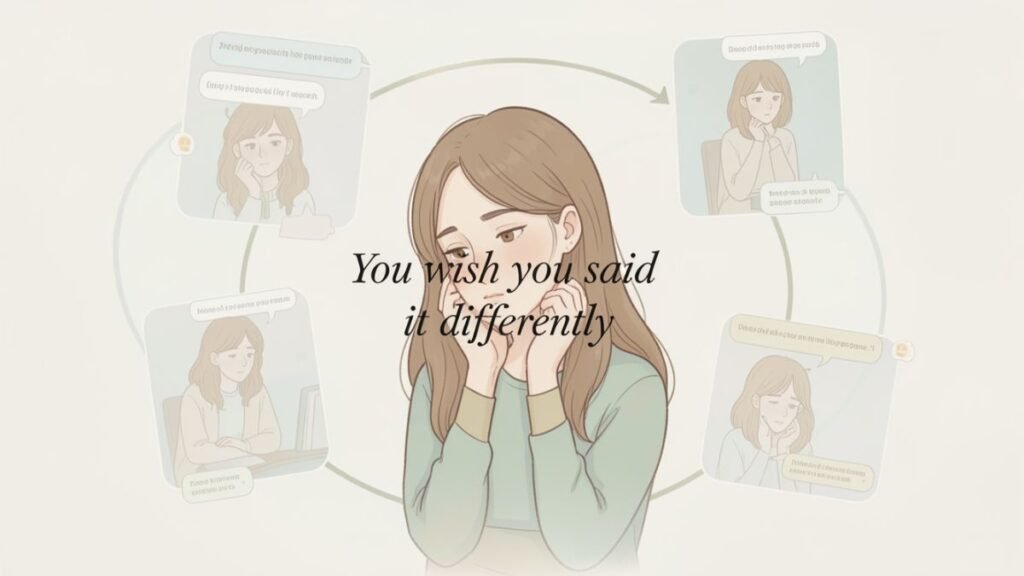
You replay the conversations.

Over and over. Every word. Every tone. Every look. The same scenes on an endless loop.
The fight that led to the breakup. The conversation where something shifted. The moment you should have said something different. The argument you wish you could take back.
You can’t stop.
You analyze every word you say. You dissect what they meant. You rewrite the script in your head, saying it better, defending yourself, catching what you missed in the moment.
The conversations haunt you. In the shower. At the same time, you’re trying to work as you’re falling asleep. They play automatically, without your permission.
And you can’t make them stop.
I see how exhausting this is. How the mental replays are driving you crazy. You’re trapped in the past, unable to be present, because your mind is stuck on repeat.
And I see you wondering: “Why can’t I stop replaying these conversations? What am I looking for? How do I make my mind stop?”
Sis, your brain is doing what traumatized brains do—trying to process what happened, searching for control, attempting to solve an unsolvable problem. But the replays aren’t helping you heal. They’re keeping you stuck.
Let me help you understand why you replay conversations and how to finally break free.
What’s Really Happening: The Rumination Loop
Let me be direct with you: Replaying conversations isn’t productive processing. It’s rumination—a mental loop that feels productive but actually keeps you trapped.
You think you’re trying to understand what happened. But actually, you’re avoiding moving forward.
Here’s what’s really going on:
Your Brain Is Trying to Process Trauma
Breakups are traumatic experiences.
When you experience trauma:
- Your brain replays the event trying to make sense of it
- It searches for what you missed
- It attempts to identify threats you didn’t see
- It tries to learn from what happened
The replays are your brain’s attempt to process the traumatic experience.
But unlike productive processing, rumination gets stuck—replaying without resolution, circling without progress.
Your brain is trying to heal, but it’s using a broken mechanism (rumination) that can’t actually heal.
You’re Searching for What You Missed
When you replay conversations, you’re looking for:
- The warning sign you didn’t see
- The moment it went wrong
- What you should have said
- What they really meant
- The thing you could have done differently
Your brain believes: “If I can just find what I missed, I can understand what happened and prevent it in the future.”
But you’ve already replayed it hundreds of times. If there was something crucial to find, you would have found it by now.
The replays aren’t revealing new information—they’re just repeating old information obsessively.
You’re Trying to Change the Outcome
In your replays, you often rewrite the conversation:
- You say the perfect thing
- You defend yourself better
- You catch their manipulation
- You don’t cry, don’t beg, don’t break
Unconsciously, you’re hoping: “If I can figure out what I should have said, maybe I can still fix this.”
But the conversation is over. The outcome is set.
The replays are an attempt to control what you can’t control—the past.
You’re Avoiding the Present Pain
As long as you’re replaying the past:
- You don’t have to face the present reality (they’re gone)
- You can stay in analysis mode instead of grief mode
- You can focus on conversations instead of feelings
- You can avoid accepting it’s over
Replaying feels productive—like you’re “working on it”—but it’s actually avoidance.
The loops keep you stuck in the past so you don’t have to feel the pain of the present.
You’re Looking for Vindication
In the replays, you might be:
- Building the case for why you were right
- Collecting evidence of their wrongdoing
- Proving you didn’t deserve what happened
- Justifying your behavior
You’re seeking validation—even just from yourself—that you weren’t wrong, weren’t bad, weren’t the problem.
The replays are an attempt to defend yourself in a trial that’s already over.
You’re Trying to Regulate Your Nervous System
Your nervous system is dysregulated from the breakup.
Replaying conversations is paradoxically an attempt to regulate:
- The familiar (even if painful) feels safer than the unknown
- Replaying gives your mind something to do with the anxiety
- The loops feel like control when everything else feels chaotic
Your brain is using rumination as a coping mechanism for overwhelm—even though it’s making things worse.
You’re Stuck in a Neural Groove
Every time you replay a conversation:
- You strengthen the neural pathway
- You make the loop easier to trigger
- You deepen the mental groove
Eventually:
- The replays become automatic
- Your brain defaults to the loop
- You can’t stop even when you want to
The replays continue because they’ve become a habitual neural pattern—your brain’s default when triggered.
You’re Seeking Closure Through Replay
You think: “If I just understand this conversation perfectly, I’ll have closure.”
But replaying doesn’t create closure—it prevents it.
Closure comes from acceptance and moving forward, not from perfect understanding of the past.
The replays are a substitute for the closure you’re seeking—a fake closure that never actually closes anything.
Why This Pattern Is Destroying You
You’re trapped in the past. While you’re replaying conversations, you’re not present in your actual life.
You’re exhausting yourself. The mental loops are draining your energy with zero productive outcome.
You’re traumatizing yourself repeatedly. Each replay reactivates the pain—you’re re-traumatizing yourself over and over.
You’re strengthening the pattern. Every replay makes it harder to stop.
You’re not actually processing. Rumination circles without progress—you’re not healing, just spinning.
You’re avoiding grief. The replays let you avoid the real work of accepting and moving on.
You’re losing the present. You can’t be here now when you’re stuck in conversations from the past.
You’re preventing closure. The replays keep the door open when you need to close it.
What You Need to Do
Step 1: Recognize Rumination vs. Processing
Productive processing:
- Moves forward
- Brings insight
- Leads to resolution
- Happens with intention and ends
Rumination:
- Circles endlessly
- Brings no new insights
- Creates no resolution
- Happens automatically and continues indefinitely
When you catch yourself replaying, ask: “Is this productive or rumination?”
If you’ve replayed it more than 3 times—it’s rumination.
Step 2: Interrupt the Pattern
When a replay starts:
Physically interrupt it:
- Say “STOP” out loud
- Clap your hands
- Stand up and move
- Change your environment
- Use the 5-4-3-2-1 grounding technique
Don’t engage with the replay. Interrupt and redirect immediately.
Step 3: Redirect Your Mind
When you interrupt the replay:
Give your mind something else to do:
- Count backward from 100 by 7s
- Name every blue thing you can see
- Describe your surroundings in detail
- Focus on your breath
- Listen to a podcast or music
Your mind needs something to replace the replay—give it a different task.
Step 4: Process the Underlying Emotion
The replays are often covering deeper emotions.
When you stop the replay, ask: “What am I really feeling right now?”
You might discover:
- Grief
- Shame
- Anger
- Rejection
- Loneliness
Feel the actual emotion instead of ruminating about the conversation.
Rumination is a defense against feeling. Drop into the feeling.
Step 5: Challenge the Replay’s Purpose
When a replay starts, ask:
“What am I hoping to gain from replaying this?”
Common answers:
- Understanding
- Control
- Vindication
- Different outcome
Then acknowledge: “Replaying this won’t give me that. I’m choosing to let it go.”
Step 6: Schedule Replay Time
If you can’t stop completely:
Give yourself 15 minutes daily to replay intentionally:
- Set a timer
- Replay whatever you need to
- When the timer ends, stop
This contains the rumination instead of letting it run all day.
Over time, reduce the minutes.
Step 7: Write It Out and Burn It
Write down the conversation you keep replaying:
- Exactly as it happened
- All the versions you wish happened
- Everything you want to say
Then burn the paper (safely) or delete the file.
Externalize and release.
Say: “I’ve processed this enough. I’m releasing it.”
Step 8: Get Professional Help
If rumination:
- Interferes with functioning
- Continues despite your efforts to stop
- Creates significant distress
- Lasts for months
Work with a therapist on:
- OCD (if rumination is obsessive)
- PTSD (if breakup was traumatic)
- Rumination-focused CBT
- Mindfulness practices
Severe rumination might need professional intervention.
What You Need to Understand
You’ve Already Extracted Everything Useful
After the first few replays, you got whatever insight was there.
Now you’re just repeating—not discovering.
Trust that you’ve learned what you need to. Additional replays won’t reveal anything new.
Replaying Doesn’t Change Anything
No matter how many times you replay:
- The conversation already happened
- The words were already said
- The outcome is already set
You can’t change the past through mental replay.
The only thing replaying changes is your present—making it more painful.
The Perfect Response Doesn’t Exist
You’re searching for what you should have said—but there’s no perfect response that would have changed everything.
Even if you’d said the “right” thing:
- The outcome would likely be the same
- The relationship had deeper issues
- One conversation doesn’t determine everything
Stop torturing yourself searching for words that would have saved it.
Stopping the Replays Is Possible
Right now it feels impossible to stop.
But with practice:
- The replays decrease
- You can interrupt them more easily
- Eventually, they stop automatically
It takes consistent effort, but you can break this pattern.
What You Deserve
You deserve freedom from the mental prison of replayed conversations.
You deserve to be present in your life instead of trapped in the past.
You deserve peace of mind instead of constant rumination.
You deserve to move forward instead of circling endlessly.
You deserve to let the conversations finally end.
The Bottom Line
Sis, you replay conversations after a breakup because:
- Your brain is trying to process trauma
- You’re searching for what you missed
- You’re trying to change the outcome retroactively
- You’re avoiding present pain
- You’re seeking vindication
- The pattern has become a neural groove
But replaying doesn’t heal—it keeps you stuck.
Interrupt the pattern. Redirect your mind. Feel the emotion underneath.
Choose yourself, sis. Let the conversations end. Be here now.
FAQ
Q: What if I keep remembering new details I’d forgotten?
Your brain is filling in details based on emotion, not retrieving true memories. After weeks, you’re reconstructing, not remembering. Don’t trust “new” details—they’re often distorted.
Q: How long will it take to stop replaying?
With consistent interruption and redirection, most people see significant decrease in 2-8 weeks. But occasional replays might happen for months—just less frequently and intensely.
Q: What if replaying helps me see red flags for the future?
Extract the lesson once, write it down, then stop. You don’t need to replay 100 times to learn. One intentional analysis is enough.
Q: Is it normal to replay conversations years later?
Occasional memories are normal. Obsessive replaying years later suggests unresolved trauma—consider therapy to fully process.
Q: What if I’m replaying because I want them to reach out?
Replaying keeps them present in your mind—which prevents you from moving on. This is avoidance. They’re not coming back. Let the conversations end.