

Help shouldn’t leave you feeling stupid.
You can appreciate what your man knows without sitting through another lesson on something you already understand. You can ask one question without inviting him to question your intelligence. And you can say, “I know,” without having to prove it for the next twenty minutes.
That’s the part that wears on you. You’re trying to have a conversation. Somehow, you keep ending up in a lesson you never asked for.
Condescending behavior can show up that way. He speaks as though you couldn’t possibly understand until he explains it. You tell him you understand, and he carries on. You correct a detail about your own experience, and he starts explaining your experience back to you.
Then, when you’re tired of it, he says he was only helping.
You’re not wrong for wanting his help to come with respect. You shouldn’t have to leave your intelligence at the door just to let that man feel useful.
Knowing more about one thing doesn’t mean he knows more about you
Your man might know more about a subject than you do. That isn’t the problem. You might want his advice. You might be glad he can explain something you haven’t learned yet.
But knowing something you don’t know doesn’t give him the right to assume you know nothing.
Look at whether he pays attention to what you actually asked. Does he answer your question, or start from the beginning every time? When you say you’ve already done that part, does he move on? Can you tell him you have your own way without getting another speech about why his way makes more sense?
You don’t need to pretend you know everything. Neither does he.
There’s room for both of you to learn in that relationship. What gets exhausting is being the one who is always expected to listen while he’s always allowed to teach.
You can value his knowledge and still want him to recognize yours. Those two things can exist in the same conversation.
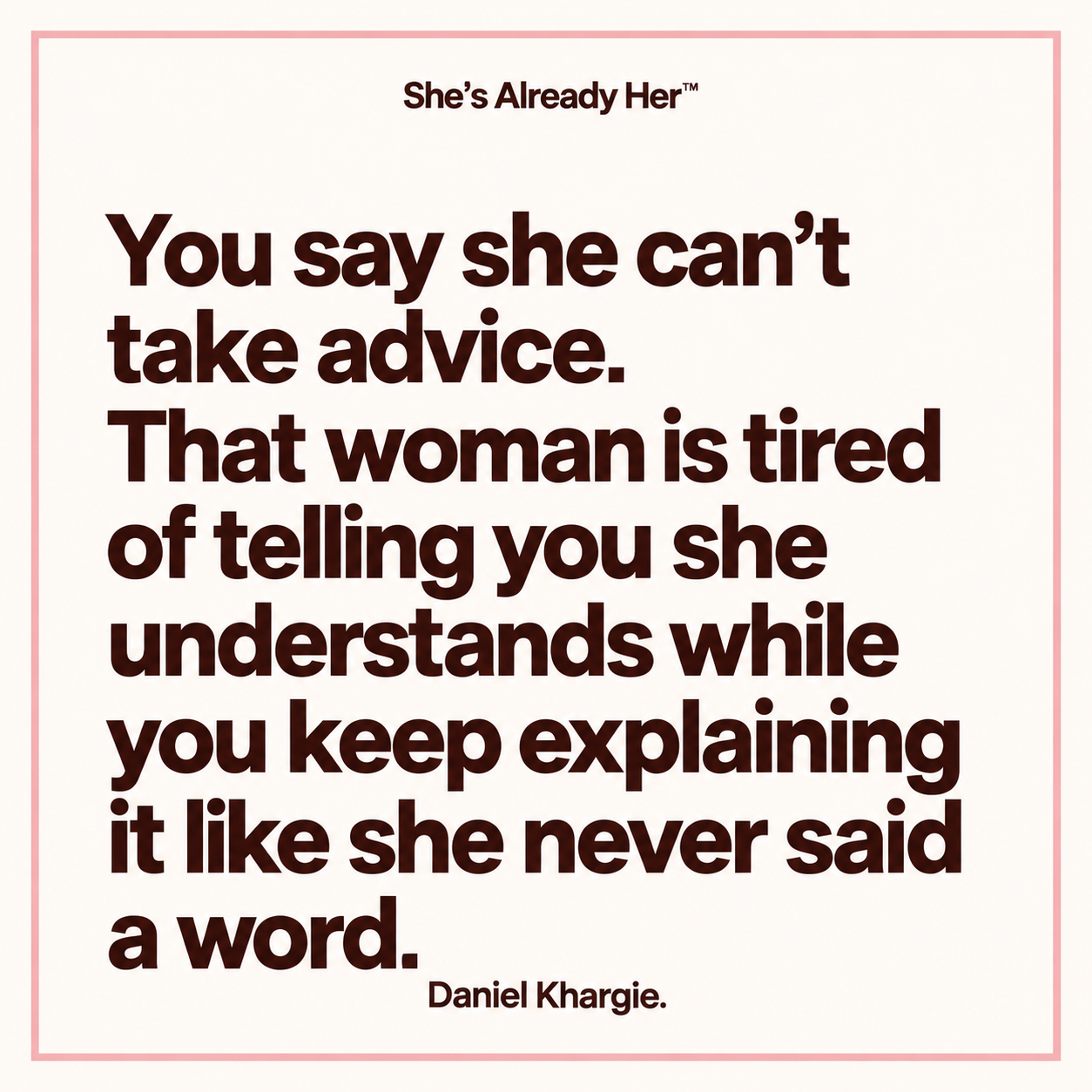
Read this quote as text
You say she can’t take advice. That woman is tired of telling you she understands while you keep explaining it like she never said a word.
Pay attention to what happens after you say you understand
An explanation can miss the mark. He can misunderstand your question. You can misunderstand his answer. That happens.
What matters is whether he takes in what you tell him next.
“I understand that part.”
“I wasn’t asking how to do it.”
“I’m telling you what happened, not asking you to fix it.”
Those are things you should be able to say to your partner. You’re giving him information about what you need from the conversation. He doesn’t have to love being interrupted, but he does need to hear you.
If he keeps going as though you haven’t said anything, his explanation has become more important than your answer.
Patronizing behavior can even sound patient. He might slow every word down, repeat the same point, or keep asking whether you understand after you’ve already answered. A soft voice doesn’t automatically make that feel respectful.
Look at the whole exchange. Does he check what you know, or decide for you? Does he accept that you understand, or insist you need more explaining until you agree with him?
Understanding him and agreeing with him aren’t the same thing. You’re allowed to understand exactly what he means and still have a different opinion.
Every conversation doesn’t need another correction
Unsolicited advice can get tiring when it becomes his answer to everything you share.
You mention what you’re working on, and he starts listing what you should change. You tell him how you handled something, and he tells you how he would have done it. You finish a thought, and the conversation moves straight to what you got wrong.
If that keeps happening, you can start checking every word before you say it. You leave out details because you don’t want another correction. You stop sharing things you’re still learning because you don’t want your question used as proof that you can’t manage.
That doesn’t mean you’ve become unwilling to learn. You might just be tired of having to defend what you already know.
You’re allowed to want interest before instruction. A question about how something went. A little room to finish your thought. Some recognition that your way can work even when it isn’t his way.
Not every correction is wrong. If there’s a real error, it can be discussed. But a conversation with the man you love shouldn’t feel like he’s marking your answers.
And if you’ve started feeling embarrassed to speak around him, that deserves his attention. Telling you to take advice better skips over how he’s been giving it.

Read this quote as text
You say she thinks she knows everything. She’s tired of proving she knows anything because you keep correcting her before you even hear her out.
You don’t have to prove your intelligence before you set a limit
You can spend so much energy showing him you understand that you lose track of the thing you wanted to say.
Now you’re listing what you’ve already tried. Explaining how you reached your answer. Giving him more detail, hoping this time he’ll recognize you’re capable.
You don’t have to win that argument to ask for a different kind of conversation.
If it feels safe and useful, you can keep it short: “I know how to do this. If I need help, I’ll ask.” Or, “I’m happy to hear your thoughts after I finish. I don’t want to be corrected through the whole conversation.”
That isn’t you claiming you’re never wrong. It’s you being clear about how you want to be spoken to.
You can also say you don’t want advice right now. You might need him to listen. You might want to work something out yourself. You might already have the help you need.
A reasonable limit doesn’t become unreasonable because he dislikes it. And if he ignores it, that doesn’t mean you failed to explain it properly.
You decide what you can safely step away from or stop discussing. You don’t have to confront him to prove you respect yourself. If speaking up brings threats or makes you afraid, put your safety and support first.
His response tells you more than another explanation from you
You don’t need to figure out everything going on inside him to notice what he keeps doing.
Maybe he thought he was helping. Then he can take in the fact that his help hasn’t been landing that way. He can ask what you wanted. He can stop repeating something once you tell him you understand.
He can also recognize when he got something wrong.
Look for that in ordinary conversations afterward. Does he let you finish? Does he ask before offering advice? Can he hear your knowledge without needing to add a correction?
One better conversation is a start. What matters is whether there’s room for your understanding the next time, too.
If every request turns into a speech about how ungrateful you are, you still haven’t been heard. You’ve been given another thing to defend.
His intention matters, but it doesn’t settle the conversation all by itself. You’ve told him what his approach is doing to you. What he does with that information matters, too.
You don’t owe him endless chances to understand a sentence he keeps refusing to take seriously.
Being open to learning shouldn’t mean accepting every lecture
Respectful communication leaves room for a simple question: “Do you want my thoughts, or do you want me to listen?”
It leaves room for your answer, too.
You should be able to ask your man something without worrying that he’ll make you regret asking. You should be able to know something he doesn’t know without having to make yourself smaller about it.
Learning can go both ways. So can being wrong. So can saying, “You already know this part. Let me get to what you asked.”
That’s what makes help easier to receive. He’s paying attention to you, not just to what he wants to explain.
You can look honestly at your own response without taking responsibility for his whole approach. If you snapped, you can own the words you used. You can still return to the issue: he kept correcting you after you asked him to stop.
You don’t have to choose between admitting a mistake and asking for respect. Your man doesn’t either.
Love is respect’s guidance on disagreements makes room for different opinions while keeping respect in the conversation. Knowing something he doesn’t, or disagreeing with his answer, shouldn’t become a personal attack on you.

Read this quote as text
You say she doesn’t ask for help anymore. She stopped asking you because every little question turns into another reason for you to question her intelligence.
You’re allowed to trust what you know
You don’t need to become an expert in everything so he’ll finally stop treating you as if you understand nothing.
You can be capable and have questions. You can be intelligent and make a mistake. You can ask for help today and handle something on your own tomorrow.
None of that gives him permission to make you feel small for learning.
And you don’t have to keep handing over more proof of your intelligence every time he questions it. Notice whether he’s actually listening to the proof you’ve already given him. Notice whether the conversation ever gets back to what you came to share.
You deserve to speak without preparing a defense of your competence first.
That man doesn’t have to make you feel stupid to show you he knows something. His help should leave room for what you know, too.
Questions you might still have
What is condescending behavior when he says he is only helping?
It’s speaking or acting as though you’re less capable or less able to understand. In a relationship, that can include explaining something you already know while brushing past your attempts to say so. An awkward explanation or one misunderstanding doesn’t establish a pattern. Pay attention to whether he checks what you need, accepts your knowledge, and changes his approach after you tell him how it’s landing.
Patronizing vs condescending: is there a difference?
The words overlap. Patronizing can describe help, praise, or patience that carries an assumption that you’re less capable. Condescending is a broader way to describe acting above someone. You don’t need to settle the label before naming the behavior. “You kept explaining after I said I understood” gives you something concrete to discuss. The important part is whether he takes that seriously.
What is mansplaining, and is every explanation from a man an example?
Mansplaining describes a man explaining something to a woman in a way that assumes he knows more or she understands less because she’s a woman. Every explanation from your man isn’t mansplaining. You might ask for his knowledge and welcome it. Look at the assumption, whether he recognizes what you already know, and whether he listens when you correct him. His gender alone doesn’t tell you what happened in that conversation.
How to respond to unsolicited advice: what can I say to my partner?
If it feels safe, try something brief: “I’m not looking for advice. I want to finish telling you what happened.” Or, “I know how to handle this part. I’ll ask if I need help.” You don’t have to build a case for why you’re allowed to decline advice. If he carries on, notice that response. A clearer sentence cannot do his listening for him.
How to deal with condescending people: what if it’s my partner?
Start with the specific conduct you want to address, rather than trying to prove what he secretly thinks of you. If you want to, name the repeated corrections or unwanted lessons and say what you’ll stop participating in. Then watch whether his behavior changes across conversations. You aren’t responsible for making him respectful. If setting a limit leads to threats or fear, focus on safe support rather than another confrontation.