
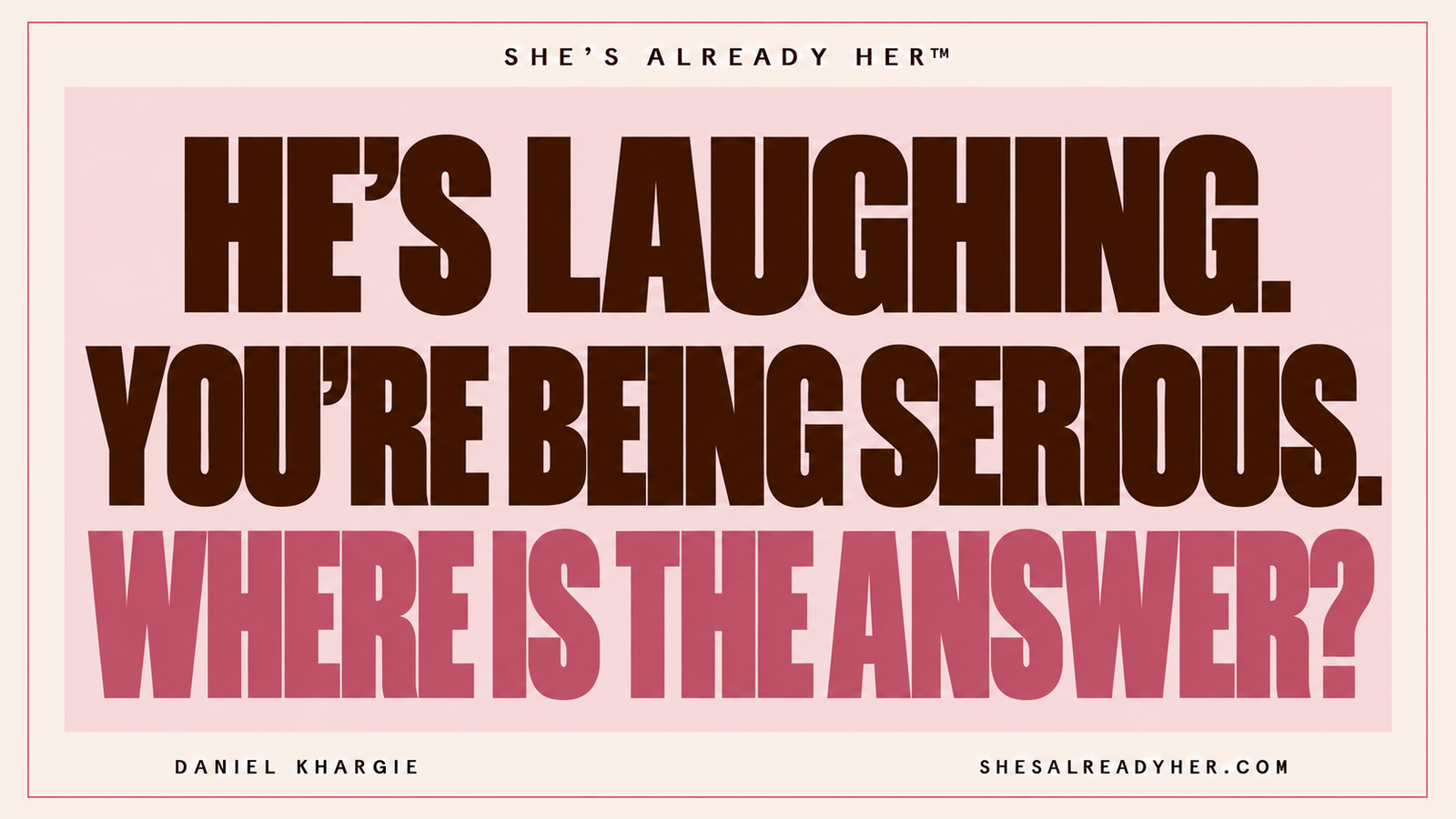
You shouldn’t have to convince the man you love that you’re being serious every time you tell him something hurts.
You already brought the concern to him. You chose your words. You gave him a chance to understand what’s been bothering you, and now you’re watching him smile like the conversation is something you both find funny.
But you don’t find it funny. You’re trying to get an answer.
Dismissive behavior in relationships can leave you doing two jobs at once: explaining the original problem and explaining why it deserves a real conversation. By the time you get back to what you wanted to discuss, you may already feel worn out.
You don’t need to figure out everything behind his laugh before you notice what happened next. Did he stop, hear you, and address what you said? Or did the joke become the place where your concern disappeared?
That’s where this conversation needs to go. You deserve more than an explanation of why he laughed. You deserve to know whether he’s willing to talk about what hurt you.
You brought him a concern, and he left you defending the conversation
Feeling dismissed can start with something as ordinary as asking to talk about an arrangement that isn’t working for you.
Here’s an example. You tell him that he keeps adding people to plans you thought were for the two of you. You aren’t saying he can never see his friends. You’re asking him to check with you before changing an evening you both agreed to.
He laughs and says, “What, do I need to submit an application now?”
Now you’re explaining that you aren’t trying to control him. You’re defending yourself against the joke instead of discussing the changed plans. Ten minutes later, you still don’t know whether he’ll check with you next time.
That is the part worth noticing. The conversation moved, but your question didn’t get an answer.
You can enjoy a man’s sense of humor and still need him to hear you when something matters. Having a playful relationship doesn’t mean every concern you bring has to survive being turned into a punchline first.
If the issue is repeated jokes aimed at your body, your history, or something private, the article about hostile humor addresses that more directly. Here, we’re talking about the joke that takes the place of answering you.
Look at what happens after the laugh
One laugh cannot tell you everything about a man’s intentions. People sometimes react awkwardly when they’re uncomfortable, surprised, or unsure what to say.
You don’t have to decide whether the sound was nervous enough or the smile looked guilty enough. You can pay attention to what he does once he understands you’re being serious.
Does he say, “Sorry, that came out wrong. Tell me what you mean”? Does he put the joke aside and listen? Does he answer the actual question, even if his answer is something you need to think about?
That gives you something different to work with than another joke, another subject change, or another accusation that you take everything too seriously.
Nervous laughter may be part of an awkward first response. It isn’t an answer to the concern. If that’s his explanation, there is still a conversation left to have.
And if he does catch himself and engage, you’re allowed to recognize that. You don’t need to keep arguing about the first few seconds after he has genuinely returned to what you raised. You can also tell him the first response hurt without pretending it defines every part of the exchange.
What you’re looking for is room for your concern to be heard and addressed. You shouldn’t have to become an expert at reading his face to find that out.
Read this quote as text
You heard her say it hurt, then turned the conversation into a joke. Making her laugh didn’t answer what she asked or fix what hurt her.
“I was only joking” still leaves your question unanswered
He may be telling the truth that he intended to make a joke. You can hear that without acting like it settles the issue.
You were asking whether he’d check with you before changing the plan. Knowing that he meant his application comment as humor doesn’t tell you whether he’ll do that.
You might say, “I understand you were joking. I’m still asking whether you’ll check with me before adding people.”
That’s an option, not a line you have to deliver perfectly. You’re allowed to use your own words. You’re allowed to feel upset. You’re also allowed to decide that you don’t want to keep talking right then.
When you’re wondering how to respond to invalidation, it can help to bring your attention back to the unfinished question. What did you ask? What did he actually answer? What are you still waiting to understand?
You don’t have to prove he secretly meant something cruel before you can say the conversation isn’t addressing your concern.
And you don’t have to accept a joke as a yes, a no, an explanation, or an agreement. If he hasn’t answered, you’re allowed to admit that to yourself.
You laughing along doesn’t mean the problem stopped hurting
Maybe you smiled because you didn’t know what else to do. Maybe you laughed at the wording even though the concern underneath it was still serious. Maybe you were relieved to have a moment when the conversation felt less difficult.
None of that means you gave up the right to return to what you were saying.
You can find a comment funny and still need an answer. You can laugh automatically and later realize you felt uncomfortable. You can change your response after you’ve had a chance to understand how the exchange affected you.
If it helps, you can say, “I laughed, but I wasn’t finished talking about this.” You don’t owe him an elaborate explanation of your own laugh before your concern can matter again.
And listen, you did not make him dismiss you by failing to hold the right facial expression. He is responsible for how he responds. This isn’t a test where one smile from you gives him permission to ignore everything you said before it.
Humor in relationships can make room for warmth during a difficult conversation. It becomes a problem when only one person gets relief while the other is left carrying the same unanswered concern.
Taking you seriously doesn’t require agreeing with every detail
A real answer might include something you didn’t know. He may remember the arrangement differently. He may disagree with what you’re asking for. You both may need to correct part of your understanding.
There’s room for that. Your hurt matters, and it doesn’t make every conclusion you reach automatically correct.
But disagreement can happen in an actual conversation. He can explain what he understood, ask you a question, or tell you what he is willing to do. Laughing at the idea that you wanted to discuss it gives you very little to work with.
To listen to understand, he needs to make room for what you’re saying before turning it into a version that’s easier to dismiss.
In the example about changed plans, that might sound like, “I thought you wanted a group evening. I didn’t realize you were expecting time together. Let’s be clearer about that next time.”
Or he might say, “I don’t want every Friday to be just us.” You may dislike that answer, but now you can discuss what each of you wants. You aren’t still trying to establish that asking the question was reasonable.
The conversation about invalidating feelings goes deeper into being heard when your experiences differ. You don’t have to get him to feel exactly what you feel before asking him to engage with you.
A pause should make room to return, not make you start over
Sometimes a serious conversation needs a break. You might be tired. He might be struggling to find his words. Both of you may need time to think.
You can pause without deciding that the concern has been dealt with.
Here’s an example. He makes a joke, sees that it lands badly, and says, “I’m not handling this well. Can we talk after dinner when I can give it my attention?”
That request gives you something to consider. Does the time work for you? Does he return to the conversation? Can he pick up what you were discussing without leaving you to persuade him that it matters all over again?
You shouldn’t have to keep restarting the whole explanation while he treats each new attempt like the first time he’s heard it.
And you aren’t required to sit through more laughter to prove you’re willing to communicate. If you want to stop, you can stop. When it feels safe and useful, you can name what remains unfinished and discuss when to return.
A pause can help two willing people. It cannot supply the willingness that one of them keeps withholding.

Read this quote as text
You don’t have to understand her hurt immediately to take her seriously. You can ask a question instead of making her feel foolish for bringing it up.
Better wording cannot do his part of the conversation
You may have searched for how to have difficult conversations because you want to give this a fair chance. You’re thinking about the timing, your words, and how to explain yourself without losing what you came to say.
Those choices can help you communicate. They cannot make another person choose to listen.
There is a difference between realizing you could explain one detail more clearly and deciding that every unsuccessful conversation proves you still haven’t found the right words.
You can correct an unfair accusation. You can own something hurtful you said. You can hear that you misunderstood part of the situation. Doing those things doesn’t mean you need to erase the original concern.
And if he can tell you exactly why he dislikes your delivery but still won’t answer the question underneath it, notice that. The article about tone policing addresses that separate conversation.
Here, ask yourself something simpler: have you made the concern understandable, and is he doing anything with what he understands?
You don’t have to keep adding examples until you’ve exhausted yourself. Sometimes you already said enough for him to respond, and you’re waiting for a response that more explaining cannot provide.
Repeated dismissal gives you information about what you can expect
When the same concern keeps getting laughed off, you may start preparing for the reaction before you’ve even opened your mouth.
You rehearse. You cut parts out. You decide it probably isn’t worth bringing up. Then the practical problem remains, and you’re carrying the hurt of not having discussed it too.
You don’t need to blame yourself for becoming reluctant. It can be hard to keep speaking openly when previous attempts have left you feeling foolish or unheard.
What matters now is being honest about what is happening. Are there concerns he does return to? Has he acknowledged this response and changed how he handles it? Or are you relying on a version of the conversation that hasn’t happened yet?
You can appreciate improvement when it shows up and still look at whether the actual issue gets addressed. Fewer jokes may be a better start, but you may still need an answer about the changed plans, shared responsibility, or other concern you raised.
That information can help you decide what to rely on, what support to seek, and what you’re willing to keep participating in. Your circumstances matter. You don’t owe anybody an immediate decision about your whole relationship because you’ve recognized a problem.
If raising concerns leads to threats or you feel afraid of what he may do, you don’t have to confront him to prove your point. Give your attention to support and your safety rather than another attempt to make the conversation work.
You deserve a conversation that gets back to what matters
You aren’t asking him to become a man who never jokes. You’re asking him to recognize when the woman beside him is trying to tell him something important.
That can look ordinary. Putting the joke down. Asking what happened. Hearing the part he missed. Giving an honest answer. Returning when he said he would.
You don’t need a flawless first response every time. You need more than the same unfinished conversation dressed up as another funny moment.
Emotional invalidation is one way to describe repeatedly brushing aside what you feel. But the label isn’t something you have to win an argument about before you can recognize that your concern still needs attention.
You told him something hurts. The next part should give you some understanding of what he heard and what he is willing to do with it.
You shouldn’t have to keep proving that you meant it.
Read this quote as text
You keep telling her you were only joking, but she’s still waiting for an answer. The conversation didn’t get resolved just because you stopped feeling uncomfortable.
A guide for looking at what happens after you explain the hurt

If you recognize a repeated pattern of explaining what hurts and still being treated like the concern doesn’t matter, When He Keeps Disrespecting You gives that bigger conversation more room.
The 135-page, 18-chapter Book + Guide includes guided reflection, a Respect Reality Review, and sections about what happens when you bring the issue up, the difference between intention and impact, and what separates an apology from repair.
It can help you look at what has actually happened after you’ve explained the hurt, without making another explanation your only plan. The guide also includes support and safety information.
Read more about When He Keeps Disrespecting You.
Frequently asked questions
What is emotional invalidation when he laughs instead of answering me?
It means your feelings are brushed aside, minimized, or treated as something that doesn’t deserve attention. A joke can contribute to that when it repeatedly replaces the conversation you were trying to have. One awkward laugh doesn’t establish the whole pattern or tell you his intentions. Look at whether he recognizes you’re serious, hears the concern, and gives it an actual response. You don’t need his agreement with every detail to ask for that.
How to respond to invalidation when he turns a serious concern into a joke?
If it feels safe and useful, you can return to the specific question: “I heard the joke. I’m still asking whether you’ll check with me before changing our plans.” Use your own words. You can also pause or stop the conversation. If he keeps brushing it aside, more explaining may not produce a different response. Consider what remains unanswered and what that means for your choices, rather than treating his willingness to engage as a test of how well you spoke.
Why do I laugh when I’m nervous, even when I’m trying to raise something serious?
You may laugh when you feel uncomfortable, unsure what to say, or eager to ease an awkward exchange. That doesn’t mean you found the situation acceptable. You can say, “I laughed, but I still need to talk about this.” You don’t have to punish yourself for the reaction or prove that your expression stayed serious enough. And your laughter doesn’t tell you why he laughed; you can consider each person’s response without assuming both meant the same thing.
How to have difficult conversations when he keeps joking?
Choose a specific concern, say what you need to understand, and leave room for an honest answer. You might ask to return at another time if the conversation isn’t working. Those choices can make your meaning clearer, but they cannot guarantee his participation. Notice whether he puts the jokes aside and addresses the issue. You’re allowed to stop repeating yourself when the question is already clear and he continues treating it as entertainment.
What is conflict avoidance, and does his laughter prove that’s what he’s doing?
Conflict avoidance means steering away from a difficult issue rather than addressing it. A joke may do that, but laughter by itself doesn’t prove the reason for his response. Consider what follows: does he return, explain his view, and hear yours, or does the concern keep disappearing from the conversation? You can name the unfinished issue without diagnosing him. His explanation for the laugh and his willingness to answer your concern are two things you can consider separately.