

He cannot keep frightening you and then make you feel wrong for being careful around him.
You’re thinking about what might happen after you speak. After you disagree. After you tell him no. You still have something to say, but now you’re weighing what it could cost you to say it.
Of course that changes how you act around him. You didn’t stop having opinions. You didn’t stop needing things. You started thinking about his response before you could even get your own words out.
Feeling unsafe around your man is something you deserve support with. You don’t have to wait for an injury or somebody else’s permission before you can speak privately about what is happening.
I’m not asking you to show him this article or start another conversation to see how he reacts. If you’re afraid of his response, take that seriously when you consider what to do next.
If you’re in immediate danger, contact emergency services when safe to do so. You don’t need to finish reading or gather proof first.
You shouldn’t have to prepare for what happens after you speak
You’re saying, “I can’t talk to my husband without him getting angry.” And now, before you bring something up, you’re already thinking about what could happen afterward.
What does that anger look like? When you speak privately with someone who can support you, tell them what he actually says and does. The threats. The things he breaks. Whether he takes your phone or stops you from leaving. Explain what has made you afraid, without making it sound smaller.
You don’t have to leave out the frightening parts to make the relationship sound more acceptable. Somebody trying to support you needs to understand what you’re dealing with.
And if you can’t put all of it into words yet, you can say that. You’re allowed to ask for support while you’re still making sense of what keeps happening.
Disagreeing with him shouldn’t make you afraid
You don’t owe him agreement because he’s upset. You don’t owe him access to your phone, your body, or your private conversations to prove that you love him.
You shouldn’t have to keep giving in because you’re frightened of what refusing might bring.
His threatening behavior does not become your fault because he didn’t like your answer. You can take responsibility for something you actually did without taking responsibility for his choice to frighten you.
And whatever you did to get through a frightening moment does not mean you agreed with what happened. Giving in because you were afraid is not a reason to blame yourself.
If you’ve been walking on eggshells around his reactions, look at what you’re trying to avoid. You can discuss that privately without testing another disagreement first.

Read this quote as text
He says you have changed around him, but you kept trying to speak while his reactions made you afraid to finish. You did not stop having a voice. You started thinking about what it might cost to use it.
He doesn’t have to hit you before it matters
You keep coming back to the fact that he hasn’t hit you. But what else has happened that made you afraid?
Threats. Blocking your way. Breaking things. Pressure that keeps going after you’ve said no. Those things deserve attention without you waiting for him to do something worse.
If you’re feeling threatened, you don’t need to collect another frightening incident before you can tell somebody what is happening.
The National Domestic Violence Hotline describes warning signs of abuse that include intimidation and control. You can seek support even when there has been no hitting.
A good week afterward doesn’t make the frightening incident disappear. You can remember the affection and still need help with what happened. You don’t have to prove every part of being with him has been terrible.
Tell someone without leaving out the frightening parts
Choose someone you can speak with privately. Someone who will listen without immediately calling him, confronting him, or repeating what you said.
If you don’t want him contacted, make that clear. Ask about privacy before sharing details you’re not ready to disclose. You don’t have to have your whole next step worked out before you ask someone to listen.
If you don’t know where to turn, the National Domestic Violence Hotline can connect you with a trained advocate. Tell them what happens and what you’re worried about. They can discuss support and options that fit your circumstances.
Think about how you reach out. If he may monitor your phone, accounts, or browsing, use a safer device or contact method when possible. Private browsing does not guarantee privacy.
Don’t assume a sudden password change, deleted message, or new account is automatically a safe move if it could alert him. Talk through those concerns with an advocate instead of trying to work them all out alone.
Your circumstances matter when you decide what to do
Advice can sound easy when the person giving it doesn’t have to deal with what happens afterward.
You may share a home, money, children, transport, medication, or care responsibilities. You may be worried about being monitored. Those things matter. They belong in the conversation about what you can do safely.
The Hotline’s personal safety planning resource explains that support can fit your circumstances while you’re staying, preparing to leave, or after you’ve left. You can ask an advocate to help you consider what applies to you.
You don’t need to gather documents, move things, or keep notes in a way that could put you at greater risk. A general checklist cannot tell you which action is safe in your situation.
If you’re staying for now, you still deserve support. If you’re thinking about leaving, you don’t owe him an announcement before you consider your options. If danger is immediate, emergency help takes priority over completing a longer plan.

Read this quote as text
He says you are too careful with him now, but you remember what happened when you spoke freely. You did not start choosing every word for no reason. You were trying to avoid another reaction that frightened you.
You don’t have to confront him to make your fear count
You don’t need to start another confrontation to find out whether your fear is serious enough.
What already happened is something you can discuss privately. You don’t owe anybody a demonstration of how firmly you can stand up to him.
A sentence from an article cannot tell you how he will respond. If saying no, asking for space, or announcing a decision could put you at risk, get support with that before acting on a script.
You can want things to be different without making yourself responsible for teaching him a lesson. You don’t have to get him to admit what he did before you’re allowed to ask for help.
Your next step can be about support for you. It doesn’t have to become another conversation where you try to make him understand.
Loving him doesn’t cancel out the fear
You can still love him. You can miss the good parts. You can wish he would treat you differently and still be afraid of what happens when he doesn’t get his way.
Those feelings don’t cancel each other out. You don’t have to wait until you feel nothing for him before you’re allowed to get support.
Tell someone who can help about both parts. The attachment matters. So does the fear. You don’t have to hide either one to deserve an honest conversation.
If being around him has left you emotionally drained, that matters too. Still getting through your responsibilities does not mean the situation is okay for you.
You’ve already been trying to manage a lot. Asking for help does not mean you failed to love him enough.
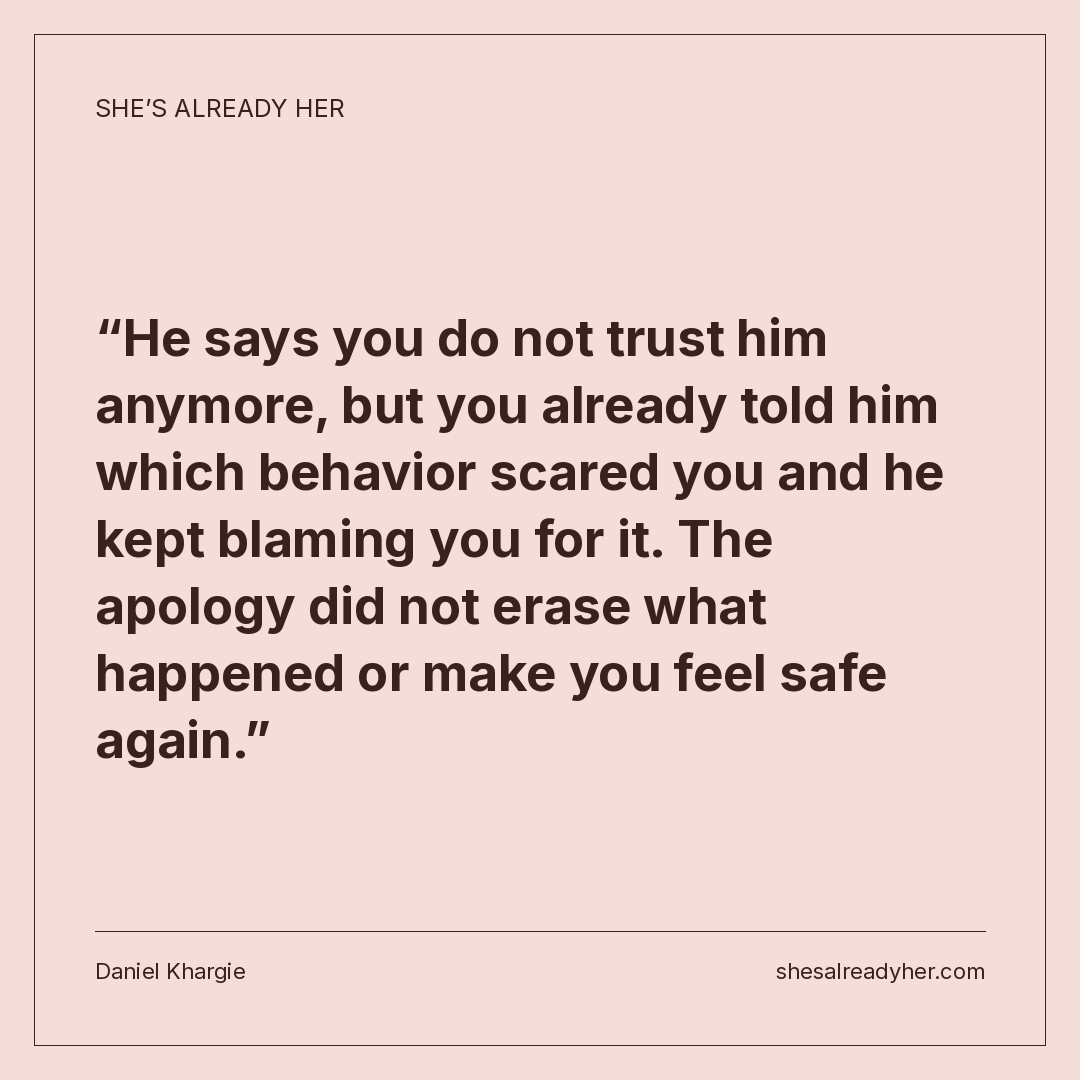
Read this quote as text
He says you do not trust him anymore, but you already told him which behavior scared you and he kept blaming you for it. The apology did not erase what happened or make you feel safe again.
His apology doesn’t decide what feels safe for you
He might say he never meant to scare you. He might apologize and want everything to go back to how it was.
You don’t have to decide the risk has passed because he says he regrets it. You can need privacy, time, support, or distance while you think about what happened.
An apology doesn’t require you to stop talking to someone who can help. It doesn’t require you to give him access to everything you’ve said or promise that you won’t consider leaving.
If abuse or danger may be involved, don’t expose yourself to another incident to measure his improvement. Get help considering the situation instead of relying only on his promises.
His regret does not mean your concern is finished. You don’t owe him a return to how things were before you’ve had room to think about what you need.
Your next step doesn’t need his permission
You might not know whether you’re staying or leaving. You can still know that you need a private conversation and some help understanding your options.
Start with what matters now. Can you reach someone safely? What are you afraid of? What practical things would make a change difficult? Tell an advocate about those concerns instead of trying to solve all of them before you reach out.
If you’ve already separated and contact makes you afraid, say that too. Shared responsibilities can keep you connected, and you deserve support with those circumstances.
For the separate conversation about deciding how much to share emotionally, read about emotional safety and opening up again. Here, take the fear of harm, intimidation, or retaliation seriously.
You don’t need his agreement before you can take your fear seriously. The man who wants you to feel like yourself around him cannot keep making you afraid of what happens when you do.
Questions you may still be asking
What is intimidation?
Intimidation means using fear or threats to pressure someone. Intimidation examples in a relationship can include threats of harm, breaking belongings, blocking an exit, or making a partner afraid to refuse a demand. These behaviors deserve support even without hitting. Describe what happens and what you fear to a trusted person or advocate; you do not need another confrontation to establish that the concern is serious.
What is verbal abuse?
Verbal abuse uses words to threaten, humiliate, degrade, or control a partner. It can include name-calling, threats of harm, and repeated insults meant to wear you down. The National Domestic Violence Hotline explains these forms of emotional abuse. He does not have to hit you for what he says to be harmful. You can seek support without having the perfect label for it.
Is yelling abuse?
Yelling can be abusive when it is used to frighten, threaten, humiliate, or control you. Volume alone does not explain the whole situation: what he says, what he does, and whether you fear the consequences of disagreeing matter. A repeated pattern matters, but a single serious threat still deserves attention. You do not need to wait for it to happen again before asking for help. The Hotline’s explanation of emotional abuse includes yelling and intimidation among warning behaviors.
What is coercive control?
It describes a pattern of behavior used to restrict a partner’s freedom through pressure, isolation, monitoring, threats, or other control. The National Domestic Violence Hotline explains power and control in relationship abuse. This description does not establish a diagnosis or determine whether a particular law applies. If you fear retaliation, seek private support rather than testing a boundary to see what happens.
How to leave an abusive relationship?
Start by contacting a trained advocate privately, using a safer device or contact method when possible. Explain what has happened, what you fear, and practical concerns such as housing, money, children, medication, or monitoring. An individualized domestic violence safety plan can consider those circumstances. You do not owe your partner an announcement or final confrontation. If danger is immediate, prioritize emergency help when safe to access it. This is a referral to support, not a complete leaving plan.
How to leave an abusive relationship with no money?
Not having money is a real barrier, and it does not mean you have to figure everything out alone. If you are in the US, you can contact a free, confidential Hotline advocate using a safer device or contact method when possible. Explain your concerns about housing, transport, and access to money. Ask about local programs that may offer help and what is available where you live. The Hotline provides support and referrals, not direct financial assistance; housing or funds cannot be guaranteed. An advocate can help you consider options around your circumstances and safety. You do not need to purchase a guide to access this support.