
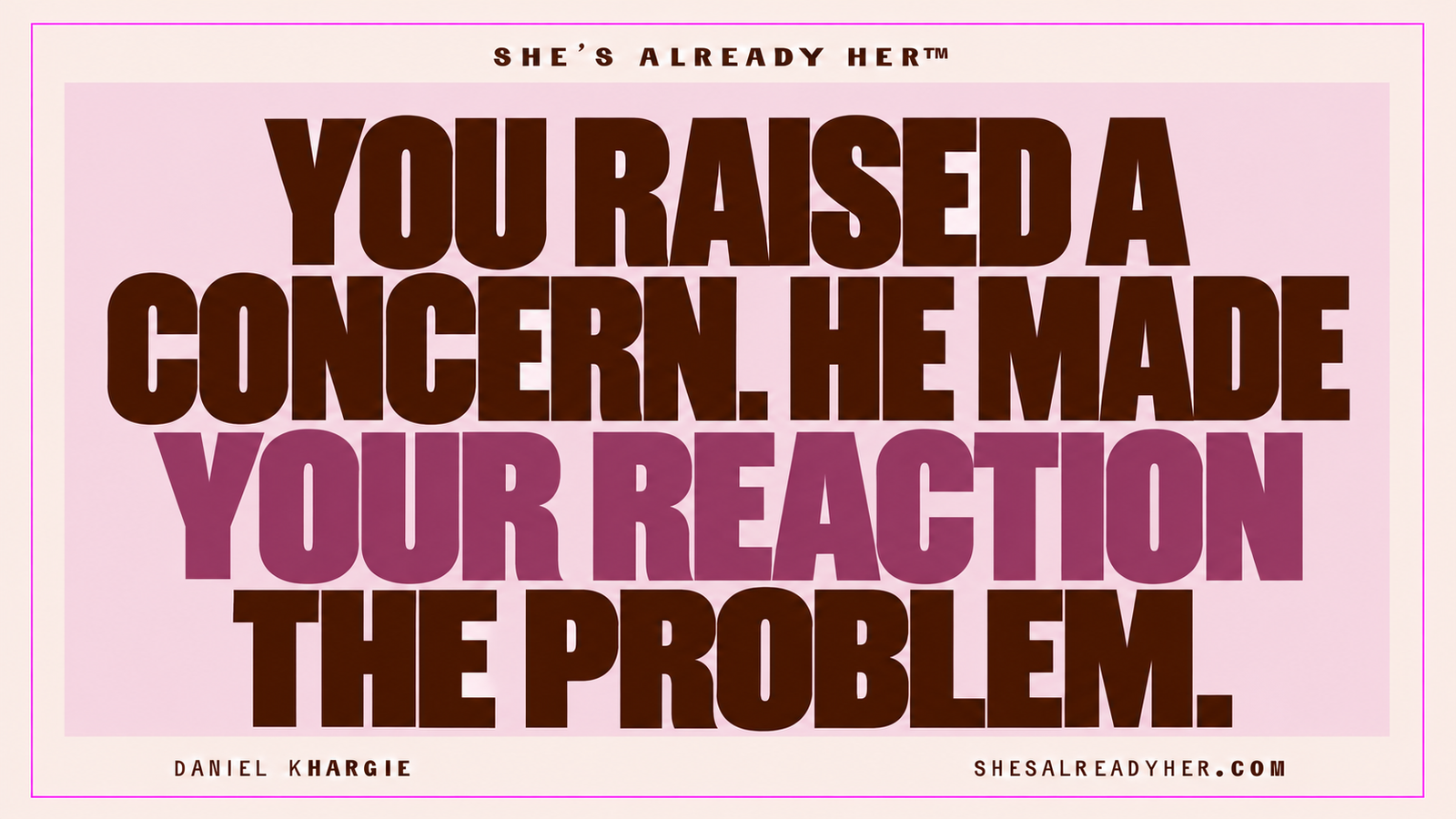
You shouldn’t have to sound untouched by something that hurt you before it deserves an answer. Tone policing in relationships can leave you explaining your voice, your tears, or your frustration while the concern you brought up gets pushed aside. You came to talk about something that happened. Now you’re defending the fact that you’re upset.
That doesn’t mean every request about your delivery is unfair. Both of you can ask not to be insulted, threatened, or shouted over. You can take responsibility for something hurtful you said. But addressing how a conversation happens shouldn’t mean the original concern never gets addressed at all.
You’re allowed to look at both. What happened before you reacted? How did you respond? And when the discussion turns to your delivery, is there still room for the thing you were trying to talk about?
You raised a concern, and suddenly you’re defending your reaction
Here’s an example. He changed plans that affected your evening without telling you. You bring it up because you were left waiting. You’re frustrated, and your voice sounds frustrated.
Instead of talking about the changed plans, he says you’re being dramatic. You explain why it mattered. He says your explanation proves that everything has to be an argument with you. Before long, you’re talking about whether you made too much of it, not whether he could have let you know.
The concern hasn’t been answered. It has been replaced by a discussion about the person raising it.
Feeling dismissed in that moment makes sense. You weren’t asking him to enjoy being questioned. You were trying to work out something that affected you. His discomfort with your frustration doesn’t, by itself, settle whether the concern was fair.
And your frustration doesn’t settle every fact either. You can check what actually happened, hear something you didn’t know, and still expect a response that goes beyond a label about your personality.
What tone policing means in this conversation
You might be wondering, “What is tone policing, and how is it different from a fair request?” Look at what happens to the actual point when your delivery becomes the topic. Does the discussion make room for the concern, or does your emotion become a reason it cannot be considered?
A specific request can help a conversation happen. For example, asking for a chance to finish speaking can make it easier for both people to explain themselves. Calling you dramatic whenever you sound hurt doesn’t offer that same clear way forward.
You may hear that you’re too upset now, too blunt later, or bringing it up too seriously when he was having a good day. None of those comments answers what you asked. If the original concern never becomes discussable, it’s worth noticing what the repeated focus on your delivery is doing.
That’s different from deciding you know every reason behind his response. You can describe the pattern without claiming you can read his mind. Your concern keeps getting left unanswered while the conversation stays on how you expressed it.
The term also gets used in wider discussions about whose anger is heard and whose is dismissed. Here, we’re looking at this specific exchange between you and him, not treating every disagreement about wording as the same thing.
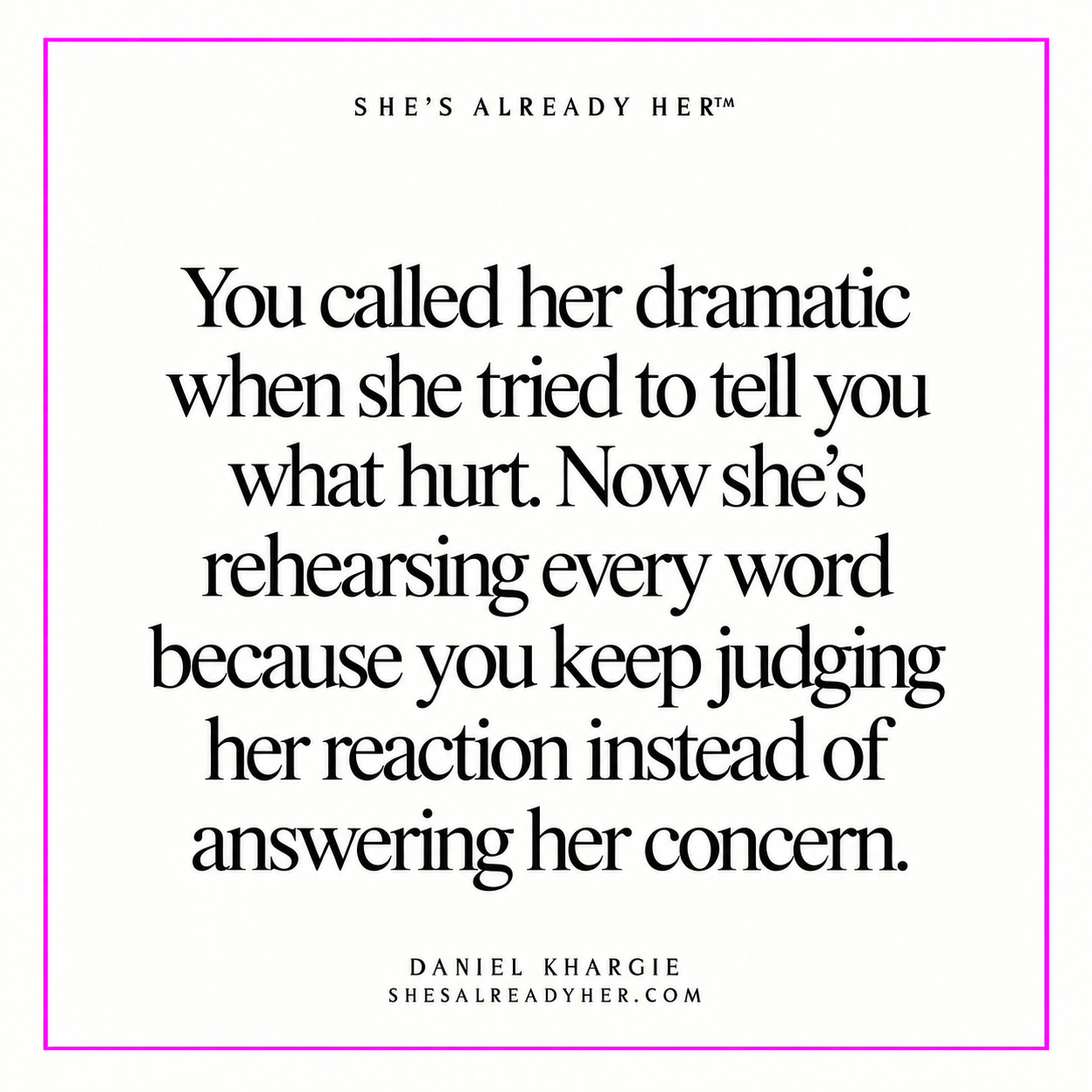
Read this quote as text
You called her dramatic when she tried to tell you what hurt. Now she’s rehearsing every word because you keep judging her reaction instead of answering her concern.
A reasonable request gives you something specific to work with
Respectful communication doesn’t require either person to sit through threats or name-calling to prove they care about the underlying issue. You can have a real concern and still say something that needs an apology.
For example, if you call him a name, he can ask you to stop calling him that. You can acknowledge it and stop. There can then be room to discuss the concern without that insult continuing.
Compare that with being told to stop being so emotional, without any explanation of what he needs beyond you looking less affected. You can apologize for an insult. You can stop interrupting. You can’t promise that something painful will stop feeling painful before you’re allowed to mention it.
A fair request doesn’t guarantee an easy conversation. It does identify something both of you can understand. You also get to ask for the same basic consideration: room to speak, no threats, and no insults used to put you down.
The distinction isn’t whether his voice sounds steadier than yours. It’s whether the way you talk is being addressed in a way that still leaves space for what you’re talking about.
A pause can protect the conversation without canceling it
Someone may need a break because they’re overwhelmed, tired, or struggling to listen. That alone doesn’t prove they’re dismissing you. Neither of you has to keep arguing just because the topic matters.
What helps is knowing what the pause means. Is there a realistic plan to return to the concern? Can either of you acknowledge that it remains unresolved? Does the conversation actually come back to it when you both can participate?
For example, he might say he wants to understand but can’t take in another point while you’re both talking over each other. You might agree to stop for now and return after dinner. The concern can stay on the table while the way you’re discussing it changes.
That is different from the issue being dropped whenever you show emotion, then treated as something you’re wrong to raise again. A break that repeatedly becomes the end of every difficult subject leaves you with a practical problem: there still isn’t a way to discuss it.
You don’t need a rigid time limit or a test to establish his motives. Look at what happens over time. A requested pause and an answered concern can exist in the same relationship. You’re allowed to notice when only the pause ever happens.
You can own your delivery without taking back your concern
Maybe you snapped. Maybe you interrupted. Maybe you made an accusation before checking a detail. You can be honest about those things without agreeing that everything you raised was nonsense.
Here’s an example of that distinction: “I shouldn’t have called you that. I’m sorry. I still need to talk about being left waiting without a message.” Your apology addresses what you said. It doesn’t have to become an apology for having a concern in the first place.
He can explain the effect your words had on him. You can listen and make a different choice about how you speak. That work matters. It also doesn’t answer whether he changed the plans, whether you had the information you needed, or what you both want to do differently next time.
Being accountable doesn’t mean accepting every accusation about your character. You can own a specific action without agreeing that you’re always dramatic or impossible to talk to.
And he can do the same. Neither person has to be perfect before the other person’s choices deserve attention. Two things can need an answer without one of them being used to erase the other.

Read this quote as text
She can own the way she spoke without taking responsibility for what you did. Her reaction doesn’t erase the conversation you still owe her.
Being hurt doesn’t prove every interpretation is right
Your feelings can be real while part of your understanding is incomplete. You might be hurt by a missed message and later learn there was a problem you didn’t know about. Hearing that information doesn’t make your hurt a performance.
The same goes for him. He can disagree with your account of what happened without dismissing the fact that you were affected. Agreement and acknowledgment aren’t the same thing.
Invalidating feelings can look like treating your upset as something too ridiculous to consider. A different response might acknowledge that waiting was upsetting, explain what happened, and discuss whether there was something either person could reasonably have done differently.
You’re not asking him to accept an accusation simply because you cried while making it. You’re asking for a conversation where facts, feelings, and conduct can each receive attention. That leaves room for you to learn something as well as for him to answer something.
If dismissal of your feelings is the broader pattern you’re dealing with, when your partner dismisses your feelings looks at that experience more fully. This conversation stays with what happens when your delivery becomes the reason the original issue gets pushed out.
Notice whether a different delivery ever leads to an answer
You may have already tried shortening your explanation, picking a different time, or asking one question instead of several. Sometimes a change like that helps both people understand what is being asked.
But if you’re always changing the way you speak and the original concern still never gets a response, that matters too. You don’t have to treat every unanswered conversation as proof that you haven’t found the right wording yet.
When you’re thinking about how to respond to invalidation, it can help to return to the specific point once, where that feels safe and useful. What are you asking him to address? What part of your conduct are you willing to own? What remains unanswered after that?
You don’t have to keep repeating the same sentence to test him. One more attempt won’t tell you everything about his intentions, and a conversation isn’t an experiment you have to finish before your experience counts.
Look at the participation available to you. Can he explain a disagreement about the actual issue? Does he acknowledge any part of it? Or are you repeatedly left defending how you said something while the thing itself stays untouched?
You don’t have to keep the discussion going at any cost
Unresolved conflict can leave you wanting to keep talking until something finally gets settled. You might be afraid that stopping means you’ve accepted his version, admitted you were dramatic, or lost the only chance to be heard.
Ending your participation doesn’t have to mean any of those things. Where it’s feasible and safe, you can recognize that the conversation isn’t bringing an answer and choose not to keep going over your delivery right now.
You may need time to think through what the unresolved issue means for you. A missed evening together, a shared expense, and a childcare arrangement can require different practical choices. You don’t have to solve the entire relationship while you’re still trying to sort out tonight.
If raising a concern brings threats, intimidation, or fear about what happens when you stop talking, don’t treat this as a challenge to find a stronger comeback. Private support from someone you trust or a relevant support service can help you think through your circumstances.
You deserve room to consider what is happening without having to prove that you can confront him perfectly. Your next choice can be about what you need, what is available, and what keeps you supported.

Read this quote as text
You keep asking her to say it differently, but you never answer the point. That’s why she’s tired of explaining the same hurt in another way.
A guide for separating what happened from how you reacted

If you keep leaving these conversations unsure which part actually belongs to you, When He Blames You for Your Reaction gives you a fuller way to work through that question.
The 117-page Book + Guide includes 12 chapters, guided reflection, and work on the event, impact, reaction, responsibility, and repair. It also includes sections on what belongs to him, what belongs to you, your own accountability plan, and safety and support.
The point isn’t to excuse everything you said because you were hurt. It’s to look at your conduct without allowing it to become the only part of the story that gets examined. You can take responsibility without taking over his responsibility too.
It’s an optional resource for your own reflection. It cannot decide what happened in a particular disagreement or make him participate in a conversation. You can use it to give yourself space to consider the pieces separately instead of trying to settle all of them while you’re being called dramatic.
Your concern still deserves an actual response
You can speak more thoughtfully and still be hurt. You can apologize for an insult and still want an answer. You can hear his side without agreeing that the entire problem was your reaction.
An actual response might be an acknowledgment, an explanation, a genuine disagreement, or an honest limit on what he is willing to offer. It doesn’t have to be the answer you hoped for to give you useful information. But a label about how emotional you are doesn’t do that work.
You don’t have to become impossible to upset before you’re someone worth listening to. And you don’t have to let hurtful behavior from either person pass without comment just to keep the original issue visible.
Both parts can matter. How you treat each other during the conversation matters. What happened before the conversation matters. You’re allowed to notice when only your part is ever expected to change.
Frequently asked questions
What is tone policing when he calls my concern drama?
It’s useful to look at whether your delivery replaces the substance of what you raised. A complaint about your tone can leave the original concern unanswered, especially when there is never a way to return to it. A specific request to stop insults or take a genuine pause isn’t automatically the same thing. Context and what happens next matter more than the label alone.
How can I respond when he calls my concern drama?
If you’re wondering how to respond to invalidation, start with the specific concern rather than trying to prove that you are never dramatic. You can acknowledge something you need to own in your delivery and still identify what remains unanswered. You don’t have to force another conversation if it feels unsafe or keep explaining indefinitely. A clearer sentence can help willing people understand; it cannot guarantee participation.
How can I have a difficult conversation if I get upset?
Knowing how to have difficult conversations doesn’t require removing every sign that you care about the subject. Try to stay with the actual concern, give both people room to speak, and avoid threats or personal attacks. A pause may help when someone cannot participate usefully. If pauses repeatedly end the discussion altogether, the issue is still unresolved. You don’t have to pretend it was settled just because the conversation stopped.
How can we disagree respectfully about my delivery?
Thinking about how to disagree respectfully includes being specific. An interruption, insult, or inaccurate accusation can be discussed as an action rather than a verdict that you’re a dramatic person. You can consider his concern while asking that the original issue also receive attention. Neither person’s feelings automatically settle the facts, and neither person has to accept harmful treatment to prove they’re listening.
How do I end an argument that keeps focusing on my reaction?
When you’re considering how to end an argument, remember that stopping a repeated exchange isn’t the same as agreeing with its conclusion. Where safe and feasible, you can stop repeating your explanation, acknowledge that the concern remains unresolved, and think through your next practical choice. If the conversation keeps circling without reaching the issue, going over what was said without solving anything discusses that loop more fully.