

You hear the door open, and there she is. No message asking whether it’s a good time. No knock and a wait for somebody to answer. Your mother-in-law has let herself in again, and now you’re trying to look welcoming when you wanted an afternoon to yourself.
Maybe you’re still in your pajamas. Maybe you’re having a private conversation with your husband. Maybe you’re doing absolutely nothing, and you would like to keep doing it without suddenly becoming somebody’s host. You don’t need a better reason than that to want a visit arranged first.
Mother-in-law boundaries can get uncomfortable when your husband sees his mom walking in as normal and you experience it as having no privacy. He grew up with her. He may not think twice about her being there. But you live in this home too, and your comfort needs to be part of the conversation.
Sis, asking his mother to check before coming over is a reasonable thing to talk about. You can want a good relationship with her and still want to know who is about to walk through your front door. Let’s put some words around that, especially if you’ve already asked nicely and nothing has changed.
1. Wanting privacy doesn’t make you a bad daughter-in-law.
You may have spent more time questioning your reaction than talking about what keeps happening. ‘Maybe I’m being rude. Maybe this is just how their family is. Maybe I should be grateful she wants to see us.’ Meanwhile, you’re getting dressed faster because somebody might arrive without asking.
There can be good things about her and a problem with the way she visits. She might be generous with the children, bring food, or have helped you through a difficult time. You can appreciate those things without agreeing that she should be able to enter whenever she wants.
Name the actual issue before the conversation turns into a judgment about whether you like her. The issue is arriving and letting herself in without checking. It is the interruption, the surprise, and the feeling that you don’t get to decide when you have company.
You don’t need to prove that she had bad intentions. She might believe she’s being helpful. She might genuinely think everybody is fine with it. You can explain what you need without pretending you know what she meant. ‘I need visits to be arranged first’ gives everybody something specific to understand and act on.
2. Talk to your husband about the visit, not whether his mom is a good person.
Choose a time when she isn’t standing in the kitchen and you aren’t trying to whisper your frustration from the bedroom. Tell him what happened and what it was like for you. Keep the example clear enough that he can’t mistake the concern for a general complaint about his mother.
Try: ‘Your mom let herself in this afternoon without checking. I was resting, and I didn’t want company. I need us to arrange visits before anybody comes over, including family.’
If he says, ‘That’s just my mom,’ you can answer, ‘I understand she’s used to this. I’m telling you it isn’t working for me.’ You don’t have to argue with the fact that he loves her. You’re asking him to hear how the arrangement affects his wife.
Tell him what support would look like. ‘I want us to agree on the rule, tell her together, and both follow through.’ Otherwise, he may think agreeing that you’re upset finishes his part. You need to know what will happen before the next visit.
You’re not asking him to stop being her son. You’re asking him to help make decisions about the home he shares with you. His familiarity with the situation doesn’t make your discomfort less real.
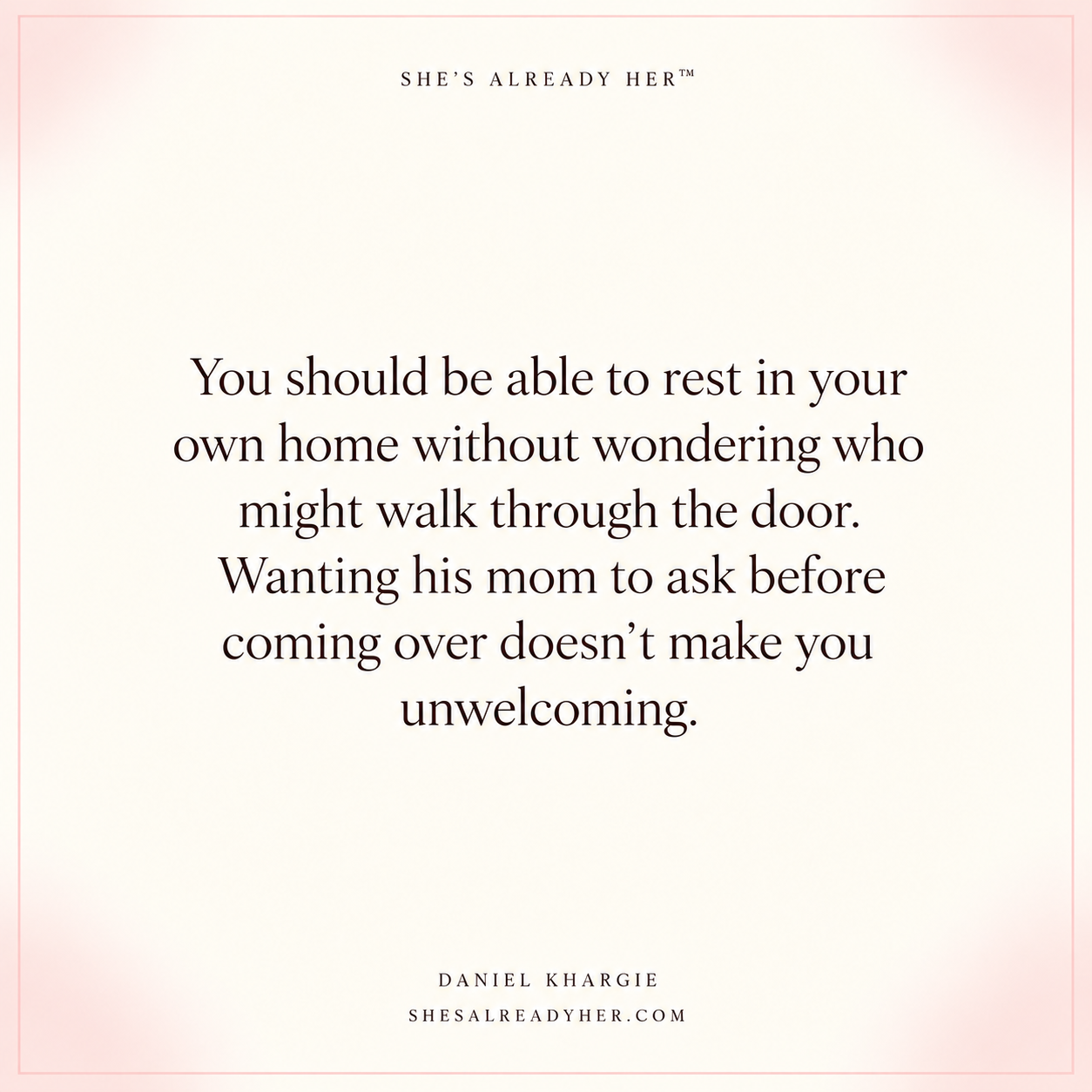
Read this quote as text
You should be able to rest in your own home without wondering who might walk through the door. Wanting his mom to ask before coming over doesn’t make you unwelcoming.
3. Agree on what ‘ask first’ actually means.
A message saying ‘I’m outside’ isn’t much notice if she’s already reaching for the door. ‘I’m coming over’ also gives you a different choice from ‘Would a visit work this afternoon?’ Talk with your husband about the difference before you explain the new arrangement to her.
You might agree that visits need a message or call and a confirmed time. If nobody answers, the visit hasn’t been agreed on. If one of you is working, sleeping, unwell, or expecting private time, you discuss that before saying yes to company.
Make the rule workable for both of you. Your husband gets a say in having his mother visit. You get a say in how visits affect the space and time you share. Talk through who will host, whether you’re expected to join, and what happens when one person wants company and the other needs quiet.
Apply the same basic courtesy to your family too. It is harder to explain a household rule if your own mother can walk in while his mother has to arrange everything. The details don’t have to be identical in every situation, but the need for privacy should count whichever family is visiting.
If you share his mother’s home, the conversation needs to reflect that arrangement. Talk together about private rooms, knocking, and agreed visiting or family time. Use an agreement that fits where everybody actually lives.
4. Give her a clear sentence she can follow.
You don’t need to begin with every time she has upset you. Start with the thing you want to change. ‘We need you to call or message and agree on a time before coming over. Please knock and wait for us to answer instead of letting yourself in.’
If you want to keep the warmth in it, you can add, ‘We want to enjoy seeing you, and planning visits works better for us.’ That is enough. You don’t need a speech about how busy you are to justify wanting a knock on your own door.
If you’ve already asked once, be honest about that too: ‘We’ve mentioned checking first before. It’s still happening, so we need to be clearer. Please wait until we’ve confirmed a visit before coming over.’ You can be firm without raising your voice or listing everything you’ve ever held against her.
Your husband should use ‘we’ only if he means it and is prepared to support it. ‘My wife says you can’t come over’ makes you the obstacle and leaves him outside the decision. He can say, ‘Mom, we’re arranging visits first from now on. Please check with us before you come over.’
You can speak for yourself as well. Having his support doesn’t mean you lose your voice. Both of you need to understand and communicate the arrangement.
5. A spare key needs a clear purpose too.
Maybe the key was given to her for a trip, an emergency, or feeding the cat. Somewhere along the way, it became a way to stop by whenever she was in the neighborhood. If that isn’t what you and your husband intended, say so directly.
Try: ‘We gave you the key for emergencies and the times we specifically ask you to help. Please don’t use it for visits.’ If the reason for lending it has ended, you and your husband can agree to ask for it back: ‘We’ll take the spare key back now. Thank you for helping while we were away.’
Discuss this with him before the conversation so you aren’t asking for the key while he’s telling her to keep it. If you disagree about who should have access, that disagreement needs attention. You can’t give her one clear expectation while giving each other different instructions.
An agreed childcare pickup or a genuine emergency may need its own arrangement. Spell that out. ‘Come in at three to collect the children’ is permission for that particular plan. It doesn’t have to become permission to arrive on a different day without asking.
Keep this about how access will work from now on. You don’t need to turn handing back a key into a test of how much anybody loves anybody else.

Read this quote as text
It hurts when you have to defend your need for privacy to the man who shares your home. You’re asking him to stand beside you in a decision that affects both of you.
6. Her disappointment doesn’t require another long explanation.
She might accept the request and change what she does. Give her room to do that. A habit you dislike doesn’t automatically tell you how she will respond once the expectation is clear.
She might also say, ‘I didn’t know I needed an appointment to see my own son.’ You can answer the actual point without taking on the wording: ‘We’re asking you to check whether it’s a good time before coming over. We’re happy to arrange a visit.’
If she says, ‘I guess I’m not welcome anymore,’ you can say, ‘You are welcome at an agreed time. Walking in without checking isn’t working for us.’ You don’t have to offer unlimited access to prove that you mean the invitation.
You can acknowledge that this feels different for her. ‘I know you’re used to dropping in. We’re doing visits differently now.’ Then leave some room in the conversation. You don’t need to fill every uncomfortable silence by weakening what you just said.
Boundaries with your mother-in-law may feel awkward before they feel ordinary. You can be considerate about her feelings and still keep the request clear. Her being unhappy about a change doesn’t, by itself, tell you that the change is unfair.
7. If she comes over anyway, follow the agreement you made.
This is the part to discuss before it happens. If the two of you say visits must be arranged, what will you actually do when an unarranged visit happens? Choose a response you are willing and able to carry out.
It could be your husband meeting her at the door and saying, ‘Now isn’t a good time. We asked you to arrange visits first. Let’s find a time for another day.’ If she has already come in, one of you can say, ‘We aren’t available for a visit right now. We need you to check before coming next time.’
If she’s come to leave something, you can thank her for the item without turning the delivery into an afternoon together. ‘Thank you for bringing it. We can’t visit today.’ You don’t need to make up a dramatic reason for being unavailable.
There may be a day when an unexpected visit genuinely suits you both. If you choose to have her stay, be clear that it’s a one-time choice: ‘Today works, but please still arrange it with us next time.’ You’re allowed to make an exception without pretending the agreement never existed.
If she becomes threatening or you feel unsafe, get support rather than trying to force a doorstep argument to a tidy ending. The conversation can wait until you have a safer way to handle it.
8. Your husband can’t agree privately and leave you to take the blame.
Maybe he nods when you talk alone, then tells his mom, ‘I don’t mind, but she gets upset.’ That leaves you defending a household decision while he presents himself as the easygoing one. You’re allowed to bring that part up with him.
Try: ‘When you tell her this is only my issue, you leave me to handle the reaction alone. If we agree on arranged visits, I need you to say that and follow it too. If you don’t agree, we need to work that out honestly.’
He may worry that setting boundaries with his mom will hurt her. Let him explain that worry without losing the original problem. You can say, ‘I understand you don’t want her to feel rejected. I also need you to understand what it’s like to have no warning that someone is entering our home.’
Look for something specific you can both agree to do. He checks with you before confirming a visit that affects your shared plans. He tells her the same rule you tell her. He handles the conversation with his mother instead of leaving every reminder to you.
If he keeps reversing the agreement, another perfectly worded message to his mom may not solve it. The two of you need to return to how decisions about your home are made and whether both people’s needs are being taken seriously.

Read this quote as text
You can care about his mother and still want visits to be agreed on. Being part of the family doesn’t mean you stop having a say in your own home.
9. Make room for the visits you actually want.
If you want a relationship with her, give that relationship somewhere practical to go. ‘Sunday afternoon would work for us’ is a real invitation. ‘You can never come over again’ is a different decision. Don’t say the second thing when what you want is the first thing with some notice.
Maybe regular visits suit everybody. Maybe each week is different and you arrange them as you go. You and your husband might also decide that some visits are time he spends with his mom while you do something else. Talk about that so you aren’t automatically expected to cook, clean, and entertain whenever he invites her.
Notice when she does respect the arrangement. You don’t have to give a big reward for ordinary courtesy, but you can respond warmly: ‘Thanks for checking. Saturday works.’ Let the new way of visiting become a normal part of how you communicate.
You don’t need to keep treating her as if she ignored the boundary if she has started honoring it. Equally, one arranged visit doesn’t mean you must stop speaking up about the next unarranged one. Respond to what is actually happening. You’re trying to build a way of sharing family time that leaves you comfortable in your home too.
When you know what you need but struggle to say it
If you keep explaining a boundary and then taking it back when somebody gets upset, my Setting Boundaries Book + Guide takes that conversation further.

The 120-page digital Book + Guide includes 12 chapters, The Boundary Framework, a Boundary Language Library covering family, privacy, space, and other everyday situations, and a 30-Day Boundary Practice. It helps you work on saying what you need and deciding what you are prepared to follow through on.
Questions about mother-in-law boundaries
How do I set boundaries with my mother-in-law about coming over?
Tell her what you need in plain language: please ask, wait for a confirmed time, and knock instead of letting yourself in. Agree with your husband on how visits will work so you aren’t giving her conflicting answers. You can welcome planned visits while saying that unannounced entry doesn’t work for your household.
What does a mother-in-law overstepping boundaries look like at home?
An example is repeatedly letting herself in after you have clearly asked her to arrange visits and wait at the door. Be specific about the action rather than trying to prove what kind of person she is. If the expectation has never been discussed, start by making it clear instead of assuming everybody knows the same household rules.
What if my mother-in-law doesn’t respect boundaries after I’ve asked?
Repeat the agreement briefly and follow the response you and your husband decided on. That might mean saying you aren’t available for an unarranged visit. If a spare key is part of the problem, discuss its purpose and whether to ask for it back. If your husband contradicts the agreement, address that with him too.
How do I deal with my mother-in-law being upset about the new rule?
You can acknowledge that the change feels unfamiliar without withdrawing it. Try, ‘I know you’re used to dropping in. We need visits to be arranged first now.’ Offer a time that works if you want a visit. You don’t have to keep explaining until she likes the rule before you can ask her to follow it.
Can I ask an intrusive mother-in-law for space without cutting her off?
Yes. You can address the behavior and keep a relationship with her. Asking her to arrange visits, respect private time, and wait for an answer at the door gives you a way to see each other with clearer expectations. You don’t have to decide the future of the whole relationship to make that request.
That’s your home too
You should be able to put on your pajamas, leave a few dishes in the sink, or spend an afternoon with your husband without wondering whether you’re about to have company. Being comfortable at home matters, even when the person coming over is family.
You can care about his mother. You can appreciate what she has done for you. You can want her in your lives and still say, ‘Please ask before you come over.’ Those things can all be true together.
Your husband’s mom belongs in his life. You belong in the decisions about the home you share. You shouldn’t have to make yourself uncomfortable every day to avoid one conversation about that. That’s your home too.