
You sent it. Now you’re staring at your phone wishing you could reach through the screen and pull the message back.
Maybe it was a simple ‘Hey.’ Maybe you told him you missed him. Maybe you had a hard day and reached for the person you used to tell everything to. Now the thought running through your head is, ‘I broke no contact. What do I do now?’
First, put down the idea that you have ruined everything. The no contact rule doesn’t require you to become a woman who never misses him. You’re learning how to get through ordinary days without somebody who used to be part of them. Some days that is going to feel harder than you expected.
You can regret sending that text and still make a good decision about what happens next. You don’t have to send five more messages, agree to see him, or go back to a relationship you already had reasons to leave. Let’s deal with the message you sent without letting it decide the rest of your night.
1. You sent a text. You didn’t agree to get back together.
I want you to separate those two things before your mind runs away with them. Reaching out is something you did. Getting back together is a decision you have not necessarily made.
You might already be telling yourself, ‘Well, I opened the door. I can’t act like I need space now.’ Yes, you can need space now. If reaching out showed you how unsettled this still feels, you’re allowed to notice that and stop.
You do not owe him a visit because you said you missed him. You do not owe him a night together because the conversation became familiar. You do not owe him another chance because you were the one who texted first. He can have his own feelings about the message. Those feelings don’t make your decision for you.
If the conversation needs a clear ending, keep it honest: ‘I reached out because I missed you. I’m realizing I still need space, so I’m going to leave the conversation here.’ You don’t have to use those exact words. The point is to say what you mean without making promises you don’t want to keep.
If he has asked you not to contact him, respect that too. Don’t send a boundary announcement, an explanation, or another message from a different account. You can stop here.
2. Don’t send another message just to make the first one feel less embarrassing.
This is where one uncomfortable moment can turn into a whole evening. You send the text. Then you worry about how it sounded. Then you want to explain that you’re doing fine. Then you want to say you shouldn’t have texted. Now you’re having a conversation with yourself in his inbox.
Before you send a follow-up, ask one plain question: ‘Is there something necessary I need to communicate, or do I want him to make me feel better about reaching out?’ Be honest with yourself. You don’t need to punish yourself for wanting reassurance. You do need to recognize when another message is really a request for it.
Put anything else you want to say in a private note first. Leave his name out of the recipient box. You can write the whole messy paragraph there without handing him every feeling as it arrives.
You also don’t have to send ‘Wrong person’ if it wasn’t the wrong person. You don’t need to pretend a friend took your phone. The message happened. Letting it stand without adding more is an option. You’re allowed to feel embarrassed and still leave the phone alone.

Read this quote as text
You texted him because you missed him. That doesn’t erase the days you chose yourself. You’re still learning to live without somebody who used to be part of your every day.
3. Give yourself something to do besides watch for his name.
Putting the phone face down while you keep picking it up every thirty seconds may not give you much of a break. Make the next little stretch easier on yourself. Mute the thread if that suits your situation. Put the phone in another room while you shower, make something to eat, fold the laundry, or sit with somebody you trust.
Choose one thing with an ending. Finish the meal. Walk to the end of the street and back. Watch one episode without keeping his thread open beside it. You’re giving your attention somewhere else to go while the urge to check is there.
If you share children or are waiting for necessary information, keep the channel you need available. You can leave important calls on and still close the personal conversation. Distance has to fit your actual responsibilities.
Tell a friend what would help: ‘I texted him and now I keep checking. Can we talk about something else for a bit?’ You don’t have to ask her to analyze his response time. Sometimes what you need is company while you get through the waiting, rather than another person staring at the screen with you.
4. Remember what you wanted from him before you decide what his reply means.
What were you hoping would happen when you pressed send? Did you want him to say he missed you? Did you want an apology? Did you want to feel familiar to somebody for a few minutes? Maybe something good happened and you reached for him before remembering that he isn’t your person to tell anymore.
That matters because a reply can give you part of what you wanted and still leave the bigger problem untouched. ‘I miss you too’ can feel good to read. It doesn’t tell you how the two of you would handle the issue that made you need distance.
Write down why you stopped talking in the first place. Use what actually happened. ‘We kept having the same argument and nothing changed.’ ‘He said he didn’t want a relationship.’ ‘I couldn’t keep waiting for him to decide.’ You don’t have to make him sound worse to take your own experience seriously.
Read that note before you turn a few familiar messages into a plan to see him tonight. You can remember the good things you miss and the reasons you left in the same sitting. Neither one needs to disappear for you to think this through.
5. If he answers warmly, you still get to take your time.
Maybe he replies right away. Maybe he calls you by the name he used to call you. You laugh at something he says, and for a moment the distance feels unnecessary. You start wondering whether you made this harder than it needed to be.
Enjoying the conversation doesn’t settle the question of going back. A familiar laugh is familiar. A sweet message is sweet. You can appreciate what happened without asking it to prove more than it does.
If he asks to see you and you aren’t ready, say that: ‘I’m not ready to meet.’ If he asks whether this means you want to try again, you can say, ‘I haven’t made that decision.’ You don’t need to agree while you’re relieved he answered.
If you ever choose to discuss getting back together, give that conversation its own time. Talk about the actual reason things ended, what each of you wants, and what would need to be different. You don’t have to hold that whole conversation tonight just because you texted him.
You’re allowed to end an enjoyable exchange and go to bed. You don’t have to stay available until the conversation turns into something you didn’t mean to start.

Read this quote as text
You can be relieved that he answered and still remember why you needed distance. Feeling close to him for a moment doesn’t mean you’re ready to go back.
6. If he doesn’t answer, don’t make yourself chase an explanation.
Silence can hurt, especially when sending the message already felt vulnerable. You may want to check whether he read it, whether he posted, or whether he was online after you reached out. Then you’re collecting little pieces of information and asking each one to tell you what he feels.
You cannot know his full reason for not replying from a timestamp. He may not want contact. He may not know what to say. You don’t have to figure it out before you stop checking. Right now, you sent a message and you do not have an answer.
If you catch yourself thinking, ‘My ex ignored my text, so I must have meant nothing to him,’ slow down. You’re hurt. That doesn’t make that conclusion a fact. His reply is not something you can use to measure whether you were worth loving.
Don’t call from another number, ask a friend to contact him, or show up to get the answer the phone didn’t give you. Respect the lack of engagement. For a genuinely necessary practical matter, use the agreed channel and keep it about that matter. An unanswered personal message doesn’t need another personal message behind it.
7. If the reply hurts, you don’t have to stay and defend yourself.
Maybe he answers with an argument. Maybe he brings up something painful. Maybe he treats your message as proof that you were wrong about everything. You might feel pulled to explain the whole relationship so he understands why you reached out and why you still don’t want to return.
You can own the message without agreeing to a conversation that is hurting you. ‘I shouldn’t have reopened this conversation. I’m going to stop here’ is enough if you choose to respond. You don’t need to answer every accusation before you leave the thread.
If you said something unfair in your original text, you can take responsibility for that specific thing without offering him a relationship. ‘What I said was unfair, and I’m sorry’ doesn’t have to be followed by ‘Come over.’ An apology and reconciliation are separate choices.
You can also stop responding when there is nothing useful left to say. You don’t have to win the last exchange to make your boundary real. If you feel afraid of his reaction, involve someone you trust and choose support that fits your situation rather than trying to handle it alone through more messages.
8. Look at what happened right before you texted him.
This part is for learning something useful about your own day. What happened before you opened the thread? Did you spend Sunday evening alone? Did a song bring back a memory? Were you tired after holding everything together? Did you see a photo and start missing the version of the relationship you wanted to keep?
Get specific enough that you can prepare for that moment next time. ‘I’m weak’ gives you nothing to work with. ‘I reach for him after I put the kids to bed and the house goes quiet’ gives you a place to start.
Maybe next evening you arrange a call with your sister. Maybe you stop looking at his page before bed. Maybe you move the chat out of sight and leave a note where you usually open it: ‘What am I hoping he will give me right now?’ Then give yourself time to answer before you contact him.
You can still miss what only he used to know about your day. A friend cannot replace the entire relationship. You’re building somewhere else to take pieces of your life, a little at a time. That can feel awkward and lonely while you’re learning it. You deserve patience while you do.
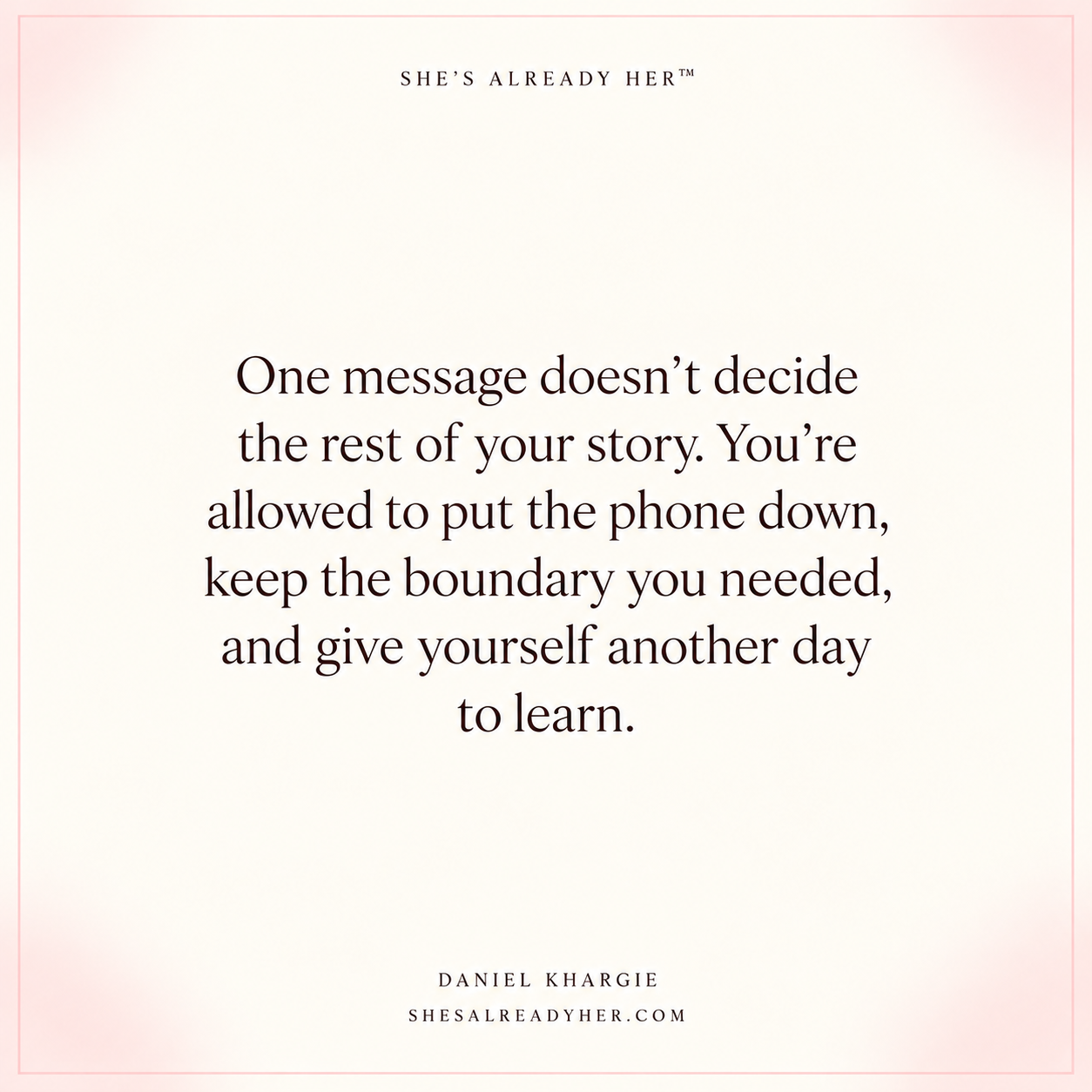
Read this quote as text
One message doesn’t decide the rest of your story. You’re allowed to put the phone down, keep the boundary you needed, and give yourself another day to learn.
9. Make a contact boundary you can actually follow.
If no contact after a breakup is still what you want, decide what that means for you now. Will you stop initiating personal messages? Mute or archive the conversation? Stop checking his social media? Tell a trusted friend before you reach out again? Choose the things that help you keep the distance you decided you needed.
If he has clearly asked for no contact, that means leaving him alone too. Don’t treat missing him, a holiday, or a difficult night as permission to get around his boundary.
If you share children, work, money, or belongings, some contact may be necessary. Keep those messages factual and limited to the task: ‘Pickup is at four on Friday. Please confirm.’ You don’t need to attach a conversation about whether he misses you to an arrangement about the children.
Replying to a necessary question doesn’t mean you must reopen personal contact. Equally, calling a personal message ‘about the kids’ doesn’t make it a practical necessity. Be honest about what the message is for. A boundary that accounts for your real life will be more useful than a rule you have to pretend you can follow.
10. Give tomorrow a plan before tonight gets harder.
Decide what you’ll do if he replies later. You might choose to leave a personal message unread until morning, or read it when you have time to think. Decide what you’ll do if he doesn’t reply too. Otherwise, you may wake up and begin the whole day by checking for an answer.
Have something small waiting for you that belongs to your life. Breakfast before you open his thread. A walk with a friend. The errand you kept putting off. You don’t need an impressive new routine by tomorrow. You need a next step that isn’t waiting for him.
If you count no-contact days, you can decide how to record this honestly. You sent a message. The days before it still happened, and whatever you learned during them still belongs to you. Don’t use the count as a reason to throw away the boundary now.
You haven’t lost your right to make a different choice because you struggled with the last one. Tonight, that choice may be as simple as leaving the conversation where it is, charging the phone away from your bed, and letting yourself rest.
When you need somewhere to go before you text again
My The Don’t Text Him SOS Pack Book + Guide is for the moment you want to reach out, answer, or keep checking. You can use it even if you have already sent the message.

The 102-page digital Book + Guide includes 10 chapters, the 20-Minute SOS Reset, a dedicated “Don’t Text Him — Open This Instead” section, and a 24-hour reset plan. It gives you something to work through when your hand keeps reaching for the phone.
Questions about breaking no contact
What does ‘broke no contact’ mean?
It usually means someone resumed communication after a period of deliberately not communicating. The details depend on the boundary you had. Sending a personal text might break that boundary; necessary communication about shared children may be part of an agreed arrangement. Either way, one message doesn’t automatically mean you are back together.
I broke no contact and my ex ignored my text. Should I send another?
You don’t need to follow an unanswered personal text with another one to get reassurance or an explanation. Leave the thread alone and respect his lack of engagement. If there is a necessary practical issue, use the appropriate agreed channel and keep it limited to that issue.
Should I break no contact again to explain why I texted?
You don’t have to send another message to explain an uncomfortable feeling. Write the explanation privately first. If a conversation is ongoing, a brief, honest ending may be useful. If he has asked you not to contact him, respect that request and stop.
How long should no contact last after I text him?
One text doesn’t establish a universal number of days you now have to complete. Return to the reason you wanted distance and decide what boundary fits your circumstances, including necessary responsibilities. You don’t owe him a new conversation when a countdown ends.
Does no contact work if I already broke it?
You can choose distance again after reaching out. If your purpose is to stop reopening a painful conversation, the next decision can support that purpose. No contact cannot guarantee that he will miss you, change, or return. His reaction is not something a perfect streak can control.
You’re still learning to live without him
You’re still learning to live without him. That includes learning what to do with the evenings, the little updates, and the moments when your hand reaches for the phone before you’ve thought it through.
You can wish you hadn’t sent that message without turning against yourself for sending it. You can miss him without making plans to see him. You can hear back and still decide you need distance.
Put the phone down for a little while. Do the next thing your day needs from you. The text has already been sent. What happens next is still something you get to choose.