
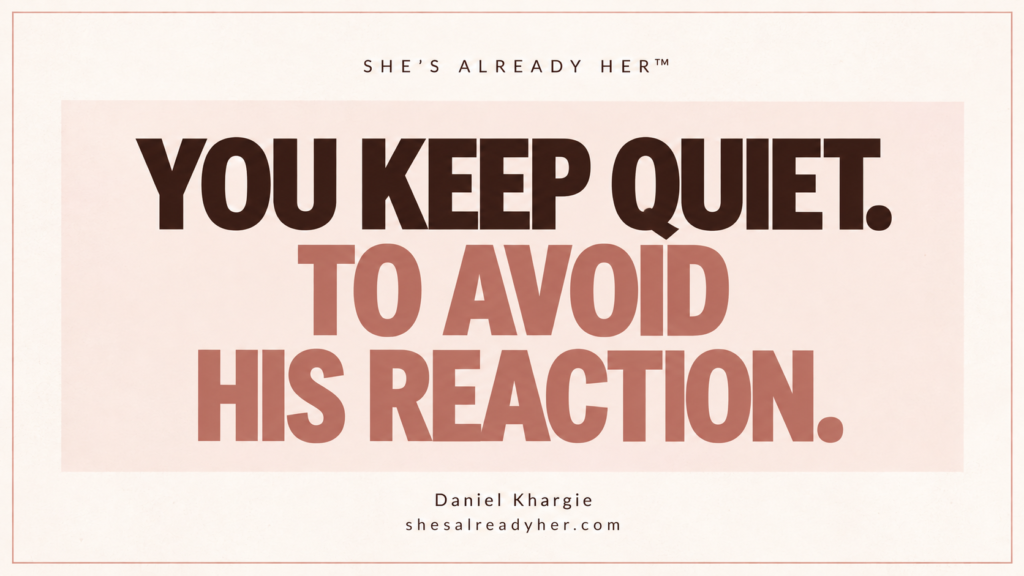
He doesn’t get to keep making you afraid of his reaction, then complain that you don’t tell him anything anymore.
You still have things to say. You still have needs. You still notice what hurts. You’re just tired of thinking about everything that might come after you bring it up.
Will he turn it into an argument? Make it your fault? Keep going until you’re the one apologizing for having a concern?
Walking on eggshells in a relationship can leave you thinking about his reaction before you’ve even finished deciding what you need to say. You make the request smaller. You leave part of it out. Sometimes you decide you’ll deal with it yourself.
And then he gets to say everything has been fine, because he hasn’t had to hear what you’ve been keeping in.
But less arguing doesn’t automatically mean you’re doing better together. What changed? Did he start hearing you differently, or did you stop giving him anything he could react to?
You shouldn’t have to keep making less room for yourself just to get through an ordinary conversation with your man.
You know what you want to say. You’re worried about what comes after it.
Being afraid to speak up doesn’t mean you have nothing worth saying. You can know exactly what hurt and still hesitate because you remember how he responded before.
You start checking your wording before you’ve even opened your mouth. Is it too direct? Too emotional? Will he hear the concern, or decide that bringing it up means you’re attacking him?
Look at how much work you’re doing before he has had to do anything with what you need.
Choosing your words with care is one thing. Feeling responsible for finding the exact words that will prevent his anger is another. You can speak respectfully without having control over how he chooses to respond.
Your need doesn’t become unreasonable because you haven’t found a way to raise it that he likes.
Giving him time should not mean your concern disappears.
You can understand that a conversation needs another time. What matters is whether there is actually another time, and whether he helps make room for it.
If you keep waiting and the conversation never happens, all that waiting is costing you something. You’re still carrying the hurt. You’re still adjusting around a problem he hasn’t addressed.
You don’t have to pretend that having no argument is the same as having an answer.
You can be considerate of what he’s dealing with and still need him to consider what you’re dealing with too. Your life doesn’t stop counting because his mood is difficult.
He cannot keep asking you to wait for a better moment while treating every moment you choose as another thing you did wrong.
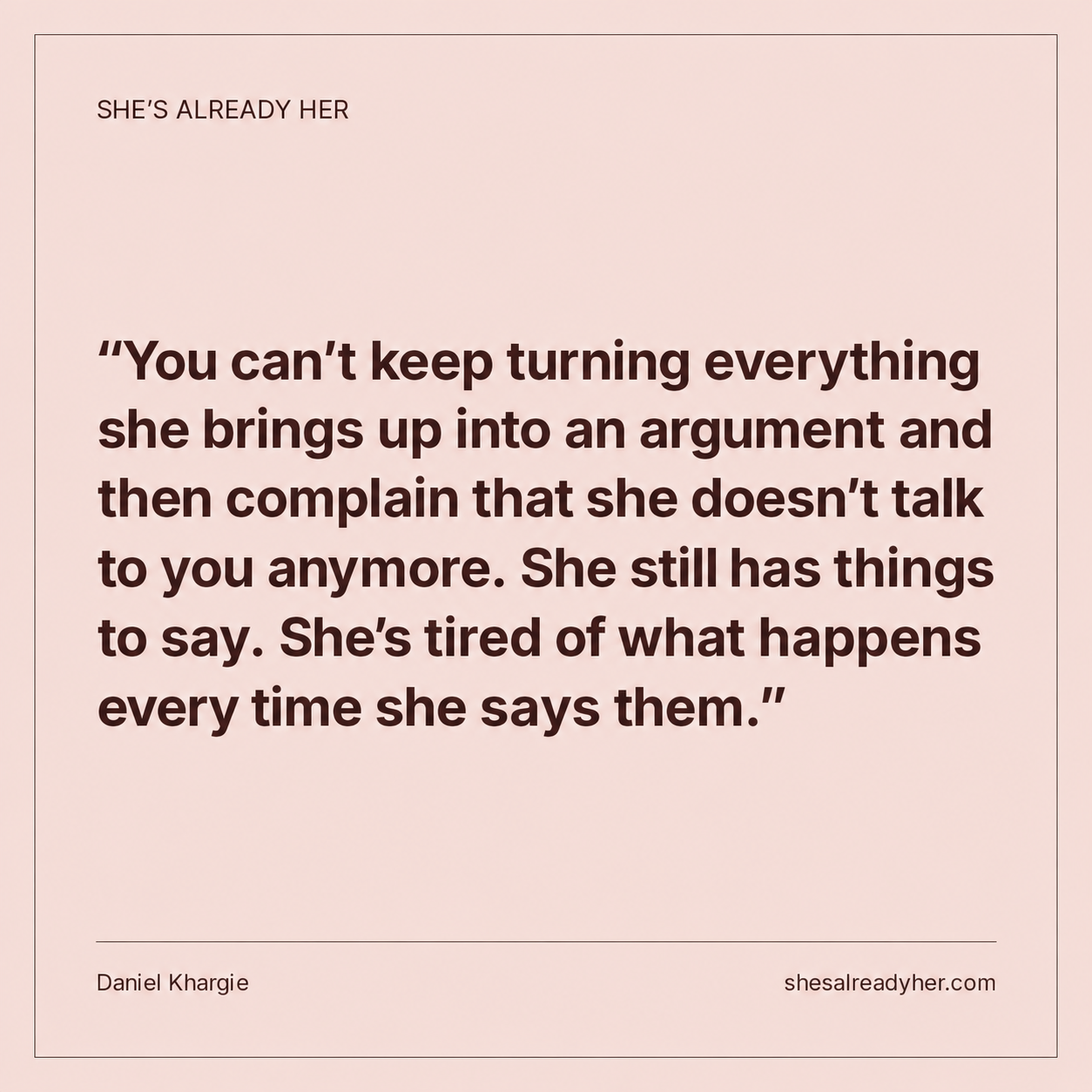
Read this quote as text
You can’t keep turning everything she brings up into an argument and then complain that she doesn’t talk to you anymore. She still has things to say. She’s tired of what happens every time she says them.
If you’re afraid of him, another perfect sentence is not the answer.
If speaking up has led to threats, intimidation, humiliation, or fear of what he might do, this needs more than a new communication technique.
The National Domestic Violence Hotline explains how threats, monitoring, and intimidation can be forms of emotional abuse. You don’t have to wait for physical violence before asking for support.
You also don’t have to confront him, announce a boundary, or show him what you’ve written to prove the concern is serious. If you fear his reaction, start with private support from someone trained to help.
Use a safer device or contact method when possible if your activity may be monitored. Private browsing does not guarantee privacy. In immediate danger, seek emergency help when safe to access it.
You deserve help that takes your circumstances seriously. Looking bold to somebody outside the relationship is not more important than your safety.
Saying sorry to end his reaction doesn’t mean your concern was wrong.
You can find yourself apologizing because you want the tension to stop. You’re exhausted. You don’t want to keep defending why you said anything.
But afterward, the concern is still there. You haven’t stopped needing help, respect, or an answer. You’ve just spent another conversation trying to make the reaction end.
Avoiding conflict may have helped you get through the moment. You don’t need to blame yourself for responding to what was happening around you.
If you regret a specific thing you said, you can own it. That does not require taking responsibility for his threats, insults, or choices.
And if going along with him has helped you stay safer, you don’t need to suddenly stop because an article tells you to be firmer. Get private support with what is realistic for you.
You shouldn’t have to prove you’re not attacking him before he hears you.
You’re allowed to bring up something that affects you. You don’t need to begin by explaining that you love him, listing everything he does well, and promising you aren’t trying to make his life difficult.
You can care about how you speak without making yourself responsible for removing every uncomfortable feeling from the conversation.
When disagreement is safe, one clear concern can give both of you something to answer. He can ask about what he doesn’t understand. He can explain his view. Your concern still needs room.
But if every attempt ends with you defending your right to speak, another explanation may not be what is missing.
You cannot keep doing all the work of making a conversation possible while he keeps deciding that having the conversation is the problem.

Read this quote as text
You say she makes everything difficult, but look at how careful that woman has to be just to tell you what hurt her. She’s not trying to start an argument. She’s trying to get you to hear her.
He can dislike your answer without making you afraid to have one.
You can say something he doesn’t want to hear and still deserve respect afterward.
His disappointment does not give him permission to humiliate you, threaten you, or pressure you until your answer changes. You don’t have to keep agreeing with him to avoid being treated badly.
You can listen to what he feels without accepting that his feelings decide what you’re allowed to need.
Notice whether there’s room for your answer to remain yours. Does he hear it and work through the disagreement? Or does the conversation only end when you take it back?
If you’re afraid of what happens when you disagree, you don’t owe him another demonstration. Tell someone who can help what has been happening. You do not need to stay in a frightening exchange to prove you were being reasonable.
He calls it better because he doesn’t hear what you’re still carrying.
Maybe the arguments have become less frequent. You can notice that and still ask why.
Has he changed how he responds? Are concerns actually getting addressed? Or have you started handling everything alone because asking him feels like more work than doing it yourself?
Your silence doesn’t complete an unfinished conversation. It doesn’t mean the comment stopped hurting or the responsibility stopped landing on you.
If he keeps dismissing what you feel, you may have started keeping more to yourself because explaining has become exhausting. That deserves attention, even if he likes having fewer complaints to hear.
He may miss how open you used to be. But you don’t owe an immediate return to that openness while you’re still worried about what he’ll do with it.
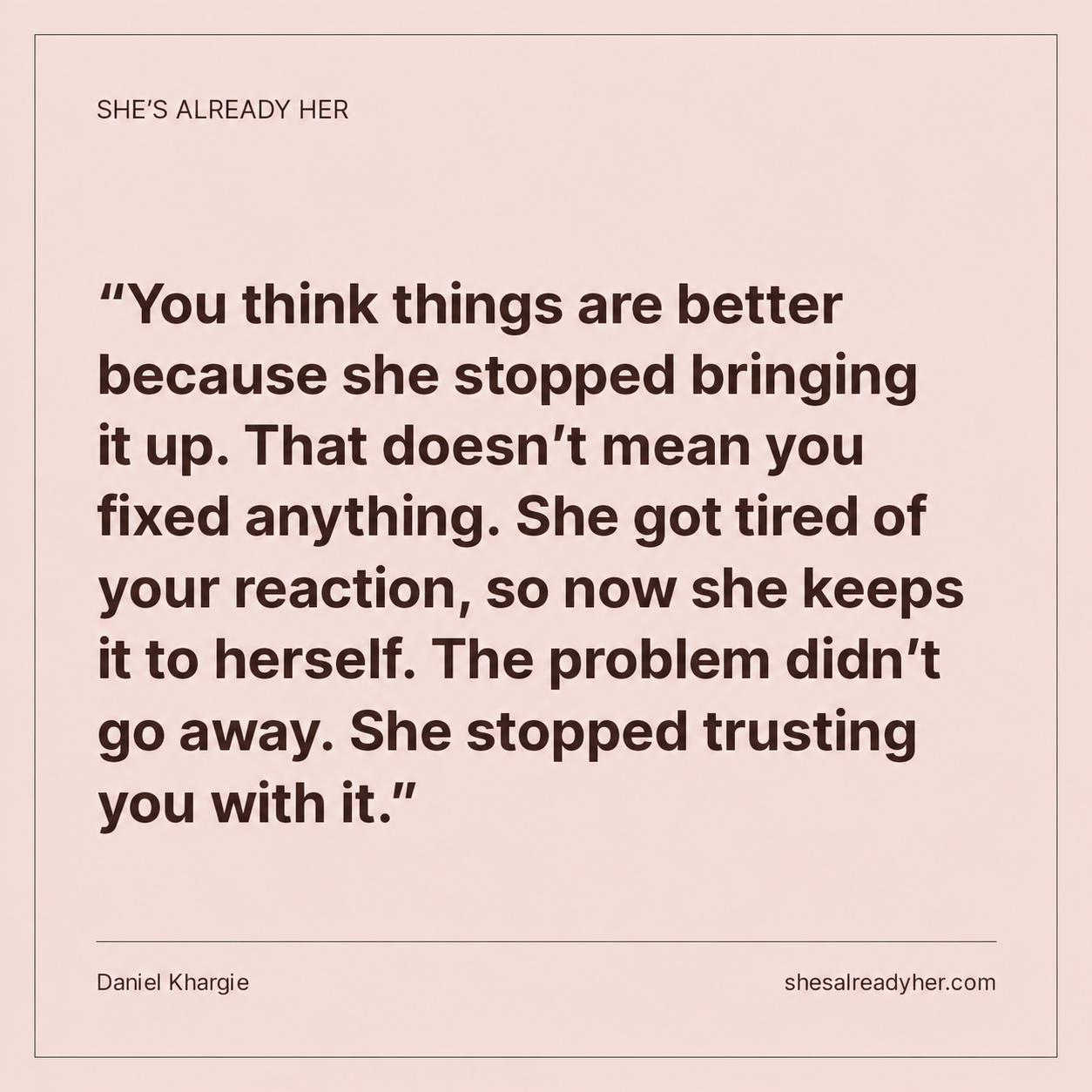
Read this quote as text
You think things are better because she stopped bringing it up. That doesn’t mean you fixed anything. She got tired of your reaction, so now she keeps it to herself. The problem didn’t go away. She stopped trusting you with it.
An apology needs more behind it than wanting you to relax around him.
You may want to believe him when he says he never meant for you to feel this way. You may still love him and want the relationship to feel different.
That doesn’t mean you have to decide everything is okay because he sounds sorry today.
Look for responsibility for specific behavior, rather than another explanation of how you made him react. Does he respect your space? Does he accept that your concern needs an answer? Does he seek appropriate help for conduct he recognizes he needs to change?
An apology alone does not establish safety or lasting change. Where intimidation or control may be involved, get support beyond his promises.
You don’t have to expose yourself to another reaction to collect proof. What has already happened matters. His wish for you to trust him does not make trust something you owe on demand.
You deserve support that doesn’t depend on his mood.
You can have a private conversation before you know what you’re going to do about the relationship.
Tell a trusted person, qualified professional, or domestic abuse advocate what happens when you disagree and what you’re afraid might follow. You don’t have to make it sound like ordinary arguing if that leaves out the part that frightens you.
You can also acknowledge how tired you are. If you’re emotionally drained, you don’t have to put that aside until every practical question is settled.
For more on private support and safer next steps when you fear harm, read Feeling Unsafe in a Relationship. You don’t need his permission to ask for help.
He wants you to be yourself around him. Then he needs to take responsibility for the reactions that keep making you careful. You making yourself smaller is not him treating you better.
Questions you may still be asking
What does walking on eggshells mean?
It describes repeatedly changing what you say or do because you are worried about another person’s response. In this relationship, it may look like checking his mood, reducing a request, or holding back a concern. The phrase describes an experience, not a diagnosis. Consideration still leaves room for your needs; fear of retaliation calls for private support rather than a communication test.
Why am I afraid of confrontation?
Several things can contribute, including previous experiences and what has happened when you disagreed with this partner. An article cannot establish the cause for you. Look at what you expect and what he has actually done, rather than assuming the fear proves something is wrong with you. You do not have to force a confrontation to prove you are strong. If you fear harm, seek private support.
Why do I avoid conflict?
You may be trying to avoid another exhausting argument, blame, or a reaction that has frightened you before. That can leave concerns unresolved while helping you get through a difficult moment. It is useful to examine what you stop saying and what you need support with. This is not a judgment of how you have coped. Where retaliation is a concern, individualized safety support comes before practicing assertiveness.
What is healthy conflict?
It is disagreement where both partners can express concerns, ask questions, and work toward an answer without threats, humiliation, or punishment for disagreeing. A pause should include a realistic way to return to the concern. Understanding does not require identical opinions. Fewer arguments are not enough to establish improvement if one partner has stopped speaking because they fear the response.
How to deal with confrontation?
First consider whether disagreement is safe in your situation. Where it is, you can discuss one specific issue, seek a clear answer, and agree on a break and return time if needed. You cannot guarantee another person’s response by choosing perfect words. If you fear threats, control, or retaliation, seek private help from a domestic abuse advocate rather than confronting him or testing a boundary.