
Your healing shouldn’t become his excuse to leave you alone with the pain he caused.
You know you have to take care of yourself. You know he can’t climb inside your mind and make every hurt disappear. But that doesn’t explain why the man who helped create the hurt now acts like caring about it is asking too much of him.
He wants things to feel good again. He wants your affection, your patience, the way you used to look at him. Meanwhile, you’re still trying to understand how something he admitted doing became something you’re expected to deal with by yourself.
That’s the part of a lack of accountability in relationships I want to talk to you about. What happens after the argument. After the apology. After he says he knows he hurt you.
Because knowing you hurt somebody should mean something in how you treat them afterward.
Your healing belongs to you. His actions still belong to him. If he wants to keep building a relationship with you, there has to be some interest in what those actions did and what he needs to handle differently. You shouldn’t be the only person dealing with what happened while he waits for you to become easier to love again.
Admitting he hurt you doesn’t finish his part
You may have waited a long time to hear him finally say it.
He acknowledges that he lied. He admits the way he spoke was disrespectful. He agrees that he let you down when you were counting on him. For a moment, you feel relief because at least you’re no longer trying to prove the thing happened.
Then the next day comes, and you’re still hurt.
That doesn’t automatically mean you rejected his apology. It means the effect didn’t disappear when he found the words to acknowledge it.
Maybe you’re more careful about depending on him now. Maybe affection doesn’t come as easily because something between you still feels unsettled. Maybe you want to talk about what needs to change before you pretend the two of you are back where you were.
There should be room for that conversation.
Accountability in a relationship includes what he does with the fact that he hurt you. Can he listen without treating your continued hurt as an insult to his apology? Does he ask what still needs attention? Does he take the agreement seriously when you’re no longer standing there asking him to?
An admission can be a beginning. You still get to look at what comes after it.
You can accept an apology and still need something different
Sis, you don’t have to decide that he was lying when he apologized just because you still need to see a change.
A genuine apology can matter. He may have meant every word. You may believe that he felt bad about what happened.
But what are you supposed to do with that belief if the same thing keeps happening?
You can appreciate that he apologized and still need him to stop insulting you when he’s frustrated. You can hear that he regrets breaking an agreement and still need an agreement you can actually rely on. You can care about his regret without making it the reason you stop asking what he’ll do differently.
Think about an ordinary example. He shared something private after you asked him to keep it between the two of you. He apologizes. You don’t need him to spend every day announcing how terrible he feels. You need him to take your privacy seriously, address what he can with the person he told, and stop repeating private things.
Those are things an apology alone can’t do.
The conversation may be uncomfortable for him. That doesn’t make the change unfair to ask for. You’re living with what happened, too.
If the part you’re stuck on is whether his explanation leaves room for him to own his choice, read about his reasons versus the part he’s responsible for. Here, I want you to stay with what he does after that part is acknowledged.

Read this quote as text
You don’t get to hurt her and call the healing her problem. That woman is asking you to care about what your actions left behind.
Your feelings shouldn’t have to disappear before he shows care
Some women start trying to recover quietly because talking about the hurt seems to upset the man who caused it.
You don’t want another difficult evening. You don’t want to hear that you’re going backward. So you try to make yourself seem okay before you are.
You laugh with him. You go along with the plans. You tell yourself it’s been long enough and you should be able to enjoy things again.
But when you’re alone, the hurt is still there.
There can be good moments while something remains unresolved. You don’t have to ruin every good moment to prove you’re hurting. You also don’t have to perform being fine so he never has to notice that something still needs attention.
It’s reasonable for both of you to need rest from a hard conversation. Nobody has to be available for the same discussion every minute of the day. But there’s a difference between agreeing on a time to return to it and treating every return as something you should have stopped needing.
Look at whether there is ever room for the hurt. Does he make time? Can he hear what remains difficult? Or does the relationship only feel peaceful when you make sure none of it reaches him?
If every attempt to discuss it gets called starting a fight, there’s more about speaking up without making yourself the whole problem. The question here is whether he stays involved after the conversation ends, too.
Taking care of yourself doesn’t do his part for him
You can reach out to somebody you trust. You can get support, take time to think, rest, and make choices that help you feel more like yourself. You don’t need his permission to begin any of that.
And none of it makes his conduct your responsibility.
This is where emotional responsibility needs to be understood clearly. You’re responsible for how you treat people and for seeking the care you need. He’s responsible for his behavior and for what he chooses to do after understanding its effect on you.
Your healing isn’t something he can complete for you. Addressing his repeated conduct isn’t something your healing can complete for him.
You could understand yourself better, communicate more clearly, and feel stronger than you have in years. That still wouldn’t turn a broken agreement into a kept one. It wouldn’t make his next choice for him.
So don’t measure your progress only by whether you can tolerate the same situation with less visible pain.
Sometimes feeling stronger helps you recognize that you don’t want to keep living this way. Sometimes it helps you name what you need before deciding whether you want to continue. You’re allowed to learn something about the relationship while you’re taking care of yourself.
And you don’t have to heal beside him. Support can come from people and places outside this relationship. Your next step doesn’t have to wait for him to become willing.
Look at the part he actually takes on
If you want to understand how to take accountability in a relationship, look beyond whether somebody can say the right sentence.
What does he do once he knows what happened and how it affected you?
Maybe he stops making commitments he hasn’t thought through. Maybe he corrects something untrue he told somebody about you. Maybe he returns to the subject himself because he knows you were still trying to talk about it.
The response needs to fit the actual hurt. Buying something nice doesn’t automatically address a pattern of dismissing you. Being affectionate for an evening doesn’t settle an agreement he keeps breaking.
Relationship repair needs some connection to what went wrong.
You can tell him what would help. He can ask questions. The two of you may need to work out what is reasonable and possible. That doesn’t mean you have to agree to every request he makes, or that he has to agree to every request you make. It means the discussion should include the actual problem and both people’s choices.
Then there needs to be follow-through.
You shouldn’t have to keep finding new ways to explain that your privacy matters after he already agreed it did. You shouldn’t have to keep making your hurt sound serious enough to deserve the change he said he understood.
If you’re doing all the teaching, reminding, and checking, read about being made responsible for his growing up. His participation has to include something he takes on himself.
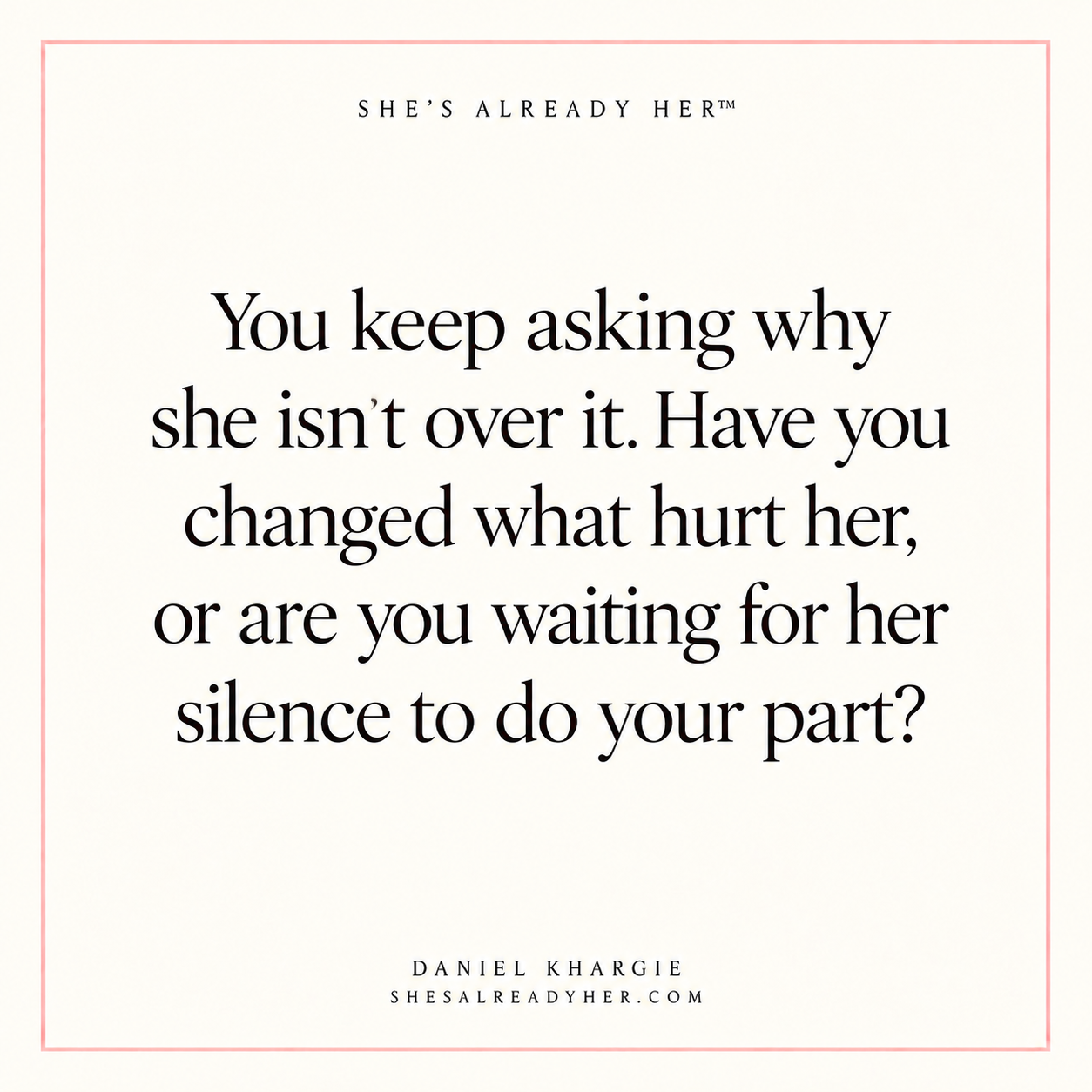
Read this quote as text
You keep asking why she isn’t over it. Have you changed what hurt her, or are you waiting for her silence to do your part?
Feeling bad for him can leave your hurt waiting again
He may feel ashamed about what he did. He may be upset with himself. You may care about that because, even while you’re hurting, you still care about him.
There’s nothing wrong with having compassion.
Just notice whether you end up spending the whole conversation reassuring him while the effect on you gets put away.
Now you’re telling him he’s not a terrible man. You’re reminding him of the good things he does. You’re making sure he knows you still love him. And the next time you need to discuss what happened, you’re afraid you’ll put him back in that place.
His feelings can be real. Your hurt can be real at the same time.
You don’t have to prove he’s pretending before you can say there’s still something that needs attention. You can care that he regrets it and ask what he’ll do with that regret.
One awkward conversation doesn’t tell you everything about his willingness. He might need time to collect himself. Look at whether he comes back, listens, and participates after that time. A pause can make room for a better response. Repeatedly disappearing from the issue leaves you with the same unanswered hurt.
You get to consider what keeps happening after the promise
One thoughtful conversation can give you hope. You don’t have to punish yourself for feeling it.
Give yourself room to notice what happens afterward, too.
Does the change last beyond the next good weekend? When something goes wrong, can he acknowledge it without making you start the whole explanation again? Is he making different choices when he isn’t worried about losing you that day?
You’re looking at the relationship you’re living in, not trying to catch him failing.
Real effort can include mistakes. You don’t need perfection to recognize a difference. But you should be able to describe what is different besides how convincing the last conversation sounded.
And if nothing changes, that deserves an honest answer from you about what you want next. You don’t have to keep offering another chance simply because he finally sounds sorry in a way you haven’t heard before.
His willingness to participate is information. So is his repeated refusal. Neither one means you have to decide your whole future tonight, but you don’t have to keep treating your own experience like it doesn’t count.
If talking about the hurt brings threats, intimidation, monitoring, or fear of what he’ll do, put private support and safety ahead of another conversation with him. You don’t owe a confrontation before you can ask for help.

Read this quote as text
You want the woman she was before you hurt her. Start looking at what you keep doing instead of blaming her for needing something different.
You’re allowed to need care after he says he’s sorry
You can love that man and still be tired of feeling alone whenever his actions leave you hurting.
You aren’t asking him to live in guilt forever. You aren’t asking for a life where nobody makes mistakes. You’re asking whether the person who wants a place in your life is willing to care about what his choices have done to it.
That question deserves more than another reminder that healing is your responsibility.
Yes, take care of yourself. Get support. Look honestly at your own conduct. If you said or did something hurtful, own that specific thing. Being hurt doesn’t make every reaction okay.
Then leave his part where it belongs.
You don’t have to keep becoming more patient with something he keeps refusing to address. You don’t have to return to the same level of closeness before you’re ready just to reassure him that his apology worked.
He wants the relationship to feel different. What is he doing differently within it?
That’s something you’re allowed to look at. Your healing matters too much to keep making room for his apology while leaving no room for what comes after it.
Frequently asked questions
What is accountability after your actions have hurt your partner?
It means acknowledging your actual conduct, considering its effect, and addressing what you reasonably can. That might include changing a repeated behavior, keeping a specific agreement, or returning to an unfinished discussion. It doesn’t mean accepting every accusation or taking responsibility for all of somebody else’s feelings. An admission matters, but what you do afterward matters too.
Why is accountability important when the original argument is over?
The argument ending doesn’t necessarily mean the effect has ended. A broken agreement may still affect what somebody can rely on. A private matter shared with others may still need attention. Accountability gives both people a way to address what remains instead of expecting the hurt person to make everything feel normal by themselves.
Guilt vs remorse: does feeling bad mean he is helping make things right?
People use these words in overlapping ways. Both can describe painful feelings about something you’ve done; neither proves that you are addressing its effect. You can’t know his private feelings just from an apology. Look at whether he listens, acknowledges what is his, and follows through. Feeling bad can be sincere while the practical work is still unfinished.
How to take accountability in a relationship after hurting your partner?
Be specific about what you did, hear how it affected the other person, and discuss what you can change or address. Follow through without making them responsible for your willingness. You can ask questions or clarify something you remember differently. You still need to handle your own conduct. Each adult can own their part without carrying the other person’s too.
What does a genuine apology mean if the same hurt keeps happening?
An apology may express real regret. Repeated hurt still needs attention, even when that regret is sincere. Consider whether the conduct changes, agreements become dependable, and the person takes part without being chased. You don’t have to prove the apology was fake before deciding that the repeated behavior is something you can’t keep accepting.