

“I didn’t mean it” still leaves you dealing with what happened.
Maybe you believe him. Maybe that’s the part making this so hard. You don’t think he sat there planning to make you question yourself, but you keep leaving conversations unsure whether you can trust what you heard.
So now you’re searching for unintentional gaslighting, trying to understand whether the way he treats your memory could be harmful even if he says hurting you was never his intention.
Here’s where I want you to put your attention: what happens after he understands the concern? Can he hear that his response left you doubting yourself? Can he consider that he got something wrong? Does anything change the next time you disagree?
You don’t have to decide what was in his head before you can look at what’s happening between you.
What the word “unintentional” can and cannot tell you
Gaslighting describes a pattern that undermines someone’s trust in their perception, memory or judgment. Cleveland Clinic explains that someone engaging in it may not recognize what they’re doing. That possibility matters. It does not tell you whether this particular man is unaware.
And a painful disagreement isn’t automatically gaslighting. He can misremember a conversation. You can misremember one, too. Neither of you has to pretend every detail is certain to treat the other person with respect.
When people discuss gaslighting in relationships, the important distinction is the repeated undermining of someone’s ability to understand their experience. One person remembering dinner plans differently doesn’t establish that pattern.
The word “unintentional” also cannot do the work of an explanation. Did he misunderstand the concern? Did he assume his recollection had to be right? Is he willing to reconsider that assumption? Those are things a conversation may help clarify, if it’s safe to have one.
But “I didn’t mean to make you feel that way” doesn’t answer all of them. It tells you what he says about his intention. You still have a concern about how he responded to you.
If you’re still trying to identify the overall pattern, this article about recognizing gaslighting gives that question more room. Here, we’re looking at what follows his explanation that he didn’t mean it.
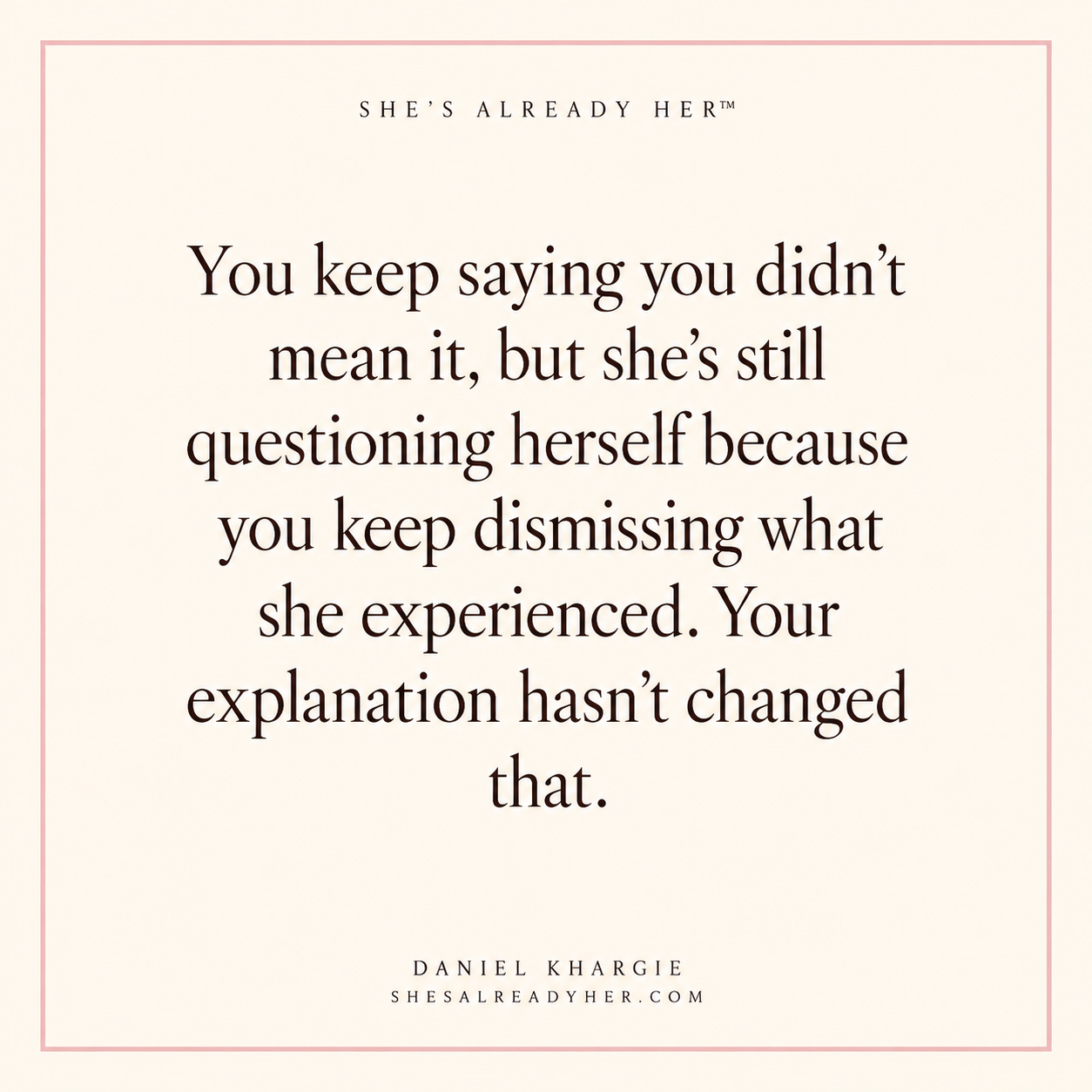
Read this quote as text
You keep saying you didn’t mean it, but she’s still questioning herself because you keep dismissing what she experienced. Your explanation hasn’t changed that.
Can he hear the impact without requiring you to accuse him?
You may be trying so hard to make him understand that you don’t think he’s a terrible person. You soften every sentence. You remind him you know he loves you. Before you get to what happened, you’ve already spent ten minutes making sure he doesn’t feel judged.
And still, your concern gets heard as an accusation about his whole character.
Listen, you can care about how you speak to him. You can correct an unfair accusation. But there needs to be room for “this is what your response did to the conversation” without it becoming a trial about whether you think he’s a bad man.
He can explain what he meant and hear how he came across. Those things can happen in the same conversation.
For example, he might say, “I wasn’t trying to make you question yourself. I can hear that telling you that you always misunderstand shut the conversation down.” That’s an illustrative response, not a script he has to memorize. What matters is that he can name his part without making you withdraw yours.
You aren’t asking him to accept every interpretation as fact. You’re asking whether your account can be considered without your ability to understand being put down.
Taking responsibility includes leaving room to be corrected
Taking responsibility here starts with something quite ordinary: he can be mistaken without making you unreliable.
Maybe he was certain he had told you about a change of plans. After listening, he realizes he mentioned it to somebody else. Can he acknowledge that? Can the correction stand without another argument about why you should have guessed?
Or maybe you never settle the exact wording. He can still recognize that he talked over you, mocked your concern or treated his memory as the only account worth hearing. Agreement about every detail isn’t required for him to own conduct he can recognize.
A more useful response might be, “I still remember that part differently, but I shouldn’t have said you invent things. I want to hear what you understood.” Again, this is an illustration of making room for clarification, not proof that the relationship is repaired.
Being open to correction needs to go both ways. Being treated as incapable of knowing anything does not.
That means you can acknowledge when you got a detail wrong. It also means that one mistake doesn’t become the reason every future concern of yours gets dismissed.
If his response keeps turning into a complaint about what you did instead, this article about blame shifting addresses that pattern. You don’t have to settle both people’s concerns in one breath for either concern to matter.

Read this quote as text
You want her to accept that you meant no harm, while she’s still afraid to speak. Look at what your responses have taught that woman.
An apology without change leaves the same problem waiting for you
An apology can matter. I’m not asking you to dismiss it because it didn’t sound perfect or because you still feel hurt afterward.
But an apology without change leaves you wondering what you’re supposed to do with the next conversation. He says he understands, and then the next time you remember something differently, he returns to telling you that you make things up.
Now you’re having the same discussion about his intentions again. You’re explaining that you didn’t call him evil. He’s explaining that he loves you. Somewhere in all of that, the way he responds to your recollection still hasn’t received attention.
So look at the specific conduct the apology was meant to address. Can you disagree without that insult returning? If he catches himself dismissing you, does he correct it without waiting for you to drag the acknowledgment out of him? Is there more room for both of you to say, “I’m not sure; let’s clarify”?
There’s no number of good conversations that automatically proves lasting change. One difficult conversation doesn’t erase every effort, either. You’re considering what keeps happening, how he responds when he gets something wrong, and whether you have more freedom to speak over time.
You don’t owe immediate trust because he found better words. And you don’t have to promise to stay while he works on something that is still hurting you.
You can listen to his explanation without becoming responsible for his progress
Maybe he says he learned to get defensive in his family. Maybe he admits he struggles to be wrong. You can hear that and still have a concern about what happens when you question his account.
An explanation can give you context. It doesn’t assign you the job of catching every dismissive response, preparing a lesson about it and checking whether he understood.
You can tell him what concerned you, if you choose and it’s safe. What he does with that information belongs to him. He can seek help and work on how he responds without making your continued patience the condition for starting.
If you’re already exhausted from being the person who has to explain and remind him of everything, read about being made responsible for his emotional growth. That’s a larger issue than finding one clearer way to describe your concern.
For this situation, stay with a simpler question: after he says he understands, are you seeing a different response when your account doesn’t match his?

Read this quote as text
You don’t get to dismiss her memory and expect trust to return with an apology. She’s watching whether you can hear her without doing it again.
You don’t have to settle his intent before choosing support
You might never get an admission that explains the whole pattern. He may say he didn’t mean it, and you may remain unsure. That uncertainty doesn’t require you to dismiss what you can describe.
You can say, “We remembered something differently. He told me I invent things. When I tried to clarify, he dismissed my whole account.” That gives a trusted person or qualified professional something concrete to help you think through. You don’t need a diagnosis or a perfectly certain label to ask for that support.
If there are threats, monitoring, intimidation or fear of retaliation, prioritize private support before confronting him or gathering evidence. You don’t have to record conversations, search his devices or keep notes he could find. The National Domestic Violence Hotline offers information and support options for people experiencing relationship abuse.
You can also decide that you don’t want to continue a conversation where you’re being insulted, if ending it is safe. You don’t have to convince him of the word “gaslighting” before noticing that the discussion has become harmful.
His intention may remain uncertain. The way you’re being treated still deserves attention.
Questions you may still have
Can gaslighting be unintentional?
Cleveland Clinic describes gaslighting as conduct the person may not recognize. But a claim of good intentions doesn’t establish that a particular pattern is unintentional, and an honest difference in memory isn’t automatically gaslighting. Look at the repeated conduct and whether clarification is possible. You can acknowledge uncertainty about his intentions while still addressing responses that undermine your confidence in your own judgment.
Do gaslighters know they are gaslighting?
Awareness can vary; you can’t establish it from “I didn’t mean it” alone. For your own decisions, consider what you can observe after the concern is made clear: whether he considers corrections, acknowledges dismissive conduct and responds differently. Those observations don’t let you read his mind, but they give you more to consider than a debate about whether he thinks of himself as someone who would cause harm.
Does “I didn’t mean it” make it a fake apology?
Those words alone don’t prove a fake apology. Someone can explain their intention and still acknowledge what they did. What matters here is whether his explanation leaves room for responsibility, or ends the discussion before your concern is heard. An apology can also be sincere and still fail to lead to change. You don’t have to prove insincerity before deciding that the same repeated conduct remains a problem.
What does lack of accountability in relationships look like after he says he didn’t mean it?
In this context, it can look like treating his lack of intent as the end of the issue: he won’t consider what he said, expects you to retract the concern, or repeats the same dismissive response without addressing it. A clumsy first response isn’t enough to establish the whole pattern. Consider whether he becomes willing to hear you and take responsibility, without making you manage that process for him.
How to deal with gaslighting when he insists it is unintentional?
You don’t need to force an admission about intent. If safe, describe the specific response that concerned you and notice whether clarification is allowed. Seek support that helps you consider your experience and options without requiring a label first. If you fear his reaction, prioritize private support over confrontation. For a fuller discussion of responding, read about gaslighting in a relationship.