

You don’t have to talk yourself out of every good thing you’ve done.
You put the time in. You followed through. You did something that mattered to you. And before you can even enjoy it, you’re already explaining why it wasn’t that big a deal.
Someone else has done more. You had help. You could have done it sooner. There’s still so much left to work on. Somehow, every reason to give yourself a little credit turns into another reason to take it back.
I want you to notice how hard you’re working to make your own effort disappear.
Learning how to be proud of yourself doesn’t mean convincing everybody you’re amazing. It can start with letting something you did actually count. Without shrinking it before anybody gets a chance to hear it. Without deciding that feeling good for a minute makes you full of yourself.
You can be honest about where you still want to grow and honest about what you’ve already done. There is room for both.
You did the work. Let yourself say that.
Sometimes you don’t need a bigger accomplishment. You need to stop changing the rules every time you reach something you were working toward.
Before you finished, it mattered. You wanted to get through that course, speak up in that meeting, finish the application, or finally do the thing you kept putting off. Then you did it, and suddenly it became something anybody could have done.
But anybody didn’t do your part. You did.
That doesn’t make you better than everybody. It means the time and effort you put in belonged to you. You’re allowed to acknowledge that without turning it into a competition.
Self appreciation can be that plain. You don’t have to give yourself a speech you don’t believe. You can simply name what happened: you prepared, you asked for help when you needed it, and you followed through.
Maybe the thing you’re proud of wouldn’t impress a room full of strangers. It can still matter in your life. You know what it took to make that appointment, finish that first piece of work, or try again after being disappointed.
And please hear this too: you don’t need a list of impressive things to deserve kindness. Your accomplishments are something you get to appreciate. They are not an entrance fee for being treated well.

Read this quote as text
You don’t get to call her full of herself for acknowledging the work she did. Giving herself credit doesn’t take anything away from you.
Having help doesn’t mean you contributed nothing
There’s nothing wrong with thanking the people who helped you. Gratitude doesn’t automatically mean you’re putting yourself down.
The question is whether you leave yourself anywhere in the story.
Here’s an example. You finish a project with support from a friend. She helped you understand a difficult part, and you’re grateful. You can say that. You can also acknowledge the evenings you spent working, the questions you asked, and the part you completed yourself.
You don’t have to choose between appreciating her and appreciating you.
The same goes for opportunity and luck. Sometimes the timing helped. Sometimes you had access to something other people didn’t. Be honest about that. Honesty includes your advantages, your limitations, and your own contribution.
What I don’t want you doing is using every helpful thing as proof that your effort meant nothing.
Receiving support is not the same as being carried through every part. And even when somebody did carry more of the work, you can be specific about the part you actually did. You don’t have to take all the credit to stop refusing any credit.
Give people their thanks. Leave yourself in the sentence.
One thing to improve doesn’t cancel everything you finished
Your inner critic can sound very reasonable when it only points to things that are technically true.
You could have organized that better. You did make a mistake near the end. You still have things to learn. All of that might be worth looking at.
But listen to what happens next. Does that observation help you understand a specific change? Or does it become a reason you’re not allowed to feel good about anything?
There’s a difference between deciding to leave more preparation time next time and deciding that finishing this time doesn’t count.
Self criticism gets exhausting when every imperfection becomes the whole story. Now you’re not learning from one part of what happened. You’re using that part to dismiss all the rest.
You can take useful feedback seriously and still recognize the work you completed. You can correct a mistake without calling the whole effort embarrassing. If something you did affected another person, address that honestly too. Pride doesn’t make you exempt from responsibility.
It also doesn’t require you to hold every good feeling until you’ve become a person who never gets anything wrong.
You’re allowed to finish something, notice what you learned, and let yourself be glad you did it. The next improvement can wait long enough for that.
Let a kind word reach you before you explain it away
You might be kinder about your work in private than you are when somebody actually compliments it.
Then the praise arrives, and suddenly you’re listing everything they didn’t notice. The mistake. The help. The part somebody else did better. You’ve barely heard their sentence before you’re building an argument against it.
If you’re wondering how to accept compliments, try giving yourself a little space before you answer with a correction.
For example, a coworker says your explanation helped them understand something. You can thank them and say you’re glad it helped. You don’t need to tell them about every person who explains it better.
If other people contributed, include them. Thanking someone and sharing accurate credit can belong in the same response. What you don’t need to do is remove yourself completely.
And you’re not required to agree with praise that feels inaccurate, intrusive, or uncomfortable for a good reason. You still get to decide what comments you welcome and what you want to respond to.
I’m talking about the kind word that matches something you actually did. The acknowledgment you keep batting away even though some part of you knows you put real effort in.
You don’t have to suddenly feel comfortable receiving it. You can be a little awkward and still let the person’s words stand. You don’t owe them a list of reasons they should think less of what you did.
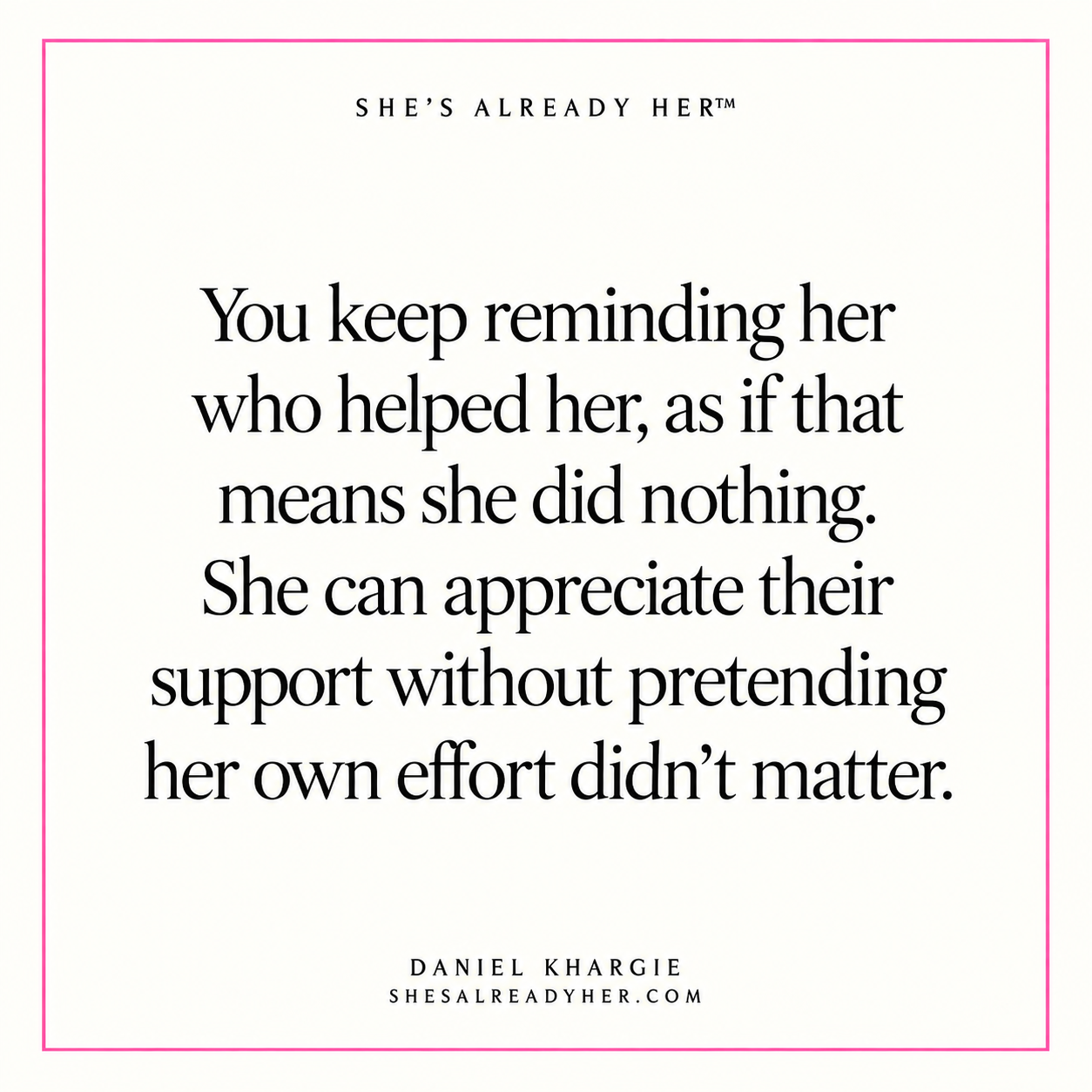
Read this quote as text
You keep reminding her who helped her, as if that means she did nothing. She can appreciate their support without pretending her own effort didn’t matter.
Someone else doing more doesn’t turn your progress into nothing
You can find somebody further along in almost anything.
Somebody finished sooner. Somebody got a bigger opportunity. Somebody seems to be doing the thing you’re proud of without even thinking about it. If that becomes the test, you’ll always be able to find a reason to dismiss yourself.
But what was the thing you were actually trying to do?
If you wanted to finish your first course and you finished it, somebody else completing a degree doesn’t undo that. If you wanted to get your first piece of work out into the world, another person having a bigger audience doesn’t mean yours never happened.
You can admire what somebody else has done. You can learn from it. Their work doesn’t have to become an insult you aim at your own.
Come back to the effort you made and why it mattered to you before you started looking around. Were you learning something? Keeping a promise to yourself? Following through on something you’d been afraid to try?
Those are real things to acknowledge. They don’t all need to become extraordinary before they deserve a place in your life.
And on the days when you don’t accomplish much, you still deserve care. I’m not asking you to replace comparing yourself to other women with another rule that says you must keep outperforming yesterday’s version of you.
Some days are for doing. Some days you need rest. You don’t lose your value in between.
You don’t need an audience to celebrate something
When you think about how to celebrate yourself, you might picture making an announcement, buying something, or getting everybody together.
You can do those things if you want to and they make sense for you. They’re not the only ways to mark something that matters.
You could tell one person who understands why it was important. Enjoy the evening instead of immediately filling it with another task. Keep the finished piece somewhere you can see it. Take a moment to admit that you’re glad you followed through.
It doesn’t have to cost money. It doesn’t have to look impressive. It doesn’t even have to leave your house.
You also get to choose who hears your good news. You don’t have to share every meaningful thing with everybody, and keeping something private doesn’t make it less real.
If his response keeps turning your good news into a competition, the conversation about him one-upping you looks at that part more closely. You don’t need to pretend a hurtful response didn’t affect you.
Here, I want you to notice what you say to yourself even before anybody responds. Are you giving yourself a chance to enjoy the moment? Or have you already decided you need somebody else to make it okay?
Other people’s encouragement can mean a lot. You’re allowed to want it. You can also begin acknowledging your effort without making every good feeling wait for an audience.

Read this quote as text
You tell her there’s always room to improve, but never room to feel proud. She can keep growing without treating everything she’s done as nothing.
You can feel proud before you feel completely comfortable
You might understand everything we’ve talked about and still feel strange saying you did well.
That doesn’t mean you need to force a bigger feeling. Start with something you can honestly stand behind.
You finished what you said you would finish. You handled one part better than you used to. You put thought into something, and you’re glad you gave it that attention.
Let that be enough for this moment. You don’t need to turn it into a promise that you’ll never doubt yourself again.
And if you catch yourself downplaying it tomorrow, you can come back to what happened. You don’t have to insult yourself for struggling to accept your own effort. That would just give you one more thing to be hard on yourself about.
You can want more for your life without speaking about everything you’ve done as though it was nothing. You can stay open to learning without refusing to recognize any growth.
You did something that mattered to you. Let yourself have that.
There will be time to decide what comes next. Right now, you don’t have to rush past the woman who showed up and did the work.
Frequently asked questions
How do I accept compliments without immediately dismissing them?
If you’re learning how to accept compliments, start by thanking the person before offering a reason they shouldn’t have said it. When the praise matches what you did, let that acknowledgment stand. You can credit other people’s help too, without removing your own contribution. You don’t have to agree with inaccurate praise or welcome intrusive comments.
What is self validation when I’m proud of something?
Self validation means acknowledging your own experience and why something mattered to you. Here, that might mean recognizing the effort you put into finishing something, even when another person doesn’t understand its importance. You can trust that it mattered in your life while still listening to useful feedback and being honest about what happened.
Self compassion vs self esteem: what’s the difference here?
Kristin Neff’s explanation of self-compassion describes a kind, understanding way of relating to yourself, including when things go wrong. Self-esteem concerns how you evaluate yourself. You can appreciate an accomplishment and still treat yourself kindly when you don’t accomplish much. Neither pride nor basic respect requires believing you’re better than somebody else.
What if fear of judgment makes celebrating feel uncomfortable?
You get to choose what you share and who you share it with. Fear of judgment doesn’t mean you must make a public announcement to prove you’re confident. You can mark the moment privately or tell someone you feel comfortable with. Other people may respond differently, but their reaction doesn’t erase the effort you actually made.
How do I stop negative self talk from cancelling a win?
If you’re wondering how to stop negative self talk after an accomplishment, notice the specific way you’re dismissing it. Then check that statement against what you actually did. You might still have more to learn and also have finished something important. Use a fairer description you believe. You don’t have to promise yourself permanent silence from every critical thought.