
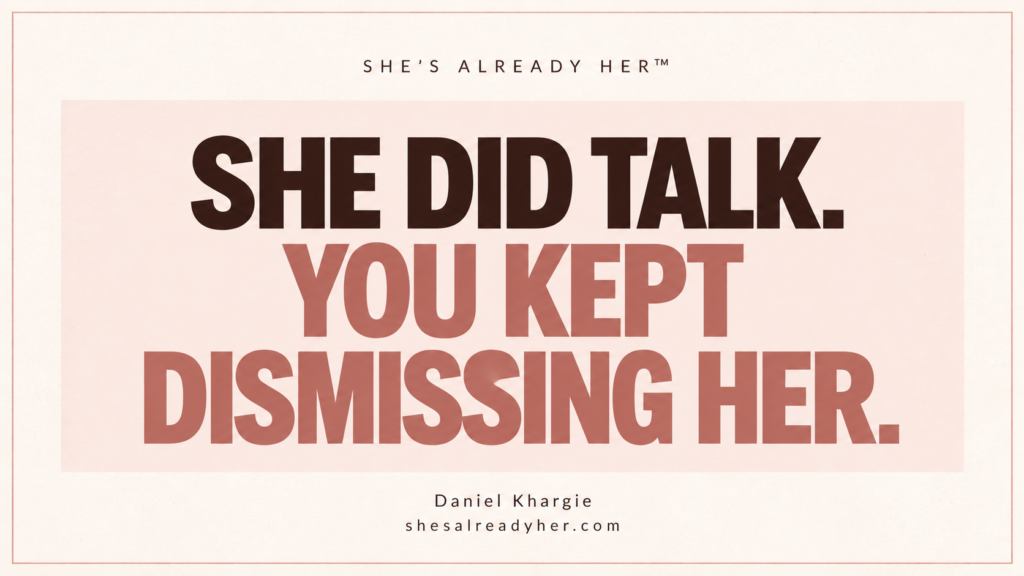
He doesn’t get to keep dismissing what you feel, then complain that you don’t talk to him the way you used to.
You did talk. You told him something hurt. You tried to explain what bothered you. You wanted an answer from your man, and somehow you ended up defending why you had a feeling in the first place.
Now you leave these conversations feeling dismissed, and he wants to know why you keep more to yourself.
Look at what happened when you didn’t.
When your partner dismisses your feelings, the conversation can become all about why you shouldn’t be hurt, while what hurt you never gets addressed.
You’re not asking him to feel everything exactly the way you do. You’re asking him to stop treating your experience like something he can brush aside because he doesn’t like hearing it.
You can love him and still get tired of trying to make your pain sound reasonable enough for him to care about. You don’t need another perfect explanation before the one you already gave deserves attention.
You brought up what hurt. Why are you defending having a feeling?
Pay attention to what the conversation actually becomes about.
You raise a concern. Does he try to understand it, or do you spend the rest of the conversation answering for your reaction?
Now you’re explaining that you weren’t trying to start anything. You’re reassuring him that you do appreciate him. You’re trying to prove you weren’t looking for a reason to be upset.
And the concern is still there.
That’s the part you need to come back to. You can spend a long time talking and still never get an answer about what needs to change.
You don’t have to follow every new accusation until you forget what brought you into the conversation. Where it’s safe to continue, you can return to the point: “I’m telling you what hurt me. I still need us to address that.”
Your reaction becoming the subject doesn’t mean the original issue stopped mattering.
He can see it differently without making your hurt ridiculous.
He doesn’t have to agree with every conclusion you reach. You can talk through what happened and what each of you understood.
But none of that requires him to mock you for being upset.
He can explain his view and still take seriously that something affected you. He can ask what you meant instead of deciding you’re making a problem out of nothing.
You’re not asking him to give up his own thoughts. You’re asking him to leave room for yours.
If the only acceptable ending is you agreeing that you shouldn’t have felt hurt, there isn’t much room for an honest conversation.
You can consider his explanation without being talked out of acknowledging your own experience. Understanding each other takes more than one person explaining why the other person has no reason to feel anything.
Read this quote as text
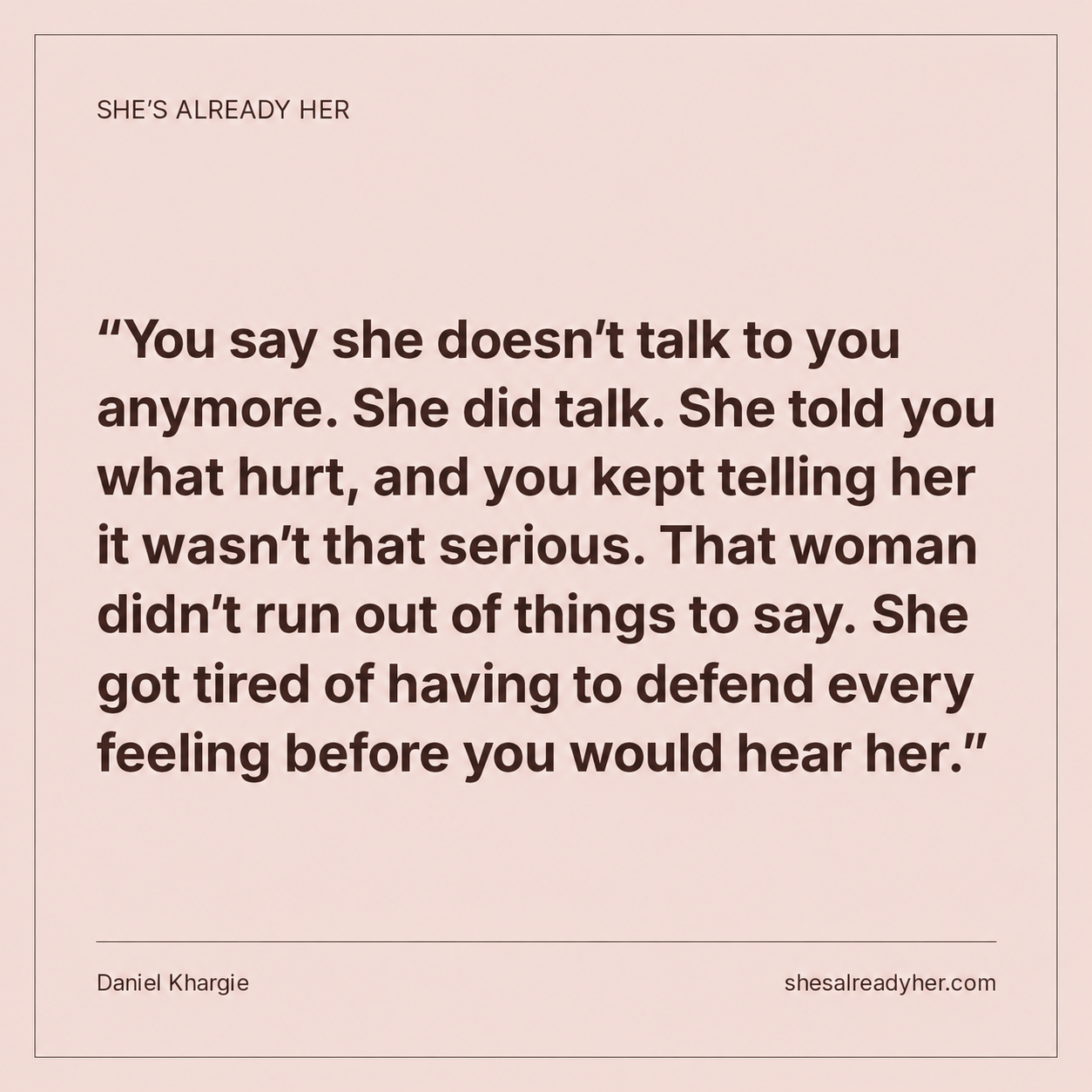
You say she doesn’t talk to you anymore. She did talk. She told you what hurt, and you kept telling her it wasn’t that serious. That woman didn’t run out of things to say. She got tired of having to defend every feeling before you would hear her.
You shouldn’t have to make the hurt smaller before he’ll hear it.
You’ve tried to find a way to say it that he won’t dismiss.
You take things out. You add reassurance. You explain what you didn’t mean before you’ve even said what you do mean.
And you can still end up feeling misunderstood because he’s responding to an accusation you weren’t making, instead of the concern you actually raised.
You don’t have to sound completely unaffected by something that affected you.
You can care about how you speak without pretending you weren’t hurt. You can stumble over a sentence and still be making a point worth hearing.
If fear of his reaction has become the bigger issue, read about walking on eggshells in a relationship. Here, notice whether he makes room for your concern or uses every imperfect word as another reason to dismiss it.
Calling you a name doesn’t answer what you told him.
He says you’re “too sensitive,” and suddenly you’re wondering whether you should have just kept it to yourself.
But what did that label actually address?
Did it help him understand what hurt? Did it lead to a conversation about what happens next? Or did it leave you trying to prove you’re not difficult for bringing it up?
He doesn’t get to decide that something can’t hurt you because it wouldn’t hurt him.
You’re allowed to ask him to discuss the specific concern without making your personality the problem. “You don’t have to react the way I do. I still need you to hear what bothered me.”
You’re not required to keep defending yourself against the same label until you have no energy left for the actual issue. His description of your reaction is not an answer to the treatment you asked him to reconsider.
What he meant doesn’t erase what he needs to address.
He says he didn’t mean it that way. You can hear that.
You’re still telling him that it hurt.
His intention can be part of the conversation without becoming the reason the conversation has to end. There is still something for him to understand about how it affected you and what you need now.
You don’t have to prove he planned to hurt you before asking him to stop repeating something you’ve already explained.
And if he has a concern about something you did, that can have its own room too. You can take responsibility for your conduct without withdrawing the concern you raised.
Both conversations need somewhere to go. Neither should become a way of making the other disappear.
Look at whether his explanation helps the two of you address what happened or simply becomes another reason you’re expected to stop talking about it.

Read this quote as text
You keep calling her too sensitive, but look at what you keep saying after she already told you it hurts. You don’t have to feel it the same way she does. You do have to stop acting like her pain means nothing because it doesn’t bother you.
You can pause without pretending the issue is finished.
You don’t have to keep talking through ridicule to prove you want the relationship to work.
Where it’s safe, you can say you’re willing to discuss the concern and you’re not continuing while you’re being insulted. A pause can give you room to stop an exchange that isn’t getting anywhere.
What matters afterward is whether the concern gets a respectful return.
Does he come back to what you were saying? Does he acknowledge how he responded? Or does the break become the end of every issue he doesn’t want to hear?
You’re allowed to notice that difference.
If pausing or ending the conversation makes you fear what he might do, seek private support before trying to demonstrate a boundary. You don’t have to put yourself at risk to make a point. Your safety matters more than finishing the discussion.
An apology should make room for the concern, not close it down.
He says sorry. You want that to mean he understands what needs to be different.
Look at what follows.
Does he recognize the particular thing he dismissed? Does he let you finish explaining without returning to the same label? Does he take responsibility for what he agreed to change?
You’re not asking him to never get a conversation wrong. You’re looking for a response that includes you after he realizes he did.
“I already apologized” doesn’t answer a concern about something that keeps happening.
You can acknowledge an apology without immediately saying everything is okay. You can need time, an answer, and different behavior.
For the wider question of whether he gives your requests attention, read Feeling Unheard in a Relationship. Here, look at whether he stops shaming the feeling long enough to address what brought it up.
Getting along again doesn’t mean the hurt got addressed.
You can have a pleasant conversation and still have something unresolved between you.
You don’t have to pretend that answering him normally means you take back what you said was hurting.
Ask yourself what actually happened after you raised it. Did he hear you? Did anything get agreed? Did he follow through? Or did the discussion end because you got tired of defending your right to have it?
That difference matters, even if he prefers things now that you’ve stopped mentioning it.
You don’t owe an endless series of explanations. If you’ve already been clear and the same dismissal keeps coming back, that response is part of what you have to consider.
The problem isn’t automatically gone because he doesn’t have to hear about it anymore. Your silence can tell him less than he thinks it does.
Read this quote as text
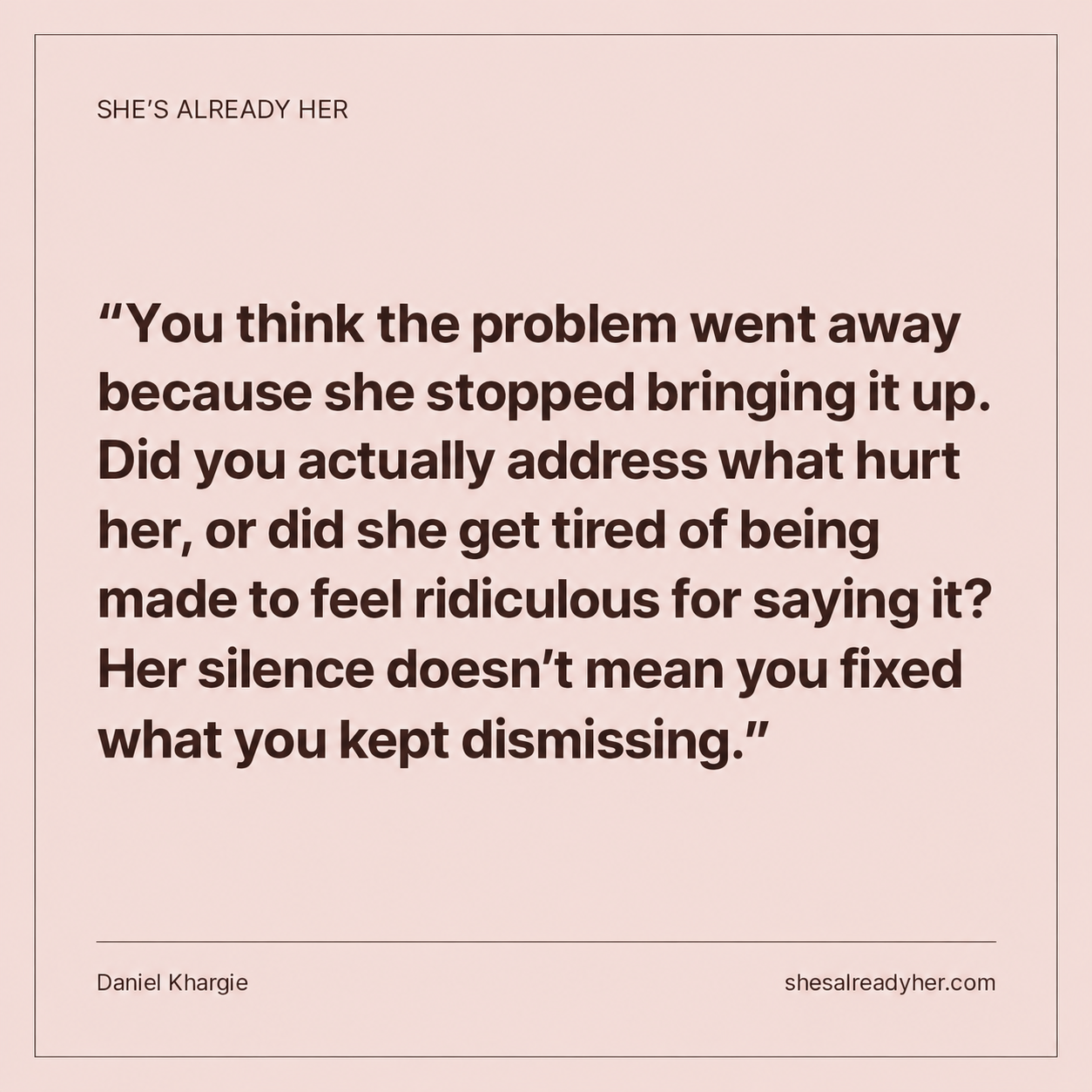
You think the problem went away because she stopped bringing it up. Did you actually address what hurt her, or did she get tired of being made to feel ridiculous for saying it? Her silence doesn’t mean you fixed what you kept dismissing.
He wants you to talk. He needs to look at what happens when you do.
You can seek support before you’ve decided what this means for the whole relationship.
Talk privately with someone you trust or a qualified counselor if you need help sorting through what keeps happening. You don’t need him to agree with your experience before you can discuss it with somebody else.
If there are threats, intimidation, monitoring, or control, prioritize private support and safety planning over another confrontation. Use a safer device or contact method if your activity may be monitored.
You can still love him. You can still want the relationship to improve. Neither requires pretending the way he responds has no effect on what you’re willing to share.
He says he misses how you used to talk to him. Then he needs to stop treating what you say like something you should regret bringing up.
He wants you to open up. He cannot keep dismissing what comes out.
Questions you may still be asking
What is emotional invalidation?
It describes responses that dismiss, reject, or minimize someone’s emotional experience instead of acknowledging it. In a relationship, that might include treating a feeling as ridiculous or insisting it should not exist. The term describes a response, not a diagnosis or proof of intent. Context, repetition, and willingness to repair matter when assessing the pattern.
Can you give emotional invalidation examples?
Examples include mocking a partner for crying, calling a concern dramatic instead of addressing it, or insisting the hurt cannot matter because it would not bother you. These differ from respectfully disagreeing about an event or declining a request. A clumsy response followed by acknowledgment and repair is different from a repeated refusal to take the feeling seriously.
Is invalidating feelings the same as disagreeing?
No. A partner can acknowledge that you are hurt while disagreeing with your interpretation or proposed solution. Acknowledging the feeling does not require approving every action taken because of it. The Gottman Institute distinguishes acknowledging a partner’s feelings from agreeing with them. The issue is whether disagreement still leaves room for your experience without ridicule or dismissal.
How to respond to invalidation?
When it is safe, name the specific concern and ask for it to be discussed without insults or minimization. You can pause an exchange that has become disrespectful and seek support if the pattern continues. You cannot make another person respond respectfully through perfect wording. If you fear retaliation or control, get private support rather than testing a confrontation.
How to respond when someone says you’re too sensitive?
You can say, “You don’t have to feel the same way I do. I still need you to hear what bothered me.” Return to the specific issue rather than debating your entire personality. If the label keeps replacing the discussion, you can pause when safe. The phrase alone cannot establish intent, but repeated dismissal after clear concerns deserves attention.