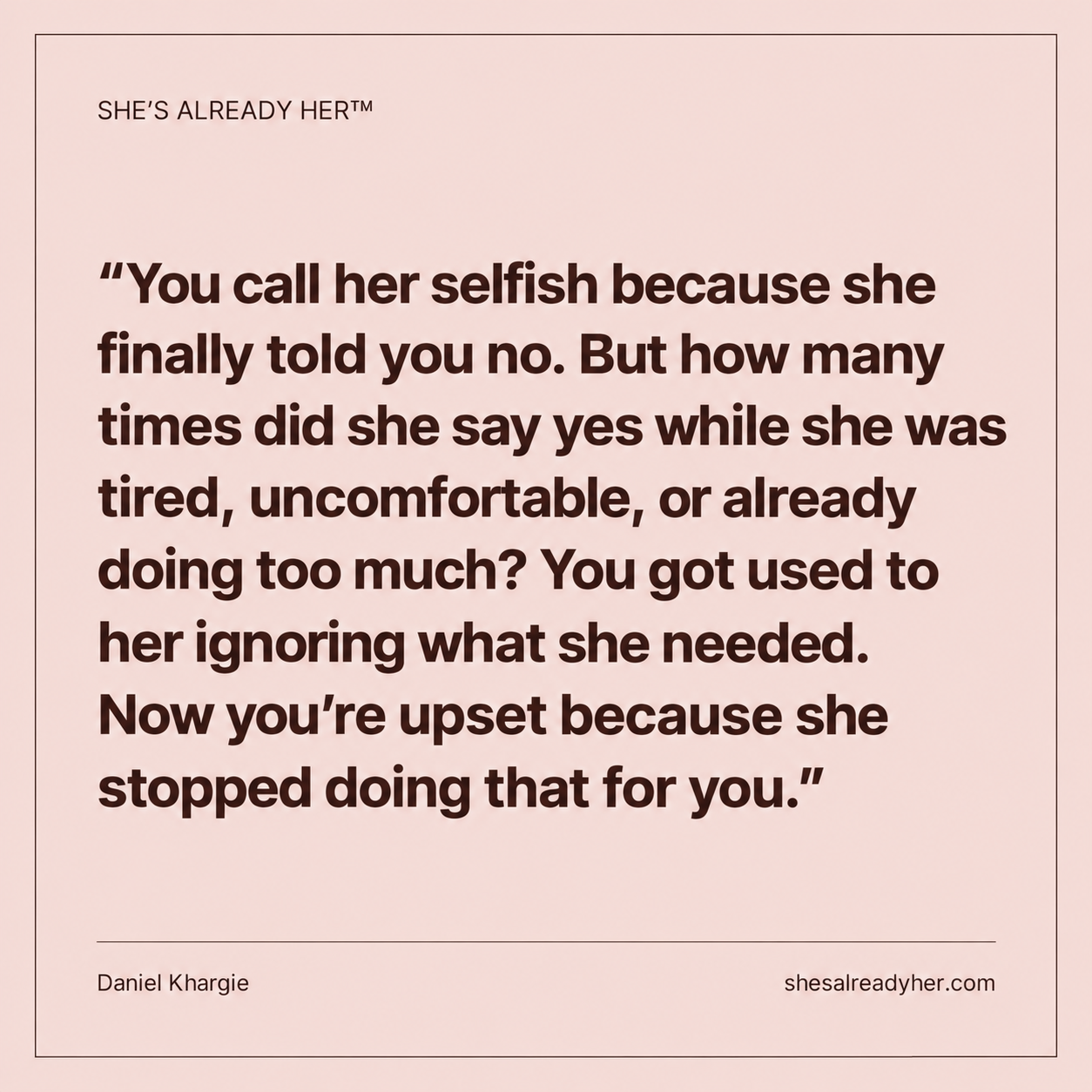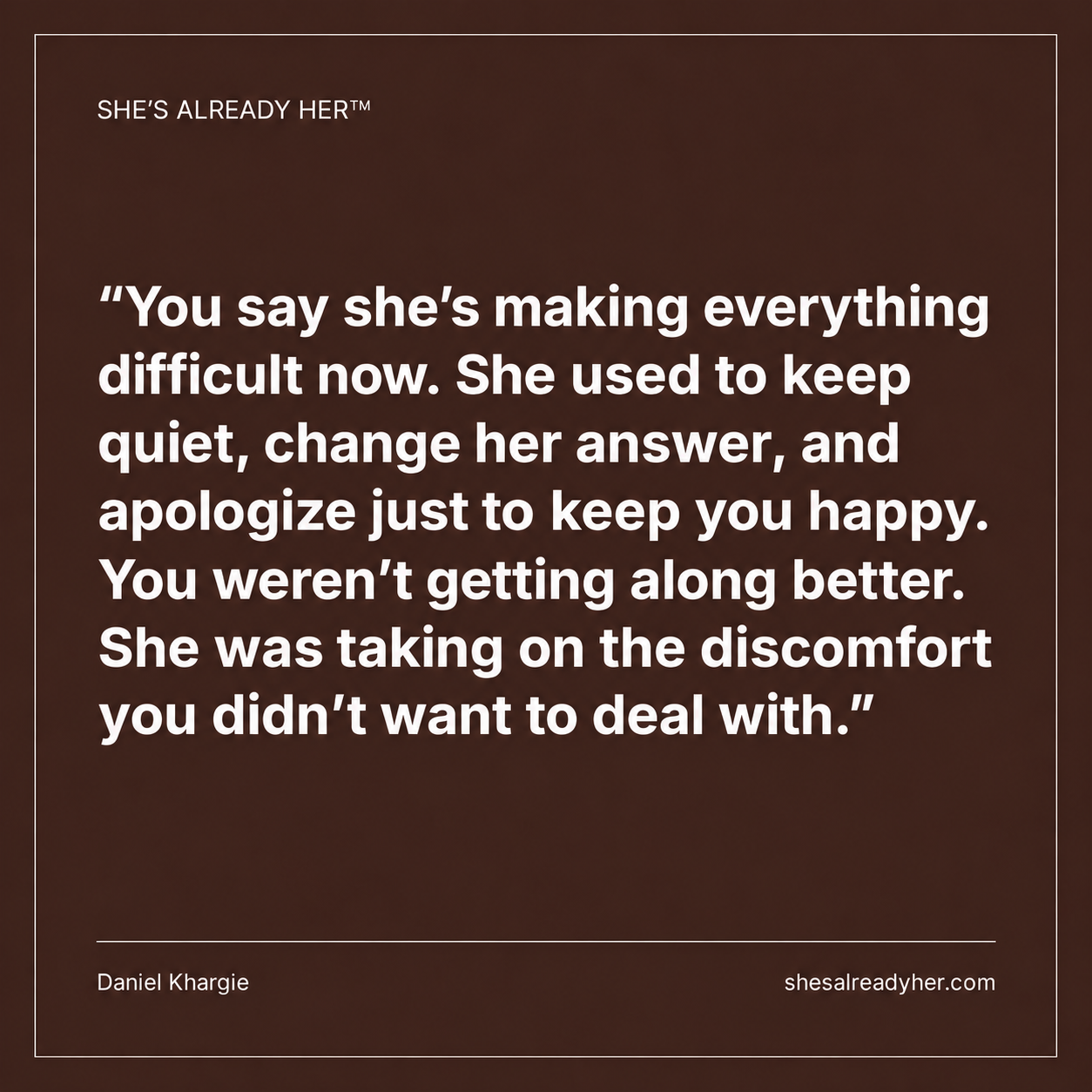

Sis, let me describe the disappearing act you perform so seamlessly that nobody in your life including you recognizes it as a disappearance.
You have a need. A real one. Not dramatic. Not excessive. Not the kind that would inconvenience anyone if it were expressed. Something as basic as “I need to rest tonight” or “I don’t want to go” or “this conversation isn’t working for me.” The need forms. Clearly. Unmistakably. In the part of you that knows what you want before the programming can intercept it.
And then the programming intercepts it.
Not with a single thought. With a sequence. A cascade so fast and so practiced it completes in less than a second. The need forms → the other person’s comfort gets evaluated → the conflict between your need and their comfort gets identified → your need gets weighed against their comfort → your need loses → the need gets suppressed → the comfortable version of you gets presented → the real version disappears.
One second. Maybe less. And the woman with the need has been replaced by the woman without one. The woman who’s fine. Who doesn’t mind. Who’s happy to do whatever works for everyone else. Who has somehow miraculously, consistently, without fail arranged her internal reality so that her needs just happen to align with whatever the room requires.
Except they don’t align. They’ve been overridden. And the overriding has been happening so consistently, for so long, that you’ve stopped recognizing it as a choice. It feels automatic. Natural. Like this is just who you are a woman whose needs are remarkably flexible. Remarkably light. Remarkably absent.
How to stop people pleasing isn’t about learning to say no more often. It’s about understanding why your needs valid, human, deserving of space get erased before they can be expressed. And why the erasure feels like peace when it’s actually self-abandonment performed so gracefully that nobody notices you’ve left.
What Suppressing Your Needs Looks Like
It doesn’t look like suppression. It looks like ease. Like a woman who’s genuinely low-maintenance. But the low-maintenance isn’t a personality trait. It’s a performance.
You don’t know what you want because knowing was never safe. “What do you want for dinner?” “I don’t care — whatever you want.” “What do you want to do this weekend?” “I’m fine with anything.” The not-knowing isn’t indifference. It’s the end product of years of having your preferences overridden, ignored, or met with consequences that taught your system: wanting things is dangerous. Preferences that conflict with someone else’s comfort produce disappointment. And disappointment produces loss. So the wanting gets shut down before it surfaces. Not suppressed after formation. Prevented from forming at all. How to stop people pleasing starts with relearning how to want — which sounds absurd until you recognize that the wanting was trained out of you so thoroughly that access to your own desires requires deliberate excavation.
You manage other people’s comfort at the expense of your own. He’s stressed, so you don’t mention what’s bothering you. She’s having a bad day, so you absorb your own frustration without expressing it. The room’s energy is delicate, so you adjust yourself to maintain stability rather than introducing the variable your need would represent. The comfort management is constant — a background process that runs in every relationship, in every room, evaluating everyone else’s emotional state and calibrating your behavior to keep the environment smooth. How to stop people pleasing means recognizing the management for what it is — not kindness, not empathy, not the natural attunement that healthy relationships include. It’s a surveillance-and-response system built on the belief that your need is the thing most likely to disrupt the peace. And peace maintained through your suppression isn’t peace. It’s control — with you as both the controller and the controlled.
You feel selfish when you express a need — any need. Not just big needs. Any need. “I need five minutes alone” feels selfish. “I’d rather not do that” feels selfish. “I’m not comfortable with this” feels selfish. The selfishness label attaches to every act of self-expression your system produces — converting legitimate human needs into evidence of a character flaw you’re terrified of embodying. How to stop people pleasing requires dismantling the equation between having needs and being selfish. Because the equation was never true. It was installed by people whose comfort depended on your needlessness. And a woman who believes her needs are selfish is a woman who will suppress them indefinitely — which is exactly the outcome the installation was designed to produce.
You anticipate what people need before they ask — and provide it before the asking can happen. Not because you enjoy anticipating. Because the asking activates the fear. If someone has to ask, they might be disappointed that you didn’t already know. And disappointment — the feeling your entire system is organized around preventing — is worse than the exhaustion of constantly reading rooms, tracking moods, and preemptively meeting needs that haven’t been expressed. How to stop people pleasing includes letting people ask. Letting them need something and sit with the needing before you rush to fill it. Letting the gap between their need and your response exist for more than a microsecond. Because the gap is where your own needs live. And your own needs deserve at least as much response time as everyone else’s.
Why You Suppress Your Needs to Keep Others Comfortable
Your needs were treated as burdens in your earliest environment. A child’s needs — emotional, physical, developmental — aren’t optional. They’re requirements. And in a healthy environment, those requirements are met with care, with consistency, with the specific energy of an adult who treats a child’s needs as important information about what the child requires to thrive. In your environment, the treatment was different. Your needs were inconvenient. Disruptive. Too much. Met with sighs, with eye rolls, with the specific energy of a caretaker who experienced your needing as an imposition on their comfort rather than a developmental necessity. How to stop people pleasing requires tracing the suppression back to its source — because the suppression didn’t start as a choice. It started as an adaptation. A child who learned that needing things produced discomfort in the adults around her adapted by needing less. And needing less became the template. Not by choice. By survival.
You were loved more when you were easy and less when you were difficult. The reward structure was clear. Easy you — the compliant, agreeable, needless version — received warmth. Difficult you — the version with opinions, with needs, with the audacity to want something that conflicted with someone else’s preference — received coldness. The structure didn’t need to be dramatic. It just needed to be consistent enough for your developing brain to detect the pattern and optimize for the rewarded behavior. How to stop people pleasing means recognizing that the “easy” version of you wasn’t your authentic self. She was the version manufactured by a reward system that gave love for compliance and withdrew it for complexity. And the authentic self the one with the needs has been waiting underneath the easy version for permission to exist.
You’ve been the emotional regulator for other people since childhood. Someone’s mood was your responsibility. A parent’s stress. A sibling’s distress. The household’s emotional temperature kept stable not by the adults who should have been managing it but by the child who learned that her own emotional regulation could be sacrificed to maintain everyone else’s. How to stop people pleasing includes retiring from a job you were never supposed to hold the job of managing everyone else’s emotional state. That job was assigned to you before you could refuse it. And you’ve been performing it ever since in friendships, in relationships, in every dynamic where someone else’s comfort has been maintained through the suppression of your own.
You believe that expressed needs produce conflict and conflict produces loss. The chain runs at reflex speed: need → expression → conflict → disappointment → withdrawal → loss. Each link in the chain has been confirmed through experience enough times that the chain feels inevitable rather than conditional. How to stop people pleasing requires breaking the chain at its first link by expressing a need and observing that the chain doesn’t complete. That expression doesn’t always produce conflict. That conflict doesn’t always produce disappointment. That disappointment doesn’t always produce withdrawal. And that withdrawal doesn’t always produce loss. The chain your system has been treating as inevitable is actually conditional dependent on specific people in specific environments responding in specific ways. And most people in most environments don’t respond the way the chain predicts.
Your identity is organized around being the comfortable one. “She’s so easy.” “She never causes problems.” “She’s the most accommodating person I know.” The identity has been praised so consistently that it’s become foundational the thing you believe about yourself that governs every other belief. And expressing a need threatens the identity. Because a woman with needs isn’t easy. A woman with needs isn’t effortlessly accommodating. A woman with needs is a woman whose identity has to expand beyond the comfortable role and expansion feels dangerous when the role is the thing that’s been earning love for your entire life. How to stop people pleasing means allowing the identity to expand. Letting the comfortable version make room for the complex version. The version with needs. The version whose comfort matters alongside everyone else’s. The version that’s harder to love, perhaps but who’s real.
You’ve never seen someone express needs without producing negative consequences. If the models in your life parents, partners, friends never demonstrated healthy need expression, you have no reference point for what it looks like when it goes well. Every example you’ve witnessed might have involved conflict, punishment, or withdrawal. You’ve never seen someone say “I need this” and have it received with warmth. You’ve never watched someone set a limit and have the relationship deepen because of it. How to stop people pleasing includes building a reference library that doesn’t currently exist through your own corrective experiences, through therapeutic modeling, through relationships with people who demonstrate that need expression and relational safety can coexist.
Suppression feels like control in a dynamic where your needs feel uncontrollable. You can’t control whether your needs are met. You can’t control how people respond when you express them. You can’t control whether the expression produces the disappointment you fear. But you can control whether you express them at all. And suppression the choice to not express feels like the only lever in a system where everything else is beyond your influence. How to stop people pleasing means releasing the control that suppression provides and accepting the vulnerability that expression requires. The vulnerability is real. The control is an illusion. Because suppressed needs don’t disappear. They metastasize into resentment, into physical symptoms, into the slow erosion of a self-concept built on a woman who doesn’t need things. And a woman who doesn’t need things isn’t a strong woman. She’s a suppressed one.
What Suppressing Your Needs Is Doing to You
You don’t know who you are underneath the pleasing. Strip away the accommodation. Remove the anticipation. Eliminate the comfort management. What’s left? If the answer takes too long to arrive if the woman without the people-pleasing feels unfamiliar, inaccessible, even frightening that’s the most important data you’ll receive today. Because it means the pleasing has consumed so much identity space that the person underneath hasn’t had room to develop. Not because she doesn’t exist. Because the suppression has been so thorough that she’s been buried under decades of someone else’s comfort. How to stop people pleasing is ultimately an excavation project digging through layers of accommodation to find the woman whose needs, desires, opinions, and preferences have been waiting underneath the performance for someone to ask about them.
You’re physically carrying what your mouth won’t say. The jaw tension from clenched-back words. The shoulder pain from carrying responsibility for everyone else’s emotional comfort. The stomach disruption from needs swallowed before they could be spoken. The fatigue from the constant energy expenditure of maintaining a performance that requires you to monitor, anticipate, calibrate, and suppress all while appearing effortless. Your body is a record of everything the suppression has been preventing your voice from expressing. And the record is getting longer.
You resent the people you’re accommodating and the resentment is destroying the relationships the accommodation was supposed to protect. The irony is devastating. You suppress your needs to keep the relationship comfortable. The suppression produces resentment. The resentment erodes the relationship. The relationship that was supposed to be protected by your accommodation is being destroyed by the very mechanism you believed was protecting it. How to stop people pleasing includes acknowledging the resentment not as evidence of ingratitude, but as the natural, predictable consequence of a system where one person gives everything and receives nothing in return. The resentment isn’t the problem. The suppression that produced it is.
You attract people who benefit from your needlessness. The dynamic self-selects. A woman who doesn’t express needs attracts people who don’t want to meet them. A woman who prioritizes everyone else’s comfort attracts people who are comfortable being prioritized. The relational environment you’ve created through years of accommodation is populated by people whose presence in your life depends on your continued suppression. How to stop people pleasing means accepting that some of those people will leave when your needs surface. And their departure isn’t evidence that your needs were wrong. It’s evidence that their presence was conditional on your absence.
Your children if you have them are learning the pattern. They’re watching. Not what you say about self-worth and boundaries and having a voice. What you do. They’re watching you suppress. Accommodate. Disappear your needs behind everyone else’s comfort. And they’re absorbing the lesson your behavior teaches that a woman’s needs come last. That comfort is provided, not received. That the most loved version of a woman is the one who needs nothing. How to stop people pleasing isn’t just about you. It’s about the pattern you’re passing forward. And the pattern deserves to end with you.
What You Need to Do
Start with one unexpressed need and express it. Not the biggest one. Not the one that would restructure your entire relational life. One. Small. Real. “I’d rather stay in tonight.” “I need to eat something before we go.” “I’m not comfortable with that plan.” Let the need exist in the space between you and another person without the suppression collapsing it before it can be heard. How to stop people pleasing starts with one need, spoken once, to one person. And then observed did the world end? Did the love evaporate? Did the catastrophe the suppression has been preventing actually materialize? It didn’t. It never does. And the evidence begins accumulating from the first unexpressed need that finally gets expressed.
Stop anticipating and let people ask. The preemptive meeting of needs is the people-pleasing at its most automatic. Start letting the gap exist. Let them need something and sit with the needing. Let them ask. And when they ask, evaluate genuinely, honestly, with your own capacity in the equation whether the yes is authentic or programmed. How to stop people pleasing includes letting people experience the mild discomfort of needing something and not having it instantly provided. The discomfort is theirs. It’s manageable. And your reflex to eliminate it before it forms is the mechanism that’s been keeping your own needs perpetually deferred.
Practice the sentence “that doesn’t work for me” without adding a justification. Not “that doesn’t work for me because…” Just “that doesn’t work for me.” Period. The justification is the people-pleasing’s insurance policy the explanation that makes the limit palatable, that softens the no, that gives the other person a reason to accept your boundary without being disappointed. How to stop people pleasing means letting the boundary exist without the justification. Because your limit doesn’t require an explanation to be valid. It requires your voice. That’s it.
Identify the need you’ve been suppressing the longest and speak it. Not to the hardest person. To the safest. The need that’s been sitting inside you maybe for months, maybe for years that you’ve been carrying alone because expressing it would have disrupted someone’s comfort. Name it. Say it. Let it exist outside your body for the first time. How to stop people pleasing includes releasing the backlog the accumulated, suppressed needs that have been stored in your body, your resentment, and your slowly eroding self-concept. One need at a time. Starting with the one that’s been waiting the longest.
Build a practice of checking in with yourself before responding to anyone else. Before every yes. Before every accommodation. Before every act of comfort management. One question: “What do I need right now?” Let the answer form. Let it exist for at least thirty seconds before you evaluate it against what they need. How to stop people pleasing starts with the radical act of consulting yourself before consulting the room. And the consultation doesn’t need to change the outcome every time. Sometimes you’ll still choose to help, to accommodate, to say yes. But the choice will be a choice rather than a reflex. And a choice made from self-awareness is fundamentally different from a reflex made from fear.
Stop treating your needs as negotiable. Your need for rest isn’t negotiable. Your need for space isn’t negotiable. Your need for emotional reciprocity isn’t negotiable. Start treating them with the same non-negotiable energy you give to everyone else’s needs. “This isn’t something I can be flexible on.” “This is what I need and it’s not up for discussion.” How to stop people pleasing includes building a category inside your internal system labeled “non-negotiable” and filing your core needs inside it with the same authority you’d use to protect someone else’s.
Get professional support. How to stop people pleasing at the level where the suppression is automatic, where the identity is organized around accommodation, where the needs have been buried for decades, where the body is carrying everything the voice won’t express requires therapeutic intervention. A therapist can help you trace the suppression to its origin, excavate the needs that have been buried, rebuild the relationship between your voice and your desires, and develop a relational style where your needs hold their position alongside everyone else’s rather than beneath them.
What You Need to Understand
You are not a woman without needs. You are a woman whose needs have been suppressed so consistently that their absence feels like your identity rather than your wound. The suppression was installed by an environment that rewarded your needlessness and punished your needing. And the installation has been running so long so thoroughly, so automatically that the woman underneath the suppression might feel unfamiliar when she surfaces.
Let her surface anyway. She’s not a stranger. She’s you. The version of you that existed before the suppression started. The version that knew what she wanted, that expressed what she needed, that took up space without the constant calculation of whether the space was deserved. She’s still there. Underneath every swallowed need. Behind every automatic yes. Inside every moment of accommodation that your body performed while your soul objected.
How to stop people pleasing isn’t about becoming selfish. It’s about becoming whole. A woman whose needs exist alongside everyone else’s not above, not below, alongside. A woman who accommodates by choice rather than by compulsion. Who helps because she wants to, not because her worth depends on it. Who says yes when yes is true and no when no is necessary. And who trusts that the people who love her really love her will love the version with needs as much as they loved the version without.
More, actually. Because the version with needs is the real one. And real is always worth more than performance.
What You Deserve
You deserve to have needs. Openly. Unapologetically. Without the suppression that converts them to silence before they can reach the air.
You deserve to express those needs without the fear that expression will produce the loss the suppression was designed to prevent. To say “I need this” and have the room absorb it rather than punish it. To want something and speak the wanting without the wanting feeling like the most selfish thing a woman can do.
You deserve to stop disappearing yourself for other people’s comfort, sis. The disappearing was never the price of love. It was the price of conditional love. And conditional love was never enough for you. Even when the suppression made it seem like it was.
How to stop people pleasing? Start appearing. One need at a time. One unedited expression at a time. One moment of refusing to suppress what your body, your heart, and your life have been trying to say for years.
The woman underneath the pleasing has been waiting for this. For you. To finally let her speak.
Let her.
The Bottom Line
You suppress your needs to keep others comfortable because your needs were treated as burdens in childhood, because love was proportional to your compliance, because you’ve been the emotional regulator for other people since before you could spell the word, because expressed needs were linked to conflict and conflict was linked to loss, and because your identity was built on being the comfortable one whose needs never disrupted the room.
How to stop people pleasing? Stop suppressing. Start expressing. Let the need exist before the programming can intercept it. Let the room absorb the discomfort your need might produce. Let the people around you experience the version of you that has needs and let their response tell you who’s safe to be real with and who was only comfortable with the performance.
The suppression protected you once. In an environment where needing things was dangerous, the suppression kept you safe. That environment is gone. The suppression remains. And the woman it’s been protecting you from being the one with needs, with desires, with the right to express them without guilt is the woman you were always supposed to become.
Stop protecting yourself from her, sis. She’s not the threat. She’s the answer.
And she’s ready.
FAQ
Q: How do I stop people pleasing when I genuinely enjoy helping others?
Keep helping. The goal isn’t to stop caring about people. The goal is to care about them from a place of choice rather than compulsion. Helping that flows from genuine desire is beautiful. Helping that flows from the need to prevent disappointment is depletion. The behavior might look the same from the outside. The internal experience fulfilled versus drained tells you which one is operating.
Q: What if people react negatively when I start expressing my needs?
Some will. Especially the people whose comfort depended on your needlessness. Their reaction isn’t evidence that your needs are wrong. It’s evidence that the dynamic was imbalanced and the imbalance was maintained by your suppression. Let them react. Hold the need. The people who adjust to the real you are the people worth keeping. The people who can’t tolerate your needs were only comfortable with your absence.
Q: How do I know the difference between compromise and people pleasing?
Compromise involves two people adjusting. People pleasing involves one person disappearing. In a compromise, both needs are on the table and both get partially met. In people pleasing, your need never reaches the table because the suppression caught it before it could. Check: is your need visible in the negotiation? If it is, that’s compromise. If it isn’t if the negotiation only includes their needs that’s people pleasing.
Q: What if I’ve been suppressing so long I don’t know what my needs are?
Start with the body. What does your body want right now? Rest? Movement? Food? Space? The body holds needs the mind has been trained to suppress. Start listening to it. Not through analysis through sensation. The needs are there. They’ve been whispering underneath the suppression for years. They just need someone to stop managing everyone else’s comfort long enough to hear them.
Q: Can people pleasing cause health problems?
Yes. Chronic suppression of needs produces chronic physiological stress the body’s version of unspoken words, swallowed feelings, and deferred self-care. Headaches, digestive issues, muscle tension, fatigue, immune suppression all documented consequences of sustained emotional suppression. Your body isn’t separate from the people pleasing. It’s the thing paying the price for it. Every day. Whether you notice or not.